

Burle Marx (São Paulo SP 1909 - Rio de Janeiro RJ 1994)
Burle Marx was a Brazilian visual artist of many talents, internationally recognized as a landscape designer, architect, painter, draftsman, printmaker, lithographer, sculptor, tapestry maker, ceramist, jewelry designer and decorator. With more than three thousand landscape projects carried out in some twenty countries, Burle Marx made a decisive contribution not only to landscape architecture but also to painting, the visual arts and the defense of environmental preservation. In 1955, he founded a landscape design studio and created the company Burle Marx & Cia. Ltda., which opened a branch in Caracas in 1956 and went on to work on several continents.
Burle Marx was born in São Paulo on August 4, 1909, and moved with his family to Rio de Janeiro in 1913, after financial difficulties. The son of Wilhelm Marx, a German Jew raised in Trier, and Cecília Burle, a native of Pernambuco of French descent, he grew up watching his mother tend gardens and vegetable plots, and began his own plant collection as a child in the family's large house in the Leme neighborhood.
In 1928, Burle Marx traveled to Germany for treatment of an eye problem. In Berlin, he came into contact with the city's intense cultural life and visited the Dahlem Botanical Garden, where he encountered Brazilian tropical species, an experience that awakened his deep interest in native flora. He frequented museums, theaters and galleries, and became familiar with the work of artists such as Vincent van Gogh, Pablo Picasso and Paul Klee. This period broadened his aesthetic perception and was decisive for the appreciation of Brazilian vegetation that would mark his artistic production.
In 1929, Burle Marx began his training in the visual arts at the studio of Degner Klemm, absorbing principles of modernism. Back in Brazil, he entered the Escola Nacional de Belas Artes (ENBA), where he studied between 1930 and 1934 with Leo Putz, Augusto Bracet and Celso Antônio, alongside Oscar Niemeyer, Hélio Uchôa and Milton Roberto. About Leo Putz, he said: "Nature was a pretext for the pictorial digressions of color", an idea that influenced his compositional freedom, present in both his painting and his landscape design. In this period, he grew close to Candido Portinari and Mário de Andrade, becoming Portinari's assistant in 1937.
In 1932, Burle Marx was invited by Lúcio Costa to carry out his first landscape project, the starting point of his professional career in garden design. Between 1934 and 1937, he headed the Parks and Gardens Division of Recife, at the invitation of Governor Carlos de Lima Cavalcanti. In this context, he developed more than ten projects for squares and public gardens, among them Praça de Casa Forte, Praça da República, Praça do Arsenal da Marinha, Praça do Derby, Praça do Entroncamento and Praça Euclides da Cunha, known as the "Cactário da Madalena" (Madalena Cactus Garden) for its use of species from the sertão and the caatinga. The proposal broke with European gardening models and sparked intense debate in the press. In 1937, he created Brazil's first ecological park in Recife, anticipating concepts of sustainable urbanism. In the artist's words: "My experience in Recife was fundamental to the direction my professional activity later took."
Still in the 1930s, Burle Marx deepened his scientific knowledge of Brazilian flora through classes with the botanist João Geraldo Kuhlmann and the naturalist Manoel de Carvalho e Melo Barreto. Under the guidance of Henrique Lahmeyer de Mello Barreto, he took part in collecting expeditions and field research, which grounded his innovative approach to modern landscape design.
In the late 1930s, Burle Marx began to incorporate principles of modern architecture into his projects, using organic forms, free curves and native species. In 1942, he designed the roof-terrace gardens of the Gustavo Capanema Building in Rio de Janeiro, considered the inaugural landmark of modern landscape design in Brazil. In 1949, he acquired a 365,000-square-meter property in Campo Grande, now the Sítio Burle Marx, administered today by IPHAN. There he carried out research on the acclimatization, preservation and cataloging of Brazilian flora. The site holds more than 3,500 species, and some 50 plants identified on expeditions were named after him, such as Philodendron burle-marxii. Declared a national monument in 1985, the site was recognized as a UNESCO World Heritage Site in 2021.
From the 1940s onward, Burle Marx divided his activity between painting and landscape design, establishing himself as one of the leading international references in garden design. Among his most emblematic projects are the Pampulha gardens, in Belo Horizonte (1940), Largo do Machado, in Rio de Janeiro (1945), Ibirapuera Park, in São Paulo (1954), the Museum of Modern Art and Botafogo Beach, in Rio de Janeiro (1955), the Monumental Axis of Brasília (1958), Aterro do Flamengo, in Rio de Janeiro (1959), and the Civic Center of Curitiba (1966), as well as projects for Plaza Perú, in Buenos Aires, Parque del Este, in Caracas, and the Garden of Nations, in Austria.
Alongside landscape design, Burle Marx maintained a constant output in the visual arts. As a painter, draftsman, lithographer, tapestry maker and jewelry designer, he took part in exhibitions from 1941 onward, including the show Landscape Architecture in Brazil (United States, 1954), the Museum of Modern Art of Rio de Janeiro (1956), the Commercial Museum in Philadelphia (1963), the Venice Biennale (1970), the Belo Horizonte Museum of Art (1972), the Gulbenkian Foundation in Lisbon (1973), the Musée Galliera in Paris (1973) and MAC-USP (1997).
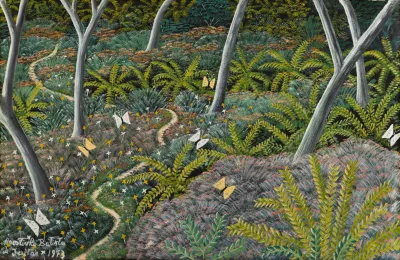
Despite his European training, Burle Marx developed a deep relationship with the Brazilian landscape and nature. Tropical flora became the central axis of his work, combining technical rigor, aesthetic sensitivity and environmental awareness. For the critic Mário Barata, his production brings together "Europeanized form and tropical experience", resulting in original compositions that transformed the Brazilian urban landscape.
Throughout his career, Burle Marx received numerous honors, including the Landscape Architecture Prize at the 2nd International Architecture Exhibition (1953), the title of Knight of the Order of the Crown of Belgium (1959), the Santos Dumont Medal (1963), the Fine Arts Medal of the American Institute of Architects (1965), the Greensfelder Prize of the Missouri Botanical Garden, and honorary doctorates from the Royal College of Art (1982) and the Royal Academy of Fine Arts of the Netherlands. In 1971, he received the Order of Rio Branco and, in 1982, he was recognized as the greatest landscape designer in the world.
Burle Marx died in Rio de Janeiro on June 4, 1994. In 2009, the centennial of his birth, the Museu de Arte Moderna de São Paulo held a major exhibition in his honor. Since then, the city of Recife has celebrated Burle Marx Week every year, established by municipal law, reaffirming the lasting relevance of his work in Brazilian art and culture.
Critical Commentary
Burle Marx was an artist whose career expresses a singular combination of art, botany and architecture, marked by an innovative stance deeply connected to the natural Brazilian landscape. The study and appreciation of native flora were central to his production, allowing him to create gardens and public spaces that celebrate Brazil's biodiversity and harmoniously integrate nature into the architectural and urban environment.
As a botanist and researcher, Burle Marx led expeditions through various regions of the country, identifying and cataloging new plant species that he later incorporated into his landscape projects. Plants from the cerrado, the Amazon and the northeastern sertão gave his gardens and parks a singular and original identity. By combining these species with architectural elements, such as columns and arcades salvaged from demolitions, as well as mosaics and tile panels, Burle Marx reinterpreted Portuguese traditions and transformed them into a contemporary and authentically Brazilian language.
The use of masses of color became one of the hallmarks of Burle Marx's work. Shrubs and trees were arranged in homogeneous groupings, taking into account chromatic variations throughout the seasons and creating vibrant, dynamic landscapes. This attention to color also appeared in his use of mineral materials - stones, pebbles and sands - which, combined with the organic forms of the gardens, resulted in balanced and visually striking compositions. Projects such as the Pampulha Complex (Belo Horizonte, 1942-1945) and the Rancho da Pedra Azul (Teresópolis, 1956) exemplify this integration between built landscape and natural environment devised by Burle Marx.
In the field of architecture, Burle Marx collaborated with central figures of Brazilian modernity, such as Lúcio Costa, Oscar Niemeyer, Affonso Eduardo Reidy and Rino Levi. His partnership with Lúcio Costa on the gardens of the Ministry of Education and Health and on the Monumental Axis of Brasília demonstrates his ability to combine landscape design and architecture in a functional and aesthetic way. These projects became icons of modernity, in which Burle Marx's landscape design plays a decisive role in creating public spaces of great cultural relevance.
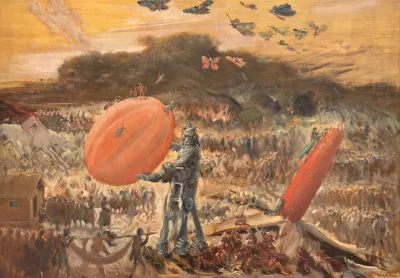
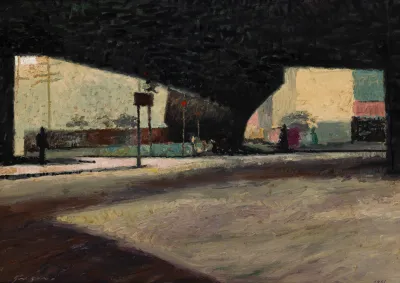
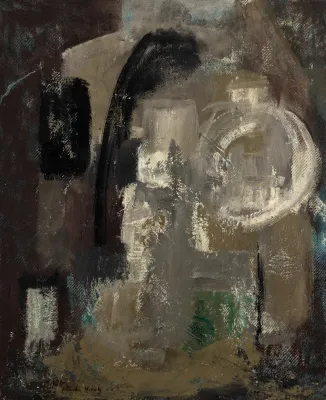
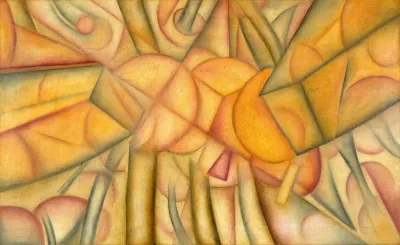
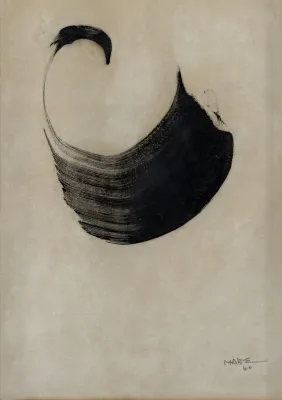
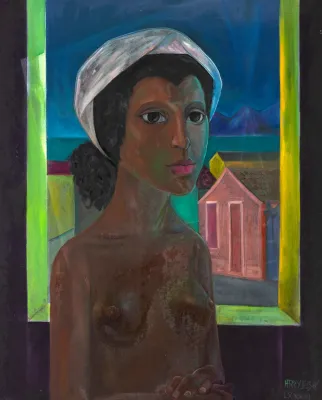
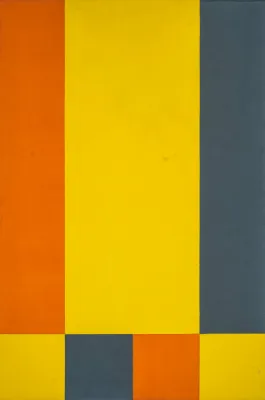
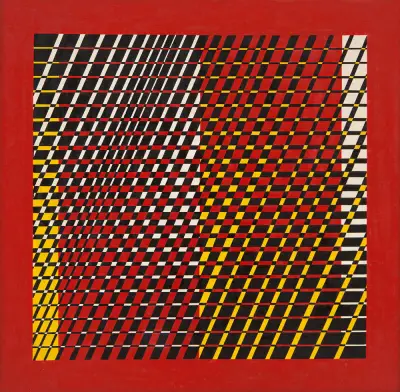
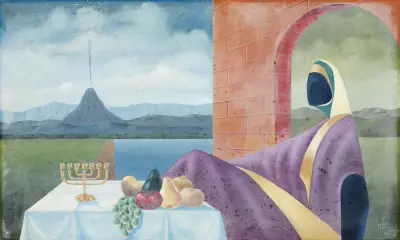
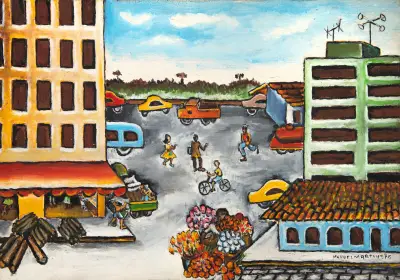
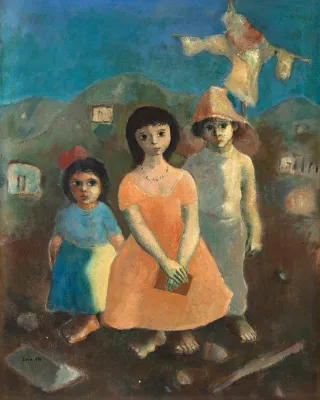
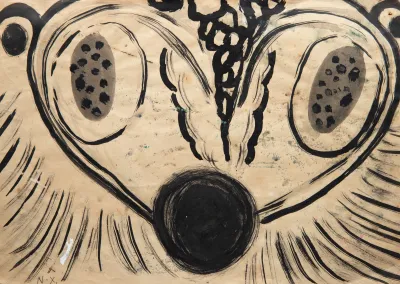
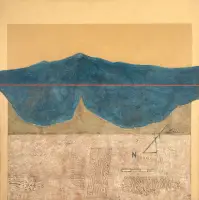
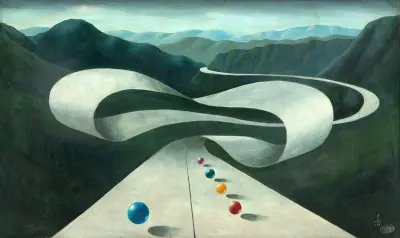
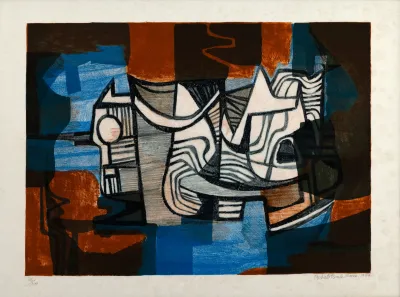
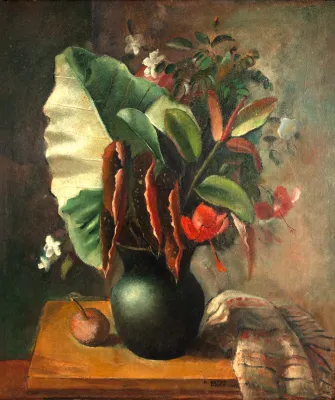
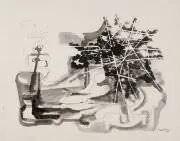
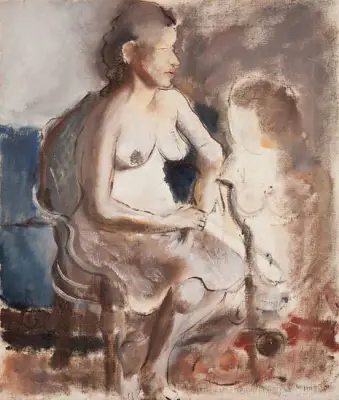
Alongside landscape design, Burle Marx built a solid career as a painter. His pictorial production evolved through still lifes, portraits and urban landscapes. Influenced by Cubism and Modernism, Burle Marx created works that show close attention to color and natural forms, often with a geometric approach in his depictions of cities. From the 1940s onward, he moved toward abstraction, adopting intense colors and geometric forms, as in the works Cataventos [Pinwheels] (1940) and Peixes [Fish] (1944).
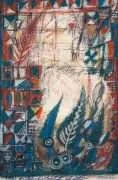
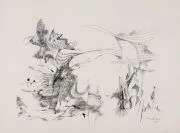
In the 1980s, Burle Marx reached a new pictorial phase by adopting acrylic paint and a more vibrant, fluid palette. Drawings inspired by foliage and branches became almost entirely abstract, emphasizing lines and tonal gradations. Works such as Dia e Noite [Day and Night] (1973 Series) illustrate this transformation, reflecting Burle Marx's continuous search for a balance between nature and abstraction.
Beyond his role as a landscape designer and visual artist, Burle Marx was one of the most active advocates of environmental preservation in Brazil, intensifying his ecological activism from the 1970s onward. His donation of the Sítio Santo Antônio da Bica to the federal government, in 1985, gave rise to the current Sítio Burle Marx, a landscape and botanical heritage site of great importance, now devoted to research on and preservation of Brazilian flora.
Burle Marx's work synthesizes the union of several artistic disciplines with a deeply innovative vision, going beyond the limits of traditional landscape design. His ability to integrate art, nature and architecture established Burle Marx as one of the most influential artists in Brazil and in the world, with projects that remain a reference in beauty, sustainability and innovation.
Critiques
Geraldo Ferraz
"Burle Marx's painting now seeks to position itself as a visual survey of the landscape work. The drawing loses its incisive presence, but beneath the colors, in parallel, the drawing preserves in Burle Marx's paintings an orchestrated trepidation, the secret of an order. The Brachian reminiscence reflects the profound obedience to the master's order, where the rule conditioned emotion. His painting re-actualizes Cubist exploration, investing in abstract invariants and creating forms that produce a serious rhythm, as seen in Composition 1. Burle Marx's painting reaches its maturity, as evidenced by the Extravasaria series, which reveals a search for images where geometry allows coloristic sensuality to escape, condensing the great previous paintings into those of 1974."
Source: FERRAZ, Geraldo. Personality in a Theme. In: MARX, Burle. Burle Marx. São Paulo: MAM, 1974.
Antonio Bento
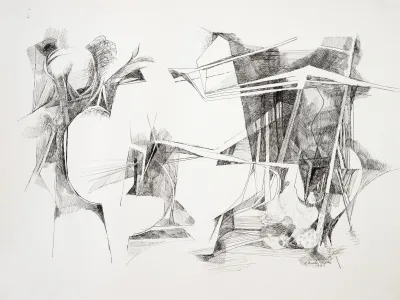
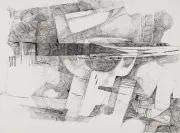
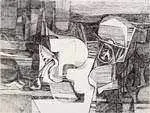
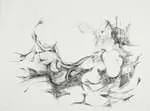
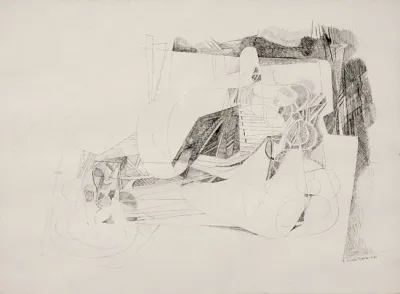
"Textures vary in Burle Marx's diverse works. The artist captures the environment, representing it in two-dimensional visions and abstract perspectives. His drawings are intriguing, demonstrating his constant renewal in the production of gardens, floral sculptures, tapestries, and other designs. Burle Marx is an artist who seeks the universal, something rare in his time. The India ink drawings, with varying shades of gray, black, and white, demonstrate the artist's visual power, evidencing the creative talent reflected in his laboriously executed works."
Source: BENTO, Antonio. Drawings and Paintings by Burle Marx. In: MARX, Burle. Burle Marx. São Paulo: MAM, 1974.
Clarival do Prado Valladares
"The difference between Burle Marx's painting and drawing can be seen in the thematic gradation. The composition, derived from the vegetal structure, loose and schematized in space, is the result of Burle Marx's experience as a gardener, botanist, and ecologist. His drawing reveals an individual language of plenitude, contemporary with Picasso, Braque, and Matisse, but with a unique focus: the weave of the vegetal world, revealing spaces, planes, and chiaroscuro never before seen."
Source: VALLADARES, Clarival do Prado. Burle Marx in 1974. In: MARX, Burle. Burle Marx. São Paulo: MAM, 1974.
Lélia Coelho Frota
"Burle Marx's graphic work, drawn in black and white, is as important as his contribution as a colorist. Drawing, being an open process, possesses great fluidity, creating a unique dynamic in prints and canvases. Burle Marx combines a wide range of colors and, at the same time, creates dramatic density with the contrast between black and white, as seen in Guaratiba (1989). Drawing also intervenes to give scale to large patches of color, like a stained glass window illuminated from within."
Source: FROTA, Lélia Coelho. Burle Marx: a tribute. In: MARX, Burle. Art and landscape: the aesthetics of Burle Marx. São Paulo: MAC/USP, 1997.
Vera Beatriz Siqueira
"Burle Marx's landscape creation allows him to deal with modern abstraction without the limitations of painting. He creates a concrete spatial fact, without resorting to arbitrary formalizations. Burle Marx combined the ability to anticipate formal relationships between plant species with the intense use of chromatic contrasts, always respecting the unpredictability and instability of nature, as exemplified in the garden of Odette Monteiro's residence in Petrópolis, where color transcends any application of two-dimensional rules, creating volumes and textures that communicate the Brazilian landscape in a unique way."
Source: SIQUEIRA, Vera Beatriz. Burle Marx: Transverse Landscapes. In: SIQUEIRA, Vera Beatriz, EUVALDO, Célia (coord.). Burle Marx. São Paulo: Cosac & Naify, 2001.
Testimonials
"My extensive and very broad experience as a landscaper, creating, implementing, and conserving gardens, parks, and large urban areas, practically since the third decade of this century, now allows me to formulate my conceptualization of the garden problem as synonymous with the adaptation of the ecological environment to meet the natural demands of civilization.
This concept, that is, my current thinking, based on considerable experience, does not claim any originality or discovery, especially because all my work responds to a historical trajectory and a consideration of the natural environment.
Regarding my life as a visual artist, with the most rigorous disciplinary training in drawing and painting, the garden was, in fact, a sedimentation of circumstances. It was simply the interest in applying the foundations of visual composition to nature itself, in accordance with the aesthetic sentiment of my time. It was, in short, the way I found to organize and compose my drawing and painting, using less conventional materials.
I can largely explain this through what happened in my generation, when painters were impacted by Cubism and Abstractionism. The juxtaposition of the visual attributes of these aesthetic movements with natural elements constituted the attraction for a new experience. I decided to use natural topography as a surface for composition and the elements of found nature—minerals, plants—as materials for visual organization, just as any other artist seeks to create their composition with canvas, paints, and brushes.
The critics most interested in my work have repeatedly pointed out the stylistic connection between painting and the landscape I do. Geraldo Ferraz and Clarival Valladares have indicated all of my work as within a visual unity, and I myself am the first to recognize that there are no aesthetic differences between the object-painting and the object-constructed landscape. Only the means of expression change."
Burle Marx
MARX, Burle. Concepts of Composition in Landscape Architecture. In: _____. Art and Landscape: Selected Lectures. São Paulo: Nobel, 1987, p. 11. [Lecture entitled Concepts of Composition in Landscape Architecture, given in 1954].
Interviews
Burle Marx – Sítio Santo Antônio da Bica / Rio de Janeiro
Ana Rosa de Oliveira interviewed Burle Marx in February 1992. The interview was made available in Vitruvius in June 2001.
This interview was carried out in order to present some of the keys to Burle Marx's poetics. It took place in 1992, when I was beginning research for my doctoral thesis in Barcelona. After an exhaustive search of Burle Marx's writings and specialized criticism, many questions remained unanswered. This led me to seek contact with Burle Marx so that, based on his own statements, I could address the doubts that arose. Burle Marx granted me this interview at his home, at the Sítio Santo Antônio da Bica, Rio de Janeiro, two and a half years before his death. His time was scarce, and throughout the interview he did not stop painting. Dressed in jeans and a paint-stained white shirt, he painted and instructed his assistant on how to arrange the silkscreen, or the color and quantity of paint to use. The interview unfolded among silkscreens, paints, brushes, plants, and a glimpse of the world that surrounded him.
If we were to trace the evolution of your garden, would it be possible to say that initially there was a more ecological approach, concerned with valuing native vegetation and plant associations, and later an aesthetic concern?
Initially, my gardens had an ecological focus. But this focus is quite relative. I designed, for example, the MEC garden with some quite abstract patches, because by that time I was already familiar with Arp. So it can't be said that my gardens, even in their early days, had an essentially ecological concern.
Studying your lectures and published interviews, I found a lot of information about your botanical training, but you don't talk much about your artistic training. Who or what moments are important in this training? The important writings. How did music influence your training?
[Looking at a silkscreen against the light, he comments: "Funny, looking from here, how beautiful this crimson and this blue are. We often find what we're looking for at the moment. For example, all these blues are a lesson in refinement."] I had a mother who was a musician; she sang very well, was a great pianist, and had a diabolical, diabolique, or divine sensitivity. She loved plants. When I started bringing in wild plants that I liked, she never said, "Oh Roberto, that's wild." She said, "Roberto, that's beautiful, I'd never seen it before; that's a kind of divine manifestation." And deep down... I'm not religious, but there are forces I can't explain. For example, why we like a certain color, a certain moment that for others has no importance whatsoever. There's something mysterious. Then I began to care about plants, and the discovery of plants, especially in Brazil, is a fabulous thing... Influences come throughout life. We all have a certain convention. I'm from the time when we listened to Wagner, who had an influence on my life, Schumann, Schubert, because my mother sang them very well, ever since I can remember, I've listened to them. There are certain musicians that, although I consider them to be of a certain value, I don't feel strongly about them. Some like gardens, others like rolled pebbles... Nowadays, it's fashionable to create gardens without vegetation, yet those who know the vegetation, its phenology... (Looking at the painted canvas: Let me see. It's great. Now give it a shade of a greenish blue, that blue).
And your journey to Berlin?
I was in Europe from 1928 to 1929. I lived a year and a half in Berlin. Everything I experienced there—Wagner's works, the suite Pelleas et Melisande, Beethoven's symphonies, the musicians, Hindemith, Schoenberg, Alban Berg—these were artists who played an essential role in my formation.
I would like to know if, beyond music and the valuable discovery of Brazilian plants at the Dahlem Botanical Garden, during the period you lived in Berlin, there was a similar revelation regarding the new trends in painting emerging across Europe?
In Berlin, I often attended exhibitions, especially those of the German Expressionists. But what I mean is this… in art, the question is not confined solely to knowledge of painting. It encompasses everything that was happening at the time. For instance, I would go to the Botanical Garden, to the opera houses—there were three operating in Berlin then. I saw stage designs created by the greatest scenographers of that era. This immersion in music, nature, and visual arts—all of it weaves a cultural fabric. What I mean is that culture is one single entity.
I detest the notion that a landscape artist should know only about plants. One must know what a Piero della Francesca is, but also grasp what a Miró, a Michelangelo, a Picasso, a Braque, a Léger, a Karl Hofer, a Renoir, a Delaunay are. I believe that the essential thing in life is never to confine oneself to a single discipline. I also enjoy poetry, music, as in a symphony by Béla Bartók. Life, I believe, is about observing, absorbing—and perhaps what has helped me most is that I have never lost my curiosity. Even at my age, there is always something new: a color, a nuance that prompts me to see.
["Look, I want a blue, that specific blue I’m talking about—greenish, almost like the tone of this screen print," he says, pointing to the serigraphy panel]
And upon your return to Brazil?
When I returned to Brazil, the excursions began. I became friends with the great botanists the country had. After coming back, I met Ducke, a botanist who spent fifty years in the Amazon. He came from Dalmatia, yet refused to accept any suggestion that he was not Brazilian.
He classified more than 500 species of legumes. We can say he knew botany masterfully. It was quite amusing, actually. One day I told him: “Professor Ducke, I would like your books.” To which he replied: “I won’t give you my books because you don’t know botany, you don’t understand botany.” He was strict, but it wasn’t severity—he simply spoke his mind, and indeed I was not a botanist.
But as I always say, if I were to hold a facsimile of a Mozart symphony in my hands, I would possess a treasure, the sheer pleasure of having it. Many times, I had this urge. Yet the very fact of living alongside Ducke, hearing him talk to me about plants, was deeply rewarding.
As you know, to this day I am not a botanist, but I am fascinated by applied botany. And for that, direct contact is essential. I never miss the chance to be around botanists, or to listen to good music, read poetry—even works by those long gone. For instance, when I think of Don Quixote—what an extraordinary thing! I had a German friend who used to say: if we know the Iliad, the Aeneid, Don Quixote, the Divine Comedy, and Goethe's Faust, we have a general understanding of European literature.
We need a broad cultural foundation, but to achieve it one would need an entire lifetime, for there is so much to know. Every day I feel the absence of what I do not yet know. Yet what compels me to keep looking is precisely my curiosity—my desire to always see what surrounds me. That, I believe, is one of the reasons I continue to live.
Who were your teachers?
The greatest teacher I had was Leo Putz—cultured, insightful, profoundly knowledgeable. Portinari possessed remarkable technical skill. After working in Pernambuco, I returned to Rio and took lessons with him. There were others, like Celso Antônio, who knew little about painting yet believed he did. I was deeply committed to discipline—discipline often leads us to results. If I had to start today, I would do it differently. But it is through mistakes that we draw our conclusions. The real problem lies with those who fear making them.
Another remarkable teacher was Mello Barreto. He became very enthusiastic when I tried to apply the concept of association I had encountered in Berlin.
At the Dahlem Botanical Garden, Engler had arranged plants from the Carpathians, the Alps, the Apennines in grouped compositions. Seeing that was overwhelming—understanding it, or perhaps feeling it. Over time, Mello Barreto began helping me apply this concept, especially in our work together at Parque do Araxá. He not only taught me how to identify plants but also their underlying significance. That exchange was invaluable. Few people have such opportunities, yet I always sought them out. As Mello Barreto used to say, “There is no shame in not mastering a certain knowledge. What we do not know must be acknowledged. The worst thing is to pretend we know.”
And architects like Lúcio Costa?
I was fortunate—Lúcio Costa lived on the same street as my family. I’ve known him since I was nine. If I am 82 today and he is 90, that tells you how long I have been surrounded by people of knowledge. A lesson in architecture from Lúcio is a master’s lesson.
Another extraordinary figure was the engineer, structural designer, and poet Joaquim Cardozo, with whom I worked for three years in Pernambuco. Possibly one of the most important figures of my time, he possessed an astonishing breadth of knowledge. Being with someone who could speak about music, poetry, or Baroque art for hours left me speechless. He died tragically of arteriosclerosis at sixty—a man who lived among books.
What writings were important in your formation?
I had a friend, the son-in-law of composer Alberto Nepomuceno, who brought me a collection of Le Corbusier’s books: Vers une architecture, Une maison, un palais, L’Art décoratif d’aujourd’hui. I began reading them, and they opened my vision. Le Corbusier visited here—always an extraordinary figure, with such clarity and precision of thought. Just pick up Vers une architecture and see how he writes about art with remarkable lucidity. Later came other books, the works of Braque, Picasso—looking at them brought back everything I had seen. All of this—plus music, magazines, exhibitions—was vital.
To say we are not influenced by a Picasso print—of course we are. And I am not afraid of influence. Analyzing one of Picasso’s works reveals how deeply he absorbed the entire history of painting. He was a genius, able to assimilate and reinterpret it as his own. He once said something beautiful: “It is better to copy the work of others than to copy oneself.” He possessed a wild inventive power, coupled with technical skill he could partially conceal. When I look at his drawings for Ovid, or his prints, they are monumental—monumental! He mastered everything—from subtle etchings to Guernica, which carries such violent force. He knew how to exploit light and shadow. Clearly, he had a profound lineage—a past of Goya, Velázquez, El Greco. That Spanish tradition, with its extraordinary strength! Seeing a Goya still startles me—he knew everything. Beyond his imagination, his technique was superb. And I believe that without technique, no work—whether painting or garden—can achieve true results. The same goes for the garden…
In the early stage of your painting, one notices a composition based on the figure and still objects.
I trained in the academy, receiving the gold medal—so one can say I had an academic foundation. Later, my contact with Leo Putz—hired by Lúcio Costa—who spoke of Gauguin and German painters, deeply influenced me. I was expelled from painting class because I began speaking about Gauguin, and the professor (Brasse) thought I was corrupting the students.
Yet you still valued regional elements, which was not a particular trait of academicism.
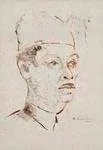
Although I received an academic education, I was never an academic painter—not even at that time. I never sought to paint to please the elite of society. I could have been a good portraitist because I knew how to paint portraits, but I was never interested in that; I was far more connected to the issues and figures of ordinary people.
Considering that the represented object is no longer identifiable, what then would be the reality of your painting? How does the transition from figurative to abstract take place?
Abstraction is simply a way of speaking. One only goes so far. For instance, if I am looking at a color, it is because it exists; therefore, it is not abstract. There are so many things that lead us toward it.
I believe it was a necessity—a need to transcend reality. It is like the honking of a car, the croak of a frog, the lowing of a cow—sounds that it is up to the musician to arrange. I think colors must also be arranged. Often I could not explain it; the prevailing idea was always to copy what we saw. One day I was watching a professor I had, Leo Putz, of the German Expressionist school. He liked me very much because I spoke German; he even called me “my son” and was related to Thomas Mann. I was observing him painting and at one point I asked: “Professor, why are you painting a roof red when it is actually brown?” He replied: “My son, nature is only a pretext… Let us say that art is a transposition of nature.” Such an explanation was enough for me to begin changing. Yet I don’t regret having an academic background; nowadays, the younger generation knows nothing. They think they are the ones discovering the world. I believe it is essential to know what has been done before us…
At that time, however, it was important to break with Academicism.
It was necessary to break away from the notion of simply copying what was in front of us. Although knowing how to copy what is before us is also important, as it trains one’s eye for rhythm, for color, for local tone—this too is very valuable.
Some critics say you paint the texture of the vegetal world. Do you agree?
The texture… I seek to understand what the vegetal world is. One must understand that each critic has their own way of expressing themselves. They might think I seek to understand the texture of the vegetal world—for instance, why this leaf exists, the reason for the Spanish moss (Tillandsia usneoides). What matters is knowing that we are influenced by what surrounds us.
To represent vegetation—if that is the sense the critics wish to convey—do you agree that this is your aim?
I disagree. It is everything. I cannot agree, as it would be far too limiting. Emotions arise from everything around us. I am here with you, I see the dog, a servant. All of this mingles with our sensibilities. To think that my painting stems solely from vegetal forms is absurd.
You mention that you detest formulas.
Indeed, I do detest them. I keep saying it because formulas are repetitive, like a dead-end street. Accepting formulas stifles the capacity to think. I detest dictatorships, which are nothing but impositions, formulas. I want the right to discover what works for me and what may not work for others. I am interested in principles.
What would you consider to be your guiding principles in painting?
Form, color, rhythm—principles common to all the arts. At times, it is construction, which is fundamental to everything. Those who cannot build cannot create art.
How does one construct a painting?
By understanding that a painting must have a dominant element and a subordinate one; that a work where darkness prevails differs from one where light prevails. There can never be two equal crescendos. One must be the more important crescendo. This can be seen, for instance, when analyzing the structure of Debussy’s L’après-midi d’un faune, which possesses such clarity, such simplicity—seemingly a small piece, yet at the same time a monument. Sometimes certain painters or composers produce, produce, and yet say nothing.
Referring to an exhibition you held at MASP in 1974, Geraldo Ferraz mentioned the term Extravasaria, saying it was one of the names you gave to what your painting achieves. Could you elaborate on that?
Extravasaria, in the sense of not remaining within a formula—of stepping beyond and seeking other paths, breaking away from routine.
Critics often suggest that your gardens are like paintings. You initially agree, yet later you disagree. Why?
It is utter nonsense to confuse my gardens with painting. Each art form has its own manner of expression. For example, color in painting is something far more defined than in a garden. In a garden, color shifts with the time of day, with light. A painting in darkness is different from one under constant illumination.
Could you name some of your landscape projects that you consider significant?
I believe my works that engage directly with the city are particularly important. A landscape designer is always subordinate to the urban planner. Without understanding the needs of a city—and above all, the functions of green spaces—the landscape designer cannot create gardens. In the Ibirapuera Park project, I carried out many plastic experiments with paving and vegetation. At Aterro do Flamengo, I explored species resistant to salinity and wind. I believe that without technique, one cannot achieve a good result. A flower, for example, has symmetry; it obeys principles akin to crystallization. The same applies to gardens. A garden is nature organized by man and for man. Discipline often leads to results.
In truth, an artist is one who can express themselves intelligently. On the other hand, for me, art is a necessity for finding inner balance. Yet there is an aspect of art as imponderable as life itself. If only we could explain why we feel the need to perpetuate ourselves, why we live.
Solo Exhibitions
1946 - São Paulo SP - Solo, at Galeria Itapetininga
1952 - São Paulo SP - Solo, at Masp
1956 - London (England) - Solo, at Contemporary Arts Gallery
1956 - Rio de Janeiro RJ - Solo, at MAM/RJ
1963 - Rio de Janeiro RJ - Solo, at MAM/RJ
1967 - Rio de Janeiro RJ - Solo, at Galeria Bonino
1968 - São Paulo SP - Solo, at A Galeria
1968 - São Paulo SP - Solo, at Galeria do Banco Nacional de Minas Gerais
1971 - Recife PE - Drawings, Galeria Bancipe
1972 - Belo Horizonte MG - 43 Years of Painting by Burle Marx, MAP
1972 - Rio de Janeiro RJ - Retrospective, Galeria do Ibeu
1973 - Lisbon (Portugal) - Solo, at Fundação Calouste Gulbenkian
1973 - Paris (France) - Solo, at Musée Galliera
1973 - Belo Horizonte MG - Solo, at MAP
1974 - Rio de Janeiro RJ - Solo, at Galeria Bonino
1974 - São Paulo SP - Solo, at MAM/SP
1974 - Curitiba PR - Solo, at MAC/PR
1974 - Salvador BA - Solo, at Foyer of Teatro Castro Alves
1976 - Porto Alegre RS - Drawings, Galeria Studiu's
1976 - Rio de Janeiro RJ - Solo, at Oficina D'Arte
1976 - Berlin (Germany) - Solo, at Atelier Noth-Hauer
1977 - Recife PE - Solo, at Casa de Olinda
1977 - Caracas (Venezuela) - Solo, at Museo de Arte Contemporáneo de Caracas
1978 - Caracas (Venezuela) - Solo, at Museo de Arte Contemporáneo de Caracas
1978 - Maracaibo (Venezuela) - Solo, at Centro de Bellas Artes
1978 - Rio de Janeiro RJ - Solo, at MNBA
1978 - Buenos Aires (Argentina) - Solo, at Atelier Internacional de Arte
1978 - São Paulo SP - Solo, at Galeria Aki
1978 - Belo Horizonte MG - Solo, at Galeria Guignard
1979 - São Paulo SP - Solo, at Masp
1980 - Rio de Janeiro RJ - Drawings from the series Erótica, Homenagem a Goya and Nuvem Carolina, Galeria Banerj
1981 - João Pessoa PB - Solo, at UFPB, Núcleo de Arte Contemporânea
1981 - Niterói RJ - Solo, at Centro de Exposições da Associação Médica Fluminense
1981 - Rio de Janeiro RJ - Solo, at Galeria Saramenha
1981 - São Paulo SP - Solo, at Espaço Plano
1982 - London (England) - Solo, at Royal College of Art
1983 - Mallorca (Spain) - Solo, at Col·legi d'Arquitectes de les Balears
1983 - São Paulo SP - Solo, at CCSP
1984 - São Paulo SP - Solo, at Paulo Figueiredo Galeria de Arte
1984 - Rio de Janeiro RJ - Solo, at Galeria Olivia Kann
1984 - Porto Alegre RS - Solo, at Livraria Prosa i Verso
1984 - Rio de Janeiro RJ - Solo, at CCCM
1984 - Fortaleza CE - Solo, at Galeria de Arte Ignez Fiuza
1984 - Joinville SC - Solo, at Museu de Arte de Joinville
1985 - Goiânia GO - The Art of Burle Marx, MultiArte Galeria
1985 - Rio de Janeiro RJ - Solo, at BNDES
1985 - Brasília DF - Solo, at Galeria de Arte
1985 - Recife PE - Solo, at Estudio A
1985 - Vitória ES - Solo, at Galeria Homero Massena
1986 - New York (United States) - Solo, at Brazilian Cultural Foundation
1986 - Washington (United States) - Solo, at Brazilian-American Cultural Institute
1986 - San Francisco (United States) - Solo, at ASLA Annual Meeting
1986 - Belo Horizonte MG - Solo, at Espaço Cultural do Pampulha Iate Clube
1987 - New York (United States) - Solo, at Private Reception for Brazilian Ambassador
1987 - Margate City (United States) - Solo, at Rosalind Sailor Gallery
1987 - Philadelphia (United States) - Solo, at University of Philadelphia, Graduate School of Fine Arts
1987 - São Paulo SP - Solo, at Galeria Ralph Camargo
1989 - Rio de Janeiro RJ - R. Burle Marx in Painting: Exhibition in Honor of the Artist's 80th Birthday, Parque Lage
1989 - Stuttgart (Germany) - Solo, at Züblin-Haus
1989 - Fortaleza CE - Solo, at Galeria de Arte Ignes Fiuza
1989 - Frankfurt (Germany) - Solo, at Buga 89
1989 - Recife PE - Solo, at Estudio A
1989 - Brasília DF - Solo, at Praxis Galeria de Arte
1989 - Rio de Janeiro RJ - Solo, at MNBA
1989 - Rio de Janeiro RJ - Solo, at Solar Grandjean de Montigny, Centro Cultural da PUC/RJ
1990 - Campinas SP - Solo, at MACC
1990 - Campinas SP - Solo, at Galeria Aquarela
1990 - Brasília DF - Solo, at Performance Galeria de Arte
1990 - Rio de Janeiro RJ - Solo, at Idea Galeria de Arte
1991 - New York (United States) - Burle Marx: The Unnatural Art of the Garden, MoMA
1992 - Caracas (Venezuela) - Solo, at La Sala Mendoza
1992 - Curitiba PR - Solo, at Museu da Gravura Cidade de Curitiba, Sala do Lustre
1993 - Sabará MG - Burle Marx Exhibition, Fundação Belgo-Mineira
1993 - Porto Alegre RS - Simply Burle Marx, Espaço Cultural BFB
Group Exhibitions
1941 - Rio de Janeiro RJ - 47th National Salon of Fine Arts, MNBA
1944 - Belo Horizonte MG - Modern Art Exhibition, Edifício Mariana
1944 - London (United Kingdom) - Exhibition of Modern Brazilian Paintings, Royal Academy of Arts
1944 - Norwich (United Kingdom) - Exhibition of Modern Brazilian Paintings, Norwich Castle and Museum
1945 - Bath (United Kingdom) - Exhibition of Modern Brazilian Paintings, Victoria Art Gallery
1945 - Bristol (United Kingdom) - Exhibition of Modern Brazilian Paintings, Bristol City Museum & Art Gallery
1945 - Buenos Aires (Argentina) - 20 Brazilian Artists, National Exhibition Halls
1945 - Edinburgh (Scotland) - Exhibition of Modern Brazilian Paintings, National Gallery
1945 - Glasgow (Scotland) - Exhibition of Modern Brazilian Paintings, Kelvingrove Art Gallery
1945 - The Hague (Netherlands) - Art in Freedom
1945 - La Plata (Argentina) - 20 Brazilian Artists, Museo Provincial de Bellas Artes
1945 - London (United Kingdom) - Brazilian Modern Painting, Burlington House
1945 - Manchester (United Kingdom) - Exhibition of Modern Brazilian Paintings, Manchester Art Gallery
1945 - Montevideo (Uruguay) - 20 Brazilian Artists, Municipal Commission of Culture
1945 - Rio de Janeiro RJ - 51st National Salon of Fine Arts, MNBA - Gold Medal
1945 - Rio de Janeiro RJ - Plastic Artists of the Communist Party, Casa do Estudante
1947 - Rio de Janeiro RJ - 53rd National Salon of Fine Arts, MNBA - Gold Medal
1950 - Venice (Italy) - 25th Venice Biennale
1951 - Salvador BA - 2nd Bahia Salon of Fine Arts, Galeria Belvedere da Sé
1951 - São Paulo SP - 1st São Paulo International Biennial, Trianon Pavilion
1952 - Rio de Janeiro RJ - Brazilian Artists Exhibition, MAM/RJ
1954 - Rio de Janeiro RJ - Salon of Fine Arts - Gold Medal in Painting
1954 - Vienna (Austria) - Die Schönsten Garten der Erde
1954 - Zurich (Switzerland) - Brasilien Baut, Kunstgewebemuseum
1955 - Boston (United States) - Group Exhibition, Institute of Contemporary Arts
1955 - Lugano (Switzerland) - Incisioni e Disegni Brasiliani, Villa Cianni
1955 - Paris (France) - Brazilian Art
1955 - São Paulo SP - 3rd São Paulo International Biennial, Pavilhão das Nações
1956 - Leverkusen (Germany) - Brasilien Baut, Leverkusen Museum
1957 - Buenos Aires (Argentina) - Brazilian Art, National Museum of Fine Arts
1957 - São Paulo SP - 4th São Paulo International Biennial, Pavilhão Ciccillo Matarazzo Sobrinho
1959 - Porto Alegre RS - Group Exhibition, Margs
1959 - São Paulo SP - 5th São Paulo International Biennial, Pavilhão Ciccillo Matarazzo Sobrinho
1959 - Washington (United States) - Contemporary Drawings from Latin America
1962 - São Paulo SP - Selection of Brazilian Artworks from the Ernesto Wolf Collection, MAM/SP
1963 - Rio de Janeiro RJ - Landscape as Theme, Galeria Ibeu Copacabana
1963 - São Paulo SP - 7th São Paulo International Biennial, Fundação Bienal
1963 - Tokyo (Japan) - Tokyo International Fair: Brazil Pavilion
1964 - Vienna (Austria) - Internationale Gartenschau
1965 - São Paulo SP - 8th São Paulo International Biennial, Fundação Bienal
1968 - Santo André SP - 1st Art Exhibition of Santo André
1969 - Rio de Janeiro RJ - General Exhibition of Brazilian Painting, MNBA
1969 - São Paulo SP - 1st Panorama of Contemporary Brazilian Art, MAM/SP
1970 - Venice (Italy) - 35th Venice Biennale
1973 - São Paulo SP - 1st Architecture Biennial, Ibirapuera Park
1974 - São Paulo SP - 1st Brazilian Tapestry Exhibition, MAB/Faap
1975 - São Paulo SP - 13th São Paulo International Biennial, Fundação Bienal
1976 - Penápolis SP - 2nd Northwest Fine Arts Salon, Fundação Educacional de Penápolis, Faculdade de Filosofia, Ciências e Letras de Penápolis
1977 - Porto Alegre RS - Group Exhibition, Galeria Studiu's
1977 - Rio de Janeiro RJ - 1st National Meeting of Art Galleries, Copacabana Palace Hotel
1978 - Venice (Italy) - 39th Venice Biennale
1979 - São Paulo SP - 11th Panorama of Contemporary Brazilian Art, MAM/SP
1980 - Rio de Janeiro RJ - Great Painters Portray Sailors, Ministry of the Navy
1981 - Maceió AL - Brazilian Artists of the First Half of the 20th Century, Historical and Geographical Institute
1982 - Berlin (Germany) - Architecture in Latin America
1983 - Montevideo (Uruguay) - 5th Maldonado Biennial, Museo de Arte de Maldonado
1983 - Olinda PE - Abelardo Rodrigues Collection of Fine Arts, MAC/Olinda
1984 - Rio de Janeiro RJ - Contemporary Brazilian Painting, Espaço Petrobras
1984 - São Paulo SP - Tradition and Rupture: Synthesis of Brazilian Art and Culture, Fundação Bienal
1985 - Rio de Janeiro RJ - Six Decades of Modern Art: Roberto Marinho Collection, Paço Imperial
1985 - São Paulo SP - 100 Works Itaú, Masp
1987 - Miami (United States) - Group Exhibition, Dade Community College, South Art Gallery
1987 - Rio de Janeiro RJ - Landscape Exhibition, IAB/RJ
1988 - Rio de Janeiro RJ - Nipo-Brazilian Group Exhibition, Rio Design Center
1989 - Lisbon (Portugal) - Six Decades of Brazilian Modern Art: Roberto Marinho Collection, Centro de Arte Moderna José de Azeredo Perdigão
1990 - Brasília DF - Arte Brasília, MAB
1991 - Curitiba PR - Municipal Museum of Art: Collection, Municipal Museum of Art
1992 - Belém PA - 11th Arte Pará Salon, Fundação Romulo Maiorana
1992 - Campinas SP - Awarded at Contemporary Art Salons of Campinas, MACC
1992 - Rio de Janeiro RJ - Nature: Four Centuries of Art in Brazil, CCBB
1992 - Zurich (Switzerland) - Brasilien: entdeckung und selbstentdeckung, Kunsthaus Zürich
1993 - Fortaleza CE - 23 Years, Galeria Ignez Fiuza
1993 - Rio de Janeiro RJ - Brazil: 100 Years of Modern Art, MNBA
1994 - São Paulo SP - Bienal Brasil Século XX, Fundação Bienal
Posthumous Exhibitions
1996 - Belo Horizonte MG - Impressões Itinerantes, at Palácio das Artes
1997 - São Paulo SP - Arte e Paisagem: A Estética de Burle Marx, at MAC/USP
1998 - São Paulo SP - Fantasia Brasileira: The Ballet of the IV Centenary, at Sesc Belenzinho
1998 - São Paulo SP - Impressões: The Art of Brazilian Printmaking, at Espaço Cultural Banespa-Paulista
1998 - São Paulo SP - The Collectors - Guita and José Mindlin: Matrices and Prints, at Galeria de Arte do Sesi
1999 - Rio de Janeiro RJ - Collection of Solar Grandjean de Montigny, at Solar Grandjean de Montigny
1999 - Rio de Janeiro RJ - Mostra Rio Gravura: Modern Brazilian Printmaking, Collection of Museu Nacional de Belas Artes, at MNBA
1999 - São Paulo SP - Cotidiano/Arte. Consumption, at Itaú Cultural
1999 - São Paulo SP - Sobre Papel, Grafite e Nanquim, at Banco Cidade
2000 - Lisbon (Portugal) - Brasil-brasis: Remarkable and Astonishing Things. Modernist Perspectives, at Museu do Chiado
2000 - Rio de Janeiro RJ - Afinidades Eletivas I, at Galeria do Tribunal de Contas do Estado do Rio de Janeiro
2000 - Rio de Janeiro RJ - When Brazil Was Modern: Visual Arts in Rio de Janeiro, 1905–1960, at Paço Imperial
2000 - São Paulo SP - Brasil + 500 Exhibition of the Rediscovery, at Fundação Bienal
2000 - Valencia (Spain) - From Anthropophagy to Brasília: Brazil 1920–1950, at IVAM. Centre Julio González
2001 - São Paulo SP - Museu de Arte Brasileira: 40 Years, at MAB/Faap
2002 - Brasília DF - JK - An Aesthetic Adventure, at Conjunto Cultural da Caixa
2002 - São Paulo SP - From Anthropophagy to Brasília: Brazil 1920–1950, at MAB/Faap
2002 - São Paulo SP - Solo, at Memorial da América Latina. Galeria Marta Traba
2004 - Rio de Janeiro RJ - The Century of a Brazilian: Roberto Marinho Collection, at Paço Imperial
2004 - São Paulo SP - Solo, at James Lisboa Escritório de Arte
2005 - São Paulo SP - The Century of a Brazilian: Roberto Marinho Collection, at MAM/SP