Iberê Camargo (Restinga Seca RS 1914 - Porto Alegre RS 1994)
Iberê Camargo was one of the most important Brazilian artists, recognized as a painter, printmaker, draftsman, writer and teacher. Born in Rio Grande do Sul in 1914, Iberê Camargo began his painting studies with Frederico Lobe and Salvador Parlagreco at the Escola de Artes e Ofícios in Santa Maria. Between 1936 and 1939, Iberê Camargo studied technical architecture at the Instituto de Belas Artes in Porto Alegre, where he also studied with the master João Fahrion.
Iberê Camargo moved to Rio de Janeiro in 1942 and, with a grant from the government of Rio Grande do Sul, entered the Escola Nacional de Belas Artes (Enba). Dissatisfied with academic teaching, Iberê Camargo sought guidance from Guignard and, in 1943, founded the Grupo Guignard with other artists. In 1947, Iberê Camargo won a travel prize to Europe, where he studied with masters such as Giorgio de Chirico, in Rome, and André Lhote, in Paris.
Iberê Camargo returned to Brazil in 1950 and joined the Comissão Nacional de Artes Plásticas. In 1953, Iberê Camargo founded the printmaking course at the Instituto Municipal de Belas Artes in Rio de Janeiro, today the Escola de Artes Visuais do Parque Lage. The following year, Iberê Camargo organized, together with Djanira and Milton Dacosta, the Salão Preto e Branco (Black and White Salon), in protest against the high import duties on art materials.
Iberê Camargo also stood out as a teacher, giving painting courses at the Theatro São Pedro in Porto Alegre between 1960 and 1965. In 1966, Iberê Camargo created a 49 m² panel for the World Health Organization (WHO) in Geneva. From 1970, Iberê Camargo taught at the School of Fine Arts of the Federal University of Rio Grande do Sul (UFRGS). In 1980, Iberê Camargo was involved in a tragic episode in which he killed a man in self-defense, an event that deeply marked his personal life and his artistic production.
In 1986, Iberê Camargo received an honorary doctorate from the Federal University of Santa Maria. His main publications include Tratado sobre Gravura em Metal (1964), the technical manual A Gravura (1992) and the short-story collection No Andar do Tempo: 9 contos e um esboço autobiográfico (1988), works that reinforce his importance for Brazilian art and culture.
Iberê Camargo was one of the great names of 20th-century Brazilian art, recognized as a painter, draftsman and printmaker. Born in Restinga Seca (RS) and deceased in Porto Alegre, Iberê Camargo built a singular career and a remarkable body of work, becoming a fundamental reference of Brazilian modern art.
Iberê Camargo began his artistic training at the Escola de Artes e Ofícios in Santa Maria, where he studied with Salvador Parlagreco and Frederico Lobe. Between 1936 and 1939, Iberê Camargo studied technical architecture at the Instituto de Belas Artes in Porto Alegre, a period in which he also deepened his painting studies under João Fahrion.
Iberê Camargo gained prominence in 1942 when he held his first solo exhibition in Porto Alegre. That same year, Iberê Camargo moved to Rio de Janeiro with a grant from the government of Rio Grande do Sul, seeking to broaden his training and improve his knowledge of painting.
Iberê Camargo had a brief but decisive passage through the Escola Nacional de Belas Artes in Rio de Janeiro. Dissatisfied with academic teaching, Iberê Camargo sought the guidance of Alberto da Veiga Guignard, who taught for only two months at the headquarters of the União Nacional dos Estudantes, on Praia do Flamengo, to a select group of about 30 students.
Iberê Camargo recalled this period in his testimony: “I arrived in Rio in August 1942. And I brought with me a great desire to learn. Through the Augusto Meyer couple, I met Portinari and Lelio Landucci, to whom I became as close as a brother. Landucci, sensitive and intelligent, knew how to see and how to teach others to see. After a brief passage through the Escola Nacional de Belas Artes, I became a student of Guignard. His work had a brief influence on mine, but the purity of his spirit marked me forever.”
In 1943, Iberê Camargo founded, together with Geza Heller and Elisa Byington, the Grupo Guignard, a collective studio set up in a building on Rua Marquês de Abrantes, in Botafogo. The space, which had previously housed the Flor do Abacate dance hall, was given the name Nova Flor do Abacate by the poet Manuel Bandeira.
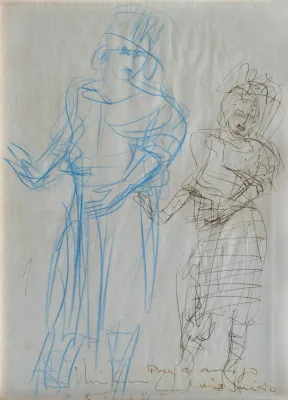
Iberê Camargo recounted that Guignard taught drawing and painting using extremely hard pencils, capable of leaving deep grooves in the paper. This rigorous practice strongly influenced his students. During this period, Iberê Camargo began his first experiments with metal printmaking, guided by Hans Steiner and by Guignard himself.
In 1947, Iberê Camargo received the Foreign Travel Prize of the Modern Division of the Salão Nacional de Belas Artes. The prize enabled Iberê Camargo to study in Rome in 1948 with masters such as Giorgio de Chirico, Achille Rosa and Petrucci. In 1949, Iberê Camargo continued his training in Paris under André Lhote, returning to Brazil in 1950.
In 1953, Iberê Camargo became professor of printmaking at the Instituto de Belas Artes in Rio de Janeiro. At the same time, Iberê Camargo taught printmaking in his studio and during residencies in Porto Alegre, in other Brazilian cities and abroad.
Iberê Camargo consolidated his international standing through participation in important exhibitions and biennials. The artist took part in several editions of the São Paulo Biennial, receiving the Best National Painter Award at the 6th Biennial, in 1961, and having special rooms in the 1963 and 1971 editions. Iberê Camargo also took part in the Tokyo Biennial in 1961 and 1968 and the Venice Biennale in 1962, and held an important retrospective at the Museu de Arte Moderna do Rio de Janeiro (MAM-RJ).
In 1962, Iberê Camargo was commissioned by the Companhia de Navegação Costeira to paint two large panels for the ships Princesa Isabel and Princesa Leopoldina. In 1966, Iberê Camargo produced the panel donated by Brazil to the headquarters of the World Health Organization (WHO) in Geneva, Switzerland.
Iberê Camargo held numerous solo exhibitions in important cultural centers in Brazil and abroad, including Porto Alegre, Santa Maria, Rio de Janeiro, São Paulo, Curitiba, Niterói, Montevideo, Paris, London and Washington, broadening the recognition of his work among critics and the international public.
Iberê Camargo's career was celebrated in important retrospectives. Notable among them are the exhibition of drawings held in 1979 at the Museu de Arte do Rio Grande do Sul, shown again in 1980 at the Museu Guido Viaro in Curitiba, and the exhibition celebrating the artist's 70th birthday, which traveled to Rio de Janeiro, São Paulo and Porto Alegre in 1984.
Iberê Camargo was also honored by major cultural institutions in the following decades. Among the most relevant exhibitions are the printmaking retrospective held in 1990 at the Espaço Cultural Banco Francês e Brasileiro in Porto Alegre, shown again in 1991 at the Museu Nacional de Belas Artes in Rio de Janeiro, and the broad retrospective organized in 1994 by the Centro Cultural Banco do Brasil, consolidating Iberê Camargo's legacy as one of the leading artists of 20th-century Brazilian art.
Iberê Camargo took part in important international group exhibitions that helped consolidate his recognition on the modern art scene. These include the Mexico Biennial (1958), the International Printmaking Exhibition in Yugoslavia (1971), the 10th Quadriennale Nazionale d’Arte di Roma (1977) and the exhibition Modernidade – Arte Brasileira do Século XX (1988), shown at the Musée d'Art Moderne in Paris and later at the Museu de Arte Moderna de São Paulo.
Iberê Camargo was also present in relevant group exhibitions in Brazil, among them Entre a Mancha e a Figura (MAM-RJ, 1982), Expressionismo no Brasil: Heranças e Afinidades (18th São Paulo Biennial, 1984), Mário Pedrosa: Arte, Revolução e Reflexão (1991, Centro Cultural Banco do Brasil, Rio de Janeiro), Bienal Brasil Século XX (1994, São Paulo) and Grito (1997, Museu Nacional de Belas Artes), reaffirming his importance in the history of Brazilian art.
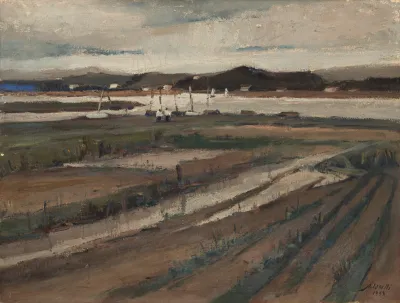
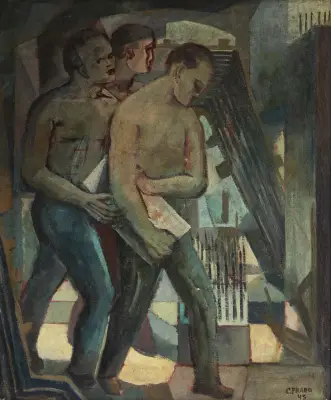
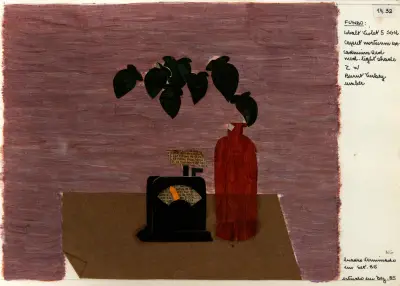
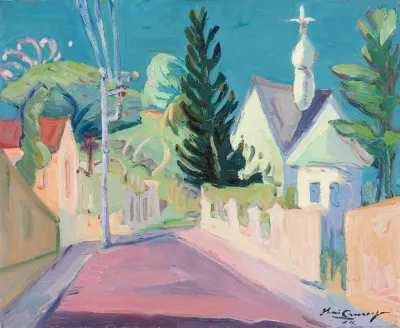
Iberê Camargo began his artistic career linked to figuration, producing landscapes, human figures and still lifes with a strong naturalistic and expressionist character. From his first works, Iberê Camargo gave color a fundamental role in his visual research. His production was influenced by important references of modern art, including Candido Portinari, the Mexican muralists, Alberto da Veiga Guignard and Pablo Picasso.
Vista da Lapa is one of the most representative works of Iberê Camargo's early period. Part of the collection of the Museu Nacional de Belas Artes, the painting won the artist the Foreign Travel Prize at the 1947 Salão Nacional de Belas Artes. The work shows characteristics that would mark his production, such as lyricism, chromatic intensity and vigorous brushstrokes that give movement and expressiveness to the composition.
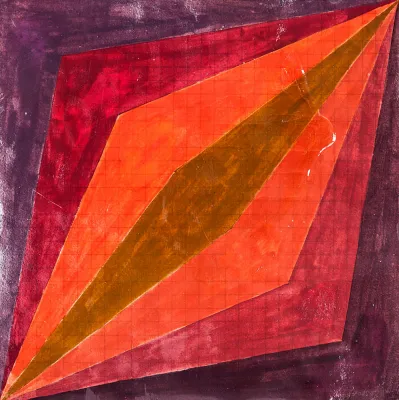
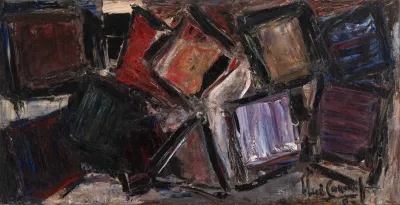
Iberê Camargo gradually moved away from objective representation throughout the 1950s, without abandoning his interest in the relationships between color, form and matter. This process reached a decisive point in 1959, with the emergence of the Carretéis (Spools) series. Although they still kept references to the concrete world, the works of this phase presented forms increasingly dissolved in a dense painting charged with gestural energy, marking the transition to a more abstract language.
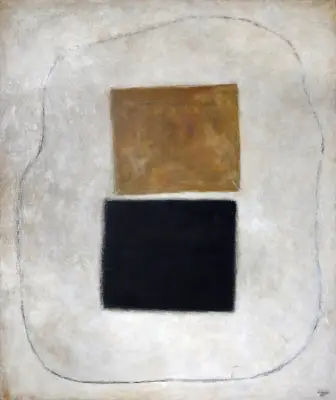
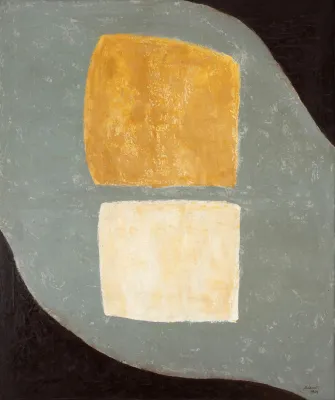
Iberê Camargo consciously adopted non-figuration in the early 1960s, establishing himself as one of the leading representatives of abstract painting in Brazil. Even when this tendency lost ground among some Brazilian critics and artists, Iberê Camargo remained committed to investigating the expressive possibilities of abstraction, developing a singular and deeply personal language.
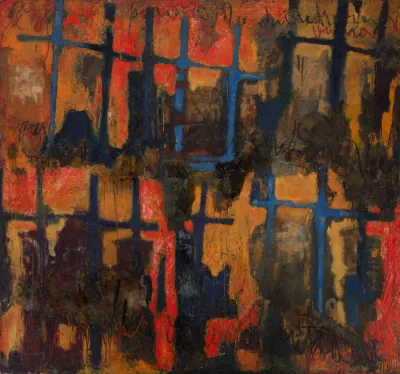
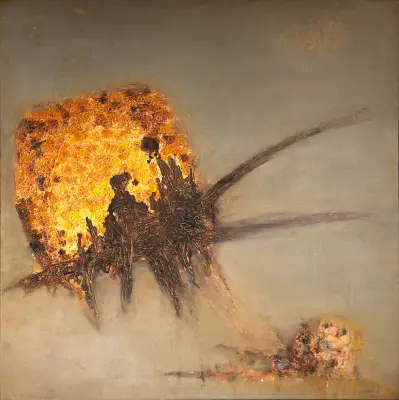
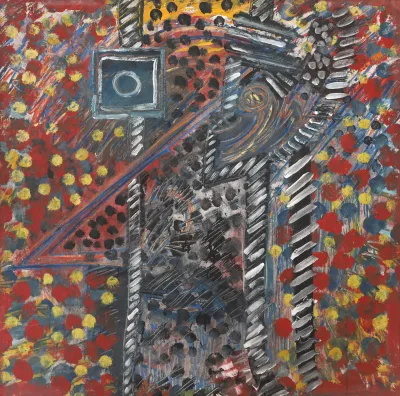
During this period, Iberê Camargo deepened his research into the materiality of painting. His canvases began to show an intense chromatic explosion, often built on dark grounds and marked by thick paint. As he said in an interview with Walmir Ayala: “Out of an almost tactile need, my painting is thick. Do not think, however, that I use predetermined reliefs or textures, as some painters do. The thickness results from the superimposition of layers that I apply in my eagerness to find the exact color or tone.”
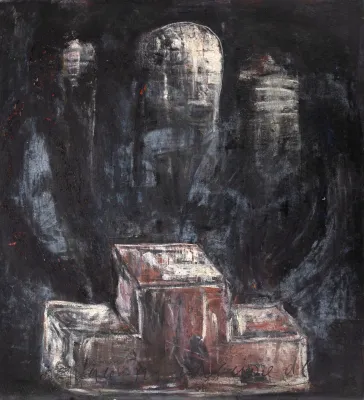
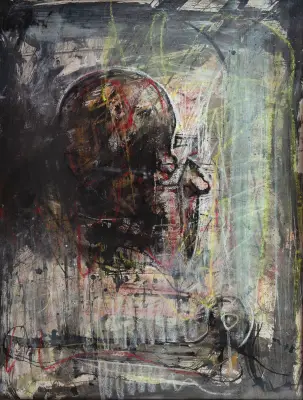
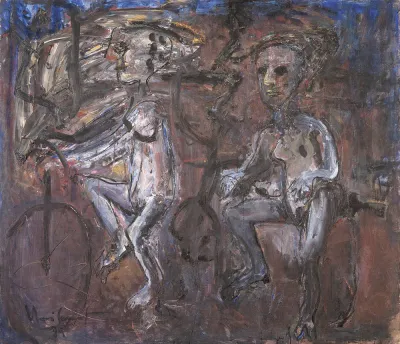
In the 1980s, Iberê Camargo went through a tragic episode in Rio de Janeiro that deeply influenced his personal and artistic life. From then on, Iberê Camargo gradually brought figurative elements back into his work, a language that remained present until the last years of his life. Human figures came to occupy a central role in his paintings and drawings, taking on an appearance marked by loneliness, fragility and existential intensity.
In his final phase, Iberê Camargo developed one of the most powerful bodies of work in 20th-century Brazilian art. The figures in his works appear pervaded by feelings of anguish, resistance and transcendence, engaging with universal questions of the human condition. In this period of maturity, Iberê Camargo reached the fullness of his artistic language, consolidating a body of work of deep emotional density, recognized as one of the most significant contributions to Brazilian modern painting.
Critical Commentary
Iberê Camargo began his artistic path far from the art world, but with a solid self-taught foundation. Born in Restinga Seca, Rio Grande do Sul, Iberê Camargo left his parents' home in 1922 and, five years later, entered the Escola de Artes e Ofícios in Santa Maria, where he took painting lessons with Frederico Lobe and Salvador Parlagreco. The academic teaching, centered on copying reproductions, did not match Iberê Camargo's search for a freer expression. After a disagreement with a teacher, Iberê Camargo interrupted his studies in 1929 and returned to his family's home.
In the following years, Iberê Camargo worked as a technical draftsman for the Railway Battalion, improving his knowledge of geometry and perspective. In 1936, Iberê Camargo returned to his studies in Porto Alegre, enrolling in the architecture course at the Instituto de Belas Artes. From 1940, Iberê Camargo devoted himself intensely to art, producing his first drawings and paintings with great spontaneity and gestural freedom.
In 1942, Iberê Camargo benefited from a grant from the government of Rio Grande do Sul to move to Rio de Janeiro and enter the Escola Nacional de Belas Artes. Dissatisfied with academic teaching, Iberê Camargo sought guidance from Guignard, whose influence became visible in his painting — marked by softer gestures and a more subtle palette.
Iberê Camargo's international projection came in 1947, when he received the foreign travel prize of the Salão Nacional de Belas Artes. In Rome, Iberê Camargo came into contact with masters such as Giorgio de Chirico and Petrucci. In Paris, Iberê Camargo studied with André Lhote and deepened his learning in European museums. Back in Brazil in 1950, Iberê Camargo began teaching and developing his printmaking technique, being hired as a teacher at the Instituto Municipal de Belas Artes in Rio de Janeiro.
In the 1950s, Iberê Camargo went through a decisive phase in the evolution of his visual language, with the emergence of the still lifes with spools. Gradually, these works lost their figurative function and paved the way for more abstract compositions. The spools became a recurring symbol in his work, marking Iberê Camargo's transition to abstraction. From 1960, Iberê Camargo made his painting more gestural and textured, with thick layers of paint and an intense use of color.
In the 1970s, Iberê Camargo began to insert recognizable signs and figures into his works, anticipating the return to figuration consolidated in the following decades. A striking episode influenced this turn: after being arrested for killing a man in self-defense, Iberê Camargo made his painting even denser and more dramatic. His human figures became somber and distorted, reflecting suffering and anguish. The series Ciclistas (Cyclists) and Idiotas (Idiots) exemplify this mature phase of Iberê Camargo, marked by a tragic vision of human existence.
Iberê Camargo's final work is striking for the density of its pictorial matter. Even in the face of images of degradation and symbolic violence, his canvases retain remarkable aesthetic force. Iberê Camargo's last works reflect the maturity of his language, revealing the tension between the beauty of painting and the dissolution of the modern subject.
When he died in 1994, Iberê Camargo left a profound legacy and an enduring body of work that continues to inspire generations of artists, researchers and admirers of Brazilian contemporary art.
Notes
1 CAMARGO, Iberê - An Autobiographical Sketch. In: ______. Gaveta dos Guardados. São Paulo: University of São Paulo Press, 1998. p.172.
2 BRITO, Ronaldo. The Eternal Restless One. In: ______. Iberê Camargo. São Paulo: DBA Artes Gráficas, 1994. p. 17.
Critiques
Pierre Courthion
Iberê Camargo’s Painting
"Let us attempt to recognize what fundamentally characterizes Iberê Camargo’s painting by following what we call the creative process in the artist. Initially, there is a figurative conception, a search for a tactile art that will find its highest expression in the non-figurative, ultimately manifesting in gesture. Camargo possesses the foresight not to rely entirely on demonstration. He knows that in art, the finest achievements surpass deductive reasoning. He surrenders to inspiration, which is not the ‘artificial breath’ Mallarmé spoke of, but an opening to the unknown. (...) Camargo always turned his back on official art, and any attempt in that direction died in the cradle. There are scratches, traces of revolt. One senses his impatience to live his art. He also has the gift of hinting at what he wishes to evoke. Thus, throughout his painting, the sea is felt everywhere, without ever seeing it, for everything is a sign, and everything in him resolves into the sign. This is why Camargo communicates with us. His painting is virulent, at times even volcanic, like lava whose torrent reaches us."
Source: COURTHION, Pierre. Iberê Camargo: The Birth of an Artist. In: IBERÊ Camargo. Porto Alegre: Margs; Rio de Janeiro: Funarte, 1985. p. 65-69. (Contemporary Collection, 1).
Frederico Morais
Informal Abstraction
"Unlike Bandeira, with his luminous ‘féeries,’ everything in Iberê Camargo is energy, drama, raw emotion. 'I do not paint models; I paint emotions,' asserts the artist. The canvas is always an emotional abyss, an endless anguish. More than once he compared himself to Sisyphus. In his studio in Porto Alegre, he showed me a canvas he had just retouched for the umpteenth time and said: 'At first, it seemed I would paint a dawn. I ended up creating a nocturne. What can I do? I have a tragic view of life. I am not a cheerful man; I see no future for humanity, no heaven (...).' 'There are two perceptual layers in his painting. The first is tactile, highly provocative, sensorial. Only the centuries-old taboo restrains us from touching the painted surface and feeling, through our fingers, the whirl of tumultuous emotions. One has the sense that the painting was completed in that very moment. The paint still appears wet, the gesture vibrates, the color pulses between blacks and violets. Up close, then, what is felt is the pure materiality of the painting. From a distance, the planes open and forms organize themselves, giving rise, as a consequence, to mysterious figures, threatening phantoms."
Source: MORAIS, Frederico. Informal Abstraction. In: DACOLEÇÃO: The Paths of Brazilian Art. São Paulo: Júlio Bogoricin, 1986. p.161.
Olívio Tavares de Araújo
The Evolution of Printmaking in the Hands of Master Iberê
"The principal phase of Iberê Camargo’s printmaking spans approximately from 1958 to 1970. It was during this time that he—and several other Brazilian artists—transitioned from figuration to abstraction. Using a single motif, reels, the painter (and printmaker) from Rio Grande do Sul follows a trajectory that is entirely coherent and organic."
Source: ARAÚJO, Olívio Tavares de. The Evolution of Printmaking in the Hands of Master Iberê. O Estado de S. Paulo, São Paulo, March 6, 1991.
Ronaldo Brito
Modern Painting in Brazil
"Without exaggeration, I believe, Iberê Camargo’s work today embodies modern painting in Brazil. The image, often commonplace, acquires, in his case, a genuinely expressive value: his canvases seem to truly incarnate painting itself. In a very specific sense, they dramatically reassert the corporeal origin of Western Form. A contemporary, uncertain, and saturated encounter with the genesis and history of form in the Western pictorial tradition might perhaps come closest to a concise characterization of this profound yet immediately impactful painting, tragic in accents but averse to grandiloquence, as ardently individualistic as it is generously public."
Source: BRITO, Ronaldo. Iberê Camargo. Translation by Cecil Stuart Birkinshaw; presentation by Jorge Gerdau Johannpeter, Alexandre Dórea Ribeiro; introduction by Rodrigo Naves; photography by Luiz Eduardo Robinson Achutti, Romulo Fialdini; edition by Alexandre Dórea Ribeiro. São Paulo: DBA, 1994. p. 33.
Paulo Venâncio Filho
A Trajectory Through Modern Painting and Beyond
"Iberê Camargo’s painting emerged under adverse conditions, on the periphery of the periphery of universal culture. In the south, in the provinces, removed from both global and national centers. Overcoming this deficit with limited local resources and a deeply acquired conviction—the boundless respect for high culture, the unrestrained admiration for masters of tradition, and a full awareness of the need for discernment in artistic formation—was a challenge Iberê set for himself to become a painter. It is evident that his artistic ambition was fully aware of the limits of Brazil’s cultural condition, of our backwardness and isolation. These elements, a mix of provincialism and transcendent artistic fervor, give, I believe, the unique and essential meaning to Iberê Camargo’s work, which cannot be found with the same intensity in any other Brazilian artist."
A typical Brazilian structural deformation, combined with an artistic ambition rare in its intensity, establishes the drive and conflict that run throughout the work: the unresolved tension between the limitations of the local environment and a universal artistic aspiration.
From this arises a somewhat solitary destiny, both in attitude and in artistic poetics. Expressionism is a rare phenomenon among us, practiced by only a few. Everything suggests that the fate of an expressionist in Brazilian art is solitude. This is the case with Iberê, solitary and also rebellious. Iberê's rebellion reflects an individualistic impulse, ambiguously modern, anti-provincial, anti-bureaucratic, anti-establishment."
Source: VENÂNCIO FILHO, Paulo. Iberê Camargo: Uma trajetória através da pintura moderna e além. In: CAMARGO, Iberê; SALZSTEIN, Sônia (coord.). Diálogos com Iberê Camargo. Text by Sônia Salzstein. São Paulo: Fundação Iberê Camargo : Cosac & Naify, 2003. pp. 127-128.
Testimonials
Angélica de Moraes
"[His] corrosive outburst, like the acid Iberê uses to etch his images into metal, is yet another facet of his perfectionism. [...] He never accepts limits. And, even stubbornly living in Brazil, he refuses to sugarcoat reality to make things more bearable. 'The economy of this country strangles every free gesture, it constrains, it prevents,' he asserts. [...] Even adapted to the Third World, he knew how to insist and persist. It was worth it.
'The most satisfying thing,' says [Carlos] Martins, 'was observing the perfect correspondence between Iberê’s prints and his paintings.' The curator [Carlos Martins] notes the similarity between the abundance of paint on the painter’s canvases and the accumulation of material in his graphic work. This buildup was achieved through successive acid baths on the same image. [...] The artist reveals himself essentially as a metal engraver. Few images exist in other techniques. Lithography [...] appears only briefly, during his return to printmaking. But he soon returned to the subtleties of metal, despite increasing difficulties in assembling a team of assistants to relieve him of the mechanical and arduous aspects of the process, such as polishing copper plates, applying acid baths, and printing the editions."
Source: MORAES, Angélica de. Gravuras de um "malnascido", o genial Iberê Camargo. Jornal da Tarde, São Paulo, 6 Mar. 1991.
Augusto Massi
"I studied printmaking with Carlos Petrucci in Rome. Back in Brazil, in 1953, I founded the printmaking course at the Instituto Nacional de Belas Artes in Rio de Janeiro. I wrote all this down; recently, Sagra published a small book of mine on printmaking techniques. It reflects my study, my experience, my journey. I belong to the era of Goeldi, who made woodcuts using a clog and a pocketknife. I improvised a burin with a sewing or gramophone needle. I made a huge effort to reinvent the wheel. I was both student and teacher of myself. [...]
Goeldi’s work was incredibly economical! He had something to say and said it with few words. Goeldi gave nothing away. He was extremely upright, sincere, true to himself. He did not like Picasso. For me, meeting Goeldi was deeply rewarding. He was a good friend."
Source: MASSI, Augusto. Iberê Camargo. The artist recalls his encounters with De Chirico and Portinari and speaks about his creative process. Folha de S. Paulo, São Paulo, 20 Sep. 1992.
Lisette Lagnado
"When painting, do you make an effort to reconstruct?
No, not at all. As a painter, I am merely a worker. I strive to create my object as best as possible, like a table or a chair. I attend to its need to exist. I know a table has a certain number of legs and cannot float in space. I must submit to the constructive necessity of the everyday object to make my painting as well as I can, using my knowledge as a painter, as an artisan, as a house painter—no more than that. Now, if I have anxieties, that is the question. Why do you pursue that image so intensely? Why do you dismantle and redo so many times, as people ask me? A painter in São Paulo watched the video and said he saw a parade of humanity, because there are so many figures emerging, which I reject. Why do I reject them? I’d like to know. For me, it’s because that one is more formally plastic, more truthful as an image. But perhaps I am giving the definition of an aesthete, of an artist. I might even be deceiving myself.
Perhaps I am unconsciously seeking the first image, the image of the mother. When it appears, it satisfies. I cannot describe it beforehand, but I can recognize it. It is her, I know it."
Source: LAGNADO, Lisette. Conversações com Iberê Camargo. São Paulo: Iluminuras, 1994. p. 33.
Iberê Camargo
"My printmaking and my painting have always proceeded in parallel. They could not be separated. Because I always paint the now. But since I am not an empty vessel, this 'now' carries a lot within it, surfacing and participating in the present. When I paint the now, I am painting the past and already opening space for the future. That is why I say that no one can walk without placing one foot forward and another back. You cannot walk by hopping. That desire to break with things is like trying to remove a leg. Are you going to hop like a frog?"
Source: ÀS VÉSPERAS dos 80 anos, o pintor é homenageado pela Bienal, escreve livro de memórias e planeja voltar às paisagens que fazia nos anos 40. Folha de S. Paulo, São Paulo, Mar. 6, 1994.
Solo Exhibitions
1942 - Porto Alegre RS - Solo, at the Government Palace
1944 - Porto Alegre RS - Solo, at Galeria de Arte Casa das Molduras
1946 - Porto Alegre RS - Solo, at the Ministry of Education and Health
1947 - Porto Alegre RS - Solo, at Galeria de Arte Casa das Molduras
1951 - Resende RJ - Solo, at Museu de Arte Moderna
1952 - Rio de Janeiro RJ - Solo, at Biblioteca Nacional
1954 - Rio de Janeiro RJ - Solo, at Galeria Ibeu Copacabana
1955 - Porto Alegre RS - Solo, at Clube da Gravura
1958 - Rio de Janeiro RJ - Solo, at Galeria GEA
1959 - Washington (United States) - Solo, at Pan American Union Gallery
1960 - Montevideo (Uruguay) - Solo, at Centro de Letras e Artes
1960 - Porto Alegre RS - Solo, at Museu de Arte do Rio Grande do Sul Ado Malagoli
1962 - Rio de Janeiro RJ - Exhibition of Panels for Cia. de Navegação Costeira, at Museu de Arte Moderna
1962 - Rio de Janeiro RJ - Retrospective, at Museu de Arte Moderna
1963 - Rio de Janeiro RJ - Solo, at Petite Galerie
1964 - Rio de Janeiro RJ - Solo, at Galeria Bonino
1965 - Rio de Janeiro RJ - Solo, at Galeria Bonino
1966 - Rio de Janeiro RJ - Solo, at Galeria Bonino
1969 - Porto Alegre RS - Solo, at Instituto de Idiomas Yázigi
1969 - Santa Maria RS - Solo, at Biblioteca Municipal de Santa Maria
1970 - Rio de Janeiro RJ - Solo, at Gabinete de Arte de Botafogo
1970 - Rio de Janeiro RJ - Solo, at Galeria Barcinsky
1972 - Rio de Janeiro RJ - Solo, at the Artist's Atelier
1973 - London (United Kingdom) - Solo, at O'Hana Gallery
1973 - Porto Alegre RS - Solo, at Galeria Ianeli
1973 - Rio de Janeiro RJ - Solo, at Galeria Maison de France
1974 - Rio de Janeiro RJ - Solo, at Galeria Aliança Francesa
1975 - Rio de Janeiro RJ - Solo, at Galeria Luiz Buarque de Holanda and Paulo Bittencourt
1976 - Rio de Janeiro RJ - Solo, at Galeria Bonino
1977 - Porto Alegre RS - Solo, at Oficina de Arte
1977 - Santa Maria RS - Solo, at Galeria Iberê Camargo
1978 - São Paulo SP - Solo, at Cristina de Paula Galeria de Arte
1979 - Paris (France) - Solo, at Galeria Debret
1979 - Porto Alegre RS - Solo, at Museu de Arte do Rio Grande do Sul
1979 - Rio de Janeiro RJ - Solo, at Galeria de Arte Ipanema
1980 - Curitiba PR - Iberê Camargo Works, at Museu Guido Viaro
1980 - Porto Alegre RS - Solo, at Galeria do Centro Comercial
1980 - Porto Alegre RS - Solo, at Galeria Tina Presser
1980 - Porto Alegre RS - Solo, at MARGS
1981 - Porto Alegre RS - Solo, at Galeria do Centro Comercial
1981 - Rio de Janeiro RJ - Solo, at Acervo Galeria de Arte
1982 - Curitiba PR - Solo, at Galeria Max Stolz
1982 - Porto Alegre RS - Retrospective on Paper by Iberê Camargo, at Museu de Arte do Rio Grande do Sul Ado Malagoli
1982 - Rio de Janeiro RJ - Solo, at Cláudio Gil Studio de Arte
1983 - Porto Alegre RS - Solo, at Galeria Tina Presser
1984 - São Paulo SP - Solo, at Galeria Luisa Strina
1984 - Fortaleza CE - Iberê Camargo: Drawings, Paintings and Prints, at Galeria Multiarte
1984 - Porto Alegre RS - Solo, at Galeria Tina Presser
1984 - Porto Alegre RS - Solo, at Museu de Arte do Rio Grande do Sul Ado Malagoli
1984 - Porto Alegre RS - Iberê Camargo, Aquele Abraço, at Centro Municipal de Cultura
1984 - Rio de Janeiro RJ - Solo, at Cláudio Gil Studio de Arte
1984 - Rio de Janeiro RJ - Solo, at Galeria Thomas Cohn
1984 - Santa Maria RS - Solo, at Universidade Federal de Santa Maria
1985 - Porto Alegre RS - Iberê Camargo: Drawings and Paintings, at Galeria Tina Presser
1985 - Porto Alegre RS - Iberê Camargo: Trajectories and Encounters, at Museu de Arte do Rio Grande do Sul Ado Malagoli
1986 - Curitiba PR - Solo, at Galeria Max Stolz
1986 - Porto Alegre RS - Solo, at Galeria Tina Presser
1986 - Vitória ES - Solo, at Galeria Usina
1987 - São Paulo SP - Solo, at Galeria Montesanti Roesler
1987 - São Paulo SP - Solo, at Galeria Montesanti Roesler
1987 - São Paulo SP - Solo, at Galeria Luisa Strina
1987 - Brasília DF - Solo, at Espaço Capital Arte Contemporânea
1987 - Campo Grande MS - Solo, at Galeria Art-Con
1987 - Caxias do Sul RS - Solo, at Galeria Soluzzione
1987 - Florianópolis SC - Solo, at Galeria Espaço de Arte
1987 - Montevideo (Uruguay) - Solo, at Centro de Exposições, Cultural Department, City Hall
1987 - Pelotas RS - Solo, at Galeria Van Gogh
1987 - Porto Alegre RS - Solo, at Galeria Tina Presser
1987 - Rio de Janeiro RJ - Solo, at Galeria Paulo Klabin
1987 - Santa Maria RS - Solo, at Galeria Matiz
1987 - Uberaba MG - Solo, at M.D. Galeria de Arte
1988 - São Paulo SP - Solo, at Documenta Galeria de Arte
1988 - Aracaju SE - Solo, at Galeria Alvaro Santos
1988 - Fortaleza CE - Iberê Camargo: Drawings, Paintings and Prints, at Galeria Multiarte
1988 - Pelotas RS - Solo, at Galeria Van Gogh
1988 - Porto Alegre RS - Solo, at Galeria Tina Zappoli
1988 - Rio de Janeiro RJ - Solo, at Galeria Montesanti
1989 - São Paulo SP - Iberê Camargo Print Exhibitions, at Biblioteca Municipal Mário de Andrade
1989 - Porto Alegre RS - Solo, at Galeria Tina Zappoli
1989 - Porto Alegre RS - Solo, at Museu de Arte do Rio Grande do Sul
1989 - Santana do Livramento RS - Solo, at Galeria Ponto D'Arte
1990 - São Paulo SP - Iberê Camargo Prints: A Retrospective, at MAM Ibirapuera
1990 - São Paulo SP - Iberê Camargo: Cyclists in Parque da Redenção, at Galeria Montesanti Roesler
1990 - Pelotas RS - Solo, at Galeria Van Gogh
1990 - Porto Alegre RS - Iberê Camargo Prints: A Retrospective, at Espaço Cultural BFB
1990 - Porto Alegre RS - Solo, at Casa de Cultura Mário Quintana
1990 - Rio de Janeiro RJ - Cyclists in Parque da Redenção, at Escola de Artes Visuais do Parque Lage
1990 - Rio de Janeiro RJ - Solo, at Museu de Arte Moderna
1990 - Rio de Janeiro RJ - Solo, at Museu de Arte Moderna
1991 - São Paulo SP - Iberê Camargo Prints: A Retrospective, at Museu de Arte Moderna
1991 - São Paulo SP - Solo, at Galeria Montesanti Roesler
1991 - São Paulo SP - Solo, at Museu de Arte de São Paulo
1991 - Passo Fundo RS - Solo, at Espaço de Arte
1991 - Porto Alegre RS - Solo, at Instituto Goethe
1991 - Rio de Janeiro RJ - Solo, at Escola de Artes Visuais do Parque Lage
1991 - Salvador BA - Iberê Camargo: Paintings and Gouaches, at Escritório de Arte da Bahia
1992 - Fortaleza CE - Solo, at Galeria Multiarte
1992 - Porto Alegre RS - Solo, at Centro Municipal de Cultura
1992 - Porto Alegre RS - Solo, at Galeria Tina Zappoli
1993 - São Paulo SP - Solo, at Galeria Camargo Vilaça
1993 - Florianópolis SC - Iberê Camargo: Paintings, at Museu de Arte de Santa Catarina
1993 - Porto Alegre RS - Solo, at Galeria Iberê Camargo
1993 - Porto Alegre RS - Iberê Camargo: Portraits of Friends, at Hotel Center Park
1993 - Ribeirão Preto SP - Iberê Camargo: Print Retrospective, at Museu de Arte de Ribeirão Preto Manuel Gismondi
1993 - Salvador BA - Solo, at Escritório de Arte da Bahia
1994 - São Paulo SP - Solo, at CCSP
1994 - Porto Alegre RS - Homage to Iberê Camargo, at Museu de Arte do Rio Grande do Sul
1994 - Porto Alegre RS - Iberê Camargo: Modern Master, at Galeria Iberê Camargo
1994 - Porto Alegre RS - Iberê Camargo: Drawings and Prints, at Espaço Cultural Fiat
1994 - Porto Alegre RS - Iberê Camargo: Drawings and Metal Prints, at Galeria Tina Zappoli
1994 - Rio de Janeiro RJ - Iberê Camargo: Modern Master, at Centro Cultural Banco do Brasil
Group Exhibitions
1943 - Rio de Janeiro RJ - Grupo Guignard, at ENBA
1943 - Rio de Janeiro RJ - National Salon of Fine Arts, at National Museum of Fine Arts
1944 - Belo Horizonte MG - Modern Art Exhibition, at Edifício Mariana
1944 - London (United Kingdom) - Exhibition of Modern Brazilian Paintings, at Royal Academy of Arts
1944 - Norwich (United Kingdom) - Exhibition of Modern Brazilian Paintings, at Norwich Castle and Museum
1944 - Rio de Janeiro RJ - 50th National Salon of Fine Arts, at National Museum of Fine Arts
1945 - Bath (United Kingdom) - Exhibition of Modern Brazilian Paintings, at Victoria Art Gallery
1945 - Bristol (United Kingdom) - Exhibition of Modern Brazilian Paintings, at Bristol City Museum & Art Gallery
1945 - Buenos Aires (Argentina) - 20 Brazilian Artists, at Salas Nacionales de Exposición
1945 - Edinburgh (United Kingdom) - Exhibition of Modern Brazilian Paintings, at National Gallery
1945 - Glasgow (United Kingdom) - Exhibition of Modern Brazilian Paintings, at Kelvingrove Art Gallery
1945 - La Plata (Argentina) - 20 Brazilian Artists, at Provincial Museum of Fine Arts
1945 - Manchester (United Kingdom) - Exhibition of Modern Brazilian Paintings, at Manchester Art Gallery
1945 - Montevideo (Uruguay) - 20 Brazilian Artists, at Municipal Commission of Culture
1945 - Rio de Janeiro RJ - 51st National Salon of Fine Arts, at National Museum of Fine Arts
1946 - Rio de Janeiro RJ - 52nd National Salon of Fine Arts, at National Museum of Fine Arts
1947 - Montevideo (Uruguay) - Brazilian Contemporary Painting
1951 - Madrid (Spain) - Madrid Biennial
1952 - New York (United States) - Group Exhibition, at Solomon R. Guggenheim Museum
1952 - Rio de Janeiro RJ - Brazilian Artists Exhibition, at Museum of Modern Art
1953 - Porto Alegre RS - 4th Salon of the Institute of Fine Arts of Rio Grande do Sul
1953 - Rio de Janeiro RJ - 2nd National Salon of Modern Art, at National Museum of Fine Arts
1954 - Rio de Janeiro RJ - Black and White Salon, at Palace of Culture
1955 - Madrid (Spain) - Madrid Biennial, at Palace of Culture
1955 - Porto Alegre RS - Contemporary Brazilian Art, at Casa das Molduras
1955 - Rio de Janeiro RJ - Carioca Salon
1956 - São Paulo SP - 50 Years of Brazilian Landscape, at Museum of Modern Art
1956 - Barcelona (Spain) - 3rd Hispano-American Biennial
1956 - Rio de Janeiro RJ - 5th National Salon of Modern Art
1957 - Buenos Aires (Argentina) - Modern Art in Brazil, at Museum of Modern Art
1957 - Montevideo (Uruguay) - Brazilian Prints, at Uruguayan-Brazilian Cultural Institute
1957 - Rio de Janeiro RJ - 6th National Salon of Modern Art
1957 - Rio de Janeiro RJ - 62nd National Salon of Fine Arts, at National Museum of Fine Arts
1957 - Rio de Janeiro RJ - Salon for All, at Ministry of Education and Culture
1958 - Mexico City (Mexico) - Inter-American Biennial of Painting and Printmaking, at National Institute of Fine Arts
1958 - Porto Alegre RS - Pan-American Art Salon, at Institute of Fine Arts
1958 - Quito (Ecuador) - Brazilian Print Exhibition
1959 - São Paulo SP - 5th São Paulo International Biennial, at Ciccillo Matarazzo Pavilion
1959 - Rio de Janeiro RJ - 30 Years of Brazilian Art, at Macunaíma Gallery
1959 - Washington (United States) - Pan American Union, at Smithsonian Institution
1960 - Mexico City (Mexico) - 2nd Inter-American Biennial of Mexico, at Palace of Fine Arts
1960 - New York (United States) - Latin American Painters and Painting, at Solomon R. Guggenheim Museum
1960 - Rio de Janeiro RJ - Twelve Brazilian Artists, at Bonino Gallery
1960 - Rio de Janeiro RJ - Bonino Gallery: Inaugural Exhibition, at Bonino Gallery
1960 - Rio de Janeiro RJ - 9th National Salon of Modern Art, at Museum of Modern Art
1960 - Tokyo (Japan) - International Biennial Exhibition of Prints, at The National Museum of Modern Art
1961 - São Paulo SP - São Paulo International Biennial, at Ciccillo Matarazzo Pavilion
1961 - Rio de Janeiro RJ - Still Life in Painting, at Ibeu Copacabana Gallery
1961 - Rio de Janeiro RJ - Rio in Brazilian Painting, at Guanabara State Library
1961 - Rio de Janeiro RJ - The Face and the Work, at Ibeu Copacabana Gallery
1961 - Rio de Janeiro RJ - National Salon of Modern Art
1961 - Tokyo (Japan) - 6th Tokyo Biennial
1962 - São Paulo SP - Selection of Brazilian Artworks from the Ernesto Wolf Collection, at Museum of Modern Art
1962 - Colorado Springs (United States) - New Art of Brazil, at Colorado Springs Fine Arts Center
1962 - Minneapolis (United States) - New Art of Brazil, at Walker Art Center
1962 - Saint Louis (United States) - New Art of Brazil, at City Art Museum
1962 - San Francisco (United States) - New Art of Brazil, at San Francisco Museum of Art
1962 - Tokyo (Japan) - 30th Exhibition of the Japan Print Association, at Japan Print Association
1962 - Venice (Italy) - Venice Biennale
1963 - São Paulo SP - 7th São Paulo International Biennial, at Fundação Bienal
1963 - Rio de Janeiro RJ - Landscape as a Theme, at Ibeu Copacabana Gallery
1963 - Rio de Janeiro RJ - JB Art Review, at Jornal do Brasil
1964 - Rio de Janeiro RJ - Small Format Exhibition, at Bonino Gallery
1964 - Rio de Janeiro RJ - The Nude in Contemporary Art, at Ibeu Copacabana Gallery
1965 - Barcelona (Spain) - Eight Brazilian Printmakers, at René Metras Gallery
1965 - Lacock (United Kingdom) - Group Exhibition, at Royal College of Art
1965 - Lisbon (Portugal) - Salon Comparaisons
1965 - Paris (France) - Salon Comparaisons
1965 - Prague (Czech Republic) - Salon Comparaisons
1966 - São Paulo SP - Half a Century of New Art, at Museum of Contemporary Art of the University of São Paulo
1966 - Austin (United States) - Art of Latin America since Independence, at The University of Texas at Austin, Archer M. Huntington Art Gallery
1966 - Belo Horizonte MG - 2nd Circulating Exhibition of Works from MAC/USP Collection, at Belo Horizonte City Museum
1966 - Bonn (Germany) - Brazilian Art Today
1966 - Mexico City (Mexico) - Painting and Printmaking from Brazil, at Museum of Modern Art
1966 - Curitiba PR - 2nd Circulating Exhibition of Works from MAC/USP Collection
1966 - La Jolla (United States) - Art of Latin America since Independence, at Museum of Contemporary Art San Diego
1966 - New Haven (United States) - Art of Latin America since Independence, at Yale University Art Gallery
1966 - New Orleans (United States) - Art of Latin America since Independence, at Isaac Delgado Museum of Art
1966 - Porto Alegre RS - Circulating Exhibition of Works from MAC/USP Collection, at Museum of Art of Rio Grande do Sul
1966 - Salvador BA - 1st National Biennial of Visual Arts, at Convento de Nossa Senhora do Carmo Church
1966 - San Francisco (United States) - Art of Latin America since Independence, at San Francisco Museum of Modern Art
1967 - Rio de Janeiro RJ - JB Art Review, at Museum of Modern Art
1968 - Porto Alegre RS - Print Exhibition, at Architects’ Institute Gallery
1968 - Tokyo (Japan) - International Biennial Exhibition of Prints
1971 - São Paulo SP - São Paulo International Biennial, at Fundação Bienal
1971 - Rio de Janeiro RJ - JB Art Review, at Museum of Modern Art
1972 - São Paulo SP - Art/Brazil/Today: 50 Years Later, at Collectio Gallery
1973 - Ljubljana (Slovenia) - International Print Biennial, at Moderna Galerija Ljubljana
1973 - Rio de Janeiro RJ - Brazilian Printmaking in the 20th Century, at National Museum of Fine Arts
1973 - Rio de Janeiro RJ - Four Brazilian Printmakers, at Grupo B Gallery
1975 - São Paulo SP - São Paulo International Biennial, at Fundação Bienal
1975 - São Paulo SP - 2nd Brazil-Japan Fine Arts Exhibition, at Legislative Assembly of São Paulo State
1975 - Rio de Janeiro RJ - 2nd Brazil-Japan Fine Arts Exhibition, at Centro Cultural Lume
1976 - São Paulo SP - Brazilian Art: Figures and Movements, at Arte Global Gallery
1977 - São Paulo SP - 3rd Brazil-Japan Fine Arts Exhibition
1977 - São Paulo SP - 5th Global Winter Salon, at São Paulo Museum of Art
1977 - Atami (Japan) - 3rd Brazil-Japan Fine Arts Exhibition
1977 - Belo Horizonte MG - 5th Global Winter Salon, at Fundação Palácio das Artes
1977 - Brasília DF - 5th Global Winter Salon
1977 - Kyoto (Japan) - 3rd Brazil-Japan Fine Arts Exhibition
1977 - Rio de Janeiro RJ - 3rd Brazil-Japan Fine Arts Exhibition
1977 - Rio de Janeiro RJ - 5th Global Winter Salon, at National Museum of Fine Arts
1977 - Rome (Italy) - 10th Quadriennale Nazionale d'Arte di Roma
1977 - Tokyo (Japan) - 3rd Brazil-Japan Fine Arts Exhibition
1978 - São Paulo SP - Biennials and Abstraction: The 1950s, at Lasar Segall Museum
1978 - Rio de Janeiro RJ - 2nd Brazil Art Tourism, at Copacabana Palace Hotel
1979 - São Paulo SP - 15th São Paulo International Biennial, at Fundação Bienal
1980 - Rio de Janeiro RJ - Homage to Mário Pedrosa, at Jean Boghici Gallery
1981 - Osaka (Japan) - Latin American Contemporary Art Exhibition Brazil/Japan, at National Museum of Art
1982 - Lisbon (Portugal) - Brazil: 60 Years of Modern Art – Gilberto Chateaubriand Collection, at José de Azeredo Perdigão Center for Modern Art
1982 - London (United Kingdom) - Brazil: 60 Years of Modern Art – Gilberto Chateaubriand Collection, at Barbican Art Gallery
1982 - Penápolis SP - 5th Northwest Fine Arts Salon, at Penápolis Educational Foundation, Faculty of Philosophy, Sciences and Letters
1982 - Porto Alegre RS - Homage to Iberê Camargo, at Yázigi Gallery
1982 - Porto Alegre RS - Homage to Iberê Camargo, at Rio Grande do Sul Museum of Art Ado Malagoli
1982 - Rio de Janeiro RJ - Between Stain and Figure, at Museum of Modern Art
1983 - Porto Alegre RS - From Past to Present: Visual Arts in Rio Grande do Sul, at Cambona Arts Center
1983 - Rio de Janeiro RJ - 3 x 4 Large Formats, at Rio Business Center Gallery
1983 - Rio de Janeiro RJ - Modern Art in the National Salon: 1940-1982, at National Arts Foundation, Arts Center
1983 - Rio de Janeiro RJ - Brazilian Self-Portraits, at Banerj Art Gallery
1983 - Rio de Janeiro RJ - 6th National Salon of Visual Arts, at Museum of Modern Art
1984 - São Paulo SP - Gilberto Chateaubriand Collection: Portrait and Self-Portrait of Brazilian Art, at Museum of Modern Art
1984 - São Paulo SP - Tradition and Rupture: Synthesis of Brazilian Art and Culture, at Fundação Bienal
1984 - Fortaleza CE - 7th National Salon of Visual Arts
1984 - Porto Alegre RS - Prints: A Trajectory Through Time, at Cambona Arts Center
1984 - Ribeirão Preto SP - Brazilian Printmakers of the 1950s/60s, at Campus Gallery
1984 - Rio de Janeiro RJ - Interventions in Urban Space, at Sérgio Milliet Gallery
1984 - Rio de Janeiro RJ - Active Brazilian Painting, at Espaço Petrobras
1984 - Rio de Janeiro RJ - Long Live Painting, at Petite Galerie
1985 - São Paulo SP - 18th São Paulo International Biennial, at Fundação Bienal
1985 - Brasília DF - Active Brazilian Painting, at Cultural Foundation of the Federal District
1985 - Porto Alegre RS - Iberê Camargo: Trajectory and Encounters, at Rio Grande do Sul Museum of Art Ado Malagoli
1985 - Porto Alegre RS - 1st Oval Exhibition, at Arco Gallery
1985 - Porto Alegre RS - Pre-Vision: Gaúchos at the Biennial, at Tina Presser Gallery
1985 - Rio de Janeiro RJ - Encounters, at Petite Galerie
1985 - Rio de Janeiro RJ - 8th National Salon of Visual Arts, at Museum of Modern Art
1985 - Rio de Janeiro RJ - Six Decades of Modern Art: Roberto Marinho Collection, at Paço Imperial
1986 - São Paulo SP - Iberê Camargo: Trajectory and Encounters, at São Paulo Museum of Art
1986 - Brasília DF - Iberê Camargo: Trajectory and Encounters, at Cláudio Santoro National Theater
1986 - Rio de Janeiro RJ - The New Avocado Flower, Grupo Guignard-1943 and The Dissidents-1942, at Banerj Art Gallery
1986 - Rio de Janeiro RJ - Iberê Camargo: Trajectory and Encounters, at Museum of Modern Art
1986 - Rio de Janeiro RJ - Seven Decades of Italian Presence in Brazilian Art, at Paço Imperial
1987 - São Paulo SP - Iberê Camargo, at Luisa Strina Gallery
1987 - São Paulo SP - The Craft of Art: Painting, at SESC
1987 - Paris (France) - Modernity: 20th-Century Brazilian Art, at Musée d'Art Moderne de la Ville de Paris
1987 - Ribeirão Preto SP - Group Exhibition, at Ribeirão Preto Fine Arts Promotions
1987 - Rio de Janeiro RJ - To the Collector: Homage to Gilberto Chateaubriand, at Museum of Modern Art
1987 - Rio de Janeiro RJ - Rio de Janeiro, February-March: From Modernism to the 1980s Generation, at Banerj Art Gallery
1988 - São Paulo SP - Modernity: 20th-Century Brazilian Art, at Museum of Modern Art
1988 - São Paulo SP - Rhythms and Forms: Contemporary Brazilian Art, at Sesc Pompéia
1988 - Ribeirão Preto SP - Lívio Abramo, Iberê Camargo, and Amilcar de Castro, at Casa da Cultura de Ribeirão Preto
1988 - Rio de Janeiro RJ - Time and Wind, at Ipanema Art Gallery
1988 - Salvador BA - Illustrators of Jorge Amado, at Jorge Amado House Foundation
1989 - São Paulo SP - São Paulo International Biennial, at Fundação Bienal
1989 - São Paulo SP - Gesture and Structure, at Raquel Arnaud Art Cabinet
1989 - São Paulo SP - Memory Game, at Montesanti Roesler Gallery
1989 - São Paulo SP - Panorama of Contemporary Brazilian Art, at Museum of Modern Art
1989 - Cachoeira do Sul RS - Iberê Camargo: Paintings, Prints, and Drawings, at Artmão Gallery
1989 - Copenhagen (Denmark) - Rhythms and Forms: Contemporary Brazilian Art, at Charlottenborg Museum
1989 - Fortaleza CE - 19th and 20th-Century Brazilian Art in Ceará Collections: Paintings and Drawings, at Unifor Cultural Space
1989 - Lisbon (Portugal) - Six Decades of Brazilian Modern Art: Roberto Marinho Collection, at José de Azeredo Perdigão Center for Modern Art
1989 - Porto Alegre RS - Arte Sul 89, at Rio Grande do Sul Museum of Art Ado Malagoli
1989 - Porto Alegre RS - Tina Zappoli Gallery: 8th Anniversary, at Tina Zappoli Gallery
1989 - Recife PE - Memory Game
1989 - Rio de Janeiro RJ - Brazilian Printmaking: Four Themes, at School of Visual Arts, Parque Lage
1989 - Rio de Janeiro RJ - Memory Game, at Montesanti Galleria
1989 - Rio de Janeiro RJ - Rio Today, at Museum of Modern Art
1989 - Rio de Janeiro RJ - Tina Zapolli Visits Saramenha, at Saramenha Gallery
1990 - São Paulo SP - 9th Brazil-Japan Contemporary Art Exhibition, at Brazil-Japan Foundation
1990 - Atami (Japan) - 9th Brazil-Japan Contemporary Art Exhibition
1990 - Brasília DF - 9th Brazil-Japan Contemporary Art Exhibition
1990 - Curitiba PR - 9th Curitiba City Printmaking Exhibition, at Printmaking Museum
1990 - Porto Alegre RS - 1990: To Our Artists, at Galeria Tina Zappoli
1990 - Rio de Janeiro RJ - 9th Brazil-Japan Contemporary Art Exhibition
1990 - Rio de Janeiro RJ - Ibeu: 1940 - 1990, at Galeria Ibeu Copacabana
1990 - Rio de Janeiro RJ - Primavera 90, at Galeria H. Stern
1990 - Sapporo (Japan) - 9th Brazil-Japan Contemporary Art Exhibition
1990 - Tokyo (Japan) - 9th Brazil-Japan Contemporary Art Exhibition
1991 - São Paulo SP - A Árvore de Cada Um, at Galeria Nara Roesler
1991 - São Paulo SP - Sobre a Árvore, at Galeria Montesanti Roesler
1991 - São Paulo SP - Sobre o Branco, at Galeria de Arte São Paulo
1991 - Rio de Janeiro RJ - Mário Pedrosa, Arte, Revolução e Reflexão, at Centro Cultural Banco do Brasil
1992 - São Paulo SP - Branco Dominante, at Galeria de Arte São Paulo
1992 - Araraquara SP - Group Exhibition, at Casa do Médico
1992 - Cachoeira do Sul RS - Francisco Stockinger and Iberê Camargo
1992 - Curitiba PR - 10th Curitiba City Printmaking Exhibition / América Exhibition, at Printmaking Museum
1992 - Poços de Caldas MG - Brazilian Modern Art: Collection of the Museum of Contemporary Art, University of São Paulo, at Casa da Cultura
1992 - Portão RS - Históricos, at Museu de Arte do Rio Grande do Sul
1992 - Porto Alegre RS - 1992, at Galeria Tina Zappoli
1992 - Porto Alegre RS - Contemporary Art: Highlights from the South, at Espaço Cultural Edel Trade Center
1992 - Porto Alegre RS - Mário Pedrosa, Arte, Revolução e Reflexão, at Centro Municipal de Cultura
1992 - Rio de Janeiro RJ - 1st A Caminho de Niterói: João Sattamini Collection, at Paço Imperial
1992 - Rio de Janeiro RJ - From Debret to Iberê, at Museu da Cidade
1992 - Rio de Janeiro RJ - Printmaking in Brazil: Proposal for Mapping, at Centro Cultural Banco do Brasil
1992 - Rio de Janeiro RJ - Nature: Four Centuries of Art in Brazil, at Centro Cultural Banco do Brasil
1993 - São Paulo SP - Poética, at Gabinete de Arte Raquel Arnaud
1993 - Fortaleza CE - 23 Years, at Galeria Ignez Fiuza
1993 - Niterói RJ - 2nd A Caminho de Niterói: João Sattamini Collection, at Museu de Arte Contemporânea
1993 - Porto Alegre RS - 1993, at Galeria Tina Zappoli
1993 - Rio de Janeiro RJ - Erotic Art, at Museu de Arte Moderna
1993 - Rio de Janeiro RJ - Brazil: 100 Years of Modern Art, at Museu Nacional de Belas Artes
1993 - Rio de Janeiro RJ - Emblems of the Body: The Nude in Brazilian Modern Art, at Centro Cultural Banco do Brasil
1993 - Rio de Janeiro RJ - Prints by Amilcar de Castro, Antonio Dias, Iberê Camargo, and Sérgio Fingermann, at Escola de Artes Visuais do Parque Lage
1994 - São Paulo SP - Brazilian Modern Art: A Selection from the Roberto Marinho Collection, at Museu de Arte de São Paulo
1994 - São Paulo SP - Brazil 20th Century Biennial, at Fundação Bienal
1994 - São Paulo SP - São Paulo International Biennial, at Fundação Bienal
1994 - São Paulo SP - Poetics of Resistance: Aspects of Brazilian Printmaking, at Galeria de Arte do Sesi
1994 - Poços de Caldas MG - Unibanco Collection: Commemorating 70 Years of Unibanco, at Casa da Cultura
1994 - Porto Alegre RS - 1994, at Galeria Tina Zappoli
1994 - Porto Alegre RS - Zero Hora 30 Years, at Agência de Arte
1994 - Rio de Janeiro RJ - Trenches: Art and Politics in Brazil, at Museu de Arte Moderna
Posthumous Exhibitions
1995 - Buenos Aires (Argentina) - Solo, at Fundación Banco Patricios
1995 - São Paulo SP - Morandi in Brazil, at Centro Cultural São Paulo
1995 - Brasília DF - Collections of Brasília, at Ministry of Foreign Affairs, Palácio do Itamaraty
1995 - Londrina PR - Brazilian Art: Confrontations and Contrasts, at Pavilhão Internacional Octávio Cesário Pereira Júnior
1995 - Rio de Janeiro RJ - Unibanco Collection: commemorative exhibition for Unibanco’s 70th anniversary, at Museu de Arte Moderna
1996 - Curitiba PR - Solo, at Galeria Max Stolz
1996 - Niterói RJ - Solo, at Art Gallery of Universidade Federal Fluminense
1997 - Porto Alegre RS - Solo, at Galeria Cezar Prestes Arte
1997 - Porto Alegre RS - Permanence, at Galeria Tina Zappoli
1997 - São Paulo SP - Brito Cimino Contemporary Art: inaugural exhibition, at Galeria Brito Cimino
1997 - Barra Mansa RJ - The Museum Visits the Gallery, at Centro Universitário de Barra Mansa, Unidade Cicuta
1997 - Curitiba PR - Contemporary Printmaking, at Museu Metropolitano de Arte de Curitiba
1998 - São Paulo SP - The Art of Exhibiting Art, at Museu de Arte Moderna
1998 - São Paulo SP - Elective Affinities I: The Collector’s Eye, at Casa das Rosas
1998 - São Paulo SP - MAM Bahia Collection: Paintings, at Museu de Arte Moderna
1998 - São Paulo SP - Highlights from the Unibanco Collection, at Instituto Moreira Salles
1998 - São Paulo SP - The Modern and the Contemporary in Brazilian Art: Gilberto Chateaubriand Collection, at Museu de Arte de São Paulo
1998 - São Paulo SP - The Collectors - Guita and José Mindlin: Matrices and Prints, at Galeria de Arte do Sesi
1998 - Niterói RJ - Reflection of the Biennale, at Museu de Arte Contemporânea
1998 - Rio de Janeiro RJ - Brazilian Art in the Collection of Museu de Arte Moderna de São Paulo: Recent Donations 1996–1998, at Centro Cultural Banco do Brasil
1999 - São Paulo SP - Brazilian Art, 20th Century: Dialogues with Dufy, at Museu de Arte Moderna
1999 - São Paulo SP - Everyday Life/Art. Consumption, at Itaú Cultural
1999 - Niterói RJ - Rio Print Exhibition. Banerj Collection, at Museu do Ingá
1999 - Porto Alegre RS - Garage of Art: inaugural exhibition, at Garagem de Arte
1999 - Rio de Janeiro RJ - Rio Print Exhibition. Brazilian Modern Print: collection of Museu Nacional de Belas Artes, at Museu Nacional de Belas Artes
1999 - Porto Alegre RS - Solo, at MARGS
1999 - Porto Alegre RS - First Exhibition of Fundação Iberê Camargo, at Fundação Iberê Camargo
2000 - Porto Alegre RS - Iberê Camargo: Paths of a Poetics, at Fundação Iberê Camargo
2000 - São Paulo SP - The Human Figure in the Itaú Collection, at Itaú Cultural
2000 - São Paulo SP - Brazil + 500: Rediscovery Exhibition, at Fundação Bienal
2000 - São Paulo SP - Investigations: Brazilian Printmaking, at Itaú Cultural
2000 - São Paulo SP - The Role of Art, at Sesi Art Gallery
2000 - Brasília DF - Brazil-Europe Exhibition: 20th Century Encounters, at Caixa Cultural
2000 - Caxias do Sul RS - Traveling Exhibition from MARGS Collection
2000 - Curitiba PR - Curitiba Print Exhibition. Marks of the Body, Folds of the Soul
2000 - Lisbon (Portugal) - 20th Century: Art from Brazil, at Centro de Arte Moderna José de Azeredo Perdigão
2000 - Niterói RJ - Paintings from João Sattamini Collection, at Museu de Arte Contemporânea
2000 - Passo Fundo RS - Traveling Exhibition from MARGS Collection
2000 - Pelotas RS - Traveling Exhibition from MARGS Collection
2000 - Porto Alegre RS - Between Centuries, at Galeria Tina Zappoli
2000 - Rio de Janeiro RJ - When Brazil Was Modern: Visual Arts in Rio de Janeiro, 1905–1960, at Paço Imperial
2000 - Santa Maria RS - Traveling Exhibition from MARGS Collection
2001 - São Paulo SP - Iberê Camargo: Retrospective, at Galeria Millan
2001 - Porto Alegre RS - Iberê Camargo: An Exercise in Viewing, at Fundação Iberê Camargo
2001 - São Paulo SP - The Spirit of Our Time, at Museu de Arte Moderna
2001 - São Paulo SP - Trajectory of Light in Brazilian Art, at Itaú Cultural
2001 - Brasília DF - Investigations: Brazilian Printmaking, at Itaugaleria
2001 - Penápolis SP - Investigations: Brazilian Printmaking, at Itaugaleria
2001 - Porto Alegre RS - Liba and Rubem Knijnik Collection: Contemporary Brazilian Art, at MARGS
2001 - Rio de Janeiro RJ - Carioca Art Collection, at Galeria de Arte Ipanema
2001 - Rio de Janeiro RJ - Brazilian Watercolor, at Centro Cultural Light
2001 - Rio de Janeiro RJ - Collections of the Modern: Hecilda and Sergio Fadel at Chácara do Céu, at Museus Castro Maya, Museu da Chácara do Céu
2001 - Rio de Janeiro RJ - The Spirit of Our Time, at Museu de Arte Moderna
2001 - Rio de Janeiro RJ - Exploring Printmaking, at Museu da Chácara do Céu
2002 - Porto Alegre RS - Portrait: A Glance Beyond Time, at Fundação Iberê Camargo
2002 - Rio de Janeiro RJ - Solo, at Bolsa de Arte do Rio de Janeiro
2002 - São Paulo SP - 28 (+) Painting, at Galeria Virgílio
2002 - São Paulo SP - Brazilian Art in the Fadel Collection: From the Restlessness of Modernity to the Autonomy of Language, at Centro Cultural Banco do Brasil
2002 - São Paulo SP - Map of the Now: Recent Brazilian Art in João Sattamini Collection, Museu de Arte Contemporânea de Niterói, at Instituto Tomie Ohtake
2002 - Brasília DF - Fragments to Their Magnet: Masterpieces from MAB, at Espaço Cultural Contemporâneo Venâncio
2002 - Niterói RJ - Brazilian Art on Paper: 19th and 20th Centuries, at Solar do Jambeiro
2002 - Niterói RJ - Sattamini Collection: Moderns and Contemporaries, at MAC-Niterói
2002 - Niterói RJ - Dialogue, Antagonism, and Replication in the Sattamini Collection, at Museu de Arte Contemporânea
2002 - Porto Alegre RS - Drawings, Prints, Sculptures, and Watercolors, at Garagem de Arte
2002 - Porto Alegre RS - Violence and Passion, at Santander Cultural
2002 - Rio de Janeiro RJ - Brazilian Art in the Fadel Collection: From the Restlessness of Modernity to the Autonomy of Language, at Centro Cultural Banco do Brasil
2002 - Rio de Janeiro RJ - Paths of the Contemporary 1952–2002, at Paço Imperial
2002 - Rio de Janeiro RJ - 1st Rio Contemporary Art Exhibition, at Museu de Arte Moderna
2003 - São Paulo SP - Iberê Camargo: In Front of the Painting, at Paço Imperial
2003 - São Paulo SP - Printmaking Is Doing Well, Thank You: Historical and Contemporary Brazilian Print, at Galeria Virgílio
2003 - São Paulo SP - MAC USP 40 Years: Contemporary Interfaces, at Museu de Arte Contemporânea da Universidade de São Paulo
2003 - São Paulo SP - Still Life, at Espaço Cultural BM&F
2003 - São Paulo SP - Paper and Three-Dimensional, at Arvani Arte
2003 - Brasília DF - Brazilian Art in the Fadel Collection: From the Restlessness of Modernity to the Autonomy of Language, at Centro Cultural Banco do Brasil
2003 - Ipatinga MG - Brazilian Art in MAP Collection, at Centro Cultural Usiminas - Ipatinga
2003 - Porto Alegre RS - Humanities, at Galeria Tina Zappoli
2003 - Rio de Janeiro RJ - Brazilian Art: From the 1930 Revolution to the Post-War, at Museu de Arte Moderna
2003 - Rio de Janeiro RJ - Art in Motion, at Espaço BNDES
2003 - Rio de Janeiro RJ - Order x Freedom, at Museu de Arte Moderna
2004 - Mariana MG - Solo, at Galeria Sesi
2004 - Ouro Preto MG - Iberê Printmaking, at Museu da Inconfidência
2004 - Porto Alegre RS - Pure Painting, at Fundação Iberê Camargo
2004 - São Paulo SP - Abstraction as Language: Profile of a Collection, at Pinakotheke
2004 - São Paulo SP - Contemporary Art in Iberê Camargo’s Studio, at Centro Universitário Maria Antonia
2004 - São Paulo SP - The Biennials: A Look at Brazilian Production 1951–2002, at Galeria Bergamin
2004 - São Paulo SP - Gesture and Expression: Informal Abstraction in the JP Morgan Chase and MAM Collections, at Museu de Arte Moderna
2004 - Belo Horizonte MG - Pampulha, Collected Work: 1943–2003, at Museu de Arte da Pampulha
2004 - Brasília DF - JK’s Modernist Gaze, at Ministry of Foreign Affairs, Palácio do Itamaraty
2004 - Niterói RJ - Transitive Modernity, at Museu de Arte Contemporânea
2004 - Rio de Janeiro RJ - The Century of a Brazilian: Roberto Marinho Collection, at Paço Imperial
2005 - Bordeaux (France) - Iberê Camargo: Ciclistas et autres variations, at Musée des Beaux-Arts de Bordeaux
2005 - São Paulo SP - 100 Years of Pinacoteca: The Formation of a Collection, at Galeria de Arte do Sesi
2005 - São Paulo SP - Pain, Form, Beauty: The Creative Representation of Traumatic Experience, at Estação Pinacoteca
2005 - São Paulo SP - The Century of a Brazilian: Roberto Marinho Collection, at Museu de Arte Moderna
2005 - Fortaleza CE - Brazilian Art: in Ceará’s Public and Private Collections, at Espaço Cultural Unifor
2005 - Porto Alegre RS - The Gathering, at Galeria Tina Zappoli
2005 - Porto Alegre RS - 5th Mercosur Visual Arts Biennial
2005 - Rio de Janeiro RJ - Masterpieces of Brazilian Art, at Centro de Exposições do Rio Design Barra
2006 - Rio de Janeiro RJ - Solo, at Galeria de Arte Ipanema
2006 - São Paulo SP - Modern Art in Context: ABN AMRO Real Collection, at Banco Santander
2006 - São Paulo SP - Concreta '56: The Root of Form, at Museu de Arte Moderna
2006 - São Paulo SP - JK’s Modernist Gaze, at MAB-FAAP
2006 - São Paulo SP - Brushstroke - Painting and Method: Projections of the 1950s, at Instituto Tomie Ohtake
2006 - São Paulo SP - 1st Art Salon, at A Hebraica
2006 - Caxias do Sul RS - Printmaking in Metal: Matter and Concept in Iberê Camargo’s Studio, at Centro Municipal de Cultura Dr. Henrique Ordovás Filho
2006 - Recife PE - Modern Art in Context: ABN AMRO Real Collection, at Instituto Cultural Banco Real
2006 - Rio de Janeiro RJ - Modern Art in Context: ABN AMRO Real Collection, at Museu de Arte Moderna
2006 - Rio de Janeiro RJ - Between Reason and Emotion, at Galeria de Arte Ipanema
2007 - São Paulo SP - Iberê Camargo’s Printmaking, at Instituto Tomie Ohtake
2007 - Porto Alegre RS - Iberê Camargo and Studio Projections Over Time, at Museu de Arte do Rio Grande do Sul Ado Malagoli
2007 - Salvador BA - Iberê Camargo Prints: Paths and Approaches in a Poetics, at Museu Rodin Bahia
2007 - São Paulo SP - Art and Audacity – Brazil in the Sattamini Collection, at Museu de Arte de São Paulo
2007 - São Paulo SP - Itaú Contemporary: Art in Brazil 1981–2006, at Itaú Cultural
2007 - São Paulo SP - Negotiated Modernity: A Selection of Brazilian Art in the 1940s, at Museu de Arte Moderna
2007 - Belo Horizonte MG - Binary: Collection and Holdings, at Museu de Arte da Pampulha
2007 - Rio de Janeiro RJ - Banco do Brasil and Graphic Arts, at Centro Cultural Banco do Brasil
2008 - Nova Hamburgo RS - Iberê Camargo Prints: Paths and Approaches in a Poetics, at Pinacoteca da Feevale
2008 - Porto Alegre RS - Modern on the Edge, at Fundação Iberê Camargo
2008 - São Paulo SP - Brazilian Brazil, at Centro Cultural Banco do Brasil
2008 - São Paulo SP - Strategies to Enter and Exit Modernity in the Itaú Moderno Collection, at Museu de Arte de São Paulo
2008 - São Paulo SP - MAM 60, at Oca
2008 - Porto Alegre RS - MARGS Collection - Expressiveness in Brazilian Art, at Museu de Artes Visuais Ruth Schneider
2008 - Tiradentes MG - Modern Greens, at Fundação Oscar Araripe
2009 - Porto Alegre RS - Persistence of the Body, at Fundação Iberê Camargo
2009 - Fortaleza CE - Iberê Camargo: An Experience of Painting, at Espaço Cultural Unifor
2009 - Porto Alegre RS - Iberê Camargo: A Visual Essay, at Fundação Iberê Camargo
2009 - Porto Alegre RS - Iberê Camargo: An Experience of Painting, at Fundação Iberê Camargo
2009 - Porto Alegre RS - Inner Landscapes: The Last Paintings of Iberê Camargo, at Fundação Iberê Camargo
2009 - São Paulo SP - Art in France 1860–1960: Realism, at Museu de Arte de São Paulo
2009 - São Paulo SP - Latitudes: Latin American Masters in the FEMSA Collection, at Instituto Tomie Ohtake
2009 - São Paulo SP - Treasures of the Roberto Marinho Collection, at Espaço Cultural BM&F Bovespa
2009 - Niterói RJ - Contemporary Brazilian Art in João Sattamini and MAC Niterói Collections, at Museu de Arte Contemporânea
2009 - Porto Alegre RS - Calculating Expression, at Fundação Iberê Camargo
2009 - Rio de Janeiro RJ - Brazilian Brazil, at Centro Cultural Banco do Brasil
2010 - São Paulo SP - Domingos Giobbi Collection: Art, an Affective Relationship, at Estação Pinacoteca
2010 - Porto Alegre RS - Meanders of Memory, at Fundação Iberê Camargo
2010 - São Paulo SP - Calculating Expression, at Museu Lasar Segall
2010 - São Paulo SP - Oca Maloca, at Caixa Cultural
2010 - Ribeirão Preto SP - Animal, at Galeria de Arte Marcelo Guarnieri
2011 - Caxias do Sul RS - Iberê Camargo: Starting Line, at Centro de Cultura Doutor Henrique Ordovás Filho
2011 - Pelotas RS - Iberê Camargo: Starting Line, at Museu de Arte Leopoldo Gotuzzo
2011 - Porto Alegre RS - The Unavoidable Line: Iberê Camargo Drawings, at Fundação Iberê Camargo
2011 - Porto Alegre RS - Conjuring the World: Iberê Camargo’s Figure-Caesuras, at Fundação Iberê Camargo
2011 - São Paulo SP - Modernisms in Brazil, at Museu de Arte Contemporânea da Universidade de São Paulo
2011 - Belo Horizonte MG - 1911–2011: Brazilian Art and Beyond, in the Itaú Collection, at Fundação Clóvis Salgado, Palácio das Artes
2011 - Brussels (Belgium) - Extreme Printmaking, at Centre de la Gravure et de l'Image Imprimée La Louvière
2011 - Florianópolis SC - Art in Everyday Life: On Collecting, at Museu Victor Meirelles
2011 - Porto Alegre RS - De Chirico: The Feeling of Architecture, at Fundação Iberê Camargo
2011 - Porto Alegre RS - From the Studio to the White Cube, at MARGS
2011 - Porto Alegre RS - Iberê Camargo and the Post-War Cultural Environment, at Fundação Iberê Camargo
2011 - Porto Alegre RS - Labyrinths of Iconography, at Museu de Arte do Rio Grande do Sul Ado Malagoli
2011 - Vitória ES - Sobrevitória, at Museu de Arte Moderna
2012 - Salvador BA - Artrio, at Paulo Darzé Galeria de Arte
2012 - Porto Alegre RS - The "Other" in Iberê Camargo’s Painting, at Fundação Iberê Camargo
2013 - Porto Alegre RS - Iberê Camargo: The Reel: "My Character", at Fundação Iberê Camargo