
Heitor dos Prazeres (Rio de Janeiro RJ 1898 - idem 1966)
Heitor dos Prazeres was a painter, composer, and carpenter. He began painting around 1937, as a self-taught artist, encouraged by journalist and illustrator Carlos Cavalcanti. Between 1937 and 1946, he worked at various radio stations in Rio de Janeiro, joining Rádio Nacional as a rhythm player in 1943. In 1951, he won third place in the national artists category at the 1st São Paulo International Biennial with "Moenda," a painting depicting the world of rural labor. Two years later, in 1953, he was honored with a special room at the 2nd edition of the same biennial.
The following year, he designed sets and costumes for the Ballet of the 4th Centennial of the City of São Paulo. His first solo exhibition took place in 1959 at Galeria Gea in Rio de Janeiro. In 1965, his career was the subject of a documentary produced by Antônio Carlos Fontoura. In addition to his visual production, he distinguished himself as a composer, instrumentalist, and lyricist in Brazilian popular music. He actively participated in the founding of Rio de Janeiro's first samba schools, including Estação Primeira de Mangueira.
In 1999, to mark the centennial of his birth, a retrospective exhibition was held at the BNDES Space and the National Museum of Fine Arts. In 2003, journalist Alba Lírio published the book Heitor dos Prazeres: Sua Arte e Seu Tempo [His Art and His Time], addressing his artistic and historical significance.
Critiques
"If there's a man who didn't need to be a painter, it was this one, whose life and loves are already so well told in another art form, but his inner richness came to find expression in painting, a sister expression to samba. It would be easy to recognize the rhythmist in the composition of his paintings, the 'technical varnisher' in their meticulous finishing, the bohemian in the roguish motifs that inspire him. He does not paint 'Partido Alto' pictures for the delight of the rich, nor does he bring to canvas scenes from the macumba and candomblé communities he frequented. He simply recounts this free and heroic life, cavaquinho in hand, cachaça and mulata, his life as a serenader and troubadour of many conquests, 'not by the face I have, but by the conversation I know how to have.'"
Rubem Braga
BRAGA, Rubem. Três Primitivos. Rio de Janeiro, Ministry of Education/Documentation Service, Culture Notebooks series no. 63, 1953, p. 14.
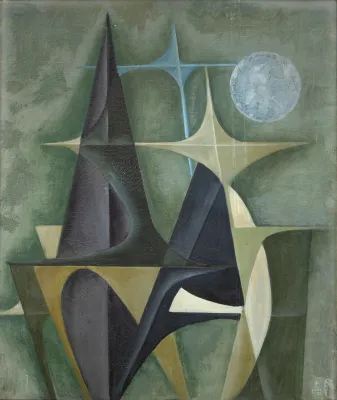
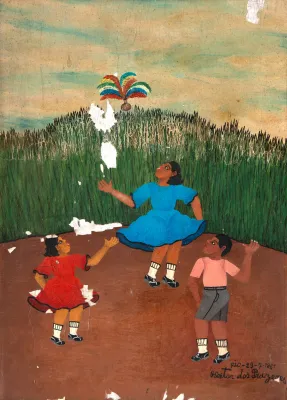
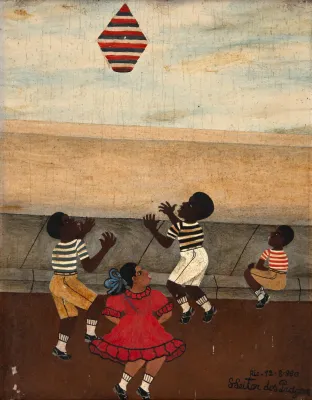
"His art consists of a clear and naive vision of an ideal world; even the outlines of the figures seem to visually represent the distance between them and reality. These figures, with very rare exceptions, are portrayed with their faces in profile, even when the body appears full-frontal or three-quarter view, and, because they are always on tiptoe, they suggest movement. They are people of all colors, fraternally participating in the same activity: a rehearsal, a serenade, a ciranda, a country scene. Rarely does Heitor focus on sad aspects of everyday life or allude to prejudice. The microscopic detail, extending to all the elements of the painting, is a constant characteristic, confirming the simplistic unreality of the work. The colors, vivid and flat in unique hues, emphasize the simplicity of this ideal world. A thin layer of varnish finishes the work, revealing the painter's trade as a 'technical varnisher'".
Pedro Manuel
ARTE no Brasil. Introduction by Pietro Maria Bardi and Pedro Manuel. São Paulo: Abril Cultural, 1979.
"The dominant tone in Heitor's paintings is the life and samba of Rio de Janeiro in Praça Onze and the Arcos da Lapa. (...) Could this painter, equally renowned in the music scene, have been more of a composer than a visual artist? There is no doubt the importance of music to this artist: in his paintings, Rio de Janeiro samba echoes the sounds of Africa. But one cannot deny the visual power of these characters from the people, who sing and dance with their bodies turned forward and their heads to the side. These bipolar human figures by Heitor, as well as the contrasting colors, particularly in the samba circle series, are reminiscent of Di Cavalcanti. His declaration that 'I am an egg and the people are the incubator' illustrates the modernist spirit of Heitor dos Prazeres."
Marta Heloísa Leuba Salum
MOSTRA do Redescobrimento: arte afro-brasileira. Nelson Aguilar, organizer/Fundação Bienal de São Paulo. São Paulo, Associação Brasil 500 Anos Artes Visuais, 2000, p. 116.
Solo Exhibitions
1959 - Rio de Janeiro RJ - Solo, at Gea Gallery
1961 - Rio de Janeiro RJ - Solo, at MAM/RJ
1961 - São Paulo SP - Heitor dos Prazeres: Paintings, at the Sistina Gallery
1963 - São Paulo SP - Solo, at Selearte Gallery
1964 - Salvador BA - Solo, at Quirino Gallery
1965 - Porto Alegre RS - Solo, at Margs
Group Exhibitions
1944 - Belo Horizonte MG - Modern Art Exhibition, at the MAP
ca.1946 - London (England) - Exhibition in honor of the British Royal Air Force - one of his paintings is acquired by Queen Elizabeth
1951 - São Paulo SP - 1st International Biennial of São Paulo, at the Trianon Pavilion - 3rd prize
1952 - Rio de Janeiro RJ - Exhibition of Brazilian Artists, at the MAM/RJ
1953 - São Paulo SP - 2nd International Biennial of São Paulo, at the Pavilion of the States
1954 - São Paulo SP - Contemporary Art: exhibition of the collection of the Museum of Modern Art of São Paulo, at the MAM/SP
1957 - Buenos Aires (Argentina) - Modern Art in Brazil, at the Museo de Arte Moderno
1957 - Lima (Peru) - Modern Art in Brazil, at the Lima Art Museum
1957 - Rosario (Argentina) - Modern Art in Brazil, at the Juan B. Castagnino Municipal Museum of Fine Arts
1957 - Santiago (Chile) - Modern Art in Brazil, at the Contemporary Art Museum
1959 - Rio de Janeiro RJ - 30 Years of Brazilian Art, at Enba
1961 - São Paulo SP - 6th International Biennial of São Paulo, at MAM/SP
1963 - Campinas SP - Contemporary Painting and Sculpture, at the Carlos Gomes Museum
1965 - Bonn (Germany) - Brazilian Art Today
1965 - London (England) - Brazilian Art Today, at the Royal Academy of Arts
1965 - Paris (France) - Eight Brazilian Naive Painters, at the Jacques Massol Gallery
1965 - Vienna (Austria) - Brazilian Art Today
1966 - Dakar (Senegal) - 1st World Festival of Black Arts
1966 - Moscow (Soviet Union, now Russia) - Brazilian Primitive Painters
Posthumous Exhibitions
1966 - Dakar (Senegal) - 1st World Festival of Black Arts
1966 - Rio de Janeiro RJ - Self-Portraits, at Galeria Ibeu Copacabana
1966 - Rio de Janeiro RJ - The Artist and the Machine, at MAM/RJ
1966 - São Paulo SP - The Artist and the Machine, at Masp
1967 - São Paulo SP - Solo, at Galeria Ars Artis
1979 - São Paulo SP - 15th São Paulo International Biennial, at Fundação Bienal
1980 - Rio de Janeiro RJ - Homage to Mário Pedrosa, at Galeria Jean Boghici
1982 - Bauru SP - 80 Years of Brazilian Art
1982 - Lisbon (Portugal) - Brazil 60 Years of Modern Art: Gilberto Chateaubriand Collection, at Centro de Arte Moderna José de Azeredo Perdigão
1982 - London (England) - Brazil 60 Years of Modern Art: Gilberto Chateaubriand Collection, at the Barbican Art Gallery
1982 - Marília SP - 80 Years of Brazilian Art
1982 - São Paulo SP - 80 Years of Brazilian Art, at MAB/Faap
1983 - Belo Horizonte MG - 80 Years of Brazilian Art, at Fundação Clóvis Salgado. Palácio das Artes
1983 - Campinas SP - 80 Years of Brazilian Art, at MACC
1983 - Curitiba PR - 80 Years of Brazilian Art, at MAC/PR
1983 - Olinda PE - 2nd Exhibition of the Abelardo Rodrigues Collection of Visual Arts, at MAC/Olinda
1983 - Ribeirão Preto SP - 80 Years of Brazilian Art
1983 - Santo André SP - 80 Years of Brazilian Art, at Santo André City Hall
1984 - Paris (France) - Heitor dos Prazeres: Retrospective, at Galeria Debret
1984 - Rome (Italy) - Heitor dos Prazeres: Retrospective, at the Brazilian Embassy in Italy
1987 - São Paulo SP - The Biennials in the MAC Collection: 1951 to 1985, at MAC/USP
1988 - Rio de Janeiro RJ - Hedonism: Gilberto Chateaubriand Collection, at Galeria Edifício Gilberto Chateaubriand
1988 - Rio de Janeiro RJ - The Fascinating World of Naïve Painters, at Paço Imperial
1992 - Poços de Caldas MG - Brazilian Modern Art: Collection of the Museum of Contemporary Art of the University of São Paulo, at Casa da Cultura de Poços de Caldas
1994 - Poços de Caldas MG - Unibanco Collection: Exhibition Celebrating Unibanco's 70th Anniversary, at Casa da Cultura de Poços de Caldas
1995 - Rio de Janeiro RJ - Unibanco Collection: Exhibition Celebrating Unibanco's 70th Anniversary, at MAM/RJ
1998 - Rio de Janeiro RJ - Heitor dos Prazeres: A Century of Art
1998 - São Paulo SP - Fantasia Brasileira: The Ballet of the 4th Centenary, at Sesc Belenzinho
1998 - São Paulo SP - Exhibition Celebrating the Artist's Centenary, at Galeria Albert Einstein
1998 - São Paulo SP - O Colecionador [The Collector], at MAM/SP
1998 - São Paulo SP - The Modern and the Contemporary in Brazilian Art: Gilberto Chateaubriand Collection - MAM/RJ, at Masp
1999 - Rio de Janeiro RJ - The Three Arts of Heitor dos Prazeres, at MNBA
1999 - São Paulo SP - Everyday Life/Art. Consumption, at Itaú Cultural
2000 - São Paulo SP - Brazil + 500 Rediscovery Exhibition, at Fundação Bienal
2001 - São Paulo SP - Figures and Faces, at A Galeria
2002 - Piracicaba SP - 6th Naïfs of Brazil Biennial, at Sesc
2002 - São Paulo SP - Pop Brazil: Popular Art and the Popular in Art, at CCBB
2002 - São Paulo SP - Santa Ingenuidade, at Unifieo
2003 - Rio de Janeiro RJ - Art in Motion, at Espaço BNDES
2005 - São Paulo SP - Solo, at Espaço Cultural BM&F
Source: Itaú Cultural