Raimundo de Oliveira (Feira de Santana BA 1930 - Salvador BA 1966)
Raimundo de Oliveira was a recorder, painter and draftsman. He started in the arts under the influence of his mother, a painter of religious themes, who encouraged him both in drawing and painting and in religious experience. Stimulated by his drawing teacher, he held his first exhibition at the Santanópolis gymnasium, where he portrayed the institution's professors. After completing the junior high school course in 1947, he moved to Salvador, where he attended regular painting courses with Maria Célia Amado, at the School of Fine Arts at the University of Bahia, and met the artists Mario Cravo Júnior and Jenner Augusto.
His first solo exhibition took place in 1951, in the hall of the Feira de Santana City Hall, when he approached a group of independent artists responsible for the Cadernos da Bahia. He lived in São Paulo between 1958 and 1964, later returning to Bahia. Between 1965 and 1966, he lived in Rio de Janeiro. In the year of his suicide, in 1966, Raimundo de Oliveira's small Bible was released. Woodcuts, organized by Julio Pacello, with a preface by Jorge Amado, and published by the galleries Bonino and Petite Galerie.
In 1982, the artist's second album, via Crucis, was published by the Cultural Foundation of the State from Bahia, and the Raimundo de Oliveira Gallery, in Salvador, was inaugurated.
Critical Comment
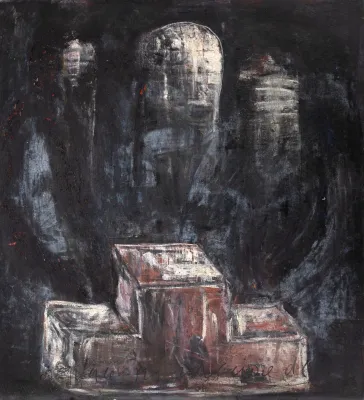
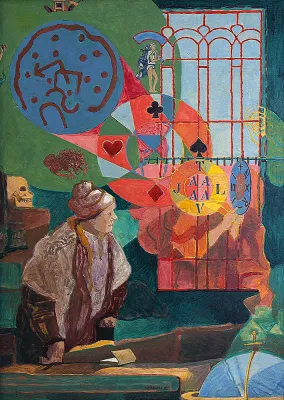
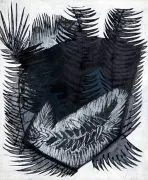
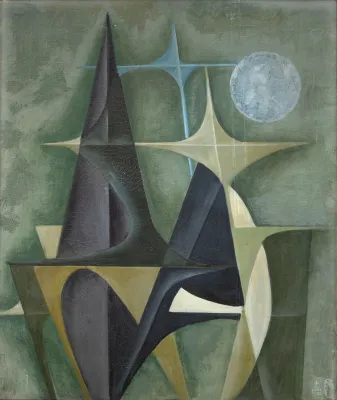
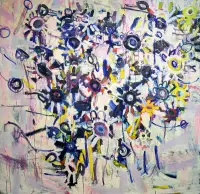
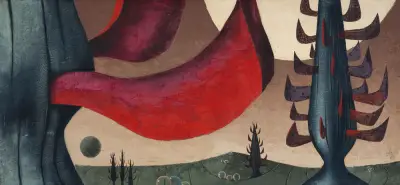
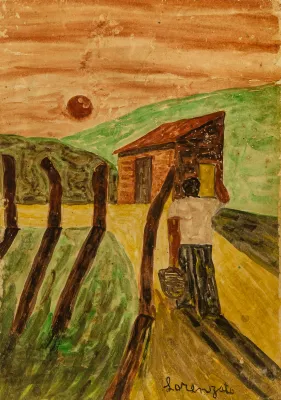
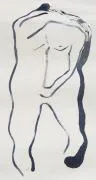
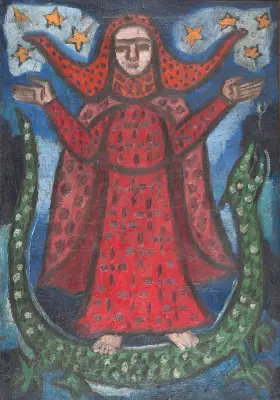
The work of Raimundo de Oliveira - Drawing, gouache, oil and engraving - unfolds in the religious universe, with saints, images and biblical scenes represented in different ways. Critics tend to distinguish two phases in their production as a function of the variations observed in the treatment given to the theme. In the 1950s and 1960s, compositions with dark colors and expressionist character predominate - figures marked by painful and dramatic traits, defined with ink and black contours, such as the head of Christ, 1957, Crucified, s.d., and Moses, 1960 - and some readings show affinities with the painting of Georges Rouault. At another time, the canvases approach small plots, prepared with the help of small figures (more humorous than tragic, due to deformations and disproportions), which are repeated because of the situations presented. Geometrically structured, by a balance of horizontal and vertical planes, the new screens have particular dynamism, obtained by spaces built on the basis of circles. The energy of vibrant colors and the dynamism of the screen are the salient marks of this phase, seen in The Dream of Jacob, s.d. In addition to the symbolist influences and Naif art by Henri Rousseau, echoes of Brazilian Northeastern popular art are perceptible. The religious universe is read from the perspective of festivals and popular religiosity, often mixing with the profane world - processions, bumba-meu-boi, domestic altars, etc. The plots and modes of figuration, in turn, refer to the art of the engravers and potters of the Northeast. Elements taken from the national landscape, such as trees and tropical animals, are another way of articulating the erudite and the popular, the universal and the national - Jesus in the Horto das Oliveiras, 1962, and Arrival in Jerusalem, 1964.
Criticism
"And then everyone realized that the burel was not a burel, it was an old cover against the rain, and the staff was not a staff, they were paint brushes. They wanted to stone him, considering him a crook from outside, but others recognized the pilgrim and addressed him, treating him familiarly with a little world, for he was Raimundo de Oliveira, son of the land, since a boy, a vague, unhandsome for work, Except for scratching paper, if this is work to consider. It had been gone for a long time, there was no news from it. It appeared now suddenly and around its big head hovered a magical atmosphere, as if it surrounded it in the light of dawn. (...)
This painter, this A great painter of the Bible and Bahia, the one who came to clear the violence of the Old Testament and made him soft with velvet, the one who filled the rough ancient tragedy, this young man with a shy voice and surely certainty, this Raimundo de Oliveira is a prophet with a soul of Francis. of Assisi. Only Bahia could produce it, on the paths of the city where the sertão was born; Only Bahia could feed him and offer him to the galleries of the South, to glory and fame, because his Bible has a candomblé breath (if it weren't for him the son of a mother of Ôpo Afonjá and had not learned to cook with Olga do Aleketu). Master painter, I don't know of another who has grown so much in his art, remaining so faithful to the dreams of his childhood, his mother's hopes and his hidden treasure. (...)
Raimundo de Oliveira (...) did not stay in Bahia. He was a prophet and had to take his prophecy into the world. He had to run the paths and linger in distant lands. He walks around here and there, but it is in Bahia that he comes to feed on land, animals, God and love, it is in Bahia that he comes, humble and victorious, to re-learn the mystery of man and his need for peace and abundance."
Jorge Amado - 1966
Amado, Jorge [Words] In: OLIVEIRA, Raimundo de. Organization Julio A. Pacello. São Paulo: Lia Cesar, 1966.
"This book (of woodcuts) was born more than two years ago, when Raimundo de Oliveira came to me to help him Distribute invitations to your exhibition at the Astreia Gallery. We went out together in this simple mission, and it was on the way that the idea of making a small Bible was born. From then on, for many months, we worked closely. We took a long time choosing the biblical scenes that seemed to us most representative. This choice took into account both the biblical and the artistic aspect. In addition, he had to be subject to the limitations imposed by the woodcutting technique". de. Small Bible by Raimundo de Oliveira. Woodcuts. Preface Jorge Amado; Organization Julio A. Pacello. São Paulo: Lia Cesar, 1966.
"Despite the naive plastic composition of his works and his frank rebellion in relation to school discipline (...) he was never, as he mistakenly presented him (...), a primitive, a 'naif' (...) interpreting them with scenes of extreme lyricism".
Clarival do Prado Valadares
Pontual, Roberto. Dictionary of Visual Arts in Brazil. Presentation by Antônio Houaiss. Texts by Mário Barata et al. Rio de January: Civilização Brasileira, 1969.
Individual exhibitions
1951 - Feira de Santana BA - First Individual, at the City Hall
1951 - Salvador BA - Individual, at the gallery Oxumaré
1953 - Feira de Santana BA - Individual, at the City Hall
1953 - Salvador BA - Individual, at Galeria Oxumaré
1956 - Salvador BA - The drama of Calvary, at Belvedere da Sé
1957 - Buenos Aires (Argentina) - Individual, at Plastic Art Gallery
1958 - Salvador BA - Individual, at Galeria Oxumaré
1959 - Santos SP - Individual, in the hall of the building Indaiá
1959 - São Paulo SP - Individual, at Galeria Ambiente
1960 - São Paulo SP - Individual, at the Novos Comediantes Theater
1960 - São Paulo SP - Individual, at Teatro Oficina
1961 - Campinas SP - Individual, at Galeria Aremar
1961 - São Paulo SP- Individual, at Galeria Astreia
1962 - São Paulo SP - Individual, at Clubinho
1962 - São Paulo SP- Individual, at Galeria Astrea
1963 - Rio de Janeiro RJ - Individual, at the Bonino Gallery
1964 - Buenos Aires (Argentina) - Individual, at the Bonino Gallery
1964 - São Paulo SP - Individual, at the Astrea Galeria
1965 - Rio de Janeiro RJ - Individual, at the Bonino Gallery
1966 - Rio de Janeiro RJ - Individual, at MAM/RJ
Collective exhibitions
1951 - Salvador BA - 1st University Hall Baiano de Belas Artes
1952 - Feira de Santana BA - 1st Exhibition of Modern Art of Feira de Santana, at Banco Econômico da Bahia
1952 - Rio de Janeiro RJ - 1st National Salon of Modern Art, at MAM/RJ
1952 - Salvador BA - 2nd Baiano University Salon of Fine Arts
1953 - Salvador BA - Poty, Carlos Bastos and Raimundo Oliveira, at Galeria Oxumaré
1953 - Salvador BA - 3rd Salão Baiano de Fine Arts
1954 - Salvador BA - 4th Bahia Salon of Fine Arts, at the Hotel Bahia
1955 - Salvador BA - 5th Baiano Salão de Belas Artes, at the Belvedere da Sé Gallery - Honorable Mention in Drawing
1956 - Rio de Janeiro RJ - 5th National Salon of Modern Art
1956 - Salvador BA - 6th Baiano Salão de Belas Artes, at Galeria Oxumaré - Honorable Mention in Painting
1956 - Salvador BA - Modern Artists of Bahia, at Galeria Oxumaré
1956 - Salvador BA - Modern Painting Exhibition, at the Rio Branco Palace
1957 - Rio de Janeiro RJ - 6th National Salon of Modern Art
1957 - São Paulo SP - Artists from Bahia, at MAM/SP
1959 - São Paulo SP - 47 artists, at the Folhas Art Gallery
1960 - São Paulo SP - 9th Salão Paulista de Arte Moderna, at the Prestes Maia Gallery - Bronze Medal
1961 - Porto Alegre RS - Circle of Friends of Art, at Margs
1961 - São Paulo SP - Contemporary Sacred Art, at the headquarters of the Grail Movement
1961 - São Paulo SP - 10th Salão Paulista de Arte Moderna, at the Gallery Prestes Maia - Acquisition Award
1962 - São Paulo SP - 11th Salão Paulista de Arte Moderna - Small Silver Medal
1963 - São Paulo SP - 12th São Paulo Salão de Arte Moderna, at the Prestes Maia Gallery
1963 - São Paulo SP - 7th São Paulo International Biennial, at Fundação Bienal
1964 - São Paulo SP - 13th São Paulo Salon of Modern Art
1965 - Caracas (Venezuela) - Latin American painting evaluation
1965 - Paris (France) - Salon Comparaisons, at the Musée d'Art Moderne de la Ville de Paris
1965 - Paris (France) - Eight Brazilian naive painters at the Galerie Jacques Massol
1965 - Rio de Janeiro RJ - 33 artists in honor of the city of Rio de Janeiro - Honorable Mention
1965 - São Paulo SP - 8th International Biennial of São Paulo, at the Bienal Foundation
1966 - Buenos Aires (Argentina) - Contemporary Brazilian artists at the Museum of Modern Art
1966 - Lausanne (Switzerland) - Artists and discoverers of our time
1966 - New York (States) United States) - Brazilian Artists, at Amel Gallery
1966 - Montevideo (Uruguay) - Contemporary Brazilian artists at the Museum of Modern Art in Buenos Aires
1966 - Madrid (Spain) - Artists from Bahia, at the Hispanic Culture Institute
1966 - Lausanne (Switzerland) - International Gallery Hall - Pilot
1966 - New York (United States) - Brazilian Artists, Amel Gallery
1966 - Moscow (Russia) - Brazilian primitive painters
1966 - São Paulo SP - 15th Salão Paulista de Arte Moderna, at Galeria Prestes Maia
1966 - New York (United States) - The Emergent Decade, at Solomon R. Guggenheim Museum
Posthetic exhibitions
1966 - Rio de Janeiro RJ - 4th Art Summary of JB, NO MAM/RJ
1966 - SALVADOR BA - 1st National Biennial of Fine Arts
1966 - São Paulo SP - 15th Salão Paulista de Arte Moderna, at the Prestes Maia Gallery
1967 - Salvador BA - Collective Exhibition of Natal, at Panorama Art Gallery
1969 - Rio de Janeiro RJ - Via Crucis, at the Botafogo Art Office
1976 - São Paulo SP - Individual, at the Portal Art Gallery
1979 - São Paulo SP - Raimundo de Oliveira: Paintings, at the Ipanema Art Gallery
1982 - Salvador BA - The Brazilian Art of the Odorico Tavares Collection, at the Carlos Costa Pinto Museum
1984 - São Paulo SP - Gilberto Chateaubriand Collection: Portrait and Self-portrait of Brazilian Art, at MAM/SP
1984 - São Paulo SP - Tradition and Rupture: Brazilian Art and Culture Synthesis, at the Bienal Foundation
1986 - São Paulo SP - Individual, at the Mário de Andrade Library
1988 - São Paulo SP - Brazilian naive painting, in the Quadros e Objects de Arte space
1990 - São Paulo SP - Figurativism/abstractionism: the red in Brazilian painting, in Itaugaleria
1992 - Belém PA - eleventh art, at the Romulo Maiorana Foundation
1992 - Rio de Janeiro RJ - Individual, at the Bonino Gallery
1993 - João Pessoa PB - woodcut: from cordel to the gallery, in the Funesc
1993 - Rio de Janeiro RJ - Individual, at Galeria Ipanema
1994 - Poços de Caldas MG - Unibanco Collection: Commemorative Exhibition of the 70th anniversary of Unibanco, at Casa da Cultura
1994 - São Paulo SP - Woodcut: From Cordel to the Gallery, in the Metro
1995 - Rio de Janeiro RJ - Unibanco Collection: Exhibition commemorating the 70th anniversary of Unibanco, at MAM/RJ
1996 - Belém PA - 15th Salão Arte Pará, at the Museu de Arte do Belém
1996 - São Paulo SP - Ex Libris/Home Page, at Paço das Artes
1997 - Porto Alegre RS - Exhibition of the Caixa, in the Caixa Cultural Complex
1997 - São Paulo SP - Exhibition of the Caixa Collection, in the Caixa Cultural Complex
1998 - Curitiba PR - Caixa Collection Exhibition, in the Caixa Cultural Complex
1998 - Rio de Janeiro RJ - Exhibition of the Caixa collection, in the Caixa Cultural Complex
1998 - São Paulo SP - Os Collectors - Guita and José Mindlin: matrices and engravings, at the SESI Art Gallery
1999 - Salvador BA - 100 plastic artists from Bahia, at the museum of Sacred Art
1999 - Salvador BA - 60 years of Brazilian art, at the Cultural Space of Caixa Econômica Federal
2000 - São Paulo SP - Investigations. The Brazilian engraving, at Itaú Cultural
2000 - São Paulo SP - Os Anjos are back, at the Pinacoteca do Estado
2001 - Brasília DF - Investigations. The Brazilian engraving, at Itaú Galeria
2001 - Penápolis SP - Investigations. The Brazilian engraving, at Galeria Itaú Cultural
2001 - São Paulo SP - Aldo Franco Collection, at the Pinacoteca do Estado
2002 - Rio de Janeiro RJ - Brazilian art in the Fadel collection: from the restlessness of the modern to the autonomy of Language, at CCBB
2002 - São Paulo SP - Brazilian art in the Fadel collection: from the restlessness of the modern to the autonomy of language, in the CCBB
2002 - São Paulo SP - Santa Ingenuidade, at Unifieo
Source: Itaú Cultural