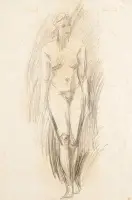
Ernesto de Fiori (Rome, Italy 1884 - São Paulo SP 1945)
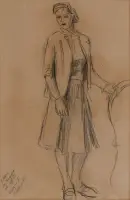
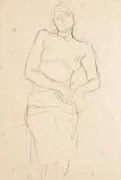
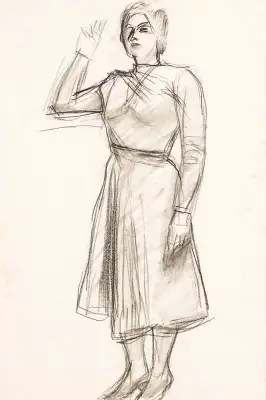
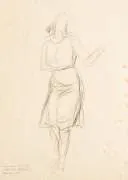
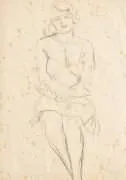
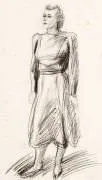
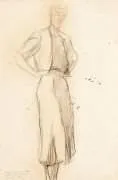
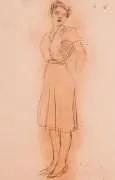
Ernesto de Fiori was a sculptor, painter and draftsman. At the age of 19, he moved to Munich, where he studied drawing with Gabriel von Hackl (1843-1926) at Königliche Akademie der Bildenden Künste (Real Academy of Fine Arts). In 1905, he returned to Rome and probably received guidance from the German painter and lithographer Otto Greiner (1869-1916).
Between 1911 and 1914, he lived in Paris, where he began his first sculptures with the help of the Swiss artist Hermann Haller (1880-1950) and integrated the intellectual and artistic environment of the city. In 1915, after being arrested for 14 days in France on suspicion of espionage, he enlisted in the German Army and began to act as a correspondent for an Italian periodical. After obtaining German citizenship, he began to fight as a soldier.
In 1917, he abandoned military service and moved to Zurich. Between 1918 and 1919, he got involved in a controversy with the Dadaist movement, diverging on the concept of art. For De Fiori, there was no new art without reference to the past, and he was opposed to any movement that sought to break with the previous art.
In 1936, he moved to Brazil and settled in São Paulo. He wrote articles for newspapers in the German and Italian colonies and, later, for the State of S. Paulo. In 1938, he participated in the Arts Integration Program of the Ministry of Education and Health, modeling a series of sculptures that were refused for not meeting official requirements.
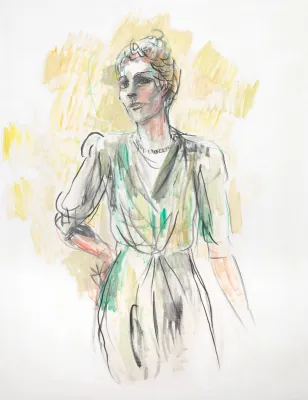
In addition to his sculptural production, Fiori also dedicated himself to painting. In his works, contrasts created by various techniques, such as quick strokes or diluted in solvents, and the use of dented instruments, among others, stand out. In the early 1940s, he participated in meetings with art critics and artists in Rossi Osir's studio (1890-1959) to discuss art. His painting had a great influence on the São Paulo artistic milieu.
Critical Comment
In 1904, Ernesto de Fiori joined Königliche Akademie der Bildenden Künste [Real Academia de Fiori. Fine Arts], from Munich and frequents the drawing class of the German painter Gabriel von Hackl (1843 - 1926). He later meets the Swiss sculptor Hermann Haller (1880 - 1950) and the German painter Karl Hofer (1878 - 1955), with whom he maintains an intense artistic dialogue. He begins to expose his painting, which is approaching, in his pictorial solutions, that performed by the Swiss painter Ferdinand Hodler (1853 - 1918). From 1911 to 1914, he lives in Paris, where he attends Café du Dôme, a place with great cultural effervescence that brings together artists, critics and collectors. In this city, he produces and participates in discussions about the new artistic trends and makes contact with the German painter Hugo Troendle (1882 - 1955) and the Italian sculptor Arturo Martini (1889 - 1947). He knows the works of French masters such as Paul Cézanne (1839 - 1906) and Auguste Rodin (1840 - 1917).
De Fiori continues to paint. He starts modeling, performing technical learning with Herman Haller. He makes his first sculptures in 1911, among them kneeling and girl walking, highlighting the sufferer, who represents a young man who, in a gesture of suffering, turns back and grabs his body with his arms. In this work, the psychological load of the figure is emphasized by the artist. In the later sculptures, such as, for example, Anastasius, Ursula (both 1912) and dancer (1914/1915), he works with the formal reduction, in dialogue with Cubism. His sculpture acquires rounded volumes and the research of movement in the figures is verified.
Engaged in the First World War (1914-1918), in 1915, as a correspondent for an Italian newspaper, he resumes his artistic activities in 1917, in Zurich. In 1918, he writes a manifesto article in which he criticizes the art of the Dadaists and clarifies his concept of new art: it must maintain the dialogue with tradition, in order to be able to differentiate what is new; Seek means that express "the feeling of the newly awake world" and "the totality of life, its intuitions".1 In addition to volumes and colors, art must be made of spiritual qualities that convey sensations, such as joy and pain. In Europe and later in Brazil, De Fiori expresses his ideas in several articles.
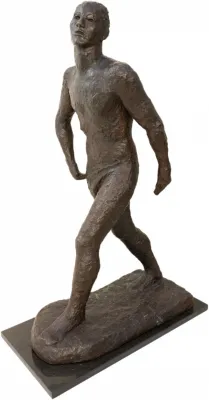
Its figures are now more freely performed, without the limits of schematization, more faithful to the human form, acquiring a certain expressionist bond, such as the bather (1917), figure. feminine, standing, in a posture that expresses tranquility and feeling. In the 1920s, he moved from Zurich to Berlin and made his first portraits, such as the head of the dancer Carina Ari (1922). Models three versions of Adam (1920), a male figure walking backwards in greeting, with his right hand raised. He also makes sculptures, drawings and lithographs of boxers. He also performs the series of the man in march, the bust of Marlene Dietrich (ca.1929), The Fugitive (1936), among other works. The central theme of his sculptures is always the human body, suggesting movement or static, executed in rough modeled, with a strong psychological load.
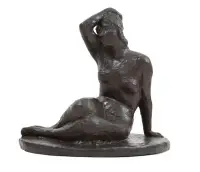
In 1938, he left Germany, dominated by Nazism, and arrived in São Paulo. His first sculptures made in Brazil are, for example, portraits of Menotti del Picchia (1892 - 1988), Francisco Matarazzo and Greta Garbo, who made a memory. In parallel, it makes female nudes, in which it accentuates the plasticity of the bodies. The painting he performs here values figuration, executing landscapes, in a first stage, with scenes of forest, farms, fires and Beira-Rio. The river trip that makes Presidente Prudente, São Paulo, even Guaíra is the source for its staff. In canvas, color and shape merge, the colors are superimposed on others, generating shapes that intersect with new colors and form the composition. Diluted and quick strokes suggest the figures, as we can see in Landscape with Cows (1942). In the early 1940s, he painted urban scenes in São Paulo: streets in angular layouts, with trees and lonely and hurried passers-by, sometimes with skyscrapers, chimneys, avenues or churches in the background. In Urban Landscape (1941) the figures are formed by the fusion with other pictorial elements, including the color of the paper in the case of gouaches, which integrates the composition as ink. In his third solo exhibition in São Paulo, he presents some paintings with themes such as São Jorge and O Dragão or Batalhas. According to the artist, they refer to the struggle fought in the world: wars of philosophies and religions, times of hatred and violence. He thus paints warriors who fight for human freedom and dignity.
The presence of Ernesto de Fiori in São Paulo in the late 1930s and early 1940s contributes to opening new horizons in the city's artistic environment, still very shy. His painting, figurative but gestural and free, marks the production of artists linked to the São Paulo artistic family - FAP, such as Mario Zanini (1907 - 1971) and Joaquim Figueira (1904 - 1943), and also the work of Alfredo Volpi (1896 - 1988), mainly in some of his navies.
Notes
1 Ernesto de Fiori, quoted in: Laudanna, Mayra. The painting in Ernesto de Fiori. In: LAUDANNA, Mayra (Org.). Ernesto de Fiori: a retrospective. São Paulo: Pinacoteca do Estado de São Paulo, 1997, p.26.
Criticism
"As a sculptor, from Fiori is halfway between the generation that still obeyed the Postulates of the monumental style of Hildebrand and the one that would embrace abstractionism: far from classical evocations, and also seeking to avoid a naturalistic stance, by Fiori intended to impose on his nudes and portraits of living personalities an expressive all personal force, always concerned in capturing, through the contained gesture, the intimate essence of his models. His sculpture is pictorial, in the sense that the bronze and terracotta from which it is made are never polished". Jose Roberto Teixeira. Ernesto de Fiori. In: Art in Brazil. São Paulo: Abril Cultural, 1979, v.2, p. 797.
"(...) The painting had marked the beginning of his career, between 1903 and 1911, within the expressionist Holderian characteristics. Then he left it aside. One can distinguish two stages in his painting of the Brazilian phase: the first, of an objective realism in the treatment of the landscape (until 1939); and the second, with apex in 1942-43, marked by the expressionist emphasis of scenes of the regatta in the Santo Amaro dam, Sao Jorge and Dragão retreats, still lifes, isolated human figures, couples or groups and the series of harlequins. by rough and resolute brushstrokes. Sometimes his narrative is excessive or approaches the picturesque, as also occurred in the treatment of composition with figures. The dragon had implicit reference to the cause of the freedom of the peoples and the tragedy of the ongoing war. But it was in the navy that the best paintings of De Fiori appeared, invested in plastic balance. Undoubtedly, it rediscovers the dimension of the painter in Brazil, but, in national and international terms, the recognition of this work remains on hold. On the other hand, there are numerous testimonies of the performance of the European master that directly and indirectly influences São Paulo artists". Moreira Salles/Fundação Djalma Guimarães, 1983.
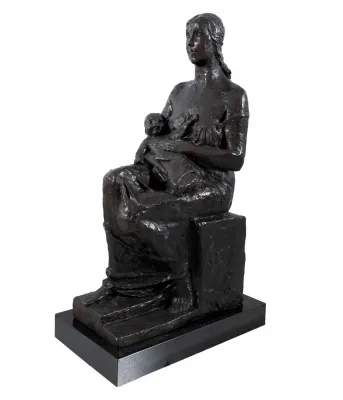
"São Paulo and Brazil are for De Fiori, when he arrived in 1936, a new world, a world full of impressions of nature, a world of men of the most different types. of Fiori is launched with furor in this world; Prepare an exhibition soon and accept a series of portrait orders. The most significant faces also lead you here to the most significant creations, in which he manages to grasp form and content. The heads of Menotti del Picchia and Francisco Matarazzo are impressive and created with psychological mastery and plastic perfection. (...) In 1938, De Fiori received the commission to create some figures for the Ministry of Education in Rio de Janeiro. Then the Brazilian, motherhood and woman seated appear, figures who resume three entirely different themes as an attempt to present them in a new way. the Brazilian, a male form, thin, quietly standing; maternity, a female form sitting in a block with a child on her lap; Sitting woman, a female form sitting on the floor and who appears to be immersed in internal contemplation. All three figures are masterfully modeled, but do not seem to produce the awakened, alive contact, like the one that immediately jumps to the eyes, for example, in the figures of Engländerin (English) and Adam (Adam). The figures appear to be collected in themselves, almost shrunk. They do not bring to De Fiori the success he would need in the country as an incentive for other and greater work. From Fiori, as a result, he moves on to painting, his first passion, and there he is carefree about this problematic and somewhat strange and hostile world. When sailing and painting, it can be entirely himself, being able to momentarily forget the insoluble problem of his permanence in Brazil and the impossibility of returning to Europe, after 1939. With that, however, he is deprived of the soil capable of nourishing great Sculptures, therefore, for that, the exchange with the artistic forces of São Paulo is not enough for that."
Wolfgang Pfeiffer
PFEIFFER, Wolfgang. Ernesto de Fiori. In: Laudanna, Mayra (org.). Ernesto de Fiori - A retrospective. São Paulo: Pinacoteca do Estado de São Paulo, 1997, p. 59-61.
"for From Fiori, many artists from the beginning of the century did not make art; However, he considered the 'artistic anarchy (...), which erupted in the fields of the European spirit, necessary and beneficial'. Clarity is exemplary: from Fiori, a witness and character of the artistic renewal of the European arts, with his articles, shows that the pictorial and sculptural research of the beginning of the 20th century is not limited to the conventions established in art history books. Both of Fiori and many of his colleagues from Munich or Zurich, France or Germany produce from clay and paint, managing the modernization of the arts and denying the schools of Fine Arts. De Fiori's is not interested in the didascalia precepted by some European artists and theorists of the 10th and 20ths who seek to highlight the difference between 'naturalism' and 'abstractionism'. For the artist, this difference is only theoretical; In practice, it does not occur.
(...)
The aesthetics of Ernesto de Fiori is the reinvented nature in thick, diluted, light, light, and pictorial lines that subvert what is understood by 'Painting of landscape', 'Marinhas', 'Scenes', themes that are articulated in the artist's painting. Often allegories that, metaphorically, recreate figures and names as they break with the reference with which they play when suggesting others. (...)
In the artist's aesthetics, the subject is irrelevant in the work; However, it is what throws the artist to creation. Ernesto de Fiori's desire is for the work to present the spirit of the time, that of the artist and that of nature; Fusioning them, accesses art. In de Fiori, color and form, as a composition of the pictorial space, they merge. Colors are being placed on others, which, overlapping or intertwined, raise shapes, or, pulled, scraped, produce other colors, which merge as a composition. Diluted brush strokes are scattered in areas of the screen, suggesting figures or veiling spaces; Often, it is this liquid coat that merges the spaces elaborated by different techniques, brush strokes, rhythms.
The elements of Ernesto de Fiori's compositions are thus produced in the process of painting: while the colors are being brushed, in General, by quick blows, figures are made. In most paintings, the first colors are superimposed on others; To these, in areas or objects of the composition, new colors are added. Sometimes the last layer is made of ink diluted in solvent, used to lower the previous tones. Other times, what concludes the work are pictorial traits, which suggest the hip of a horse, the shoulders of a figure, features. The brush is also observed in the dry paint over others, used to show figures (...), or the use of a toothed instrument, which, in some works, highlights parts (...)". Mayra. The painting in Ernesto de Fiori. In: Laudanna, Mayra (org.). Ernesto de Fiori - A retrospective. São Paulo: Pinacoteca do Estado de São Paulo, 1997, p. 26 and 28-31.
"In 1918, Ernesto de Fiori attacks, in Zurich's newspaper, Dadaism, the center of the 'new art' target; The shooting, ironically returned by Max Ernst, does not defend some prevailing art, but modernity itself. 'New art', a label of general circulation, includes, in addition to Dadaism, abstractionism, cubism, futurism and simultaneism, which surround it; de Fiori aims at them as aged artistic positions, but not entirely fallen. The critique of these movements remains in it later, matizing and extending over time; With the subsequent appearance of surrealism, it starts to aim at modernism in general and, although expanded and circumstantially specified, both in its European and Brazilian texts, it shows a position since 1918 signed. Indicating modernity already in the proliferation of current maxims in the attacked movements, of which the 'primitive of the new times' also adheres to Brazilian modernists such as Mário de Andrade, De Fiori's position is defined as recognition of the perfection of classicism fanado and the imperfection of nascent art. In the irreversible erasure of classicism and in the extreme affirmation of the modern, it is the story that accedes in De Fiori to the eminence, with which his reflection is confronted, poignant. This position is already evident in 1918: while in the modernist 'modern' order-words the 'new' is identified in the opposition of this to 'old' or 'past', in de Fiori the two terms receive interpretation that presents them as relative; Relativizing them, the artist isolates them from the notion, central to modernisms, of rupture, which legitimizes them, especially when they are triggered by the vanguards". Leon. The artistic reflection of Ernesto de Fiori. In: Laudanna, Mayra (org.). Ernesto de Fiori - A retrospective. São Paulo: Pinacoteca do Estado de São Paulo, 1997, p. 11.
"To tell the truth, I am not exactly against virtuosity or contrary to tricks such as scraping when put to the service of an expression. Ernesto de Fiori, in his way of obtaining the matter of the oil, does not reveal his sculptor personality. And this seems to me a strong compliment, for I recognize that he is really doing a painter's painting and not a sculptor - which is very common. Instead of the bony material of his bronzes, his oil is a voluptuous, fat, full meat, in which we perceive the brush drowned in the very liquefied paint, coloring wide stains, which the scraper often shows in layers. superimposed, obtaining rich and unexpected effects that the painter lets wisely. And both by the process of scraping and by others, finishing, with a drier brush and provided with less liquefied oil, the artist obtains vibration effects and a very fine multiplicity of Entretons. (...) But if I do not doubt that Ernesto de Fiori is thus painter of excellent painting, it always seems to me that, in his works of color, he tends to be more conserved in the drawing and are more the qualities and characters of the drawing he appreciates. In an interview that he gave to one of the afternoons in São Paulo, Ernesto de Fiori spoke out frankly in favor of the resurgence of the importance of the subject in painting, censured the painters who abandoned him. In fact, the subject has always existed in painting and will always exist. Even the abstractionist painting of current times ultimately takes its subject away from the assumption of having no subject, its subject is the line, the color, in full gratuity. where it is socially characteristic and proves to be one of the pictorial avatars of the granfining of certain classes".
Mario de Andrade
ANDRADE, Mario de. Ernesto de Fiori. In.: Laudanna, Mayra (org.). Ernesto de Fiori - A retrospective. São Paulo: Pinacoteca do Estado de São Paulo, 1997, p. 208. [Text originally published in Diários Associados, São Paulo, 2.4.1941]
Testimations
"In today's art, research is everything. Not the realization of known values, not the false consciousness of copying or imitating nature, not the servile acquiescence to aesthetic dogmas imposed by a class or a government, much less the presumptuous and claiming opposition to the conventionalism of the mediocre. (...) Art without formulas is, of course, an art of research, which requires more a 'laboratory' than a studio, is the result of many experiences, many errors and infinite doubts.
(...)
In classical periods, It can be said without fear of being superficial, art was easier because the artists did nothing but continue a great tradition until that complete flowering to which one had to follow, of course, decay. We moderns have no tradition. It is true that we know all the astistical times, all the styles, all the schools on this earth, but this knowledge is only intellectual; None of these schools really live in our blood, for the artistic anarchy that has erupted (necessary and beneficial storm) cannot be called school in the fields of the European spirit in the last thirty-five years. In this anarchy, which comes from the end of the great artistic epoch of the last century, we should find the path of success, we should collect the sparse stones, separate them, measure them, adapt them and thus try to reconstruct that image of our consciousness called art. Every time has its artistic problems. Ours consists of creating a new art, that is, that reproduces, through its style, the state of mind of this century, so deeply different from past centuries. We find ourselves in the face of a splendid company, but very difficult, very delicate...
(...)
I am convinced that artistic research should be limited to the problems of form, color, composition, harmony, in short, to the different values of a painting or sculpture. It is also my conviction that this art has no other theme than that of nature. Those who seek other themes far from visible nature exceed the limits of our art, penetrates regions that belonged to the poet or philosopher, musician or scientist. If you can't do it any other way, change your profession. These are, in a nutshell, my convictions. Whoever thinks I'm wrong, prove it with your works. Freedom of research!"
Ernesto de Fiori
Fiori, Ernesto. The research of art. In: Laudanna, Mayra (org.). Ernesto de Fiori - A retrospective Pinacoteca do Estado de São Paulo, 1997, p. 113-114. [Text originally published in O Estado de S. Paulo, 22 Oct. 1941].
Exhibition Individuals
1910 - Munich (Germany) - Individual
20's - Berlin (Germany) - Bilder Ernesto de Fiori, at Galerie Flechtheim
1921 - Berlin (Germany) - individual, at the Galerie Fritz Gurlitt
1923 - Berlin (Germany) - Neue Bildwerke von Ernesto de Fiori, at Galerie Flechtheim
1935 - Berlin (Germany) - Skulpturen und Zeichnungen, at Galerie Buchholz
1936 - Berlin (Germany) - Skulpturen und Zeichnungen, at Galerie Buchholz
1936 - São Paulo SP - Ernesto de Fiori: sculptures, paintings and drawings, at the Guatapará Gallery
1939 - São Paulo SP - Individual, at Galeria Casa e Jardim
1941 - São Paulo SP - Brazilian works by Ernesto de Fiori, at Galeria Casa e Jardim
1944 - São Paulo SP - Individual, at Galeria Itá
Exhibitions Collectives
1909 - Vienna (Austria) - Internationale Kunstschau
1911 - Cologne (Germany) - Kunst Unserer Zeit in Kölner Privatbesitz, organized by the League of Cologne artists
1912 - Cologne (Germany) - Internationale Kunstausstellung des Sonderbundes Westdeutscher Kunstfreunde und Künstler Zu Köln, at Kunsthalle AM Aachener Tor
1912 - Munich (Germany) - 1. Gesamtausstellung, at Galerie Neue Kunst - Hans Goltz
1913 - Berlin (Germany) - Berliner Secession, Frühjahrausstellung
1913 - Berlin (Germany) - Berliner Secession, Herbstausstellung
1913 - Düsseldorf (Germany) - Eröffnungausstellung Weihnachten, at Galerie Flechtheim
1913 - Munich (Germany) - 2. Gesamtausstellung, at Galerie Neue Kunst - Hans Goltz
1914 - Berlin (Germany) - 1. Ausstellung der Freie Secession Berlin
1914 - Bremen (Germany) - Internationale Ausstellung in Kunsthalle
1914 - Cologne (Germany) - Deutsche Werkbundausstellung, at Galerie Flechtheim
1914 - Düsseldorf (Germany) - 3. Internationaler Markt, at Galerie Flechtheim
1914 - Düsseldorf (Germany) - Der Dôme, at Galerie Flechtheim
1914 - Mannheim (Germany) - 2. Ausstellung von Zeichnungen und Plastiken Neuzeitlicher Bildhauer, at Städtische Kunsthalle
1914 - Munich (Germany) - 3. Gesamtausstellung, at Galerie Neue Kunst - Hans Golz
1914 - Paris (France) - 30E Salon des Indépendants
1914 - Rome (Italy) - Prima Esposizione Libera Futurista, at Galleria Sprovieri
1915 - Munich (Germany) - 4. Gesamtausstellung, at Galerie Neue Kunst - Hans Goltz
1916 - Berlin (Germany) - 2. Ausstellung der Freien Secession
1916 - Wiesbaden (Germany) - Nassauischer Kunstverein
1917 - Berlin (Germany) - 3. Ausstellung der Freien Secession
1917 - Berlin (Germany) - Moderne Gemälde, at Galerie Paul Cassirer
1919 - Bern (Switzerland) - Collective, at Kunsthalle
1919 - Düsseldorf (Germany) - 1. Ausstellung Expressionisten - Wiedereröffnung, at the Galerie Flechtheim
1919 - Düsseldorf (Germany) - Auf dem Weg Zur Kunst Unserer Zeit, NA Galerie Flechtheim
1919 - Mannheim (Germany) - Collective, at Kunsthalle
1919 - Munich (Germany) - 5. Gesamtausstellung, Herbst-Ausstellung at Galerie Neue Kunst - Hans Goltz
1919 - Zurich (Switzerland) - Zürcher Kunstgesellschaft, Kunsthaus 1920 - Zurich (Switzerland) - Zürcher Kunstgesellschaft, Kunsthaus
1921 - Berlin (Germany) - Freie Secession, Frühjahrausstellung
1921 - Berlin (Germany) - Grosse Berliner Kunstausstellung
1921 - Hamburg (Germany) - 16. Ausstellung des Deutschen KünstlerBundes Hamburg
1922 - Berlin (Germany) - Das Schwedische Ballet, at the Galerie Flechtheim
1922 - Darmstadt (Germany) - Deutsche Kunst, Mathildenhöhe
1922 - Düsseldorf (Germany) - Internationale Kunstausstellung, at Hause Leonhard Tietz
1923 - Bremen (Germany) - Bremer Kunsthalle
1923 - Darmstadt (Germany) - Deutsche Kunst, Mathildenhöhe
1923 - Dresden (Germany) - Kunst der Gegenwart, Jubiläumausstellung, at Galerie Arnold
1923 - Munich (Germany) - 9. Ausstellung der Neue Secession, in Glaspalast
1924 - Munich (Germany) - 10. Ausstellung der Neue Secession
1924 - Stuttgart (Germany) - Ausstellung Neuer Deutscher Kunst, Kunstgebäude
1925 - Berlin (Germany) - Collective at the Galerie Flechtheim
1925 - Berlin (Germany) - Preussische Akademie der Künste - Frühjahrausstellung
1925 - Berlin (Germany) - Preussische Akademie der Künste - Herbstausstellung
1925 - Düsseldorf (Germany) - Grosse Kunstausstellung. Jubiläumausstellung
1925 - Munich (Germany) - 11. Ausstellung der Neue Secession, in Glaspalast
1925 - Wiesbaden (Germany) - Nassauischer Kunstverein
1925 - Zurich (Switzerland) - Internationale Kunstausstellung, at Kunsthaus Zürich
1926 - Berlin (Germany) - Ausstellung der 51. Berliner Secession - Herbstausstellung
1926 - Berlin (Germany) - Ausstellung von Gemälden Jüngeren Künstler Aus Deutschland, England, Frankreich und den Vereinigten Staaten, Nationalgalerie
1926 - Berlin (Germany) - Berliner Bühnenbildner
1926 - Berlin (Germany) - Preussische Akademie der Künste, Frühjahrausstellung
1926 - Dresden (Germany) - Internationale Kunstausstellung
1926 - Düsseldorf (Germany) - Gelosei, Kunst und Leibesübungen - Grosse Ausstellung Für Gesundheitsflege, Soziale Fürsorge und Leibesübugen
1926 - Düsseldorf (Germany) - Heinrich Nauen: Neue stillleben; and Ernesto de Fiori: Portraitbüsten, at Galerie Flechtheim
1926 - Milan (Italy) Berlin (Germany) - 52. Berliner Secession - Frühjahrausstellung
1927 - Berlin (Germany) - Das Problem der Generation. 1. Teil: Die Deutschen, at the Galerie Flechtheim
1927 - Berlin (Germany) - Die Bildgiesserei Noack. Zum Dreißigjährigen BESTEhen der Bronzegiesserei Noack in Berlin at Friedenau
1927 - Berlin (Germany) - Eröffnungsausstellung Unseres Neuen Berliner Hauses at Galerie Thannhauser
1927 - Berlin (Germany) - Preussische Akademie der Künste - Frühjahrausstellung
1927 - Berlin (Germany) - Preussische Akademie der Künste - Herbstausstellung
1927 - Berlin (Germany) - Karl Jofer: Neue Bilder; Porträts und Kleinplastik von Ernesto de Fiori, at Galerie Flechtheim
1927 - Düsseldorf (Germany) - Karl Jofer: Neue Bilder; Porträts und Kleinplastik von Ernesto de Fiori, at the Galerie Flechtheim
1927 - Dresden (Germany) - Deutscher KünstlerBund
1927 - Düsseldorf (Germany) - Impressionisten Zeitgenössische Malerei. Exotische Skulpturen
1927 - Geneva (Switzerland) - Exposition d'artistes italiens contemporains, at the Musée Rath
1927 - Hamburg (Germany) - Europäische Kunst der Gegenwart
1927 - Kassel (Germany) - 150 Jahre Kasseler Kunstakademie - Jubiläumsausstellung, Na Schloss Orangerie
1927 - New York (United States) - Deutsche Kunst in Amerika
1928 - Amsterdam (Holland) - 9. Olympiad Amsterdam. Concours et de l'Exposition d'Art Olympique, in the Municipal Musée d'Amsterdam
1928 - Berlin (Germany) - Berliner Secession. "Die Berliner Secession im neuen hause tiergartenstrasse 21". Frühjarhausstellung
1928 - Berlin (Germany) - Zweite Ausstellung Deutscher Nach-Impressionistischer Kunst aus Berliner Privatbesitz, Kronprinzenpalais
1928 - Düsseldorf (Germany) - Collective at Galerie Flechtheim
1928 - Düsseldorf (Germany) - Deutsche Kunst
1928 - Frankfurt (Germany) - Künstler-Selbstbildnisse Unserer Zeit, Kunstverein
1928 - Hannover (Germany) - 96. Grosse Kunstausstellung des Kunstvereins Hannover des Deutschen KünstlerBundes at Künstlerhaus
1928 - Magdeburg (Germany) - Werke Neuzeitlicher Plastik, at the Kaiser-Friedrich-Museum
1929 - Berlin (Germany) - Ausstellung der Berliner Secession. Frühjahrausstellung
1929 - Berlin (Germany) - Ausstellung der Berliner Secession. Herbstausstellung
1929 - Berlin (Germany) - Preussische Akademie der Künste. Frühjahrausstellung
1929 - Cologne (Germany) - Deutscher KünstlerBund
1929 - Darmstadt (Germany) - Der Schöne Mensch in der Neuen Kunst. Internationale Ausstellung, at Mathildenhöhe
1929 - Duisburg (Germany) - 60. Ausstellung Deutscher Kunst der Letzten 5 Jahre. Duisburger MuseumVereins
1929 - Düsseldorf (Germany) - Kleinplastik at Galerie Flechtheim
1929 - Düsseldorf (Germany) - Lebende Deutsche Kunst. Aus Rheinischen Privatbesitz, at Galerie Flechtheim
1929 - Kassel (Germany) - Vierte Grosse Ausstellung. Neue Kunst in der Orangerie
1929 - Zurich (Switzerland) - Graphik Ausstellung, Kunsthaus
1930 - Berlin (Germany) - Ausstellung der Berliner Secession. Werke Lebender Bildhauer
1930 - Berlin (Germany) - Der Sport Als Kulturfaktor, at the Künstlerhaus Berlin
1930 - Berlin (Germany) - Preussische Akademie der Künste. Frühjahrausstellung
1930 - Hannover (Germany) - Grosse Kunstausstellung
1930 - Munich (Germany) - Deutsche Kunst Ausstellung, in Glaspalast
1930 - Stuttgart (Germany) - Deutscher Künstlerbund
1931 - Belgrade (Yugoslavia - current Serbia) - Deutsche Zeitgenössiche Bildende Kunst und Architektur (Veranstaltet von der Deutschen Kunstgesellschaft E.V. Berlin)
1931 - Berlin (Germany) - Ausstellung der 64. Berliner Secession. Künstler Unter Sich
1931 - Berlin (Germany) - Ausstellung der 66. Berliner Secession.
1931 - Berlin (Germany) - Deutsche Bauausstellung, No Messehallen am Funkturm
1931 - Berlin (Germany) - Preussiche Akademie der Künste. Frühjahrausstellung
1931 - Essen (Germany) - Deutsche Künstlerbund Ausstellung
1931 - New York (United States) - German Painting and Sculpture, at MoMA
1931 - Vienna (Austria) - Europäische Plastik im Hagenbund
1931 - Zagreb (Yugoslavia - present-day Croatia) - Deutsche Zeitgenössiche Bildende Kunst und Architektur (Veranstaltet von der Deutschen Kunstgesellschaft E.V. Berlin)
1931 - Zurich (Switzerland) - Internationale Ausstellung: Plastik, Na Kunsthaus Zürich
1932 - Bergen (Norway) - Nyere Tysk Kunst. Maleri Og Skulptur. "Neuere Deutsche Kunst-malerei und Skulptur", Zusammengestellt von Ludwig Tormaehlen (organization by L. Tormaehlen
1932 - Berlin (Germany) - 111 Porträts Zeitgenösischer Bildhauer, at the Flechtheim Gallery
1932 - Berlin (Germany) - Ausstellung der Berliner Secession. Frühjahrausstellung
1932 - Berlin (Germany) - Ausstellung der Berliner Secession. Herbstausstellung
1932 - Berlin (Germany) - Lebendige Deutsche Kunst: Ausstellung in Drei Abteilungen - 1. Ausstellung., at the Galerie Paul Cassirer
1932 - Cologne (Germany) - Nyere Tysk Kunst. Maleri Og Skulptur. "Nuere Deutsche Kunst-malerei und Skulptur", Zusammengestellt von Ludwig Tormaehlen (organization by L. Tormaehlen
1932 - Düsseldorf (Germany) - Vereinigung für Junge Kunst. Kunst der Gegenwart aus Düsseldorfer privatbesitz
1932 - Götenborg (Sweden) - Nyere Tysk Kunst. Maleri Og Skulptur. "Neuere Deutsche Kunst-malerei und Skulptur", Zusammengestellt von Ludwig Tormaehlen (Organization by L. Tormaehlen
1932 - Kopenhagen (Denmark) - Nyere Tysk Kunst. Maleri Og Skulptur. "Neuere Deutsche Kunst-malerei und Skulptur", Zusammengestellt von Ludwig Tormaehlen (organization of L. Tormaehlen
1932 - Oslo (Norway) - Nyere Tysk Kunst. Maleri Og Skulptur. "Nuere Deutsche Kunst-malerei und Skulptur", Zusammengestellt von Ludwig Tormaehlen (Organization of L. Tormaehlen
1932 - Stavanger (Norway) - Nyere Tysk Kunst. Maleri Og Skulptur. "Nuere Deutsche Kunst-malerei und Skulptur", Zusammengestellt von Ludwig Tormaehlen (Organization by L. Tormaehlen
1933 - Berlin (Germany) - Grosse Berliner Kunstausstellung, at the Schloss Bellevue
1933 - Berlin (Germany) - Preussische Akademie der Künste. Frühjahrausstellung
1933 - Bremen (Germany) - Bildhauerzeichnungen, at Kunsthalle Bremen
1933 - Chicago (United States) - Exhibition of Paintings and Sculptures, at The Art Institute
1933 - Düsseldorf (Germany) - 30 Deutsche Bildhauer, at Galerie Vömel
1933 - Magdeburg (Germany) - Deutsche Künstlerbund: Aquarele, Zeichnung, Bildhauerwerke
1934 - Berlin (Germany) - Das Bildnis in der Plastik: Deutsche Kunst Seit Dürrer, at the Staatliche Museum - Nationalgalerie
1934 - Berlin (Germany) - Sechs Jahrtausende Kupferkunst: Ausstellung der Staatlichen Museen Und der Preussischen Akademie der Künste
1934 - Berlin (Germany) - Zeichnungen Deutscher Bildhauer der Gegenwart at the Karl Bookstore Buchholz
1935 - Berlin (Germany) - Berliner Secession "Zusammenschluss 1934" - Erste Ausstellung Nach der Neugründung
1935 - Berlin (Germany) - Geist der Antike in der Neueren Kunst, at Galerie Buchholtz
1935 - Dessau (Germany) - Bildhauerzeichnungen, at Anhaltischer Kunstverein
1935 - Dresden (Germany) - Deutsche Bildhauer, at Galerie Kuehl
1936 - Berlin (Germany) - Deutsche Kunst im Olympiajahr: Malerei und Plastik at Neue Berliner Kunstverein
1936 - Berlin (Germany) - Neuere Deutsche Plastik, at Galerie Buchholz
1936 - Berlin (Germany) - Olympische Kunstausstellung, at Ausstellungsgebäude AM Kaiserdamm
1936 - Hamburg (Germany) - Form Probleme in Neuer Zeit, Kunstverein
1937 - Rio de Janeiro RJ - Ernesto de Fiori and Águas Fortes de Zangerl, in the new art gallery - organized by Theodor Heuberger
1937 - São Paulo SP - 1st Salão da Família Artistic Paulista, at Esplanada Hotel de São Paulo
1937 - São Paulo SP - 1st Salon of May, at Esplanada Hotel de São Paulo
1938 - Düsseldorf (Germany) - Bildhauer der Gegenwart, at the Galerie Vömel
1938 - Rio de Janeiro RJ - State Exhibition new
1938 - São Paulo SP - 2nd Salon of May, at Esplanada Hotel de São Paulo
1939 - São Paulo SP - 2nd Salon of the São Paulo Artistic Family, at Automóvel Clube
1939 - São Paulo SP - 3rd Salão de Maio, at Galeria Itá
1940 - Rio de Janeiro RJ - 3rd Salon of the São Paulo Artistic Family, at the Palace Hotel
1941 - São Paulo SP - 1st Art Salon of the National Industries Fair, at Água Branca Park
1942 - São Paulo SP - 7th Hall of the Plastic Artists Union, at the Prestes Maia Gallery
1943 - São Paulo SP - Collective, held by Henrique Liberal, at Alameda Casa Branca, 1. 179
1944 - Rome (Italy) - Mostra Di 25 Artisti del Secolo, at Galleria del Secolo
1944 - São Paulo SP - 9th Hall of the Plastic Artists Union, at the Prestes Maia Gallery
1944 - São Paulo SP - Brazilian-North-American Modern Painting Exhibition, at the Prestes Maia Gallery
1945 - São Paulo SP - Galeria Domus: Inaugural Exhibition, at the Domus Gallery
Posthumous exhibitions
1945 - São Paulo SP - Individual - exhibition and cycle of conferences organized by the IAB
1946 - São Paulo SP - 10th Hall of the Plastic Artists Union, at Galeria Prestes Maia
1946 - São Paulo SP - 12th São Paulo Salon of Fine Arts, Prestes Maia Gallery
1947 - Luzern (Switzerland) - Vierzig Jahre Italienischer Kunst - Die Erneuerungsbewegungen von Futurismus bis Heute, Kunstmuseum
1948 - Germany - Tekessel - Exhibition organized by Ilse Scherpe
1948 - São Paulo SP - Collective, at Masp
1950 - Venice (Italy) - 25th Venice Biennale
1951 - Vienna (Austria) - Secession 1951
1952 - Braunschweig (Germany) - Ernesto de Fiori: Watercolors, Kunstverein Studioraum
1954 - São Paulo SP - Contemporary Art: Exhibition of the Museum of Modern Art of São Paulo, at MAM/SP
1954 - São Paulo SP - Ernesto de Fiori - Posthumous tribute, MASP
1955 - Kassel (Germany) - 1st Documenta, at the Fridericianum Museum
1956 - São Paulo SP - 50 years of Brazilian landscape, at MAM/SP
1957 - Darmstadt (Germany) - Kunstwerk aus Darmstädter Privatbesitz at Darmstadt Kunsthalle
1957 - Messina (Italy) - Show All'Aperto della Italian Sculpture del XX Secolo, at Villa Mazzini
1957 - Rome (Italy) - Sculture Italiane 1911-1957, at Galleria La Bussola
1959 - São Paulo SP - Individual, at MAM/SP
1961 - São Paulo SP - de Fiori: sculptures and drawings, at Galeria São Luís
1962 - Munich (Germany) - Berliner Bildnisse Aus Drei Jahrhunderten, Städtische Galerie Im Lenbachhaus
1963 - Araraquara SP - 1st Circulating Exhibition of Works of the MAC/USP Collection
1963 - Campinas SP - 1st Current Exhibition of Works of the MAC/USP
1963 - Campinas SP - Contemporary painting and sculpture, at the Carlos Gomes Museum
1963 - Marília SP - 1st Circulating Exhibition of Works from the MAC/USP Collection
1963 - Ribeirão Preto SP - 1st Current Exhibition of Works of the MAC/USP Collection
1966 - Belo Horizonte MG - 2nd CIRCULATE EXHIBITION OF WORKS OF THE MAC/USP Collection, at the MUSIC MUSEUM OF ART
1966 - CURITIBA PR - 2nd CIRCULATE EXHIBITION OF WORKS of the MAC/USP collection, at the Department of Culture of the Secretary of Education and Culture of the State of Paraná
1966 - Porto Alegrers - 2nd Circulating Exhibition of Works of the MAC/USP Collection, at MARGS
1966 - São Paulo SP - 2nd Current Exhibition of Works from the MAC/USP Collection, at the Museum of Archeology and Ethnology at USP
1966 - São Paulo SP - Half a century of Art Nouveau, at MAC/USP
1967 - São Paulo SP - Exhibition of Ernesto de Fiori, at Galeria Mirante das Artes
1970 - São Paulo SP - Pinacoteca do Estado de São Paulo: 1970, at the Pinacoteca do Estado
1972 - São Paulo SP - The Week of 22: Background and consequences, at MASP
1974 - São Paulo SP - Ernesto de Fiori Retrospective: sculptures, oils, gouaches, at the Cosme Velho gallery
1975 - São Paulo SP - 7th Panorama of Current Brazilian Art, at MAM/SP
1975 - São Paulo SP - Individual, at MAC/USP
1976 - Bonn (Germany) - Die Zwanziger Jahre im Porträt: Porträts in Deutschland 1918-1933, at Rheinisches Landesmuseum Bonn
1976 - São Paulo SP - Brazilian Art in the 20th Century: Paths and Trends, at the Global Art Gallery
1976 - São Paulo SP - The Salons: From the São Paulo Artistic Family, in May and the Plastic Artists Union of São Paulo, at the Lasar Segall Museum
1977 - São Paulo SP - Highlight of the month, at the Pinacoteca do Estado
1978 - São Paulo SP - The landscape in the Pinacoteca Collection, at the Pinacoteca do Estado
1979 - Munich (Germany) - Die Zwanziger Jahre in München, at the Münchner Stadt Museum
1980 - Buenos Aires (Argentina) - Ochenta Años de Arte Brasileño, at Banco Itaú
1980 - São Paulo SP - The Brazilian landscape: 1650-1976, at Paço das Artes
1980 - São Paulo SP - Pinacoteca at Sesc, at the Sesc Carmo Gallery
1981 - Curitiba PR - Pinacoteca in Curitiba, at Solar do Rosário
1982 - Bauru SP - 80 years of Brazilian art
1982 - Marília SP - 80 years of Brazilian art
1982 - Rio de Janeiro RJ - Entre a Mancha e a Figure, at MAM/RJ
1982 - São Paulo SP - 80 years of Brazilian Art, at MAB/FAAP
1982 - São Paulo SP - From Modernism to Bienal, at MAM/SP
1982 - São Paulo SP - Marines and Ribeirinhas, at the Lasar Segall Museum
1982 - São Paulo SP - Italian painters in Brazil, at MAM/SP
1982 - São Paulo SP - a century of sculpture in Brazil, at MASP
1983 - Belo Horizonte MG - 80 years of Brazilian art, at the Clovis Salgado. Palace of the Arts
1983 - Berlin (Germany) - Deutsche Bildhauer 1900-1945 Entartet
1983 - Campinas SP - 80 years of Brazilian art, at MacC
1983 - Curitiba PR - 80 years of Brazilian art, at MAC/PR
1983 - Ribeirão Preto SP - 80 years of Brazilian art
1983 - Santo André SP - 80 years of Brazilian art, at City Hall
1984 - São Paulo SP - Tradition and Rupture: Synthesis of Brazilian Art and Culture, at Fundação Bienal
1985 - Rio de Janeiro RJ - Six decades of modern art: Roberto Marinho Collection, at the Paço Imperial
1985 - São Paulo SP - 100 Obras Itaú, at MASP
1985 - São Paulo SP - 18th São Paulo International Biennial, at the Biennial Foundation
1985 - São Paulo SP - The sculptors of the city: tribute to the anniversary of São Paulo, in the Pinacoteca do Estado
1986 - Rio de Janeiro RJ - Seven decades of Italian presence in Brazilian art, in the Imperial Palace
1987 - São Paulo SP - Brazil painted by national and foreign masters: 18th - 20th centuries, in the MASP
1987 - São Paulo SP - The craft of art: painting, at SESC
1988 - São Paulo SP - Brasiliana: O Homem e a Terra, in the Pinacoteca do Estado
1988 - São Paulo SP - Academism to Abstraction, at the Pinacoteca do Estado
1988 - São Paulo SP - MAC 25 years: Highlights of the initial collection, at MAC/USP
1989 - Lisbon (Portugal) - Six decades of Brazilian modern art: collection Roberto Marinho, at the Calouste Gulbenkian Foundation. José de Azeredo Perdigão Modern Art Center
1989 - São Paulo SP - 20th Panorama of Current Brazilian Art, at MAM/SP
1989 - São Paulo SP - Painting Brazil 20th Century: Works from the Banco Itaú collection, Itaugaleria
1990 - São Paulo SP - Brazilian landscapes, at MASP
1991 - São Paulo SP - Images Paulistas, in the Paço das Artes
1991 - Wiesbaden (Germany) - Schwerpunkt Malerei, 1860-1937, at the Wiesbaden Museum
1992 - Berlin (Germany) - Ernesto de Fiori 1884-1936: Retrospective of sculptures European, at the Georg-Kolbe Museum
1992 - Münster (Germany) - Deutsche Bildhauer 1900-1945 ENTARTET
1992 - Poços de Caldas MG - Brazilian Modern Art: Collection of the Museum of Contemporary Art of the University of São Paulo, at the Casa da Cultura
1992 - São Paulo SP - The Seduction of Volumes: The Three-Dimensionals of MAC, at MAC/USP
1992 - São Paulo SP - Individual, MASP
1992 - São Paulo SP - Modernism: 20's, 30's and 40's, at the Pinacoteca do Estado
1992 - São Paulo SP - Sérgio's look at Brazilian art: drawings and paintings, at the Municipal Library Mário de Andrade
1993 - Rio de Janeiro RJ - Brazil, 100 years of art, at the MNBA
1993 - São Paulo SP - The Italian look at São Paulo, at the Pinacoteca do Estado
1993 - São Paulo Paulo SP - Brazilian art from the Academy to Contemporary, at the Pinacoteca do Estado
1993 - São Paulo SP - were Brazilians who stayed at the Pinacoteca do Estado
1994 - Poços de Caldas MG - Unibanco Collection: Exhibition Commemorative of the 70th anniversary of Unibanco, at the Casa da Cultura
1994 - São Paulo SP - Bienal Brasil Século 20th, at the Biennial Foundation
1994 - São Paulo SP - Poetics of the Resistance: Aspects of Brazilian Engraving, at the Art Gallery of the SESI
1995 - Rio de Janeiro RJ - Unibanco Collection: Exhibition commemorating the 70th anniversary of Unibanco, at MAM/RJ
1995 - São Paulo SP - Body expressions in Rodin's sculpture, Leopoldo e Silva, from Fiori, Brecheret, Bruno Giorgi, at the Safra Cultural Space
1995 - São Paulo SP - The Santa Helena Group, at MAM/SP
1996 - Rio de Janeiro RJ - The Santa Helena Group, at CCBB
1996 - São Paulo SP - Brazilian Art: 50 years of history at the MAC/USP collection: 1920-1970, at MAC/USP
1996 - São Paulo SP - Individual, at Skultura Art Galeria
1997 - São Paulo SP - Brazilian sculpture: profile of an identity, at Banco Safra
1997 - São Paulo SP - Masters of Expressionism in Brazil, at MASP
1997 - São Paulo SP - The revealing touch: portraits and self-portraits, at MAC/USP
1997 - São Paulo SP - Retrospective organized by the Pinacoteca do Estado de São Paulo, in Ibirapuera Park
1997 - São Paulo SP - Three-dimensionality in Brazilian art of the 20th century, in the Itaú Cultural
1997 - Washington (United States) - Brazilian sculpture: profile of an identity, at the Cultural Center of the IDB
1998 - Belo Horizonte MG - Three-dimensionality in Brazilian art of the 20th century, at Itaú Cultural
1998 - Brasília DF - Three-dimensionality in Brazilian Art of the 20th Century, at Galeria Itaú Cultural
1998 - Penápolis SP - Three-dimensionality in Brazilian art of the 20th century, at the Itaú Cultural Gallery
1998 - Rio de Janeiro RJ - Brazilian art in the museum's collection of Modern Art of São Paulo, at CCBB
1998 - Rio de Janeiro RJ - Negotiated Images: Portraits of the Brazilian Elite, at CCBB
1998 - Santos SP - Body expressions in Rodin's sculpture, Leopoldo e Silva, from Fiori, Brecheret, Bruno Giorgi, at SESC
1998 - São Paulo SP - The Collector, at MAM/SP
1998 - São Paulo SP - The modern and the contemporary in Brazilian art: Gilberto Chateaubriand collection - MAM/RJ, at MASP
1999 - São Paulo SP - Brazilian art, 20th century: dialogues with Dufy, at MAM/SP
1999 - São Paulo SP - The Italians and the Brazilians in the Art of the Entrewars, in the Pinacoteca do Estado
2000 - Lisbon (Portugal) - 20th century: Art of Brazil, at the Calouste Gulbenkian Foundation. José de Azeredo Perdigão Modern Art Center
2000 - São Paulo SP - The human figure in the Itaú Cultural collection at Itaú Cultural
2000 - São Paulo SP - Brazil + 500 Rediscovery Exhibition, at Fundação Bienal
2000 - São Paulo SP - A certain point of view: Pietro Maria Bardi 100 years old, at the Pinacoteca do Estado
2001 - Rio de Janeiro RJ - Brazilian Watercolor, at the Light Cultural Center
2001 - São Paulo SP - 30 Masters of Painting in Brazil, at MASP
2001 - São Paulo SP - Brazilian Art Museum: 40 years old, at MAB/FAAP
2002 - Rio de Janeiro RJ - Brazilian art Fadel collection: from the restlessness of the modern to the autonomy of language, in the CCBB
2002 - São Paulo SP - Brazilian art in the Fadel collection: from the restlessness of the modern to the autonomy of language, in the CCBB
2002 - São Paulo SP - Wild Mirror: Modern Art in Brazil in the first half of the 20th century, Nemirovsky Collection, at MAM/SP
2002 - São Paulo SP - Modernism: from the week of the 22nd to the Art Section of Sérgio Milliet, at the CCSP
2003 - Brasília DF - Brazilian art in the Fadel collection: from the restlessness of the modern to the autonomy of language, in the CCBB
2003 - São Paulo SP - sculptors - sculptures, at Pinakotheke
2003 - São Paulo SP - ONE HEART, at MAM/SP
2004 - São Paulo SP - Paper Office, at CCSP
Source: Itaú Cultural