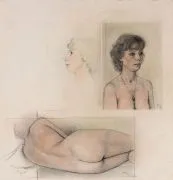
Eli Heil (Palhoça SC 1929 - Florianópolis SC 2017)
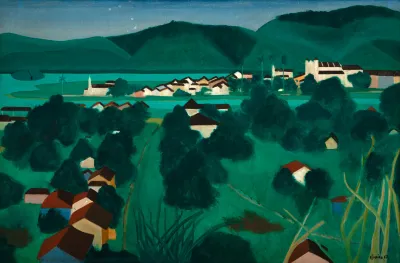
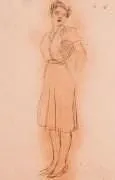
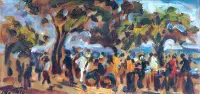
Eli Heil was a painter, draftswoman, ceramist, sculptor, tapestry maker and poet. In the 1950s, she worked as a physical education teacher. Self-taught, she began her artistic production in 1962, drawing animals and painting landscapes of hills with houses, using thick layers of paint and saturated colors. In 1963, she held her first solo exhibition, in Florianópolis. That same year, the critic and art historian João Evangelista de Andrade Filho (1931) published an essay on her work and presented it in an exhibition in Brasília.
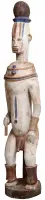
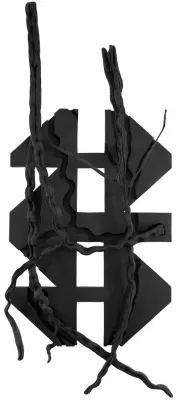
Still in the 1960s, she began to develop three-dimensional objects — first applying rag dolls onto canvases and then creating imaginary beings with a variety of materials, such as ceramics, cement, wood, mortar and melted plastics. In 1966, she held a solo exhibition at the Museu de Arte Contemporânea da Universidade de São Paulo (MAC/USP), at the invitation of the historian Walter Zanini (1925 - 2013). Two years later, she began exhibiting in European countries.
She took part in the 1st Bienal Latino-Americana de São Paulo, in 1978, and in the Unusual Art section of the 16th Bienal Internacional de São Paulo, in 1981. In 1982, the Museu de Arte de Santa Catarina (MASC) held a retrospective of her work. In 1987, she created O Mundo Ovo de Eli Heil (Eli Heil's Egg World), in the capital of Santa Catarina, where she set up her studio and a space for the permanent display of her production. The Fundação O Mundo Ovo de Eli Heil was officially opened in 1994. She is the author of the book of poems and drawings Vomitando Sentimentos (Vomiting Feelings), published in 2000.
Critical Commentary
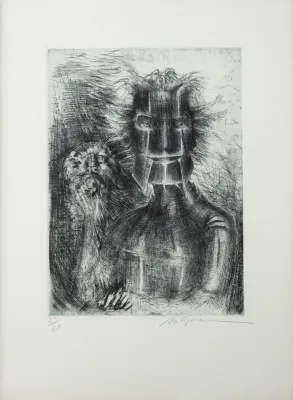
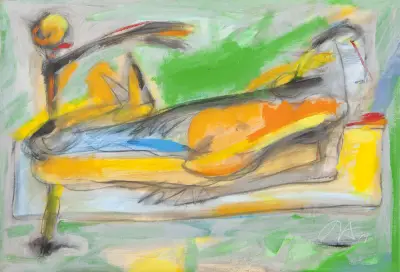
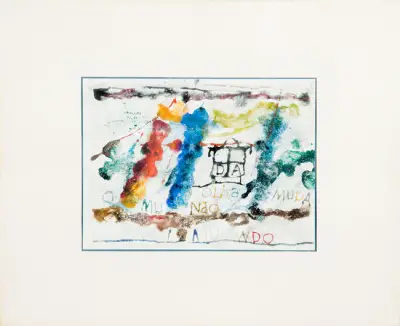
Eli Heil's body of work draws attention for the variety of materials and methods used by the artist. Self-taught, she begins with drawing and painting, but soon starts working with three-dimensional space, sewing embroidery and padded shapes onto her canvases. She then builds sculptures using clay, cement, mortar, fabric, wood, melted plastic or recycled industrial objects. In the works modeled in clay, the heavily textured surfaces and the volumes made from fragments of predominantly curved forms stand out. The paintings are characterized above all by technical simplicity and the non-naturalistic use of color. In some series, the large quantity of paint gives the colors a material density.
Eli Heil usually refers to her work as a spontaneous creation that would be the immediate transposition of her feelings onto matter. Her work can be considered within what art history calls primitive or naïve art (from the Latin insitus, innate): a non-erudite aesthetic manifestation linked to themes of the popular imagination.1 Spontaneity constitutes both the strength and the limit of her works. While it allows unpredictable formal and symbolic articulations, the artist's attitude is confined to the concept of art as a synonym for self-expression.
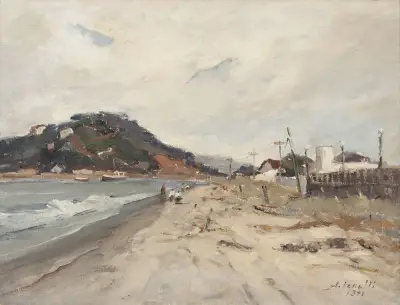
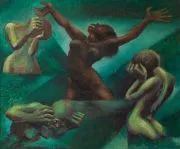
Her first works refer to the urban landscape of Florianópolis, where she lives. They are paintings showing hills with colorful houses that seem to float. Next, the artist depicts Christian icons and subjects related to the female universe, such as the woman's body and motherhood. However, most of her works present hybrid beings composed of human forms, animals and mythological characters. These imaginary animals inhabit amorphous spaces made of patches of color and often merge with them.
Note
1 AQUINO, Flávio de. Aspectos da pintura primitiva brasileira. Rio de Janeiro: Spala, 1978. p. 11.
Critiques
"(...) We have no hesitation in considering her the greatest revelation of our art of primitive intuition in the last 20 years. At a glance we perceive her imagistic, plastic and technical qualities, in strong contrast with the features of other primitives, whether from the North, Guanabara or São Paulo. Unlike their spiritual meekness, descriptive subject matter and emphasis on regional impressions, Eli Heil's works define themselves as an 'abstract-expressionist' vision (João Evangelista), of a cosmic nature, which gives magnitude to her small world of hills and corrals. Time is an omnipresent function of her space: she inscribes it in this enchanted universe of 'fauve' colors (applied to the canvas with a small stylus), and it flows in the undulating rhythm of a drawing of impressive psychological peculiarity. We are caught up in this atmosphere of estrangement; we feel ourselves at the edge of hallucination. A logical organicity, however, holds together all these oscillating images, which in the artist's development always start from her inner experience, the reason for her admirable authenticity".
Walter Zanini
PINTURAS e desenhos de Eli Heil. Introdução de Walter Zanini. São Paulo: MAC/USP, 1966.
"Since all her work in art is a way of exorcising the very strong mental pressures to which she is subjected, one notes in it the frequent presence of mandala-like structures and the resort to animating the inanimate (the houses turn into people, window-eyes staring at us), as well as a characteristic fantastic fauna accompanying these faces of extreme intensity in color, astonishment and tension. It is also curious to observe, in the development of Eli Heil's drawing and painting, an intuitive obedience to the path of overcoming the flat plane through three-dimensional space, including as a means of softening the hallucinatory violence of the figures which, she says, 'come out' of the paper or canvas, engulfing her in the act of creating. Thus, after the first works on an entirely two-dimensional surface, the paintings gradually acquired relief through the handling of grooves in the paint, until reaching the more recent addition of stuffed dolls applied onto the worked surface of the canvas; along this path, her most elaborate pieces are the current object-tapestries, in which she continues to preserve the naïve-expressionist deformation in violently colored masks of hallucination, as a direct record of the flowing unconscious".
Roberto Pontual
PONTUAL, Roberto. Arte/Brasil/hoje: 50 anos depois. São Paulo: Collectio, 1973.
Solo Exhibitions
1962 - Florianópolis SC - Solo, at Galeria Baú
1963 - Rio de Janeiro RJ - Solo, at Instituto Cultural Brasil-Estados Unidos - Ibeu
1963 - Brasília DF - Solo, at Aliança Francesa
1964 - Rio de Janeiro RJ - Solo, at Ibeu
1964 - Florianópolis SC - Solo, at Universidade Federal de Santa Catarina. Faculdade de Direito
1966 - Florianópolis SC - Solo, at Museu de Arte de Santa Catarina - Masc
1966 - São Paulo SP - Solo, at Museu de Arte Contemporânea da Universidade de São Paulo - MAC/USP
1967 - Paris (France) - Solo, at Galeria Solstice
1967 - Florianópolis SC - Solo, at Universidade Federal de Santa Catarina. Centro de Filosofia e Ciências Humanas
1968 - Ibiza (Spain) - Solo, at Galeria Ivan Spence
1968 - Paris (France) - Solo, at Galeria M. Benezite
1968 - Porto Alegre RS - Solo, at Museu de Arte do Rio Grande do Sul Ado Malagoli - Margs
1969 - Amsterdam (Netherlands) - Solo, at Galeria Espace
1969 - Florianópolis SC - Solo, at Masc
1971 - Florianópolis SC - Solo, at Masc
1971 - Paris (France) - Solo, at Galeria Solstice
1971 - Rio de Janeiro RJ - Solo, at Galeria Barcinski
1971 - Amsterdam (Netherlands) - Solo, at Galeria Espace
1971 - Blumenau SC - Solo, at Galeria Açu-Açu
1973 - Copenhagen (Denmark) - Solo, at Museu Louisiana
1973 - Oslo (Norway) - Solo, at Museu Sonja Henie Onstad
1973 - Paris (France) - Solo, at Galeria Debret
1973 - Paris (France) - Solo, at Galeria L'Oeil de Boeuf
1973 - Paris (France) - Solo, at Galeria M. Benezite
1974 - Florianópolis SC - Solo, at Masc
1974 - São Paulo SP - Solo, at Galeria Oca
1977 - Paris (France) - Solo, at Galeria L'Oeil de Boeuf
1978 - Paris (France) - Solo, at Galeria L'Oeil de Boeuf
1982 - Florianópolis SC - Solo, at Masc
1984 - Florianópolis SC - Eli Heil Retrospective, at Masc
1984 - Paris (France) - Solo, at Galeria L'Oeil de Boeuf
1986 - Brasília DF - Retrospective, at Museu de Arte de Brasília
1986 - Florianópolis SC - Solo, at Masc
1989 - Paris (France) - Solo, at Galeria L'Oeil de Boeuf
1990 - Florianópolis SC - Solo, at Masc
1992 - Florianópolis SC - 30 Years of Art, at Associação Catarinense dos Artistas Plásticos - Acap
1993 - Florianópolis SC - Solo, at Espaço Cultural da Aabb
1995 - Florianópolis SC - 66 Years of Life, at Banco do Desenvolvimento de Santa Catarina - Badesc
Group Exhibitions
1965 - Blumenau SC - 1st Pró Arte Nova Salon - 1st prize with special mention
1967 - Brasília DF - 4th Federal District Salon of Modern Art, at Teatro Nacional Cláudio Santoro
1968 - Campo Grande MS - 28 Artists from the MAC/USP Collection of São Paulo, at Galeria do Diário da Serra
1968 - Florianópolis SC - 1st National Visual Arts Exhibition, at Masc
1968 - Caen (France) - Group Show, at Théâtre Maison la Culture de Caen
1969 - Fortaleza CE - 28 Artists from the MAC/USP Collection of São Paulo, at Centro de Artes Visuais Raimundo Cela
1969 - Geneva (Switzerland) - Salon Beauregard
1969 - Florianópolis SC - Rádio Diário da Manhã Art Salon
1970 - São Paulo SP - Pre-Bienal de São Paulo, at Fundação Bienal
1970 - Blumenau SC - Santa Catarina Salon
1971 - Curitiba PR - 28th Paraná Salon, at Biblioteca Pública do Paraná
1971 - Florianópolis SC - 12 Artists from Santa Catarina, at Museu de Arte de Santa Catarina
1971 - Belo Horizonte MG - 11th National Salon of Visual Arts
1971 - Blumenau SC - 2nd Barriga-Verde Visual Arts Group Show
1971 - Rio de Janeiro RJ - Group Show, at Museu de Arte Moderna - MAM/RJ
1972 - São Paulo SP - Independence Sesquicentennial Art Show and Brasil Plástica - 72, at Fundação Bienal
1972 - Bratislava (Czechoslovakia - now Slovakia) - Bratislava Triennial
1972 - São Paulo SP - Art/Brazil/Today: 50 Years Later, at Galeria da Collectio
1972 - Blumenau SC - 3rd Barriga-Verde Visual Arts Group Show
1973 - Paris (France) - Group Show, at Galeria Debret
1975 - Rio de Janeiro RJ - Instituto e Criatividade Popular, at Mnba
1974 - Curitiba PR - Group Show of Santa Catarina Visual Artists, at Galeria do Centro Cultural Brasil Estados Unidos - Ccbeu
1976 - São Paulo SP - 8th Panorama of Current Brazilian Art, at MAM/SP
1978 - São Paulo SP - 1st Bienal Latino-Americana de São Paulo. Myths and Magic in Santa Catarina Art: Eli Heil and Franklin Cascaes, at Fundação Bienal
1980 - Florianópolis SC - Four Ladies of Santa Catarina Art, at Masc
1981 - Curitiba PR - 3rd Brazilian Drawing Show, at Teatro Guaíra
1981 - Naples (Italy) - Mito e Magia del Colore
1981 - São Paulo SP - 16th Bienal Internacional de São Paulo, at Fundação Bienal
1984 - São Paulo SP - Art of Santa Catarina, at Faap
1990 - Aracaju SE - Art in Contrast, at Shopping Riomar
1993 - Rio de Janeiro RJ - Brazil: 100 Years of Modern Art, at Mnba
1993 - Florianópolis SC - The Heil Family, at Assembleia Legislativa do Estado de Santa Catarina - Alesc
2000 - Miramas (France) - Collection Cérès Franco - Peintures, Sculptures, Sculptures Objects, at Miramas Château de Belval
2000 - Florianópolis SC - Victor Meirelles National Salon - special room
Source: Itaú Cultural