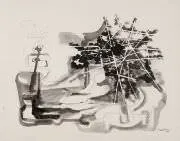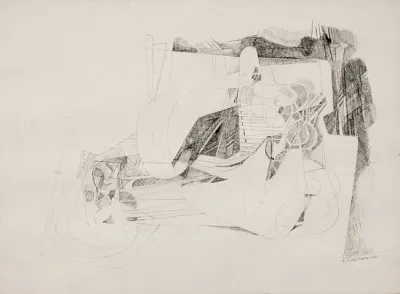


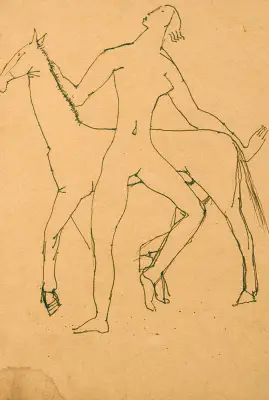
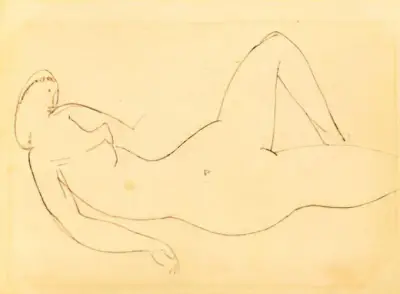
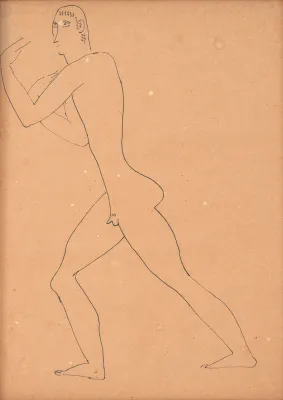
Victor Brecheret (São Paulo SP 1894 - idem 1955)
Victor Brecheret, born Vittorio Breheret in a small town near Rome, was a leading sculptor in Brazil. The son of Augusto Breheret and Paolina Nanni, who died when he was only six, Victor was taken in by the family of his maternal uncle, Enrico Nanni. He emigrated to Brazil with his family as a child. As an adult, already in his thirties, he formalized his Brazilian nationality by belatedly registering his birth at the Jardim América Civil Registry in São Paulo. This kind of regularization was common among Italian immigrants in Brazil in the early 20th century.
Brecheret's artistic training began in 1912, when he studied drawing, modeling and wood carving at the Liceu de Artes e Ofícios de São Paulo. Between 1913 and 1919, he went to Rome, where he studied with the sculptor Arturo Dazzi. After returning to São Paulo, he set up a studio in the Palácio das Indústrias, where his work was discovered by the modernists Di Cavalcanti, Hélios Seelinger, Menotti del Picchia, Mário de Andrade and Oswald de Andrade. In 1921, with a scholarship, he went to Paris, where he came into contact with renowned sculptors such as Henry Moore, Emile Antoine Bourdelle, Aristide Maillol and Constantin Brancusi. During this period, he alternated his residence between France and Brazil until 1936.
Brecheret was a notable presence at important international exhibitions, including the Salon d'Automne and the Salon des Indépendants. Although living outside Brazil, he took part in the 1922 Semana de Arte Moderna with 12 sculptures. In 1932, he became a founding member of the Sociedade Pró-Arte Moderna (Spam). In 1936, he began work on the Monumento às Bandeiras, a project dating from 1920, which was inaugurated in 1953 in Praça Armando Salles de Oliveira, São Paulo. In the 1940s and 1950s, he made numerous sculptures for public places, façades and bas-reliefs, as well as works depicting Brazilian Indigenous culture in materials such as terracotta, bronze and stone, establishing himself as one of Brazil's leading sculptors.
Critical Commentary
Brecheret began his artistic training in 1912 at the Liceu de Artes e Ofícios de São Paulo, where he studied drawing, modeling and wood carving. In 1913, he went to Rome and became a disciple of Arturo Dazzi, a sculptor noted for his taste for monumental figures executed with great formal synthesis. In Rome, he closely studied the works of Auguste Rodin (1840-1917) and Emile Antoine Bourdelle, among others, and met the sculptor Ivan Mestrovic (1883-1962). When he returned to São Paulo in 1919, he was a sculptor with broad technical mastery. He improvised a studio in a space lent by the engineer Ramos de Azevedo in the Palácio das Indústrias. His works were admired by a group of intellectuals linked to the modernist movement: Oswald de Andrade, Menotti del Picchia and Mário de Andrade.
The sculptures Ídolo [Idol] and Eva [Eve] (both from 1919) show a naturalistic treatment of anatomy and a restrained drama, expressed through torsions of the body and volumes worked in strong light and shadow. The writer and critic Mário de Andrade called this period of Brecheret's work (as opposed to the later period in Paris) the phase of shadows, in which shadows are always valued more than light. In 1920, he made the maquette for the Monumento às Bandeiras, in which he evokes the saga of the bandeirantes in the conquest of new lands. The following year, he received a grant from the Pensionato Artístico do Estado de São Paulo and went to Paris, where he stayed until 1935. Although absent, he exhibited some works at the 1922 Semana de Arte Moderna.
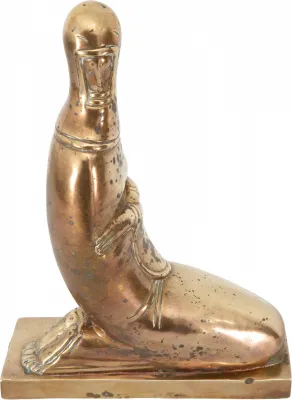
In Paris, Brecheret was highly receptive to three sources that he sought to merge in a personal way: the emphasis on geometric volume in Cubist sculpture, the synthetic treatment of form by the Romanian sculptor Constantin Brancusi, and the elegant stylization of Art Deco. The convergence of these sources can be seen in Tocadora de Guitarra [Guitar Player] (1923). In this phase, the sculptor reduced the drama seen in his earlier works. He now produced simplified forms with a strong ornamental character. The sculpture Mise au Tombeau [The Entombment], from 1923 - now in the Cemitério da Consolação in São Paulo - is one of the most outstanding works of his French period. It is organized in linear forms and has a melodic softness. The theme is treated with great formal simplification, evoking an atmosphere of great serenity.
In 1936, Victor Brecheret settled in São Paulo, where he received commissions for public sculptures as well as works with religious themes. He resumed the Monumento às Bandeiras project, which was only completed in 1953. The work stands out for its figures executed with great formal synthesis, its concern with volume, its simplification of detail and its stylized lines. The monument manages to sum up the narrative and allegorical appeal of the theme: its composition brings together a strong horizontal emphasis and a dragging movement that culminates in the figure of Glory, which heroically binds together the whole sculptural group. The surface treatment is rougher than in earlier works; the sculptor places greater emphasis on the material.
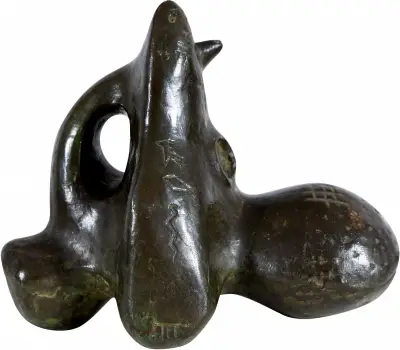
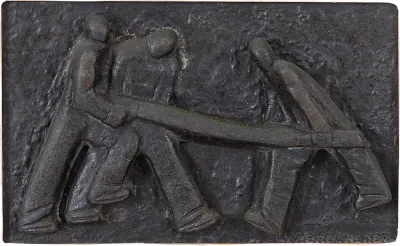
From the 1940s onward, the artist turned to themes linked to Indigenous culture, in sculptures made in bronze or terracotta: Drama Marajoara (1951) or Drama Amazônico (1955). In this phase, when he reached the high point of his career, he also worked with rounded stones, on which he intervened by making gentle incisions, as in Luta da Onça [Jaguar Fight] or Índia e o Peixe [Indian Woman and the Fish] (both 1947/1948). In these he evokes the sacred or magical character of stones and thus takes up, in a very personal way, Indigenous forms and archetypes, although the presence of the sculpture of Henry Moore and Hans Arp (1886-1966) can be noted here. In works such as Luta dos Índios Kalapalos [Fight of the Kalapalo Indians] (1951), he produces forms that engage in dialogue with abstraction. In Índio e Suassuapara [Indian and Deer] (1951), the artist starts from two volumes that merge and works the empty or full surfaces into which the incisions are inserted.
Critiques
"The only admissible comment before such works is a devout silence, a religious silence that conveys the tacit confession that we are facing something that transcends the circle of our habitual perceptions. This state of soul is always produced (in those who have a soul, of course) by the action of music, when it is Beethoven who fills the innermost substance of our being with sound; by the action of painting, when the hand of genius makes it; by the action of verse, when the supreme poets sing it; by the action of sculpture, when one of those rare shapers of marble life has lent life to stone. Well then: if Brecheret's Eva transfuses such a state of soul into us, there is no need to say more. That consecrates him. That consecrates him. And that covers with shame our petulant Carthage, this São Paulo that casts such an artist out of its bosom, exiles him, starves him, only to then put hundreds of contos into the pocket of a land-grabber of genius in exchange for a nativity scene of stone and bronze, full of lions, panthers, natives, Trojan horses, giraffes, alligators, etc. A most false monument, since it forgot the paying camels and, as the crowning of it all, at the summit, the crowbar omnipotent, omnipresent, omniscient, omni-digging".
Monteiro Lobato
"But for me Brecheret has more than the mere volatile brilliance of youth. In the continued contact in which I was able to observe and admire him, the conviction took deep and strong root in my mind that the young sculptor is a distinctive personality, the most brilliant promise the country has had in sculpture to date, lacking only a more considered contemplation of the great works of art of our time and a mind more inclined to aesthetic reasoning in order to produce the complete masterpiece that Brazil still does not have to compete in the world's artistic exchange, and which it fervently expects of him.
He is, of this I am absolutely certain, a spirit that tends to become independent, a personality inclined to set itself apart. It is one of his most remarkable qualities. Well then: instead of forming a sculptural type based on the traditional Assyrian or Egyptian currents, instead of stylizing in marble or bronze the physical characteristics of a Nordic, after Carl Milles, or of a Slovak, after Mestrovic - tendencies that would internationalize rather than nationalize him - let him study the types of our Indians, types not devoid of beauty, stylize them, unify them into a single, original type, and he will thus have acquired the greatest of his qualities".
Mário de Andrade
"But anyone who analyzes his complex evolution will not miss the tendency, more marked every day, toward an exclusive concern with volumes and planes and an ever greater lack of interest in subject, theme, figurative concession. The current phase of the stones rigorously highlights this love of form for form's sake, even though Brecheret masks it with somewhat confused explanations in his catalog. In reality, the use of nature's chance and the graphism of primitive engravings merely reveal the artist's timidity in search of a justification for the future gesture. This will be, I believe, the making of the stone itself, the search for new eurhythmies, for ideal proportions of planes and volumes that no longer recall the human body, that are born simply from the artist's imagination and sensibility. His whole course, from the beginning, has been mapped out and is visible to a perceptive eye in the stylizations, the simplifications, the deformations, the syntheses. The sculptor never held to the analytical conception, and when he stopped at detail it was always to make the part a whole, to value it plastically as a work in itself and not to mark a naturalistic tendency. And when his aim was the whole itself, detail interested him only as a solution of balance or of sensitive graphism".
Sérgio Milliet
"Like Anita Malfatti, he polarized the ideals of the modernists before the 1922 Week. His Italian training, between 1913 and 1916, with Arturo Dazzi, was also marked by the secessionist sculpture of the Yugoslav Ivan Mestrovic. Back in São Paulo, between 1919 and 1921, he had a renewing influence with his sculptures stylized by elongations and a dramatic tension of anatomy. Between 1921 and 1936 his sculptural production belongs to the context of the School of Paris, undergoing a cleansing and simplification of Brancusian inspiration and the sweetened geometrism of Art Deco, reaching a synthesis of abstracting volumes of great luminosity. In the 1930s, after some abstract experiments, he insisted on the globalization of forms, with rustic turning, archaizing simplifications and volumes cut along edges. In 1936, with the possibility of executing the Monumento às Bandeiras, he returned to São Paulo for good. After an episodic investigation of archaic Greek sculpture, abandoning geometrism, his sculpture of mass expresses greater naturalism, centered on the female figure, monumental, with Maillolesque resonances. At the end of the 1940s he turned to national, Indigenous themes - his plastic language became increasingly organic, outcrops of deep intuitions, mapping essential, primitive forms, sensitizing the masses with incisions".
Daisy Valle Machado Peccinini de Alvarado
"Until 1921, the sculptor still resorted now and then to the stock of Rodinian forms; from that year, for example, is the Mask of Menotti Del Picchia, so close to the bust of Mahler, nervously modeled by the French genius a little over ten years earlier. Now, with these forms of supreme elegance and refined simplicity, Brecheret rigorously formulates a style. This first fixing of his singularity, of his "manner," so to speak, is of capital importance. Not because this is a style ne varietur; quite the contrary, the sculptor's work would still undergo the most radical inflections, from the stones to the Marajoara, from the monumental granite alla Bourdelle of the Bandeirantes to the Graças I and II inspired by Maillol, etc. But because, whatever "phase" he is in, Brecheret will no longer give up a poetic identity, which always makes it possible, beyond this or that passing experiment, to recognize the same capacity for formal synthesis, the same unmistakable style.
Victor Brecheret's greatest merit was perhaps that of always choosing (with the exception of Arturo Martini, probably) the greatest masters of modern sculpture as his interlocutors: Rodin, Medardo Rosso, Brancusi, Bourdelle and Maillol. That he did not always emerge unscathed from these confrontations, the only ones that could fascinate his very high profile as a sculptor, in no way diminishes the greatness of his challenges. Among us, he was the only one capable of sustaining them, aware that they were the only ones sculpture demands".
Luiz Marques
"With no ties to the rarefied Brazilian sculptural tradition, Brecheret must be analyzed, as Luiz Marques suggests, within the scope of European sculpture, with which he engages in a dialogue that marks his career as a multifaceted artist. Considering, moreover, his training and his long stay abroad, a decisive question arises: to what extent can Brecheret be considered a Brazilian artist? Does he not in fact belong to the history of European sculpture, since there are no closer ties in his work to the art produced in Brazil in that same period? The very Indigenous inspiration that punctuates his late production, in which he seems finally to answer the appeal Mário de Andrade had addressed to him in 1921 - "Study the types of our Indians, types not devoid of beauty, stylize them, unify them into a single, original type, and you will thus have acquired the greatest of your qualities" -, can be placed, albeit belatedly, within that interest in the primitive that mobilized the European avant-gardes at the beginning of the century. Perhaps by answering this question, untying this knot, it will be possible to assess Brecheret with other eyes and, who knows, to recontextualize him properly in Brazilian art, beyond a merely geographical evidence, incapable of accounting for the complex elements that involve any definition of artistic work".
Annateresa Fabris
"Only two sculptors took part in the 1922 Semana de Arte Moderna, W. Haarberg and Victor Brecheret, the latter with twelve works. Two years earlier, in June 1920, Brecheret had already presented his design for the Monumento às Bandeiras, whose construction would only begin in 1936 and be completed in 1953. In other words, when he presented his design, the Week had not yet taken place, and the São Paulo art world knew nothing of Cubism, Futurism, Dada and other modernist innovations. When it was inaugurated, the Bienal Internacional de São Paulo, a watershed in Brazilian art, was holding its second edition. Revolutionary in 1920, very conservative in 1953. Brecheret himself, who had earlier experimented with various styles - Egyptian hieratism, Art Deco and Cubism -, had already reached his full artistic maturity in works made in bronze covered with rock-art inscriptions (Índio e a Suassuapara, 1951), and in the so-called "stone phase," which lasted until his death in 1955, in which he appropriated granite pebbles as they had been shaped by nature, but intervened on their surface with incisions".
Frederico Morais
"It is in Victor Brecheret that the representation of the sacred becomes eloquent as the language of an extensive production that runs through the whole long course of his life.
In him, sacred art finds a way to travel all the various paths of sculptural expression, from the monumentality of some tombs in São Paulo to the delicate subtlety of his terracottas, whether in the representation of the Virgin Mary or the Flight into Egypt, in the fourteen Stations of the Cross that adorn the chapel of the Hospital das Clínicas de São Paulo, or in the various representations of the Last Supper, to which the artist wisely gives an absolutely original language".
Emanoel Araújo
Testimonials
"I ended up in Paris - the artist recounts - shortly after World War I, a time when the revolution in art was at its peak. What I found there was completely different from what I had been learning until then. I was stunned, confused. I spent a year without working, although I frequented studios and artists. Then, carried along by the surroundings, I entered my modernist phase. Granite figures that presented only volume (I called them pneumatic...). Or advanced conceptions in which geometry played with form, figures executed in polished copper. (...)
What is done today - the artist continues - abroad or here in our country was already done in Europe after 1920. At that time people wanted to put an end to a certain conventionalism in art, since art was sweet, made for bourgeois taste. A transformation was attempted that could not be achieved because it reached nothing. Outside the classical foundations it would be useless to try to create anything new. In fact, in art, everything that could be achieved has already been done. In the effervescence of the modernist movement I used to think: then why do those famous statues in museums, which have come down through the centuries without their beauty or value diminishing, continue to be the greatest attraction? Nothing to this day has managed to diminish them. In 1928 there was also, in France, a real invasion of artists from every country, who brought new, revolutionary ideas. But they then disappeared, like a will-o'-the-wisp, nothing more. (...)
- When did you return to the classical foundations? - I ask.
In truth - Brecheret replies - I never moved away from them. But, carried by the influence of the time, I followed what everyone was doing at that moment. However, I kept sifting through my works, advancing, or rather, going back until I settled. The experience gained in the modernist period was truly useful to me, since I acquired a vast knowledge of geometric lines in sculpture. (...)
But the sea is a poor supplier - Brecheret adds - and in the absence of other stones whose beauty might inspire me, I have been working in terracotta, always on the same subject, with national motifs, thus seeking a new form, a new modality, another Brazilian sculpture, legitimately ours".
Victor Brecheret
ANTONIA, Maria. Brecheret fala de arte. In: BRECHERET: 60 anos de notícia. São Paulo: s.n., 1976. p.93-95.
Collections
Acervo da Pinacoteca do Estado de São Paulo/Brasil
Banco Interamericano de Desenvolvimento - Washington D.C. (United States)
Casa Guilherme de Almeida - São Paulo SP
Coleção Museu de Arte Contemporânea da Universidade de São Paulo - MAC/USP - São Paulo SP
Coleção Museu de Arte Moderna do Rio de Janeiro - MAM/RJ
Coleção Museu de Arte Moderna de São Paulo - MAM/SP - São Paulo SP
Fundação Armando Álvares Penteado - São Paulo SP
Fundação Cultural de Curitiba - PR
Fundação Maria Luiza e Oscar Americano - São Paulo SP
Museu da Casa Brasileira - São Paulo SP
Museu de Arte de São Paulo Assis Chateaubriand - SP
Museu Júlio Prestes - Itapetininga SP
Solo Exhibitions
1920
Santos SP - Exhibition of the maquette of the Monumento aos Andradas
São Paulo SP - Exhibition of the first maquette of the Monumento às Bandeiras, at Casa Byington. Work on the monument began in 1936 and it was inaugurated in 1953
1921
São Paulo SP - Solo, at Casa Byington
1926
São Paulo SP - First solo exhibition, showing 33 sculptures from the French phase. Donates Porteuse de Parfum to the Pinacoteca do Estado
1930
São Paulo SP - Solo
1934
Rio de Janeiro RJ - Solo
1935
São Paulo SP - Solo
1948
São Paulo SP - Solo, at Galeria Domus
1953
São Paulo SP - Solo, at Galeria Tenreiro
Group Exhibitions
1916
Rome (Italy) - International Fine Arts Exhibition
Rome (Italy) - Takes part in the Amatori e Cultori exhibition - with the work Despertar [Awakening], receives 1st prize at the International Fine Arts Exhibition
1919
Rome (Italy) - Mostra degli Stranieri alla Casa del Pincio
Rome (Italy) - Mostra degli Stranieri alla Casina del Pincio
1921
Paris (France) - Salon d'Automne - awarded for the sculpture Templo da Minha Raça [Temple of My Race]
1922
São Paulo SP - Semana de Arte Moderna, at Teatro Municipal de São Paulo
1923
Paris (France) - Exhibition of Brazilian Artists, at Maison de L'Amérique Latine
Paris (France) - Opening of the Maison de L'Amérique Latine
Paris (France) - Salon d'Automne - awarded for the work Mise au Tombeau [The Entombment]
1924
Paris (France) - Exposition d'Art Américain-Latin, at Musée Galliéra
Paris (France) - Salon d'Automne - shows Porteuse de Parfum [Perfume Bearer]
1925
Paris (France) - 18th Salon d'Automne, at Grand Palais
Paris (France) - Salon de la Société des Artistes Françaises - honorable mention
Paris (France) - Salon des Artistes Français
Rome (Italy) - Rome International Exhibition
1926
Paris (France) - 19th Salon d'Automne, at Palais de Bois
Paris (France) - Peintres et Sculpteurs de L'École de Paris
Paris (France) - Salon d'Automne
1928
Paris (France) - Salon des Indépendants
1929
Paris (France) - 40th Salon des Indépendants, at Société des Artistes Indépendants
Paris (France) - Salon des Indépendants
1930
São Paulo SP - Exhibition of a Modernist House
1931
Rio de Janeiro RJ - Exhibition at the First Modernist House of Rio de Janeiro, on Rua Toneleros
Rio de Janeiro RJ - Revolutionary Salon, at Enba
1933
São Paulo SP - 1st Modern Art Exhibition of SPAM, at Palacete Campinas
1934
Rio de Janeiro RJ - 4th Pró-Arte Salon
1937
São Paulo SP - 1st Salão de Maio, at Esplanada Hotel de São Paulo
1938
São Paulo SP - 2nd Salão de Maio, at Esplanada Hotel de São Paulo
1939
São Paulo SP - 3rd Salão de Maio, at Galeria Itá
1941
São Paulo SP - Art Salon of the National Industries Fair
1945
São Paulo SP - Galeria Domus: Inaugural Exhibition
1950
Venice (Italy) - 25th Venice Biennale
1951
São Paulo SP - 1st Bienal Internacional de São Paulo, at MAM/SP - national sculpture prize for the work O Índio e a Suassuapara
1952
Chile - Salón del Museo de Arte Contemporáneo de la Universidad de Chile
Paris (France) - Salon de Mai
Rio de Janeiro RJ - Exhibition of Brazilian Artists, at MAM/RJ
Venice (Italy) - 26th Venice Biennale
1954
São Paulo SP - Contemporary Art: Exhibition of the Collection of the Museu de Arte Moderna de São Paulo, at MAM/SP
1955
Paris (France) - Brazilian Artists
São Paulo SP - 3rd Bienal Internacional de São Paulo, at Pavilhão das Nações