Toledo Piza (Capivari SP 1887 - São Paulo SP 1945)
Toledo Piza was a painter. He graduated in law from the Sorbonne, in Paris, around 1909. In 1913, he attended classes at the Académie de la Grande Chaumière, under the guidance of Lucien Simon (1861 - 1945) and René Ménard (1862 - 1930). He held solo exhibitions at the Galerie Carmine in Paris in 1926 and 1929. He took part in the Salon d'Automne in 1921 and 1932, the Salon des Indépendants in 1925 and the Salon du Franc in 1926. He moved to São Paulo in 1933, where he joined the Família Artística Paulista (FAP), taking part in the group's second exhibition in 1939. That same year, one of his works was acquired by the French government. He held solo exhibitions in Brazil and showed work at the Salon of the Sindicato dos Artistas Plásticos in São Paulo in 1942 and 1944.
After his death, his work was shown in two solo exhibitions: at the São Paulo headquarters of the Instituto de Arquitetos do Brasil (IAB) in 1946, and at the Museu de Arte de São Paulo Assis Chateaubriand (Masp) in 1972. His works were also included in several group exhibitions organized by the Museu de Arte Moderna de São Paulo (MAM/SP), the Museu Lasar Segall and the Pinacoteca do Estado de São Paulo (Pesp), among others.
Critical Commentary
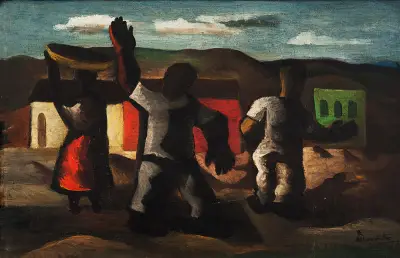
Commentators agree that Toledo Piza absorbed Impressionism and the work of Cézanne late. The historian Walter Zanini (1925 - 2013) writes: "Unaware of Cubism, or indifferent to it, as indeed to other avant-garde currents before the First World War, he belatedly assimilated Impressionism, moving beyond it under the influence of Cézanne"1. This dialogue with Impressionist painting can be seen in canvases such as Medas de Feno à Beira da Estrada [Haystacks by the Roadside] (n.d.) and Paisagem Sob a Neve [Landscape Under Snow] (n.d.). Despite his presence in Paris in the early 20th century, Piza's painting makes no reference to the avant-garde movements of the period - even though he recorded his knowledge of Cubism in a written statement around 19342. According to the historian Aracy Amaral, his return to Brazil brought a change in the artist's visual approach, as he moved away from Impressionist solutions. In the 1930s, in São Paulo, the painter came into contact with the Família Artística Paulista - FAP, exhibiting with its members in 1939. There is an affinity between the moderately modernist tone of the group's production and Piza's somewhat conservative work. From the Brazilian phase is Amparo II, c. 1935, which asserts the two-dimensionality of the picture - the elements seem stacked in very shallow planes. There is a composition of blocks or massive volumes - a reference to Cézanne's painting - together with a rather descriptive treatment of the houses. The sky is reduced to a minimal area of the composition, almost entirely filled with volumes forming a kind of hill. A comparison of the artist's Brazilian and French phases shows the transformation he underwent: he still avoids perspectival planes, but is no longer interested in the effects of light on the landscape. The brushstroke now rarely shows the gesture that produced it.
Notes
1 ZANINI, Walter (org.). História geral da arte no Brasil. Apresentação Walther Moreira Salles. São Paulo: Instituto Walther Moreira Salles, Fundação Djalma Guimarães, 1983.
2 Esse depoimento do artista foi reproduzido no catálogo 50 pinturas de Domingos de Toledo Piza. São Paulo: Museu de Arte de São Paulo Assis Chateaubriand, 1972.
Critiques
"His painting was always marked by a concern with visual form, conceived without hard edges and achieved through color and matter. His way of building form recalls the familiar gesture of a child's hand pressing a little ball of clay into shape. His frank concern with iconography brings us the lived image. Facing the damp earth, the painter seems to us barefoot, leaning forward to climb the slope of the embankment, ready to read in the clouds the coming rain. He speaks to us of man occupying the landscape, set with severity against the smallness of the oxen and houses".
Antonio Hélio Cabral
TRÊS pioneiros do tempo dos salões: Domingos Toledo Piza, Renée Lefevre e Hugo Adami - década de trinta. São Paulo: Museu Lasar Segall, 1980, p. 5.
"Unaware of Cubism, or indifferent to it, as indeed to other avant-garde currents before the First World War, he belatedly assimilated Impressionism, moving beyond it under the influence of Cézanne. On his return in 1933, he captured the Brazilian landscape with plethoric, romantic views of defined planes and toned cool colors".
Walter Zanini
ZANINI, Walter, org. História geral da arte no Brasil. Apresentação de Walther Moreira Salles. São Paulo: Instituto Walther Moreira Salles, Fundação Djalma Guimarães, 1983.
"Domingos Viegas de Toledo Piza practiced landscape and still life, coming successively under the influence of the Impressionists and, in the early 1920s, of Cézanne. (...) He spent his last years isolated, misunderstood and very little known, and only recently has he been undergoing a gradual process of critical reassessment. His landscapes, still lifes and urban scenes secure him a prominent place in the history of Brazilian painting, since, although he produced relatively little, everything he painted is of a high level of quality".
José Roberto Teixeira Leite
LEITE, José Roberto Teixeira. Dicionário crítico da pintura no Brasil. Rio de Janeiro: Artlivre, 1988.
Solo Exhibitions
1915 - São Paulo SP - Toledo Piza
1922 - São Paulo SP - Toledo Piza, at Casa Sotero
1926 - Paris (France) - Toledo Piza, at Galerie Carmine
1929 - Paris (France) - Toledo Piza, at Galerie Carmine
1945 - Rio de Janeiro RJ - Toledo Piza, at MNBA
Group Exhibitions
1921 - Paris (France) - Salon d'Automne
1925 - Paris (France) - Salon des Indépendants
1926 - Paris (France) - Salon du Franc
1932 - Paris (France) - Salon d'Automne
1934 - São Paulo SP - 1st São Paulo Fine Arts Salon
1939 - São Paulo SP - 2nd Salon of the Família Artística Paulista, at Salão Eldorado, in the basement of the Automóvel Clube
1941 - Rio de Janeiro RJ - 47th National Salon of Fine Arts, at MNBA
1942 - São Paulo SP - 7th Salon of the Visual Artists' Union, at Galeria Prestes Maia
1944 - São Paulo SP - 9th Salon of the Visual Artists' Union, at Galeria Prestes Maia
Posthumous Exhibitions
1946 - São Paulo SP - Toledo Piza, at Instituto de Arquitetos do Brasil
1956 - São Paulo SP - 50 Years of Brazilian Landscape, at MAM/SP
1972 - São Paulo SP - Toledo Piza, at Masp
1972 - São Paulo SP - The 1922 Week: Background and Consequences, at Masp
1975 - São Paulo SP - O Modernismo de 1917 a 1930 [Modernism from 1917 to 1930], at Museu Lasar Segall
1976 - São Paulo SP - Os Salões: da Família Artística Paulista, de Maio e do Sindicato dos Artistas Plásticos de São Paulo [The Salons: Família Artística Paulista, Salão de Maio and the São Paulo Visual Artists' Union], at Museu Lasar Segall
1976 - Campinas SP - Aspectos do Modernismo no Brasil [Aspects of Modernism in Brazil], at Galeria de Arte do Centro de Convivência Cultural da Secretaria Municipal de Cultura
1978 - São Paulo SP - A Paisagem na Coleção da Pinacoteca [Landscape in the Pinacoteca Collection], at Pinacoteca do Estado
1980 - São Paulo SP - The Brazilian Landscape: 1650-1976, at Paço das Artes
1980 - São Paulo SP - Três Pioneiros do Tempo dos Salões: Domingos Toledo Piza, Renée Lefevre e Hugo Adami [Three Pioneers from the Era of the Salons: Domingos Toledo Piza, Renée Lefevre and Hugo Adami], at Museu Lasar Segall
1982 - São Paulo SP - From Modernism to the Bienal, at MAM/SP
1984 - São Paulo SP - Tradition and Rupture: A Synthesis of Brazilian Art and Culture, at Fundação Bienal
1988 - São Paulo SP - Brasiliana: Man and the Land, at Pinacoteca do Estado
2004 - São Paulo SP - New Acquisitions: 1995-2003, at MAB/Faap
Source: Itaú Cultural