Maria Helena Coelho Andrés Ribeiro (Belo Horizonte MG 1922)
Painter, draftsman, illustrator, writer and teacher.
She studied painting with Carlos Chambelland in Rio de Janeiro between 1940 and 1944, and with Guignard and Edith Behring at the Escola do Parque in Belo Horizonte between 1944 and 1947. She took part in several editions of the Salão Nacional de Belas Artes - SNBA [National Fine Arts Salon], the Salão Nacional de Arte Moderna - SNAM [National Salon of Modern Art] and the São Paulo International Biennial between 1946 and 1961. From 1950 to 1970, she taught painting and drawing at the Escola de Belas Artes de Belo Horizonte, where she served on the board of directors for a few years. In 1961, she studied at the Art Students League of New York, where she was a student of Theodorus Stamos. In the mid-1960s, she wrote about art for the newspapers Diário de Minas and Estado de Minas. She published the books Vivência e Arte [Experience and Art], 1965, and Os Caminhos da Arte [The Paths of Art], 1977.
From the 1970s she made several trips to the East, visiting Nepal, Tibet, Japan, Thailand and India. On these occasions, she took part in seminars and lectures. In 1979, she taught drawing at the Kalakshetra School of Art and creativity at the Theosophical Society in Madras, India. Motivated by these experiences, she carried out a comparative study of Indian and Brazilian cultures, published in the book Oriente-Ocidente: Integração de Culturas [East-West: Integration of Cultures] in 1984. She taught art at the Universidade Holística Internacional [International Holistic University] in Brasília in 1989. She gives workshops in the basic holistic training course. She published the book Maria Helena Andrés: Depoimentos [Maria Helena Andrés: Testimonies] in 1998.
Critical Commentary
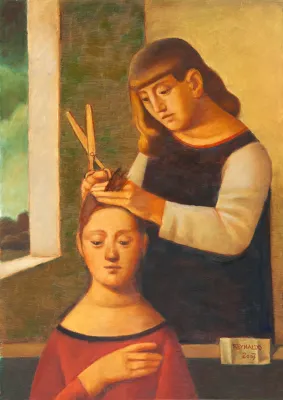
Maria Helena Andrés trained at the Escola do Parque, where she was a student of Guignard. The master's influence is noticeable in the paintings of the period following her studies in Belo Horizonte, in the transparent and luminous treatment of the background, in the drawing of the figures, and in the lyricism and lightness of compositions such as the canvas Casamento na Roça [Country Wedding], 1950.
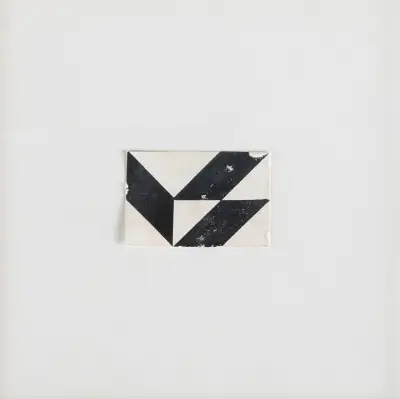
During the 1950s, the artist broke with lyrical figuration toward Concrete art. Her passage through Concretism, a movement of which she was a forerunner in Minas Gerais, can be seen in works such as Movimento de Cores [Movement of Colors], 1955, and Fantasia de Ritmos [Fantasy of Rhythms], 1958, the latter from the Adolpho Leirner collection, now part of the Museum of Fine Arts, Houston, United States. The compositions of this period present a rhythmic sequence of vertical and horizontal lines; the delimited areas resulting from this distribution of lines are filled, here and there, with distinct colors, which give rise to geometric forms such as rectangles and squares. Lines and colors are arranged in an organized schematization, achieving the formal synthesis sought by the Concretists. At the same time, the rhythm and delicacy of the compositions give a poetic aspect to this production, whose formal result bears similarities to the canvases of the Dutch artist Piet Mondrian. The series of India ink drawings Cidades Iluminadas [Illuminated Cities], made in 1958, is also an example of this type of visual solution.
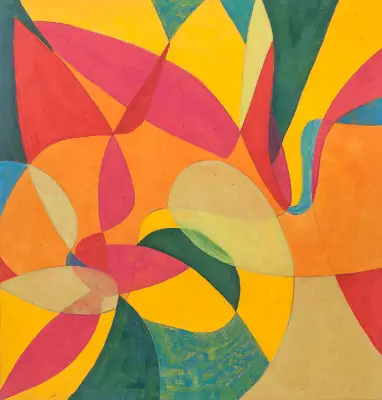
In the early 1960s, she made a study trip to New York, where she was guided by Theodorus Stamos and came into contact with Abstract Expressionism. This experience brought about a significant transformation in her production, which turned to gestural painting and can be classified as lyrical, informal abstraction. Boats are a reference for the artist's creation in several canvases of this period, worked on surfaces of thick matter, as in the work Embarcação [Vessel], 1963.
In the 1960s, she made a series of India ink drawings on the theme of war and destruction and several canvases referring to the space race, such as Foguete Espacial [Space Rocket], 1968. In some works, she uses collage of cutouts of photographs taken from the mainstream press and other elements, mixing them with abstract forms, as in Radioactive Ship, 1964, in the collection of the Museu de Arte da Pampulha - MAP. In the following decade, she produced numerous tapestry designs, in which she sought to apply aspects of pictorial language to textiles, exploring the combination of colors and the different textures of the stitches.
A visual artist and writer, Maria Helena Andrés shows a clear connection between her visual production and her publications. In 1966, she published Vivência e Arte, which offers a reflection on the sources of creativity, the nature of artistic communication and art teaching. Influenced by the philosophy of Jacques Maritain and the aesthetic thought of Kandinsky, Maria Helena defends the existence of a spiritual impulse in the creative movement and seeks to establish a link with Christian teachings. Caminhos da Arte, from 1977, matures the author's reflections on modern art, paying special attention to informal abstract painting.
Her interest in and study of Eastern culture manifested themselves in the 1970s, when she made her first trips to India and other Eastern countries. The importance of contact with Eastern art and culture, especially Indian, can be seen in several articles and in the publication of Oriente - Ocidente: Integração de Culturas in 1984, a comparative study of Indian and Brazilian cultures.
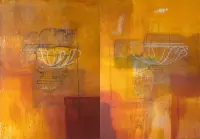
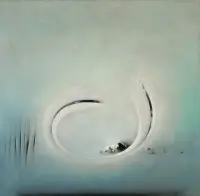
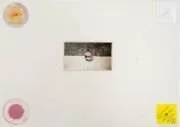
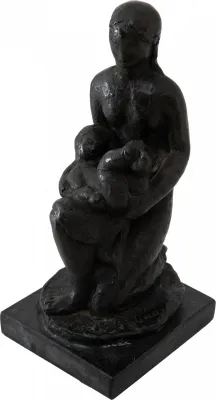
These reflections permeate her artistic work, which broadens abstraction, the gestural aspect, and the fluidity and transparency of composition, procedures probably incorporated through her contact with and admiration for Eastern art. In her more recent production, the painting of circular forms and mandalas is frequent. In the last decade, the artist has also turned to photography and sculpture.
Critiques
"The presence and importance of Maria Helena Andrés as draftsman, painter and teacher in the art of Minas Gerais over the last twenty-five years has become an undisputed fact. (...). In her personal work, she has maintained certain basic characteristics throughout these years, such as the tendency to dilute the forms of the real into a series of semi-abstract suggestions, and a romantic propensity for symbol, metaphor and allegory. Boats, or configurations that merely suggested them, were, for example, a constant of her drawing and painting during a long phase, symbolizing, as she herself states, the atavistic desire for travel, for discovery, for abandoning the interior for the exterior (...). Around 1964, fusing the symbolic meaning of vessels with direct calls of contemporaneity, she began to depict, in the same growing quasi-abstract dilution, flying machines in a universe of dream and metallic luminosities; (...). In the most recent drawings and paintings, abstraction has broadened in terms of a new pleasure in the gestural, in the fluidity of transparencies and the impact of contrasts, perhaps incorporated through her interest in and contact with Eastern art."
Roberto Pontual
PONTUAL, Roberto. Arte/Brasil/hoje: 50 anos depois. São Paulo: Collectio, 1973.
Testimonials
"In 1944 Guignard arrived in Belo Horizonte, invited by the then mayor Juscelino Kubitschek to direct the Escola de Belas Artes. I felt the impact of his presence as a renewal of the artistic scene in Minas and a break with academicism. I tried to enroll in his course. It was necessary to unlearn the concepts and formulas inherited from academicism so that I could gain access to my own individuality. My aim was to free myself from the academic past and find the language suited to my time. Guignard encouraged the new, and from this encouragement we discovered our individual style. Living with my fellow students and the poetry of the Parque Municipal stimulated my creation and awakened new questions about art in me. The school was frequented by great artists and intellectuals. Guignard took us to Pampulha to watch Portinari paint the mural of the Church of São Francisco, and there we also had contact with Burle Marx, Santa Rosa and other artists who came from Rio de Janeiro. At that time, Belo Horizonte was living a synthesis of all the arts, with the creation of the Pampulha complex, the presence of the conductor Bosmans leading the Symphony and of João Ceschiatti directing plays. The war in Europe brought to us artists of great importance, such as Maria Helena Vieira da Silva, Arpad Szenes, Bernanos and Marcier. The encounter with these international artists enabled us to leave regionalism behind and see further. It was a time of great ferment in the capital of Minas Gerais."
Maria Helena Andrés
ANDRÉS, Maria Helena. Maria Helena Andrés: depoimentos. Belo Horizonte: C/Arte, 1998. 96 p. il. p. b. color. (Circuito atelier). p. 12-13.
Collections
Brazilian American Cultural Institute - Baci - Washington D.C. (United States)
Casa do Brasil - Paris (France)
Museu de Arte Contemporânea da Universidade de São Paulo - MAC/USP - São Paulo SP
Fundação Cidade da Paz - Brasília DF
Fundação Clóvis Salgado - Belo Horizonte MG
Museu de Arte Contemporânea de Santiago, Chile
Museu de Arte da Pampulha - MAP - Belo Horizonte MG
Museu de Arte de Santa Catarina - Masc - Florianópolis SC
Museu de Arte Moderna de São Paulo - MAM/SP - São Paulo SP
Museu de Arte Moderna do Rio de Janeiro - MAM/RJ - Rio de Janeiro RJ
Museu Mineiro - Belo Horizonte MG
Museu Nacional de Belas Artes - MNBA - Rio de Janeiro RJ
Museum of Fine Arts - Houston (United States)
New Mexico Museum of Art - Santa Fé (United States)
Palácio da Alvorada - Brasília DF
Pinacoteca Municipal - São Paulo SP
Seattle Art Museum - Seattle (United States)
Solo Exhibitions
1947 - Belo Horizonte MG - Solo, at Cultura Francesa
1953 - Belo Horizonte MG - Solo, at IAB/MG
1954 - Rio de Janeiro RJ - Solo, at Ibeu
1961 - Washington (United States) - Solo, at União Pan-Americana
1961 - New Mexico (United States) - Solo, at Museu de Santa Fé
1961 - New York (United States) - Solo, at Galeria Sulamericana
1962 - São Paulo SP - Solo, at Galeria de Arte das Folhas
1962 - Seattle (United States) - Solo, at Dusane Gallery
1963 - Santiago (Chile) - Solo, at Centro Cultural Brasileiro
1963 - Valparaíso (Chile) - Solo, at Centro Cultural Brasileiro
1965 - Rio de Janeiro RJ - Solo, at Galeria Goeldi
1967 - Paris (France) - Solo, at Galerie Valerie Schmidt
1967 - Washington (United States) - Solo, at Instituto Cultural Brasileiro-Americano
1968 - Rome (Italy) - Solo, at Casa do Brasil
1969 - Rio de Janeiro RJ - Solo, at Galeria do Copacabana Palace
1969/1982 - Belo Horizonte MG - Solo, at Galeria Guignard
1982 - Brasília DF - Solo, at Galeria Oscar Seráphico
1987 - Madrid (Spain) - Solo, at Casa do Brasil
1988 - Ouro Preto MG - Solo, at Museu da Inconfidência
1990 - Belo Horizonte MG - Solo, at Galeria do Pampulha Iate Clube
1992 - Belo Horizonte MG - Solo, at Belas Artes Liberdade Galeria de Arte
2005 - Belo Horizonte MG - Da Ardilosidade da Linha [On the Cunning of the Line], at Léo Bahia Arte Contemporânea
2007 - Belo Horizonte MG - O Caminho das Águas [The Path of the Waters], at Galeria de Arte Copasa
Group Exhibitions
1943 - Rio de Janeiro RJ - 49º Salão Nacional de Belas Artes [49th National Fine Arts Salon], at MNBA - honorable mention
1944/1947 - Rio de Janeiro RJ and Belo Horizonte MG - Mostras dos alunos de Guignard [Exhibitions of Guignard's Students]
1946 - Rio de Janeiro RJ - 52º Salão Nacional de Belas Artes [52nd National Fine Arts Salon], at MNBA
1947 - Rio de Janeiro RJ - 53º Salão Nacional de Belas Artes [53rd National Fine Arts Salon], at MNBA
1948 - Rio de Janeiro RJ - 54º Salão Nacional de Belas Artes [54th National Fine Arts Salon], at MNBA - honorable mention
1951 - Rio de Janeiro RJ - 57º Salão Nacional de Belas Artes [57th National Fine Arts Salon], at MNBA - bronze medal
1951 - São Paulo SP - 1ª Bienal Internacional de São Paulo [1st São Paulo International Biennial], at Pavilhão do Trianon
1952 - Rio de Janeiro RJ - 1º Salão Nacional de Arte Moderna [1st National Salon of Modern Art]
1953 - Rio de Janeiro RJ - 2º Salão Nacional de Arte Moderna [2nd National Salon of Modern Art] - acquisition prize
1953 - São Paulo SP - 2ª Bienal Internacional de São Paulo [2nd São Paulo International Biennial], at Pavilhão dos Estados
1955 - Rio de Janeiro RJ - 4º Salão Nacional de Arte Moderna [4th National Salon of Modern Art]
1955 - São Paulo SP - 3ª Bienal Internacional de São Paulo [3rd São Paulo International Biennial], at Pavilhão das Nações
1957 - Rio de Janeiro RJ - 6º Salão Nacional de Arte Moderna [6th National Salon of Modern Art]
1957/1959 - Montevideo (Uruguay), Buenos Aires (Argentina), Santiago (Chile) - Artistas Brasileiros [Brazilian Artists]
1958 - Rio de Janeiro RJ - 7º Salão Nacional de Arte Moderna [7th National Salon of Modern Art] - acquisition prize
1959 - Belo Horizonte MG - Salão Municipal de Belas Artes [Municipal Fine Arts Salon] - 3rd prize
1959 - Leverkusen (Germany) - Primeira Exposição Coletiva de Artistas Brasileiros na Europa [First Group Exhibition of Brazilian Artists in Europe]
1959 - Munich (Germany) - Primeira Exposição Coletiva de Artistas Brasileiros na Europa [First Group Exhibition of Brazilian Artists in Europe], at Kunsthaus
1959 - São Paulo SP - 5ª Bienal Internacional de São Paulo [5th São Paulo International Biennial], at Pavilhão Ciccillo Matarazzo Sobrinho
1959 - Vienna (Austria) - Primeira Exposição Coletiva de Artistas Brasileiros na Europa [First Group Exhibition of Brazilian Artists in Europe]
1960 - Belo Horizonte MG - Retrospectiva [Retrospective], at Museu de Arte de Belo Horizonte
1960 - Belo Horizonte MG - Salão Municipal de Belas Artes [Municipal Fine Arts Salon] - 1st prize
1960 - Hamburg (Germany) - Primeira Exposição Coletiva de Artistas Brasileiros na Europa [First Group Exhibition of Brazilian Artists in Europe]
1960 - Lisbon (Portugal) - Primeira Exposição Coletiva de Artistas Brasileiros na Europa [First Group Exhibition of Brazilian Artists in Europe]
1960 - Madrid (Spain) - Primeira Exposição Coletiva de Artistas Brasileiros na Europa [First Group Exhibition of Brazilian Artists in Europe]
1960 - Paris (France) - Primeira Exposição Coletiva de Artistas Brasileiros na Europa [First Group Exhibition of Brazilian Artists in Europe]
1960 - Rio de Janeiro RJ - 9º Salão Nacional de Arte Moderna [9th National Salon of Modern Art]
1960 - São Paulo SP - Contribuição da Mulher às Artes Plásticas no País [Women's Contribution to the Visual Arts in Brazil], at MAM/SP
1960 - Utrecht (Netherlands) - Primeira Exposição Coletiva de Artistas Brasileiros na Europa [First Group Exhibition of Brazilian Artists in Europe]
1961 - Rio de Janeiro RJ - 10º Salão Nacional de Arte Moderna [10th National Salon of Modern Art]
1961 - São Paulo SP - 6ª Bienal Internacional de São Paulo [6th São Paulo International Biennial], at Pavilhão Ciccillo Matarazzo Sobrinho
1962 - Belo Horizonte MG - Salão Municipal de Belas Artes [Municipal Fine Arts Salon] - Sesc Prize
1963 - Rio de Janeiro RJ - 12º Salão Nacional de Arte Moderna [12th National Salon of Modern Art]
1963 - São Paulo SP - 7ª Bienal Internacional de São Paulo [7th São Paulo International Biennial], at Fundação Bienal
1965 - United States - Brazilian Contemporary Art Exhibition
1967 - São Paulo SP - 9ª Bienal Internacional de São Paulo [9th São Paulo International Biennial], at Fundação Bienal
1968 - Florianópolis SC - 1ª Exposição Nacional de Artes Plásticas [1st National Visual Arts Exhibition], at Masc
1969 - São Paulo SP - 1º Panorama de Arte Atual Brasileira [1st Panorama of Current Brazilian Art], at MAM/SP
1970 - São Paulo SP - 2º Panorama de Arte Atual Brasileira [2nd Panorama of Current Brazilian Art], at MAM/SP
1970 - São Paulo SP - Pré-Bienal de São Paulo [São Paulo Pre-Biennial], at Fundação Bienal
1971 - Curitiba PR - 28º Salão Paranaense [28th Paraná Salon], at Biblioteca Pública do Paraná
1971 - São Paulo SP - 3º Panorama de Arte Atual Brasileira [3rd Panorama of Current Brazilian Art], at MAM/SP
1972 - São Paulo SP - Arte/Brasil/Hoje: 50 anos depois [Art/Brazil/Today: 50 Years Later], at Galeria da Collectio
1973 - São Paulo SP - 12ª Bienal Internacional de São Paulo [12th São Paulo International Biennial], at Fundação Bienal
1974 - Belo Horizonte MG - 6º Salão Nacional de Arte Contemporânea [6th National Contemporary Art Salon] - acquisition prize
1974 - Belo Horizonte MG - Retrospectiva [Retrospective], at Museu de Arte de Belo Horizonte
1974 - Belo Horizonte MG - Salão Municipal de Belas Artes [Municipal Fine Arts Salon] - acquisition prize
1976 - Belo Horizonte MG - Exposição dos Murais das Escolas Municipais de Belo Horizonte [Exhibition of Murals of Belo Horizonte Municipal Schools]
1976 - São Paulo SP - 8º Panorama de Arte Atual Brasileira [8th Panorama of Current Brazilian Art], at MAM/SP
1979 - Belo Horizonte MG - 6º Salão Global de Inverno [6th Global Winter Salon], at Fundação Clóvis Salgado. Companhia de Dança de Minas Gerais
1979 - São Paulo SP - 2ª Trienal de Tapeçaria [2nd Tapestry Triennial], at MAM/SP
1981 - Belo Horizonte MG - 8º Salão Global de Inverno [8th Global Winter Salon], at Fundação Palácio das Artes
1981 - Belo Horizonte MG - Alunos de Guignard [Guignard's Students], at Itaugaleria
1981 - Rio de Janeiro RJ - 8º Salão Global de Inverno [8th Global Winter Salon], at MAM/RJ
1981 - São Paulo SP - 8º Salão Global de Inverno [8th Global Winter Salon], at Masp
1982 - Penápolis SP - 5º Salão de Artes Plásticas da Noroeste [5th Noroeste Visual Arts Salon], at Fundação Educacional de Penápolis. Faculdade de Filosofia, Ciências e Letras de Penápolis
1987 - Chandigarh (India) - Festival de Arte [Art Festival]
1989 - São Paulo SP - 20ª Bienal Internacional de São Paulo [20th São Paulo International Biennial], at Fundação Bienal
1991 - Belo Horizonte MG - Congresso Holístico Internacional [International Holistic Congress]
1992 - Belo Horizonte MG - Ícones da Utopia [Icons of Utopia], at Fundação Palácio das Artes
1994 - Belo Horizonte MG - Guignard: 50 anos de uma escola de arte [Guignard: 50 Years of an Art School], at Galeria Vidyã
1994 - São Paulo SP - Bienal Brasil Século XX [20th-Century Brazil Biennial], at Fundação Bienal
1996 - Belo Horizonte MG - Improviso para Guignard [Improvisation for Guignard], at Espaço Cultural Bamerindus Seguros
1997 - Contagem MG - Alunos de Guignard em Contagem [Guignard's Students in Contagem], at Casa de Cultura Nair Mendes Moreira
1999 - Rio de Janeiro RJ - Arte Construtiva no Brasil: Coleção Adolpho Leirner [Constructive Art in Brazil: Adolpho Leirner Collection], at MAM/RJ
2003 - Belo Horizonte MG - Geométricos [Geometrics], at Léo Bahia Arte Contemporânea
2003 - Belo Horizonte MG - Mulheres [Women], at Galeria de Arte Copasa
2003 - Rio de Janeiro RJ - Ordem x Liberdade [Order x Freedom], at MAM/RJ
2004 - Belo Horizonte MG - Pampulha, Obra Colecionada: 1943-2003 [Pampulha, Collected Work: 1943-2003], at MAP
2005 - Belo Horizonte MG - 40/80: uma mostra de arte brasileira [40/80: An Exhibition of Brazilian Art], at Léo Bahia Arte Contemporânea
Source: Itaú Cultural