Manoel Santiago (Manaus AM 1897 - Rio de Janeiro RJ 1987)
Painter, Designer, Professor.
Manoel Colafante Caledônio de Assumpção Santiago moved to Belém in 1903 and began painting studies. In 1919, he moved to Rio de Janeiro, and is studying law at the same time as he attends the National School of Fine Arts - ENBA, where he is a student of Rodolfo Chambelland and Baptista da Costa. At the time, he attended private lessons by Eliseu Visconti. In 1925 he married the painter Haydeá Santiago. Participated in 1927 in the National Salon of Fine Arts - SNBA and receives the Travel abroad award. He goes to Paris the following year, and stays there for five years. Back in Rio de Janeiro, in 1932, he became a professor at the Institute of Fine Arts. In 1934, he began teaching painting and drawing at Núcleo Bernardelli, among his students José Pancetti, Edson Motta, Bustamante Sá, Ado Malagoli, Rescála and Milton DaCosta.
Commentary Critic
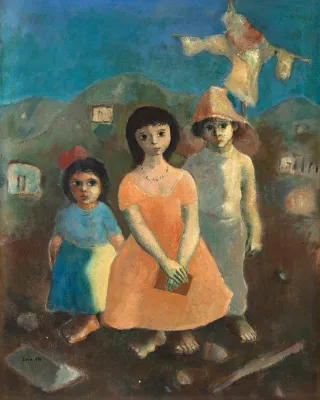
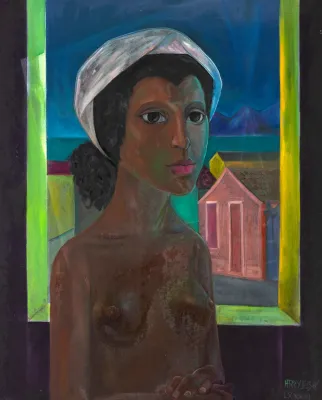
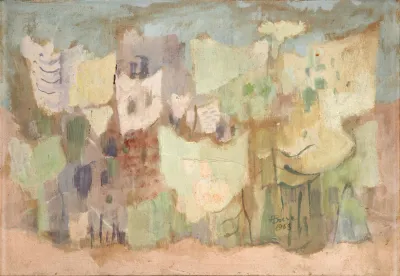
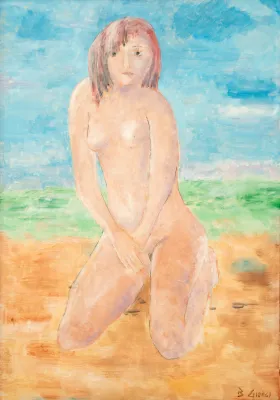
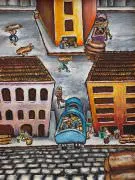
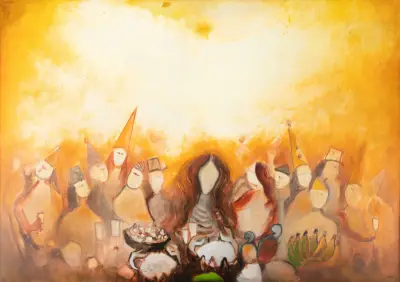
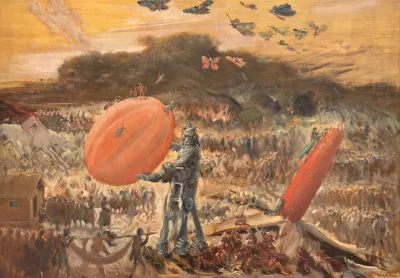
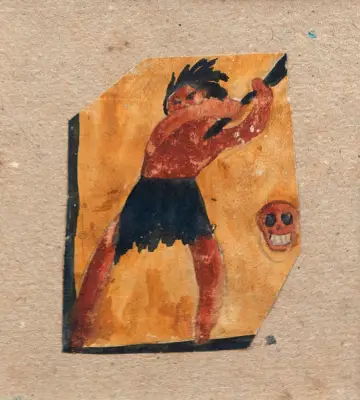
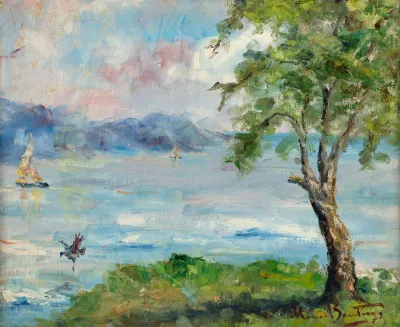
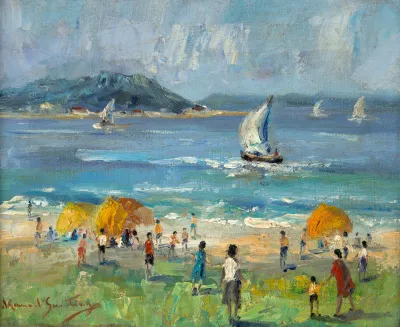
At the beginning of his career, Manoel Santiago Pinta Nus Femininos and works on a theme linked to the indigenous legends of the Amazon, carried out in a luminous palette, inspired by the Impressionists, with free brush strokes. His work reveals an affinity with that of Haydeá Santiago, his wife, although the production of this has a more intimate character, with themes related to genre scenes.
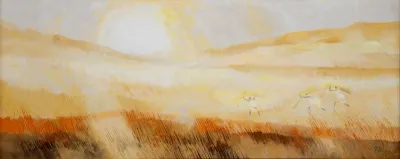
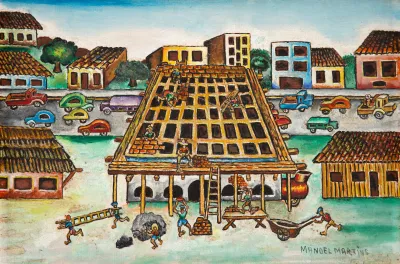
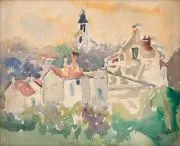
Manoel Santiago represents the landscape of Rio de Janeiro on numerous canvases. The critic Angyone Costa, in an article from 1932, praises his work, stating that the light of certain misty days of the carioca land had not had a better interpreter, with the exception of Eliseu Visconti.1 In Alto Teresópolis, 1947 highlights the refined use of color and a light that transfigures the landscape, in addition to the use of thick brushstrokes.
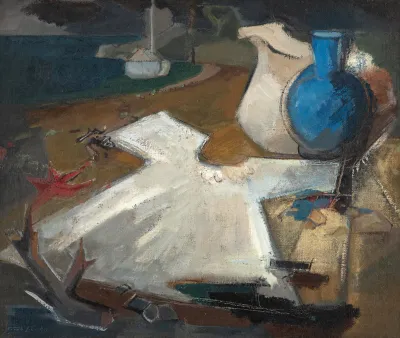
Some of its canvases evoke, in its structure, the production of Jean-Baptiste-Camille Corot, as in Pescador, déc.1960, in which he explores the effects of light on the rough bark of the tree in the foreground. In later works, the use of color becomes freer, as in the coastal landscapes of Maranhão and Paraíba, déc.1980.
Notes
1 mentioned in Morais, Frederico. Núcleo Bernardelli: Brazilian art in the 30s and 40s. Rio de Janeiro: Pinakotheke, 1982, p. 79.
Criticism
"Santiago, vigorous artist's temperament and defined personality. The landscape, the main piece of his contribution, is a museum work. not to acquire it. He is, above all, a great landscaper. In such a way that he treats the figure, in his portraits, as if it were landscapes. Aerial, as well as the linear, which give a sense of breadth, almost do not exist. Its portraits lack volume, are modulated by tonal chords. A tree, the sea or a human face has the same treatment, always prevailing the poetic and radiant sense of the style. In place of the psychological sense, of the intimate interpretation of the portrayed character, as the true portraits are usually, the color that literally dominates this painter makes the drawing explode and the work becomes open, free from the contour drawing, like every impressionist canvas. It is not just the fixation of the fleeting-eternal that defines the impressionist picture, nor its separate brushstrokes, but mainly the transformed transcription of nature into colored poetry."
Alfredo Galvão
AQUINO, Flávio de. Manoel Santiago: life, work and criticism. Presentation by J. Cabicieri. Rio de Janeiro: Cabicieri, 1986.
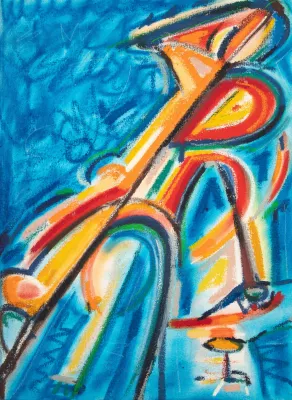
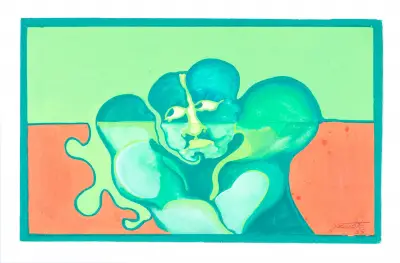
"Throughout his extensive career, Manoel Santiago, the great landscaper, also had the figure as the main theme of his painting several times. the nude or the portrait, the figure as an attempt to probe the intimate of the model. Manoel Santiago faced this problem in two different ways. the first, trying to loyalty to the model; The second, looking - and did it successfully -, bowing the model to its fluid and impressionistic style. In his reproductions, as confluent ways of linking the psychic expression of the portrayed to the fractional way, it approaches the fauvecubist. (...) Manoel Santiago's theosophical ideas are of interest, because they better explain the work's interaction with the author's thinking. If when he sees a figure, an object, a being or a landscape, he feels them as a form, as pictorial images; However, his temperament, his ideas also act as a primordial element. 'Style is the man' (Flaubert). but not man in his appearances, but in his deepest existential sense. And the style of Manoel Santiago is that of the idealistic, spiritualist and theosophical man who was the painter. In this way, when he says that “life is one, the forms are multiple” is, in the end, proclaiming that the interpretations of life and the environment in which life exists are multiple, but this multiplicity obeys the artist's one view. Its object is, therefore - as he wrote -, to interpret the ideal, to make an idealistic art, elevated spiritually with intuition and sensitivity. He also speaks - and with propriety - that creation and pictorial matter are inseparable".
Flávio de Aquino
AQUINO, Flávio de. Manoel Santiago: life, work and criticism. presentation by j. Cabicieri. Rio de Janeiro: Cabicieri, 1986.
Individual exhibitions
1987 - Rio de Janeiro RJ - Individual, at Toulouse Art Gallery
Exhibitions Collectives
1920 - Rio de Janeiro RJ - 27th General Exhibition of Fine Arts, at ENBA
1921 - Rio de Janeiro RJ - 28th General Exhibition of Fine Arts, at ENBA
1922 - Rio de Janeiro RJ - 29th General Exhibition of Fine Arts, at Enba
1923 - Rio de Janeiro RJ - 30th General Exhibition of Fine Arts, at Enba
1924 - Rio de Janeiro RJ - 31st General Exhibition of Fine Arts, at ENBA
1925 - Rio de Janeiro RJ - 32nd General Exhibition of Fine Arts, at ENBA
1926 - Rio de Janeiro RJ - 33rd General Exhibition of Fine Arts, at Enba
1927 - Rio de Janeiro RJ - 34th General Exhibition of Fine Arts, NA ENBA - Exterior Travel Award
1927/1932 - Paris (France) - French Artists' Hall, Autumn Hall, Artist Colonial Hall of Artists French, Tuileries Salon and Winter Salon
1929 - Rio de Janeiro RJ - National Salon of Fine Arts - Gold Medal
1932 - Rio de Janeiro RJ - 1st Salon of the Bernardelli Nucleus, at Sociedade Sul-Riograndense de Culture
1933 - Rio de Janeiro RJ - 40th General Exhibition of Fine Arts, at Enba
1935 - Rio de Janeiro RJ - 4th Salon of the Bernardelli Nucleus, at Enba
1936 - São Paulo SP - 4th Paulista Salon of Fine Arts - Honorable Mention
1937 - São Paulo SP - 5th Paulista Salon of Fine Arts - Bronze Medal
1939 - Porto Alegre RS - Salon of Fine Arts - Medal of Honor
1940 - São Paulo SP - 7th Paulista Salon of Fine Arts, at the Salão de Arte Almeida Júnior of the Municipality of São Paulo - Small Silver Medal
1941 - Santiago (Chile) - Exhibition of the IV Centenary of the City of Santiago - Medal of Gold
1942 - São Paulo SP - 8th Paulista Salon of Fine Arts, at the Prestes Maia Gallery
1944 - Rio de Janeiro RJ - 50th National Salon of Fine Arts, at MNBA
1945 - São Paulo SP - 11th São Paulo Salon of Fine Arts, at the Prestes Maia Gallery  - great silver medal
1948 - Rio de Janeiro RJ - National Salon of Fine Arts - Medal of Honor
1949 - São Paulo SP - 15th Salão Paulista de Belas Artes, at the Prestes Maia Gallery
1950 - Rio de Janeiro RJ - A century of Brazilian painting: 1850-1950, at MNBA
1951 - São Paulo SP - 1st International Bienal de São Paulo, at the Trianon pavilion
1954 - Rio de Janeiro RJ - Black and White Hall
1958 - Porto Alegre RS - Panamerican Salon of Art
1961 - Rio de Janeiro RJ - O Rio Na Brazilian painting, at the State Library of Guanabara
1965 - Rio de Janeiro RJ - Hall of the IV Centenary of Rio de Janeiro - Medal of Honor
1968 - Rio de Janeiro RJ - 17th National Salon of Modern Art, in the MAM/RJ
1970 - Curitiba PR - Art Exhibition
1976 - São Paulo SP - 8th Panorama of Current Brazilian Art, at MAM/SP
1982 - São Paulo SP - Exhibition Núcleo Bernardelli: Brazilian art in the years 30 and 40, at the Art Gallery Collection
1984 - São Paulo SP - Tradition and Rupture: Synthesis of Brazilian Art and Culture, at the Biennial Foundation
1985 - Rio de Janeiro RJ - 8th National Salon of Plastic Arts, in the MAM/RJ
Posthumous exhibitions
1989 - São Paulo SP - Thirty-three ways to see the world, at Ranulpho Art Gallery
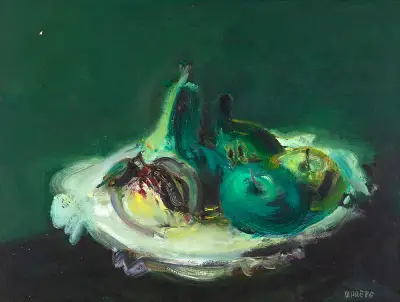
1990 - São Paulo SP - Fruits, flowers and colors, Ranulpho Art Gallery
1996 - Osasco SP - 4th Art Exhibition, at Centro Universitário FIEO
2003 - São Paulo SP - Tomie Ohtake in the Spiritual Plot of Brazilian Art, at Instituto Tomie Ohtake
2004 - Rio de Janeiro RJ - Tomie Ohtake in the spiritual plot of Brazilian art, at MNBA
Source: Itaú Cultural