Le Corbusier (1887-1965)
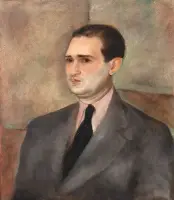
Le Corbusier was an architect, urban planner, sculptor and painter of Swiss origin, naturalized French in 1930. Born October 6, 1887, in Chaux-de-Fonds, Switzerland. He joined the School of Art at the age of 13 and, at 15, received an award from the Turin School of Decorative Arts for a clock design. His first project was carried out in 1906: the home of a watch manufacturer. The following year, he began a trip through Europe with the aim of improving his knowledge and, in 1908, he started working in the office of Auguste Perret, a pioneer of reinforced concrete, whose influence was remarkable in his professional training. Later, he founded the Atelier das Artes Reunidas.
In 1910, he traveled to Germany and worked as a draftsman at the Peter Behrens studio, also a pioneer of modern architecture. The following year, he toured Central Europe and Greece, producing drawings that would later be gathered in the book Travels in the East. along the lines of the Bauhaus, and designed houses for industrialists in the region. In 1914, he developed a garden city project for his hometown and a system for the reconstruction of French cities destroyed by the First World War.
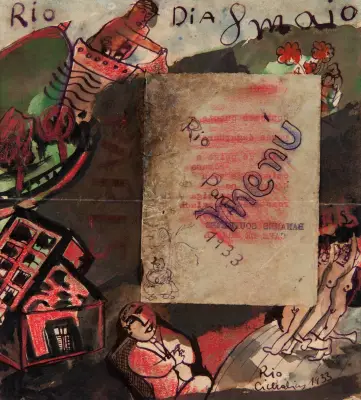
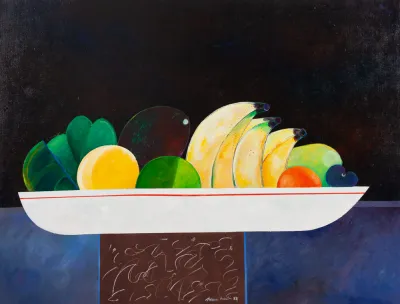
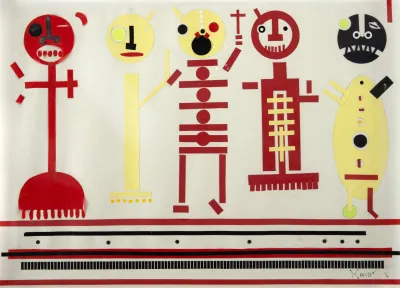
In 1917, he settled in Paris and began to work in the concrete application society. armed. The following year, in partnership with the painter Amédée Ozenfant, he published Après le Cubisme, a work that criticized the Cubist movement and proposed a return to the rigor of the design of the object. From that period onwards, he started painting, already using the pseudonym Le Corbusier, and began to exhibit regularly until 1924.
With Ozenfant, he founded the magazine L’esprit nouveau, which had the collaboration of intellectuals such as Louis Aragon and Jean Cocteau. The publication became its main platform for action, allowing it to publicize innovative architectural proposals even before having a significant production built. This visibility guaranteed him the first orders, especially for country houses on the outskirts of Paris.
His project of developing large-scale housing has remained suspended, since the decisions in France were still strongly influenced by the École Des academics. Beaux-Arts. In view of this, Le Corbusier began to serve a private clientele, formed by connoisseurs of modern art and new conceptions of housing.
Between 1927 and the mid-1930s, his office experienced a period of great activity. He gave conferences and prepared urban projects for several European countries, in North Africa and Latin America, including Brazil, which he visited for the first time in 1929. That same year, he participated in the organization of the I International Congress of Modern Architecture (CIAM), whose resolutions defined The principles of the modern movement in architecture.
In 1930, he married the Parisian Yvonne Gallis and became a French citizen. In 1936, he returned to Brazil to collaborate in the project for the Ministry of Education and Health building. As one of the founders of CIAM, he profoundly influenced Brazilian modern architecture with his ideas.
During the German occupation in Paris, in 1940, He closed his office and took refuge in the south of France. In the following years, he intensified his international performance, consolidating his reputation as a theorist of the new architecture and promoting the viability of new constructive methods. projects carried out, including the Marseille Housing Unit. In 1946 and 1947, he collaborated with Oscar Niemeyer in his studies for the UN headquarters in New York.
Its definitive international recognition took place between 1950 and 1965, the final phase of its career. In 1959, he received the title of Doctor Honoris Causa from the University of Cambridge. He died in 1965.
Individual
2012 - São Paulo - São Paulo - Brazil - Le Corbusier - South America - 1929 (2012 : São Paulo, SP) - Centro Universitário Maria Antonia (São Paulo, SP)
Collective
1998 - Rio de Janeiro - Rio de Janeiro - Brazil - O Rio Não Visa (1998 : Rio de Janeiro, RJ) - Centro Cultural Banco do Brasil (Rio de Janeiro, RJ)
2000 - Valencia - Valencia - Spain - From La Anthropophagia to Brasília: Brazil 1920-1950 (2000 : Valencia, Spain) - Ivam. Center Julio Gonzáles (Valencia, Spain)
2000 - Rio de Janeiro - Rio de Janeiro - Brazil - The Carioca Landscape (2000 : Rio de Janeiro, RJ) - Museum of Modern Art (Rio de Janeiro, RJ)
2000 - Rio de Janeiro - Rio de Janeiro - Brazil - The Carioca Landscape (2000 : Rio de Janeiro, RJ) - Museum of Modern Art (Rio de Janeiro, RJ)
2000 - Rio de Janeiro - Rio de Janeiro - Brazil - When Brazil was modern: plastic arts in Rio de Janeiro January 1905 to 1960 (2000: Rio de Janeiro, RJ) - Paço Imperial (Rio de Janeiro, RJ)
2002 - São Paulo - São Paulo - Brazil - From anthropophagy to Brasília: Brazil 1920-1950 (2002 : São Paulo, SP) - Brazilian Art Museum (São Paulo, SP)
Source: FGV and Itaú Cultural