
Glauco Rodrigues (Bagé RS 1929 - Rio de Janeiro RJ 2004)
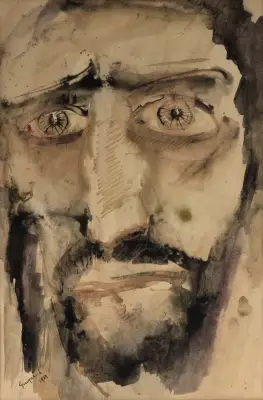
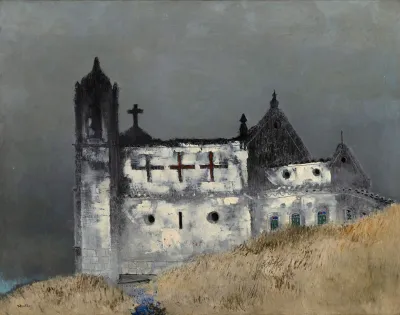
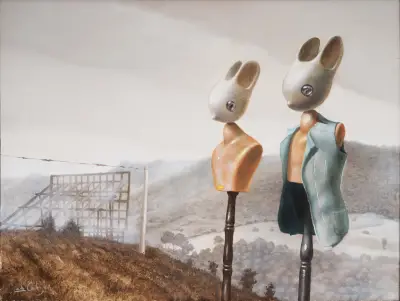
Glauco Rodrigues was a painter, draftsman, printmaker, illustrator and set designer. He began his artistic path as a self-taught artist, starting to paint in 1945. In 1949, he received a scholarship from the Bagé City Hall and, for three months, attended the Escola Nacional de Belas Artes (Enba), in Rio de Janeiro. In 1951, he founded the Clube de Gravura de Bagé with Glênio Bianchetti (1928 - 2014) and Danúbio Gonçalves (1925 - 2019). He settled in Porto Alegre, where he took part in the local Clube de Gravura, founded by Carlos Scliar (1920-2001) and Vasco Prado (1914-1998). In 1958, he moved to Rio de Janeiro, where he was part of the first team of the magazine Senhor. Between 1962 and 1965, he lived in Rome. After returning to Brazil, he took part in important exhibitions, such as Opinião 66, at the Museu de Arte Moderna do Rio de Janeiro (MAM/RJ). In the late 1950s, his production began to approach abstraction, but in the 1960s he returned to figuration, creating works influenced by pop art.
With humor, he addressed national themes such as the image of the Indian, carnival, football, tropical nature and the history of Brazil, which inspired series such as Terra Brasilis (1970), Carta de Pero Vaz de Caminha (1971), No País do Carnaval (1982) and Sete Vícios Capitais (1985). In the 1980s, he received the Golfinho de Ouro Prize in Visual Arts from the Government of the State of Rio de Janeiro and published the book Glauco Rodrigues, which brings together his entire body of work. In 1999, he was awarded the Ministry of Culture's Candido Portinari Prize in Visual Arts.
Critical Commentary
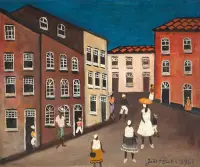
Glauco Rodrigues takes up painting in 1945, as a self-taught artist. In 1949, he takes lessons with the painter José Moraes (1921 - 2003), who sets up a collective studio near Bagé, Rio Grande do Sul. That year, he receives a scholarship from the Bagé City Hall and attends the Escola Nacional de Belas Artes - Enba, in Rio de Janeiro, for three months. With the artists Glênio Bianchetti (1928 - 2014) and Danúbio Gonçalves (1925 - 2019), he creates the Clube de Gravura de Bagé in 1951. Three years later, he joins the Clube de Gravura de Porto Alegre. During the period in which he frequents these printmakers' associations, his works focus on the depiction of rural people and of regional types and customs. He moves to Rio de Janeiro in 1959, when, as an illustrator, he is part of the first team of the magazine Senhor. He lives in Rome between 1962 and 1965. On returning to Brazil, he takes part in important exhibitions, such as Opinião 66, at the Museu de Arte Moderna do Rio de Janeiro - MAM/RJ.
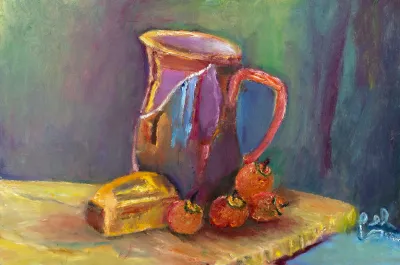
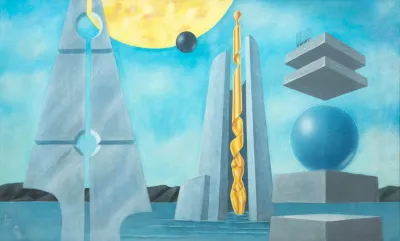
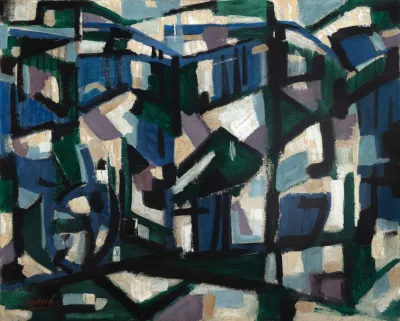
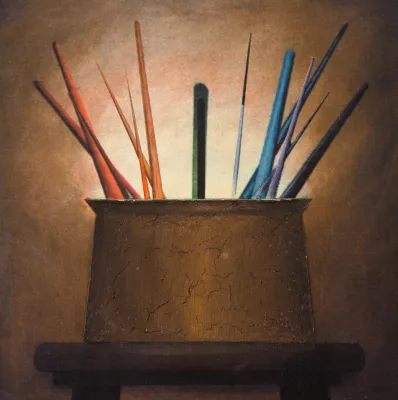
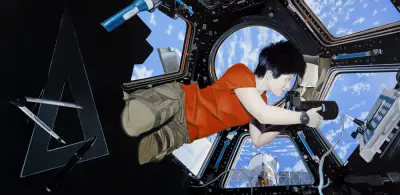
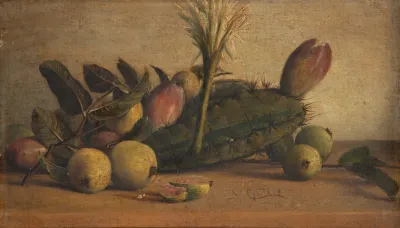
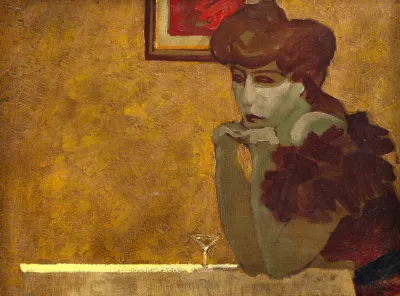
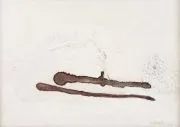
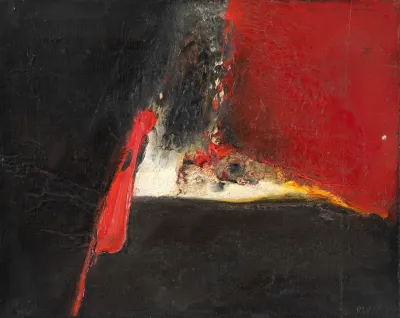
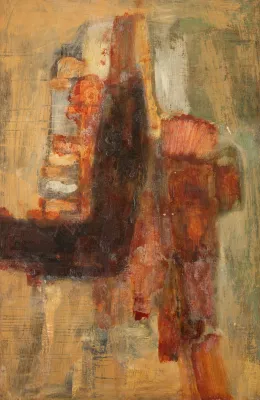
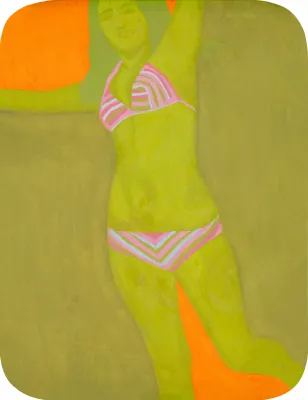
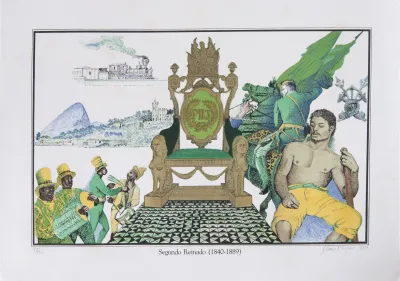
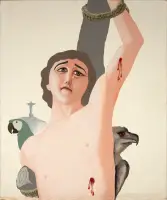
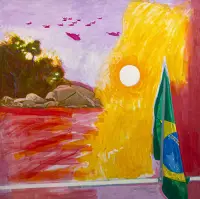
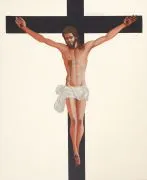
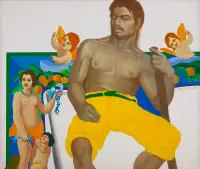
From the late 1950s and during the period he lives in Italy, his production approaches abstraction, as in Paisagem de Porto Alegre, 1957, or takes on an openly abstract character, as in the series of watercolors made in Rome. He returns to figuration in the early 1960s and produces works under the impact of pop art, such as O Mito, 1964/1965, and Pão de Açúcar, 1968, or the series Carta de Pero Vaz de Caminha, 1971, in which the discovery of Brazil is told as a comic strip. From the 1970s on, he begins to incorporate historical characters into his works, together with contemporary figures. He often quotes celebrated paintings, such as the figure from O Derrubador Brasileiro, 1879, by Almeida Júnior (1850 - 1899), present in Abrasileirar-Se, 1986, and Paz na Tarde, 1989, or Primeira Missa no Brasil, 1860, by Victor Meirelles (1832 - 1903), revisited in a work of the same name dated 1980. The canvas A Ira, 1985, features the figures from the fresco Expulsion from Paradise by the Renaissance painter Masaccio (1401 - 1428).
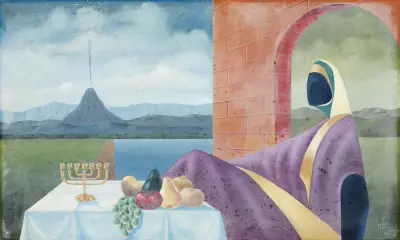
His paintings reveal a process of critical carnivalization of Brazilian visual culture: the presence of the Indian, carnival, football and tropical nature is constant, as in De Natureza Tão Sutil, 1970, or Abaporu, 1981, along with images appropriated from significant 19th-century artists. Some critics highlight the hyperrealist character of his paintings, as in A Juventude, 1970. In several works he reveals an interest in the Brazilian landscape, as in Icatu-Água Boa, 1975.
According to the critic Roberto Pontual, Glauco Rodrigues's work shows a character of "critical tropicalism", questioning the Brazilian social and political context through identifiable characters from the historical past and using a light irony. He starts from photographic sources, postcards or reproductions, regarding photography as a fixer of facts and gathering on the surface of the canvas signs of a reality that presents itself as undeniably Brazilian: samba or the Indian, for example. In his canvases he constantly uses green and yellow and the Brazilian flag itself. In the critic's view, humor and celebration are tactics through which the artist questions a series of clichés associated with the country's image.
Critiques
"The critical spirit begins to emerge in 1969, in the first paintings of the Terra Brasilis series, when tropicalist enthusiasm and a full understanding of Oswald de Andrade's anthropophagy lead him to create photographic-realist montages with the physical urban iconography of Brazilianness; he draws on the anarchic-constructive spirit of our roots and influences to reveal a hidden characteristic of order and decoding that comes to reflect the reality of an untold history, in which the fait accompli, marked in time and space, is permeated by a permanent renewal in motion. This process is refined in the following series, O Descobrimento do Brasil, in which the narrative is structured through the sum of icono-historical details which, taken intact from the most diverse sources, are given new dimensions from a critical standpoint in the search for the Brazilian collective unconscious, in a work of synthesis and justification of past and present time. Updating the classic images of Brazilian painting by inserting trivial, everyday images gathered from urban life, he recreates the fable of our destiny with ancestry and humor. His experience as an illustrator, layout artist and graphic designer influenced the most recent phase of his work, when he moved from abstraction to the conquest of the transfigured real image, giving new life to the static document, with the utmost fidelity to the specific atmosphere of time and space, with great power of synthesis and simplicity of language. A conceptual and critical work, typical of a contemporary creator".
Samyra B. Serpa Crespo and others
LOUZADA, Júlio. Artes plásticas Brasil 1985: seu mercado, seus leilões. São Paulo: J. Louzada, 1984.
"A regionalist and realist when he belonged to the Clube de Gravura in 1950, informal in his European period (1960s), Glauco Rodrigues has produced, since the 1970s, a painting devoted to Brazilian themes, adopting devices drawn from pop art and hyperrealism, but viewing our culture through the prism of allegory or carnivalization. As he himself admits: 'I would say I am a kind of samba school. My theme in 1970 was Terra Brasilis; in 1971, Carta de Pero Vaz de Caminha; in 1972, Os Olhos do Senhor Estão em Todo Lugar, Contemplando os Maus e os Bons; in 1973, Adivinhações; in 1974, Accuratisima Brasiliae Tabula; in 1975, Pau-Brasil; in 1976, Tradições Gaúchas; and Visão da Terra in 1977'. In his more recent paintings, among them Le But de la Peinture, of 1985, Glauco Rodrigues restages his own parade, reaffirming and deepening the basic characteristics of his work, while accentuating technical virtuosity and the erotic charge of the subjects, of color and of the very act of painting - whole areas of pure color coexist with patches and vibrant touches of the brush".
Frederico Morais
DA COLEÇÃO: os caminhos da arte brasileira. São Paulo: Júlio Bogoricin, 1986.
"Glauco's return to figuration coincided with his return to Brazil, and his way of rediscovering figuration and the Brazil of just after 1964 - that astonished paradise - was to use metaphor. The anecdotal fact transformed by intelligence and critical acuity, the anecdotal fact and the pictorial fact finally reconciled in a common aim, the image used at once to delight the eye and as commentary and suggestion. At once impact and reflection, realism and delirium. Metaphor was somewhat imposed by the restrictions of the time, when you had to be careful how you said things. But it was also the eye of Bagé turned on the wrong turns of the republic.
(...)
Glauco painted the turmoil and the fear. In successive exhibitions from that time on he created a kind of great parade, in which Brazil saw itself in colorful allegories, as on a catwalk.
At a time when little could be written about the prevailing folly, Glauco put it into his paintings. The juxtaposition of contrasting elements, all meticulously reproduced, for ironic or dramatic effect. Our self-devouring vocation reaffirmed and at the same time satirized, with quotations of old paintings and the evocation of an entire national graphic memory".
Luis Fernando Verissimo
RODRIGUES, Glauco. Glauco Rodrigues. Rio de Janeiro: Salamandra, 1989. p. 31-35.
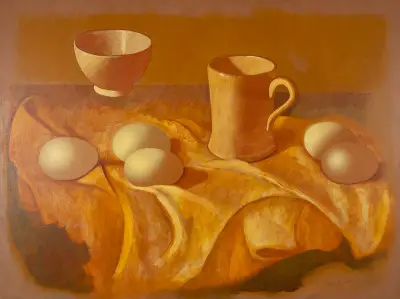
"For forty years, the substance and aim of Glauco Rodrigues's work has been a particular vision of his own country: Brazil. This corresponds to the entirety of his working life so far, from the realist drawing and printmaking with which he set out in the fields of Rio Grande do Sul to the successive series of paintings produced after he settled in Rio de Janeiro. Along the way, there is only one moment of exception to the rule: precisely when, living in Rome between 1962 and 1965, he used informal abstraction to compose analogies and still lifes of nostalgic chromatic ardor. But with his return to his homeland and under the influence of the then-thriving pop art, our artist soon set in motion a language system entirely his own, which, still practiced today, deserves the label of 'critical tropicalism'.
He is primarily interested in rearranging the nation's history from the ingredients bubbling in the country's now half-millennial cauldron. In this particular thread of events he sees a matrix of truths and lies, of encounters and deviations, of hopes and frustrations, whose weave his scalpel-brush sets out to investigate. The operation, however, has nothing of the partisan linearity of a discourse seeking to prove at all costs how this or that happened. It is much more questioning than affirmation. And questioning through irony, farce and derision: an opera buffa of national existence, composed with the memory of the naked and the clothed, the raw and the cooked, the tribe and the metropolis. Pieces of Brazil anthropophagically devoured again to build a new, coherent and complete map. There, the subconscious and the present, finally joined by a logical link, prefigure a country without complexes and without masks, ready to lead its own future.
The unit of the system with which Glauco Rodrigues operates is the cliché, that image of the image through which our view of things settles and becomes immovable in the flow of time. Each of his paintings works like a stage occupied by sets and characters from other places and situations, easily recognizable. Starting from a photographic base (for what is photography but a fixer of facts?), he regroups on the painted surface, through appropriation of a heritage, the immediate signs of a reality that presents itself as excessively, undeniably 'Brazilian': the sun and samba, the Indian and the Copacabana bather, the white Eve and the black malandro, drama and magic, escape and repression, misery and exuberance - baroque excesses of how we see ourselves and how we are seen. In a recent painting, whose title echoes lines from a popular song (Não existe pecado do lado de baixo do Equador - There Is No Sin South of the Equator), all these clichés come together in apotheosis. Brazil seems to show itself there whole, more authentic than ever. But beware: so much effusion of the people is nothing but a veil, a facade, a costume to be taken off when carnival ends. That is when the artist slips in, between the fire and the ash".
Roberto Pontual
RODRIGUES, Glauco. Un opera nomme Bresil. Paris: Galerie Etienne Dinet, 1990.
Testimonials
"In 1945, when the Second World War had not yet ended, Glênio Bianchetti, some others and I formed a group in Bagé, in Rio Grande do Sul. [...] In 1949, I went to Rio de Janeiro. Young, I was marked by the fate of almost all Brazilian artists, that is, being self-taught and subject to hundreds of influences, which is why, a year later, I found myself at a dead end, overly influenced by the School of Paris and above all by Picasso. My painting then reached a point that left me practically without prospects. At that time, I was shuttling back and forth between Bagé and Rio de Janeiro. On one of my trips to my hometown, I had the idea of doing something I had not yet done in my life as a painter: a classical apprenticeship. An in-depth study of drawing, form and composition, trying to draw anatomy and planning in the manner of Leonardo da Vinci. It so happened that, at that moment, in Bagé, there were Glênio Bianchetti, who had been in Porto Alegre, and Danúbio Gonçalves, who had arrived from Europe. We met, and we were all more or less at the same impasse. Soon afterwards Carlos Scliar came back; he had taken part in that worldwide conflict and had returned to Brazil with the same intention of undertaking this apprenticeship, since modernism had kept him away from classical study. Hence the emergence of the famous Clube de Gravura de Porto Alegre, where we began to draw. [... Our] apprenticeship was taken very seriously, so much so that we worked with live models, and it provided a way out of the dead end to which the School of Paris had led me, allowing me to return to classical painting, to a clear and sharp figuration. In fact, working together in this apprenticeship, we were all teachers to one another, since each of us was a master to the others, as shown by the criticism we made of the works produced. At that same time, our interest in the customs, traditions and landscapes of Rio Grande do Sul was born, giving rise to an art that was not exactly social realism, since it was characterized rather by a regional realism".
Glauco Rodrigues to Hugo Auler, September 7, 1977
AULER, Hugo. Um dos caminhos de uma arte brasileira? Correio Brasiliense, Brasília, n. 7, set. 1977.
"What was being done in Brazil in the 1950s was art with the full influence of the School of Paris, and our group felt that we had to make Brazilian art, so we went into the detail of things, portraying our customs. That was our position. We were a group here in Rio Grande do Sul, and our position was strongly contested. [...]
Our project was interconnected work and mutual criticism, so as to put into practice our awareness that only by documenting reality, with the most demanding fidelity, would we fulfill the duty of every artist, which is to serve. From Porto Alegre we set out for the interior, in this search for what was specifically gaúcho. The more particular, the more universal; the more gaúcho, the more Brazilian. Between 1950 and 1954, the adventure unfolded intensely. Drawing and printmaking served an immediate, concrete purpose. [...]
First, the work has to be good, and then, insofar as it is Brazilian, it is universal. Being Brazilian, we are part of a Western world and are influenced by European painting. What must not be done is to copy. We have to digest these influences, and besides, there is a whole range of information we cannot isolate ourselves from. I follow my instinct; I make no concessions".
Glauco Rodrigues, September 13, 1977
LOPEZ, Maria Beatriz. Glauco Rodrigues sempre perto da temática gaúcha. Zero Hora, Porto Alegre, n. 13, set. 1977.
"I would say I am a kind of samba school. My theme in 1970 was Terra Brasilis; in 1971, Carta de Pero Vaz de Caminha; in 1972, Os olhos do Senhor estão em todo o lugar contemplando os Maus e os Bons; in 1973, Adivinhações; in 1974, Acuratissima Brasiliae Tabula; in 1975, Pau Brasil; in 1976, Tradições Gaúchas; and, in 1977, Visão da Terra: a Lenda do Caotipurú. The forerunner of all these themes is De Natureza tão Sutil, painted in 1970, which features the flag-bearer Neide and the master of ceremonies Delegado, along with a macaw, a rainbow, bananas, etc.
Like every samba school, I follow the rules: my colors are green, yellow, blue and white, with gold, silver and skin tones permitted".
Glauco Rodrigues
RODRIGUES, Glauco. Apoteose Tropical: desfile-exposição com pinturas de Glauco Rodrigues. Rio de Janeiro: Fundação Casa-França Brasil, 1991.
Solo Exhibitions
1961 - Rio de Janeiro RJ - Glauco Rodrigues: Painting, at Petite Galerie
1962 - Munich (Germany) - Glauco Rodrigues: Watercolor, at Consulado Geral do Brasil em Munique
1962 - São Paulo SP - Glauco Rodrigues: Drawing, at Petite Galerie
1963 - Frankfurt (Germany) - Glauco Rodrigues: Watercolor, at Casa da Cultura de Frankfurt
1963 - Rome (Italy) - Glauco Rodrigues: Painting, at Galeria d'Arte della Casa do Brasil
1963 - Stuttgart (Germany) - Glauco Rodrigues: Watercolor, at Galeria Maercklin
1964 - Rio de Janeiro RJ - Vinyl Temperas and Watercolors from Rome, 1962/64, at Petite Galerie
1965 - Rio de Janeiro RJ - Glauco Rodrigues: Painting, at Petite Galerie
1965 - Rome (Italy) - 50 Disegni dal 1960 a 1963, at Galeria Bianco e Nero
1966 - Porto Alegre RS - Glauco Rodrigues: Painting, Drawing and Silkscreen, at Galeria Leopoldina
1966 - Rio de Janeiro RJ - Glauco Rodrigues: Painting, Watercolor, Drawing and Objects, at Galeria Relevo
1967 - Rio de Janeiro RJ - Drawings for the Titles of the Film Garota de Ipanema, at Galeria Santa Rosa
1968 - Porto Alegre RS - Glauco Rodrigues: Painting and Drawing, at Galeria Leopoldina
1969 - Rio de Janeiro RJ - Beach Scenes, at Petite Galerie
1970 - Rio de Janeiro RJ - Terra Brasilis: Painting, at Galeria Bonino
1971 - New York (United States) - Solo, at Iramar Gallery
1971 - São Paulo SP - Carta de Pero Vaz de Caminha sobre o descobrimento da Terra Nova que fez Pedro Álvares Cabral a El Rey Nosso Senhor: Sequence of 26 Paintings, at Galeria de Arte Portal
1973 - Brasília DF - Adivinhações (Riddles): Painting, at Oscar Seraphico Galeria de Arte
1973 - Rio de Janeiro RJ - Glauco Rodrigues 1964/1973: Paintings in Private Collections, at Centro Cultural Lume
1973 - Rio de Janeiro RJ - Proverbs: The Eyes of the Lord Are in Every Place, Beholding the Good and the Evil, at Galeria Luiz Buarque de Hollanda e Paulo Bittencourt
1974 - São Paulo SP - Acuratíssima Brasiliae Tabula, at Galeria de Arte Ipanema
1975 - Rio de Janeiro RJ - Pau Brasil, at Galeria de Arte Ipanema
1977 - Porto Alegre RS - Gaúcho Traditions: Paintings and Silkscreens, at IAB/RS
1977 - Rio de Janeiro RJ - The Legend of the Coati-Puru, at Galeria de Arte Ipanema
1977 - São Paulo SP - Glauco Rodrigues: Aquarela do Brasil, at Galeria de Arte Ipanema
1979 - Rio de Janeiro RJ - Tourist and Historical Guide to Rio de Janeiro in the Time of the Viceroys: Tribute to Leandro Joaquim, at Galeria de Arte Ipanema
1980 - Bagé RS - Glauco Rodrigues: Lithographs, at Museu da Gravura Brasileira
1981 - Brasília DF - Glauco Rodrigues: Imaginary Brazilian Landscapes, at Oscar Seraphico Galeria de Arte
1981 - Porto Alegre RS - Memories, at Cambona Centro de Artes
1981 - Rio de Janeiro RJ - Glauco Rodrigues in the Land of Carnival: Tribute to Tarsila, at Galeria de Arte da Gávea
1983 - Porto Alegre RS - Glauco Rodrigues from 1952 to 1983, at Masson Galeria de Arte
1985 - Rio de Janeiro RJ - Glauco Rodrigues: The 7 Deadly Sins, at Galeria Estampa
1986 - São Paulo SP - Solo, at Escritório de Arte São Paulo
1987 - Rio de Janeiro RJ - Picturesque and Historical Voyage to Brazil, at GB Arte
1988 - Rio de Janeiro RJ - Glauco Rodrigues: Watercolors, at GB Arte
1989 - Porto Alegre RS - Glauco Rodrigues: Graphic Works, at Espaço Cultural BFB
1989 - Porto Alegre RS - Glauco Rodrigues: Imaginary Gaúcho Landscapes, at Galeria de Arte Mosaico
1989 - São Paulo SP - Solo, at Escritório de Arte São Paulo
1989 - São Paulo SP - Solo, at Paulo Prado Galeria de Arte
1990 - Paris (France) - Un Opera Nomme Bresil, at Galerie Étienne Dinet
1990 - São Paulo SP - Glauco Rodrigues: Paintings and Watercolors, at Escritório de Arte São Paulo
1991 - Rio de Janeiro RJ - Tropical Apotheosis, at Fundação Casa França-Brasil
1995 - Barra Mansa RJ - Solo, at Centro Universitário de Barra Mansa
1999 - Porto Alegre RS - Solo, at Galeria de Arte Mosaico
Group Exhibitions
1948 - Porto Alegre RS - The Young Artists of Bagé, at Jornal Correio do Povo
1949 - Rio de Janeiro RJ - 55th National Salon of Fine Arts - Modern Division, at MNBA - honorable mention
1950 - Rio de Janeiro RJ - 56th National Salon of Fine Arts - Modern Division, at MNBA - bronze medal
1951 - Rio de Janeiro RJ - 57th National Salon of Fine Arts - Modern Division, at MNBA - silver medal
1952 - Porto Alegre RS - Clube da Gravura de Porto Alegre
1952 - Rio de Janeiro RJ - 1st National Salon of Modern Art, at MAM/RJ
1953 - Rio de Janeiro RJ - 2nd National Salon of Modern Art, at MNBA
1954 - Goiânia GO - Exhibition of the National Congress of Intellectuals
1954 - Rio de Janeiro RJ - Black and White Salon, at Palácio da Cultura
1956 - São Paulo SP - Contribution to Realism, at MAM/SP
1959 - São Paulo SP - 5th Bienal Internacional de São Paulo, at Pavilhão Ciccilo Matarazzo Sobrinho
1960 - Rio de Janeiro RJ - 4th National Salon of Modern Art, at MAM/RJ - domestic travel award
1961 - Paris (France) - 2nd Biennale des Jeunes
1961 - Rio de Janeiro RJ - 1st The Face and the Work, at Galeria do Ibeu Copacabana
1961 - São Paulo SP - 6th Bienal Internacional de São Paulo, at Pavilhão Ciccilo Matarazzo Sobrinho
1961 - São Paulo SP - Group Show, at Petite Galerie
1962 - Kassel (Germany) - Brasilianische Künstler der Gegenwart, at Kasseler Kunstverein
1962 - Spoleto (Italy) - Brazilian Prints and Drawings
1962 - Washington (United States) - Spotlight in Brazil, at OEA
1963 - Spoleto (Italy) - Arte del Sud America
1964 - Venice (Italy) - 32nd Venice Biennale
1966 - Houston (United States) - Group Show, at Kiko Gallery
1966 - Rio de Janeiro RJ - Self-Portraits, at Galeria do Ibeu Copacabana
1966 - Rio de Janeiro RJ - Opinião 66, at MAM/RJ
1966 - Rio de Janeiro RJ - Supermercado 66, at Galeria Relevo
1967 - Petrópolis RJ - 1st National Salon of Young Painting, at Hotel Quitandinha
1967 - Rio de Janeiro RJ - Group Show, at Petite Galerie
1967 - Rio de Janeiro RJ - Nova Objetividade Brasileira (New Brazilian Objectivity), at MAM/RJ
1967 - São Paulo SP - 9th Bienal Internacional de São Paulo, at Fundação Bienal - acquisition prize
1968 - Belo Horizonte MG - Silkscreens, at UFMG. Faculdade de Letras
1968 - Cali (Colombia) - 1st Salón Austral y Colombiano de Pintura - honorable mention
1968 - Rio de Janeiro RJ - 1st Rio de Janeiro Art Fair, at MAM/RJ
1968 - Rio de Janeiro RJ - Group Show, at Galeria de Arte do Copacabana Palace
1968 - Rio de Janeiro RJ - Group Show, at Galeria Santa Rosa
1968 - Rio de Janeiro RJ - The Brazilian Artist and Mass Iconography, at Esdi
1968 - São Paulo SP - Group Show, at Galeria Cosme Velho
1969 - São Paulo SP - Group Show, at Galeria Cosme Velho
1969 - São Paulo SP - Group Show, at Paço das Artes
1970 - Rio de Janeiro RJ - Group Show, at Galeria Espaço
1971 - New York (United States) - Group Show, at Iramar Gallery
1971 - Rio de Janeiro RJ - 50 Years of Brazilian Modern Art, at MAM/RJ
1971 - Rio de Janeiro RJ - 9th JB Art Summary, at MAM/RJ
1972 - Rio de Janeiro RJ - 1st Silkscreen Show, at MNBA
1972 - Rio de Janeiro RJ - 50 Years of Brazilian Art: Gilberto Chateaubriand Collection, at Galeria do Ibeu Copacabana
1972 - Rio de Janeiro RJ - Exhibition, at MAM/RJ
1972 - São Paulo SP - Art/Brazil/Today: 50 Years Later, at Galeria da Collectio
1973 - Bagé RS - Four from Bagé, at Fundação Attila Taborda
1973 - Belo Horizonte MG - Group Show, at Escola Theodor Herzl
1973 - Rio de Janeiro RJ - Some Aspects of Brazilian Drawing, at Galeria Ibeu Copacabana
1973 - Rio de Janeiro RJ - Tribute to Eneida, at Galeria Chica da Silva
1974 - Rio de Janeiro RJ - Renouveau de la Figuration, at Galeria Maison de France
1976 - Bagé RS - 2nd Meeting of Visual Artists, at Museu Dom Diogo de Souza
1976 - Porto Alegre RS - For a Brazilian Art: Grupo de Bagé, at UFRGS. Instituto de Artes
1976 - Porto Alegre RS - Gaúcho Traditions, at UFRGS. Instituto de Artes. Pinacoteca Barão de Santo Ângelo
1976 - Salvador BA - Brazilian Art of the 1960s/70s in the Gilberto Chateaubriand Collection, at MAM/BA
1976 - São Paulo SP - Artists from Rio, at Azulão Galeria
1977 - Belo Horizonte MG - 5th Global Winter Salon, at Fundação Palácio das Artes
1977 - Brasília DF - 5th Global Winter Salon
1977 - Brasília DF - Brazilian Art of the 1960s/70s in the Gilberto Chateaubriand Collection, at Fundação Cultural do Distrito Federal
1977 - Recife PE - Brazilian Art of the 1960s/70s in the Gilberto Chateaubriand Collection, at Casarão de João Alfredo
1977 - Rio de Janeiro RJ - 2nd Arte Agora: Vision of the Land, at MAM/RJ
1977 - Rio de Janeiro RJ - 5th Global Winter Salon, at MNBA
1977 - São Paulo SP - 5th Global Winter Salon, at Masp
1978 - Curitiba PR - 1st Curitiba Annual Printmaking Show, at Centro de Criatividade
1978 - São Paulo SP - 1st Latin American Biennial of São Paulo, at Fundação Bienal
1978 - São Paulo SP - The Object in Art: Brazil in the 1960s, at MAB/Faap
1979 - Curitiba PR - 1st Brazilian Drawing Show, at Sala de Exposições do Teatro Guaíra
1981 - Panama City (Panama) - 8 Expresiones Artísticas, at Centro de Convenções Atlapa. Teatro Anayansi
1981 - Rio de Janeiro RJ - From the Modern to the Contemporary: Gilberto Chateaubriand Collection, at MAM/RJ
1981 - Rio de Janeiro RJ - Universe of Carnival: Images and Reflections, at Acervo Galeria de Arte
1982 - Lisbon (Portugal) - Brazil 60 Years of Modern Art: Gilberto Chateaubriand Collection, at Centro de Arte Moderna José de Azeredo Perdigão
1982 - Lisbon (Portugal) - From the Modern to the Contemporary: Gilberto Chateaubriand Collection, at Centro de Arte Moderna José de Azeredo Perdigão
1982 - London (England) - Brazil 60 Years of Modern Art: Gilberto Chateaubriand Collection, at Barbican Art Gallery
1982 - Rio de Janeiro RJ - What House Is This of Brazilian Art
1983 - Porto Alegre RS - Gaúcho Art Book: 1950/1983, at Margs
1983 - Porto Alegre RS - From Past to Present: The Visual Arts in Rio Grande do Sul, at Cambona Centro de Artes
1983 - Rio de Janeiro RJ - 6th National Salon of Visual Arts, at MAM/RJ
1983 - Rio de Janeiro RJ - Brazilian Self-Portraits, at Galeria de Arte Banerj
1983 - São Paulo SP - 14th Panorama of Current Brazilian Art, at MAM/SP
1984 - London (England) - Portrait of Country: brazilian modern art from the Gilberto Chateaubriand collection, at Barbican Art Gallery
1984 - Rio de Janeiro RJ - Recent Donations 82-84, at MNBA
1984 - São Paulo SP - Gilberto Chateaubriand Collection: Portrait and Self-Portrait of Brazilian Art, at MAM/SP
1985 - Brasília DF - Brazilianness and Independence, at Teatro Nacional Cláudio Santoro
1985 - Porto Alegre RS - Iberê Camargo: Trajectories and Encounters, at Margs
1985 - Rio de Janeiro RJ - 8th National Salon of Visual Arts, at MAM/RJ
1985 - Rio de Janeiro RJ - Portrait of the Collector in His Collection, at Galeria de Arte Banerj
1986 - Brasília DF - Iberê Camargo: Trajectories and Encounters, at Teatro Nacional Cláudio Santoro
1986 - Rio de Janeiro RJ - Iberê Camargo: Trajectories and Encounters, at MAM/RJ
1986 - São Paulo SP - Iberê Camargo: Trajectories and Encounters, at Masp
1987 - Rio de Janeiro RJ - To the Collector: Tribute to Gilberto Chateaubriand, at MAM/RJ
1987 - Rio de Janeiro RJ - Rio de Janeiro, February and March: From Modernism to the 80s Generation, at Galeria de Arte Banerj
1988 - Novo Hamburg RS - Carlos Scliar, Glauco Pinto de Moraes and Glauco Rodrigues, at Galeria Contemporânea
1988 - Rio de Janeiro RJ - 88 x 68: A Review of the Years
1988 - Rio de Janeiro RJ - Le Déjeuner sur l'Art: Manet in Brazil, at EAV/Parque Lage
1988 - Salvador BA - The Illustrators of Jorge Amado, at Fundação Casa de Jorge Amado
1989 - Juiz de Fora MG - Each Head a Sentence, at Museu Mariano Procópio
1989 - Ouro Preto MG - Inconfidência Ideology in Process, at Museu da Inconfidência
1989 - Rio de Janeiro RJ - Brazilian Printmaking: 4 Themes, at EAV/Parque Lage
1989 - Rio de Janeiro RJ - Yesterday, Today, Tomorrow, at Galeria do Centro Empresarial Rio
1989 - São Paulo SP - 20th Bienal Internacional de São Paulo, at Fundação Bienal
1990 - Goiânia GO - 20 Years of the Museu de Arte de Goiânia, at Museu de Arte
1991 - São Paulo SP - The Forest, at MAC/USP
1991 - São Paulo SP - Man and Nature, at MAC/USP
1992 - Rio de Janeiro RJ - 1st On the Way to Niterói: João Sattamini Collection, at Paço Imperial
1992 - Rio de Janeiro RJ - Art Printmaking in Brazil: A Proposal for a Mapping, at CCBB
1992 - São Paulo SP - The 1960s/70s: Gilberto Chateaubriand Collection/Museu de Arte Moderna-RJ, at Galeria de Arte do Sesi
1992 - Zurich (Switzerland) - Brasilien: entdeckung und selbstentdeckung, at Kunsthaus Zürich
1993 - Rio de Janeiro RJ - Brazil 100 Years of Modern Art, at MNBA
1993 - Rio de Janeiro RJ - The Paper of Rio, at Paço Imperial
1993 - Rio de Janeiro RJ - Passion of the Gaze, at MAM/RJ
1993 - São Paulo SP - Modern Drawing in Brazil: Gilberto Chateaubriand Collection, at Galeria de Arte do Sesi
1994 - Lisbon (Portugal) - Beyond Taprobana: The Human Figure in the Visual Arts of Portuguese-Speaking Countries, at Sociedade Nacional de Belas Artes
1994 - Rio de Janeiro RJ - Modern Drawing in Brazil: Gilberto Chateaubriand Collection, at MAM/RJ
1994 - Rio de Janeiro RJ - Trenches: Art and Politics in Brazil, at MAM/RJ
1994 - São Paulo SP - Bienal Brasil Século XX, at Fundação Bienal
1994 - São Paulo SP - Poetics of Resistance: Aspects of Brazilian Printmaking, at Galeria de Arte do Sesi
1995 - Brasília DF - Brasília Collections, at Ministério das Relações Exteriores. Palácio do Itamaraty
1995 - Rio de Janeiro RJ - Beyond Taprobana: The Human Figure in the Visual Arts of Portuguese-Speaking Countries, at MAM/RJ
1996 - Bagé RS - Grupo de Bagé: Printmaking Retrospective, at Museu da Gravura Brasileira
1996 - Belo Horizonte MG - Traveling Impressions, at Palácio das Artes
1996 - Porto Alegre RS - Grupo de Bagé in the Margs Collection, at Margs
1996 - Porto Alegre RS - Grupo de Bagé at the Clube de Gravura, at Galeria da Caixa Econômica Federal
1996 - Porto Alegre RS - Grupo de Bagé: Printmaking and the Present, at Centro Municipal de Cultura
1996 - Porto Alegre RS - Grupo de Bagé: Painting and the Present, at Galeria de Arte Mosaico
1996 - São Paulo SP - Ex Libris/Home Page, at Paço das Artes
1997 - Brasília DF - Grupo de Bagé at the Clube de Gravura: The 1950s, at Galeria da Caixa Econômica Federal
1997 - Curitiba PR - Grupo de Bagé at the Clube de Gravura: The 1950s, at Galeria da Caixa Econômica Federal
1997 - Rio de Janeiro RJ - Grupo de Bagé at the Clube de Gravura: The 1950s, at Galeria da Caixa Econômica Federal
1997 - Rio de Janeiro RJ - Visited Poems, at Espaço Cultural dos Correios
1997 - São Paulo SP - Grupo de Bagé at the Clube de Gravura: The 1950s, at Galeria da Caixa Econômica Federal
1998 - Rio de Janeiro RJ - The Image of the Sound of Caetano Veloso, at Paço Imperial
1998 - São Paulo SP - Frontiers, at Itaú Cultural
1998 - São Paulo SP - Impressions: The Art of Brazilian Printmaking, at Espaço Cultural Banespa-Paulista
1998 - São Paulo SP - The Modern and the Contemporary in Brazilian Art: Gilberto Chateaubriand Collection - MAM/RJ, at Masp
1999 - Porto Alegre RS - Garagem de Arte: Inaugural Exhibition, at Garagem de Arte
1999 - Rio de Janeiro RJ - Everyday Life/Art. The Object 1960s/90s, at MAM/RJ
1999 - Rio de Janeiro RJ - Mostra Rio Gravura. Brazilian Modern Printmaking: Museu Nacional de Belas Artes Collection, at MNBA
1999 - São Paulo SP - Everyday Life/Art. Consumption, at Itaú Cultural
1999 - São Paulo SP - Everyday Life/Art. Object 1960s/90s, at Itaú Cultural
2000 - Brasília DF - Brazil Europe Exhibition: Encounters in the 20th Century, at Conjunto Cultural da Caixa
2000 - Rio de Janeiro RJ - Brasil + 500 Mostra do Redescobrimento. Letter of Pero Vaz de Caminha, at Museu Histórico Nacional
2000 - São Paulo SP - Almeida Júnior: An Artist Revisited, at Pinacoteca do Estado
2000 - São Paulo SP - Brasil + 500 Mostra do Redescobrimento. Black in Body and Soul, at Fundação Bienal
2000 - São Paulo SP - Investigations: Brazilian Printmaking, at Itaú Cultural
2001 - Brasília DF - Investigations. Brazilian Printmaking, at Galeria Itaú Cultural
2001 - Penápolis SP - Investigations. Brazilian Printmaking, at Galeria Itaú Cultural
2001 - Rio de Janeiro RJ - Treading the Path of Printmaking, at Museu da Chácara do Céu
2002 - Niterói RJ - Collection on Paper, at MAC/Niterói
2002 - Porto Alegre RS - Drawings, Prints, Sculptures and Watercolors, at Garagem de Arte
2002 - Rio de Janeiro RJ - Paths of the Contemporary 1952-2002, at Paço Imperial
2002 - Rio de Janeiro RJ - Identities: The Brazilian Portrait in the Gilberto Chateaubriand Collection, at MAM/RJ
2003 - Rio de Janeiro RJ - Caixa Treasures: Brazilian Modern Art in the Caixa Collection, at Conjunto Cultural da Caixa
2003 - São Paulo SP - Art and Society: A Controversial Relationship, at Itaú Cultural
2004 - Rio de Janeiro RJ - New Acquisitions 2003: Gilberto Chateaubriand Collection, at MAM/RJ
Source: Itaú Cultural