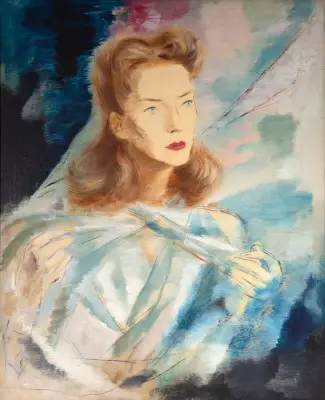
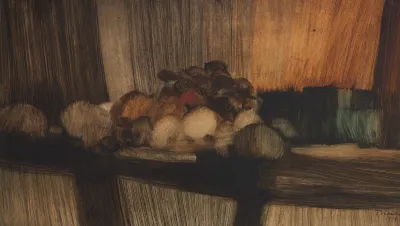
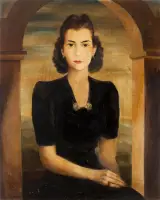
Enrico Bianco (Roma, Italy 1918 - Rio de Janerio RJ 2013)
Enrico Bianco was a painter, engraver, designer and illustrator. He began his studies with Maud Latour, in Rome, in the 1930s. In Rio de Janeiro, between 1935 and 1937, he studied with Candido Portinari (1903-1962) at the Institute of Arts of the University of the Federal District. (UDF). The following year, he worked with Portinari on several works, highlighting the murals of the Ministry of Education and Culture (MEC), the panels of Banco da Bahia and the UN Building, among others. In 1940, he held his first solo exhibition at the Copacabana Palace Hotel. He illustrated the special edition of Hunt for Esmeraldas, by Olavo Bilac (1865-1918), organized by Brazilian bibliophiles, in addition to the recording album of the symphonic poem Anhanguera, by Hekel Tavares, in 1951.
An intellectual and two artists
Rome, 1935. In the vast room of the old mansion, the sound of a piano conveys the chords of a night night from Chopin to the environment.
Sitting at the table, a teenager, in his 17 years, keeps scattered colored pencils, paints and sheets with sketches of drawings. Some paintings take shape on some of them, still unfinished, but forwarded to the resolution, with the security of someone who knows what they are doing. end of the day.
The man is Francesco Bianco, writer and international correspondent for «Jornal do Brasil», from Rio de Janeiro. The pianist, his wife, is Maria Bianco-Lanzi who, in addition to virtuosity and familiarity with the keyboard, is endowed with an unusual culture. of age, encouraged by his parents, had been studying drawing and painting, having listed among his masters some well-known names in Italian art, such as Deoclécio Redig de Campos, who became the director of the Vatican Museum. Ricci, once a teacher of the royal family, not so famous, but equally capable and strict, passing on to the student not only the techniques but above all a concept of strict discipline, necessary for those who wish to carry on any artistic work. your work. The young man, who trained at least six hours a day, is immersed in his chores. And the sound of the piano continues, illuminating the environment and inspiring the artist.
Adio,Italia Mia
So, once, the piano was silent. silenced forever. The Bianco family lived at that moment their worst days. In addition to the tragedy that befell them, with the painful loss of his wife and mother, the problems accumulated, with no prospect of a solution.
Francesco Bianco was once a deputy for Christian democracy and, with the rise of fascism in Italy, it fell into disgrace. the «Jornal do Brasil», living the crisis of the 1930s and feeling the effects of the closure of the regime also in Brazil, after the inauguration of Getúlio Vargas, dismissed it from the position of its correspondent in Italy. Italy, Francesco might as well get a new job, but to work in the press or any media outlet, he would need to have a fascist license, which neither he wanted to take, nor would he be given, due to his political background.
There was another possible way out, which was to travel to the Brazil, where he had already been in 1920. There, he even had a job promise at Italcable, a telegraphic service for submarine cables that competed with the American Western. But for that, passports were needed and they were denied to him, as he was considered an enemy of the government, undesirable when close and uncontrollable when far away.
Avanti Tutti
Feeing the emerging difficulties, the family doctor, who was also Cardiologist of Mussolini, proposed to seek a solution and, during a routine consultation with the dictator, risked a sentence: «The wife of Bianco died».
«I know», replied the Duce. The answer was cold, but not unfriendly or ostentatious. The doctor risked another onslaught: “He wants three passports, for him and the two children.”
A new and prolonged silence and then Mussolini responds firmly: “For he fills in the papers, I authorize the Issue.»
And that was how, in 1937, led by the forces of fate, Enrico Bianco arrived in Rio de Janeiro, accompanied by his father and sister, establishing himself forever in Brazil. Months after his arrival, he had a meeting that marked him for the rest of his life.
The hand of the prospector
Six months ago Bianco was in Brazil when the painter Paulo Rossi suggested he visited a work that Portinari was preparing in the headquarters of the Ministry of Education. He went, but only found three helpers there: Burle Marx (1909-1994), Inês and Ruben Cassa (1905). Garimpeiro, asked him to let him try and, counting on his assent, he painted that detail by himself. The disciples pointed to Bianco, huddled in a corner, to whom the master apparently paid little or no attention. At lunchtime, he decided to return to the house, saying goodbye to Portinari, who asked him, with the usual energy: “But where are you going?” «I'm going home», replied Bianco.
The master held out his hand, with the same angry face and asked him: «But tomorrow you will come back, don't you come back? From Portinari, becoming, for many, many years, a valiant collaborator.
The «hand of the prospector», Bianco's first intervention in the master's painting, is still there, where it was painted. And Portinari's influence on Bianco is visible in many of his paintings. The painter grew up, took on a life of his own, but never strayed from the style he assimilated and learned to respect.
Barrado at the dance
The approximation between Bianco and Portinari, if on the one hand, it only brought him pride and Admiration, on the other hand, also caused him problems, notoriously due to the aversion of some Brazilian politicians to Portinari, mainly for his ideology and political positions. Although the Master was not an activist, the simple fact of showing sympathies to communism put him under the matrixist sight and, with him, all those who followed him.
In 1960, Mexico took care of the organization of its 2nd Bienal and, wishing to include some Brazilian artists in it, he sent here a representative, who, among others, invited Enrico Bianco, in charge of preparing three paintings especially for the event.
As Itamarati offered to pay the expenses of Travel, he found himself entitled to review the list of guests, scratching from her Bianco, on the grounds that he was born in Italy, not representing Brazilian art.
It was barely possible to hide the aversion to the painter. Bianco was born in Italy but made himself in Brazil in the shadow of one of the greatest Brazilian masters. His theme was all about it focused on our land, our people, our customs. Rubem Braga came out in his defense, in an article published by the magazine «Manchete»:
«I saw the paintings. They are better than I expected, they are good paintings of modern painting in any part of the country and the world, and they are the paintings of a painter trained in Brazil and sensitive to the suggestions and the feeling of Brazilian life are, therefore, excellent paintings of Brazilian painting in any international exhibition. I've seen it and critics can't argue with me, because critics haven't seen it.»
It didn't help. When the state interferes with art, art always leads to worse. and the artist too.
The most Brazilian of the Italians
Enrico Bianco was born in Rome on July 18, 1918. Although Italian, he came to Brazil as a teenager, developing his art in the midst of the effervescence of the Brazilian modernism, activated from the modernist movement of 1921 in Rio de Janeiro and gaining consistency from the 1922 Modern Art Week in São Paulo.
He lived with great Brazilian masters of painting, such as Cândido Portinari, of whom he was a disciple, deprived of the friendship of Burle Max and received torn praise from bow people in the artistic world, such as Antônio Bento and Pietro Maria Bardi.
for having chosen Brazil as his second homeland, for having settled here for Always, and for having developed here practically all his work, with the undeniable influence of Brazilian artists, and having, as a work theme, life, customs and Brazilian society, Bianco can be included, with great propriety, among the painters of Brazil. Victorino
Criticism
"The immediate knowledge with Portinari, the year following his arrival in Brazil, definitively marked Enrico Bianco's drawing and painting since then. (...) Thus, we see, throughout Bianco's work, the search for fusion between apparently opposite poles, which are the organizational discipline of the pictorial space according to schemes of linearities and games of subtly Cubist planes, and propensity. In fact, more comprehensive, in the sense of expressionist vehemence. Hence the predominance of the figure in Bianco's work, treated with the concern of recording the drama of typical contingencies of today's world, plus global wars, or under the stimulation of other memories of the drama, in the series of paintings of religious foundation. The landscapes, in turn, accentuated their presence in the current work, without in them, however - despite the agility and identical vehemence in the treatment of the whole -, that same expressionist density of approaching the other themes can be experienced; It is even possible to feel, in these works, a direction for the abstract simplification of each element and its context, although the landscape remains there, visible and reactivated". 50 years later São Paulo: Collectio, 1973.
"Bianco is a talented painter, of which he learns to respect from a young age. does not limit its activity to certain sectors. Everything in life interests you; which allows it to manifest itself in the most varied theme. It flees from formulas and fads. Companion of Portinari, he participated, in the times of the construction of the building of the Ministry of Education and Health, in the action of the Group of Modernists that brought together Mário de Andrade, Manuel Bandeira, Carlos Drummond de Andrade, Graciliano Ramos, Oscar Niemeyer, Lúcio Costa, Carlos Leão, The brothers Roberto and Affonso Eduardo Reidy, Villa-Lobos and how many others are due to the renewal that had its starting point in the week of 22. As an artist emerging from the erroneously called academic tradition, Bianco interests the figure, the landscape, the still life and particularly the field scenes. Each canvas shows the mastery of those who devote themselves to the profession of painter-painter, continuing to consider and reveal cases and encounters".
Pietro Maria Bardi
LOUZADA, Júlio. Market, its auctions. São Paulo: J. Louzada, 1984-.
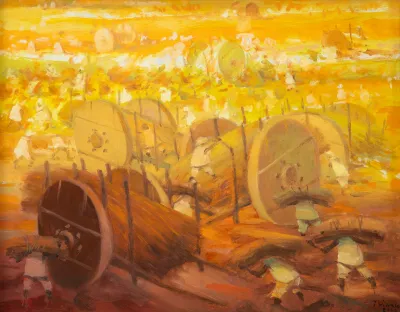
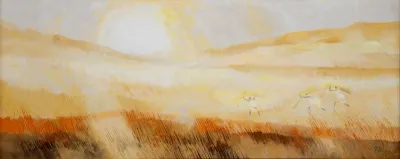
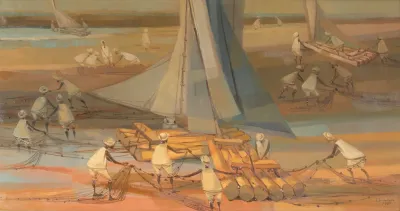
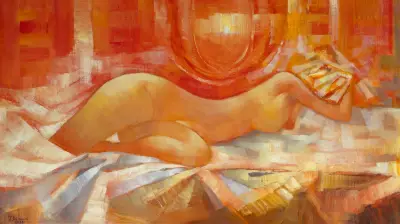
"Enrico Bianco is this rare event, in Brazil, of the artist who paints from a tradition that is over 10 years old. This is, by the way, the first thing that impresses the public when contacting this work. Suddenly there is something different about this work and this is not only in the theme or vision of the artist, but in his way of painting. Which, that is, this difference, this something that draws attention, is in the brushstroke, in the use of pigments, in the colors superimposed on other colors, in the composition and in the design, in the exaltation of the model. The public is sure that these paintings took a long time to be made and that the artist's learning was a long, dedication to a lifetime. These are works that seem to have eliminated chance, even if this is not true. There is a purpose and the dialogue between the work and the public takes place from this observation. And, finally, if we were still at the time of refuting the anecdotal bourgeois, this time we could say that he would not say: "This my 10-year-old son does too". We can certainly call this pictorial doing Enrico Bianco mastery. This knowledge, built by the artist in so many years of labor worship, takes place in some favorite subjects such as the female figure, still life, wheat fields, scenes from rural work, landscapes, in which we find more than the transfiguration of everyday reality, since what is present is the painting made of delicacies, lyricism, hidden sounds. We are no longer interested in exactly the reason why the artist or his visual stimulus starts, but the creation of a single and particular universe. Enrico Bianco does not make flowers, women or herds, but painting".
Jacob Klintowitz
Bianco. Bianco. Curatorship José Adolpho M. Ayres; Presentation Jacob Klintowitz; graphic design Hélio Alves Neves. São Paulo : André Art Gallery, 1997. 25 P. Il. Color.
Individual exhibitions
1940 - Rio de Janeiro RJ - First individual in Brazil, at Copacabana Palace Hotel
1941 - São Paulo SP - Individual, at Galeria ITA
1942 - São Paulo SP - Individual, at Galeria Casa e Jardim
1956 - Rio de Janeiro RJ - Individual, at Petite Galerie
1958 - Rio de Janeiro RJ - Individual, at Galeria Tenreiro
1963 - Europe - Exposicion of América y España
1964 - Lisbon (Portugal) - Individual
1964 - New Orleans (United States) - Individual
1966 - Rio de Janerio RJ - Individual, at Petite Galerie
1966 - Rome (Italy) - Individual, in the Galeria da Casa do Brasil
1967 - Tel Aviv (Israel) - Individual
1967 - Rome (Italy) - Individual, at Galeria Piazza di Spagna
1968 - Recife - Individual, at the Ranulpho Gallery
1970 - Rio de Janeiro RJ - Individual, at the Ipanema Art Gallery
1971 - São Paulo SP - Individual, at The Chelsea Art Galleries Jardim
1972 - Rio de Janeiro RJ - Individual, at Galeria Copacabana Palace
1973 - Rio de Janeiro RJ - Individual, at the Ipanema Art Gallery
1973 - São Paulo SP - Individual, at the Ipanema Art Gallery
1975 - Rio de Janeiro RJ - Individual, at the gallery Graffiti
1976 - Rio de Janeiro RJ - Individual, at the Ipanema Art Gallery
1978 - Rio de Janeiro RJ - Individual, at the Mini Gallery
1980 - São Paulo SP - Individual, at the gallery Renot
1981 - Rio de Janeiro RJ - Individual, at Galeria Dezon
1982 - São Paulo SP - Retrospective Exhibition, at MASP
1982 - Rio de Janeiro RJ - Retrospective exhibition, in the MNBA
1996 - Brasília DF - Individual, at the Itamaraty Palace
1997 - Santos SP - Individual, at the Benedito Calixto Foundation
1997 - São Paulo SP - Individual, at the André Art Gallery
Collective exhibitions
1935 - Rome (Italy) - 1st Quadriennale Nazionale d'Arte
1940 - Rio de Janeiro RJ - Modern Section of the National Salon of Fine Arts - Medal of Silver
1951 - Rio de Janeiro RJ - Exhibition of dead natures, at the Food and Social Security Service
1951 - São Paulo SP - 1st São Paulo International Biennial, at the Trianon Pavilion
1954 - Rio de Janeiro RJ - 8th National Salon of Plastic Arts - Special Room
1954 - Rio de Janeiro RJ - Salão Preto e Branco, at Palácio da Cultura
1954 - São Paulo SP - Contemporary Art: exhibition of the collection of the Museum of Modern Art of São Paulo, in the MAM/SP
1960 - Mexico City (Mexico) - 2nd Inter-American Biennial of Mexico - Special Room
1972 - São Paulo SP - Art/Brazil/Today: 50 years later, at the Collectio Gallery
1974 - Rio de Janeiro RJ - O Mar, at the Ibeu Copacabana Gallery
1981 - Paris (France) - Salon de la Société Nationale des Beaux-Arts
1982 - Rio de Janeiro RJ - Football Universe, at MAM/RJ
1983 - Atami (Japan) - 6th Brazil-Japan Fine Arts Exhibition
1983 - Kyoto (Japan) - 6th Fine Arts Exhibition Brazil-Japan
1983 - Rio de Janeiro RJ - 6th Exhibition of Fine Arts Brazil-Japan, at MNBA
1983 - São Paulo SP - 6th Exhibition of Fine Arts Brazil-Japan, at MASP
1983 - Tokyo (Japan) - 6th Exhibition of Fine Arts Brazil-Japan
1985 - Rio de Janeiro RJ - 8th National Salon of Plastic Arts, at MAM/RJ
1985 - São Paulo SP - 100 works Itaú, at MASP
1986 - Rio de Janeiro RJ - Seven decades of the Italian presence in Brazilian art, at Paço Imperial
1988 - São Paulo SP - 15 years of the Brazil-Japan Fine Arts exhibition, at the Mokiti Okada M.O.A.
1989 - São Paulo SP - Thirty-three ways to see the world, at Ranulpho Art Gallery
1992 - Rio de Janeiro RJ - Eco Art, at MAM/RJ
1993 - São Paulo SP - 100 masterpieces of the Mário de Andrade collection: painting and sculpture, at IEB/USP
1995 - Rio de Janeiro RJ - 1st Riocult, in Riocentro
1996 - Passo Fundo RS - Ruth Schneider Visual Arts Museum: Inaugural Exhibition, at the Ruth Schneider Visual Arts Museum
1996 - Rio de Janeiro RJ - Visions do Rio, at MAM/RJ
1998 - Rio de Janeiro RJ - Negotiated Images: Portraits of the Brazilian Elite, at CCBB
1998 - São Paulo SP - Football in Art, at the André Art Gallery
2000 - São Paulo SP - Collective, at the Ricardo Camargo Gallery
2001 - São Paulo SP - 4 Decades, at Nova André Galeria
2002 - São Paulo SP - Landscapes of the Imaginary, in the new André Galeria
2003 - Rio de Janeiro RJ - Treasures of Caixa: Brazilian modern art in the Caixa collection, in the Caixa Cultural Complex
2003 - São Paulo SP - Entre Aberto, in the Brazilian engraving
Source: Itaú Cultural