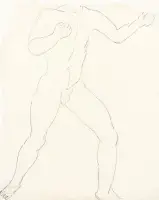
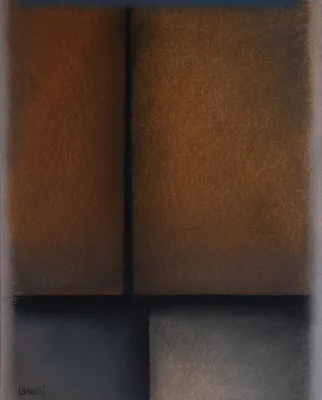
Bernard Bouts (1909 - 1986)
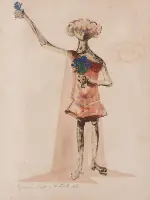
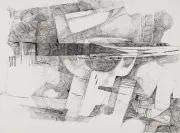
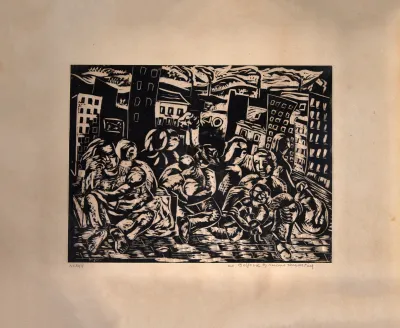
Bernard Bouts was a painter and philosopher of art. He was born on December 2, 1909, in Versailles, France, a descendant of a Flemish lineage that included the painter Thierry Bouts. He spent his childhood in Brittany, where he aroused his fascination with the sea. He began his artistic studies in 1929 with Henri Charlier, from whom he assimilated fundamentals such as the elimination of the dark light and the search for a free rhythm in painting, principles to which he remained faithful throughout his life. France in 1942, during the Second World War, moving to Argentina with his wife and children. He held his first solo exhibition in Buenos Aires in 1943, returning to the city in 1951, at the Wildenstein Gallery. He traveled to several countries in South America, expanding his visual and chromatic references.
In 1954, he began navigation with the sailboat Andariego. In 1961, he acquired the schooner Cisne, in Bahia, where he began to live and paint on board for ten years, traveling through the entire Brazilian coast. Much of his work was dedicated to the navies, reflecting his deep connection with the sea. He remained on the sidelines of the vanguards and the art market, faithful to his aesthetic vision, inspired by ancient traditions such as Egyptian, Byzantine and medieval art. He died while always keeping an independent and nonconformist artist.
The artist
For three years, Bouts attended and taught in France courses in Philosophy of Art.
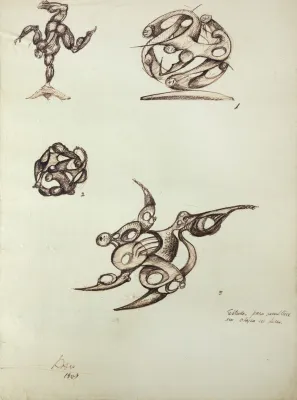
He thus sought to find his own path, from which he did not move away. Only the great artist pays the high price of this intransigent fidelity to himself, because only he, patiently, harmoniously, is able to combine the most solid artisanal and technical knowledge with the most exquisite pictorial language. It is thus understood that, from an early age - from his decisive encounter with Henri Charlier - Bouts, he proved docile to the appeal of the essential and strict values of painting and sculpture, although also attentive to its elements and decorative aspects that always deserve to be considered, because Contrary to what some think, they do not diminish the merits of any artistic work, precisely because they come from the plastic beauty and enchantment of all authentic work of art. It would also be important to note that I would never be an engaged artist! Both in relation to politics, such as this or that current of the supposed vanguard of its times of youth or the precarious current vanguard, Bouts has always remained an independent artist. It is like a man - not as an artist who has had political, philosophical or religious positions. Nobody took him away from the trail he chose, contemptuously to the extreme not only of artistic chapels, from appraisals and critical judgments, but also from exhibitions and official halls. He was a nonconformist by nature. He was never interested in what the public could think about art, both that of others and his. remained until the end of his life faithful to the itinerary he chose in his youth.
Bernard Bouts was always in a solitary position in relation to painting and other visual arts.
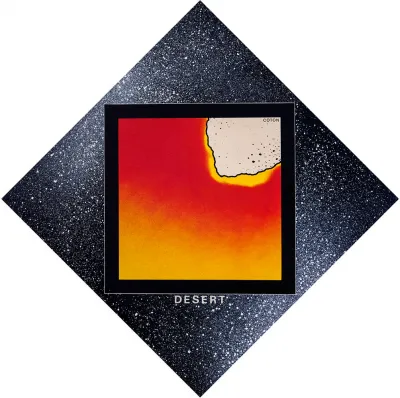
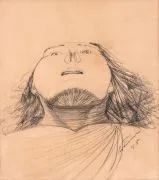
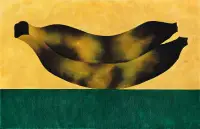
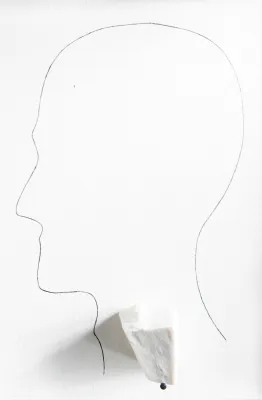
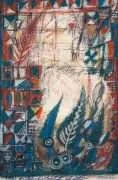
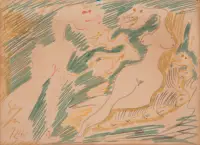
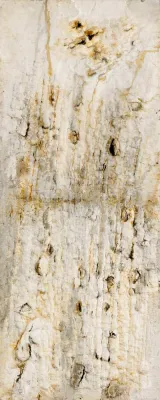
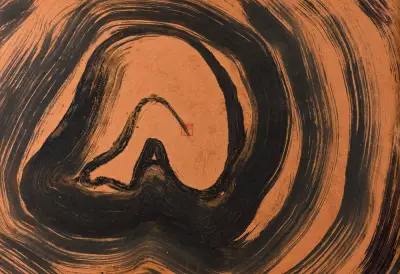
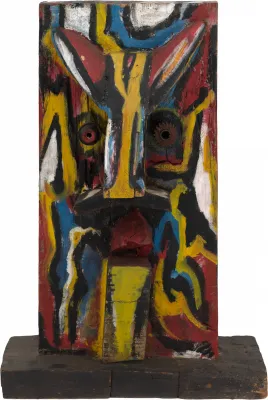
He rebelled with irony or contempt against fashions and the Schools, against all the isms and artistic movements that took place in the Old World, especially throughout this century. He fought the school of Paris and the incessant, successive, overwhelming changes - and for him the unjustifiable art of art subjected to the tyranny of the market in the consumer society. It is always exciting, in this matter, to swim or, as in the case of bouts, sail against the tide. Instead of seeking inspiration from cubism, surrealism and other manifestations of contemporary art, to exercise his admirable creative power he prefers to turn to rock painting, to the forms of ancient pitchers, to the achievements of the artists of the old China, of Egypt, of the Archaic Greece, Byzantium, the Middle Ages of the 13th century and other times. This is indeed a sui-generis behavior. It has the purpose of returning to the constants of periods, for him, decisive in the history of art, carried by the characteristics of his spirit and by specialized studies. Bernard Bouts saw no sense in worrying about different periods or phases in his work, as he always worked in the same direction. It was not uncommon to make three different themes simultaneously and in different techniques.
The relationship with the sea
So that we can better understand the life and work of Bernard Bouts we must know a little about his connection with the sea, whose life has marked him very much since His youth in Brittany, sailing along its beaches. He loved maritime civilization and all its culture from the time of the Phoenicians, becoming a second profession for Bouts, complementing and enriching his art and his thinking.
In South America, Bouts began to navigate in 1954 with the sailboat called the Andariego. He liked to sail, with his wife and his son (his daughter had already died at the age of 7 in Buenos Aires), in the midst of adventure or winds, who always blow whisperly. In his handwritten text, found in his book, Bouts compares his practice as a sailor to his painter's work. thus equates the activity of the sailor to his craft of plastic artist. The confrontation is suggestive and is still unique in our country. This is another of the painter's originalities.
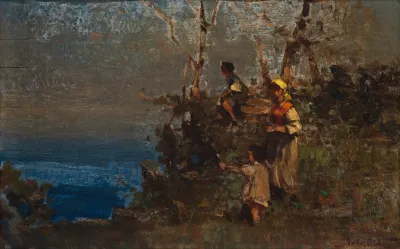
The permanence of the Bouts family in Argentina was interrupted in 1954. Bahia Bernard Bouts comes across a schooner that fascinates him. He asked a friend to buy it for him, if by chance it would be put up for sale in his absence. She had been happy, because she was soon available. That's how on February 1, 1961 he bought the swan, his beautiful schooner, in which he lived and painted. He worked and traveled in this way, for ten years, the entire huge coast of Brazil, from Oiapoque to Chuí. Of this life at sea, Bouts targets the navies one of the main objects of their work.
Source: Artist's Site