Servulus Esmeraldo (Crato CE 1929 - Fortaleza CE 2017)
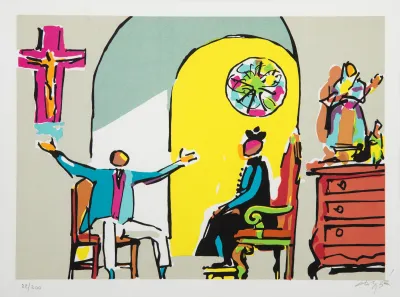
Esmeraldo Servulus was a sculptor, engraver, illustrator and painter, who throughout his career became He dedicated to a series of techniques and artistic movements, always looking for new forms of expression. At the beginning of his trajectory, he focused on the woodcut. From 1947, in Fortaleza, he joined the Ceará Society of Plastic Arts (SCAP), where he kept in touch with artists such as Inimá de Paula, Antonio Bandeira and Aldemir Martins. During this period, he also took painting classes with Jean-Pierre Chabloz. In 1951, he worked on the assembly of the 1st International Biennial of São Paulo, which would mark the beginning of his most intense performance in the national artistic scene. After the Bienal, he moved to São Paulo, where he worked as a recorder and illustrator at Correio Paulistano and started to have contact with important names such as Marcelo Grassmann and Lívio Abramo.
In 1956, he founded the Engraving Museum in the city of Crato, in Ceará, and the following year he held an individual exhibition at the Museum of Modern Art in São Paulo (MAM/SP). With a scholarship from the French government, he traveled to Europe in 1957, where he studied lithography at the École Nationale Supérieure des Beaux-Arts in Paris. During his stay, he had access to the rare works of the Bibliothèque Nationale de France, which allowed him to study in depth the engraving of Albrecht Dürer. Under the guidance of Johnny Friedlaender, Esmeraldo began his work of engraving in metal, having his works published by European editors. From the 1960s onwards, he became part of the kinetic art movement, creating works such as the excitables—frames and objects powered by static electricity.
Returning to Brazil in 1978, he settled again in Fortaleza, where he became dedicate more to public art. He was the founder of the International Exhibition of Ephemeral Sculptures in the capital of Ceará, of which he was curator in 1986 and 1991. His career is marked by the incessant search for innovation and the integration of art with new technologies, remaining one of the great names of the Brazilian art throughout his life.
Critical comment
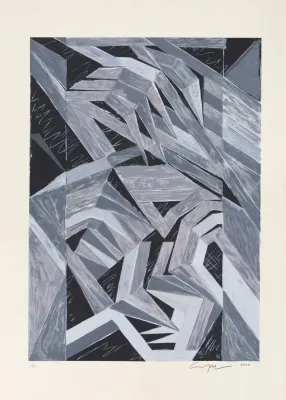
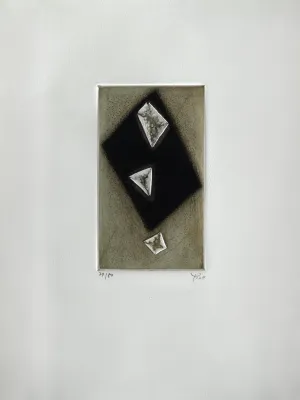
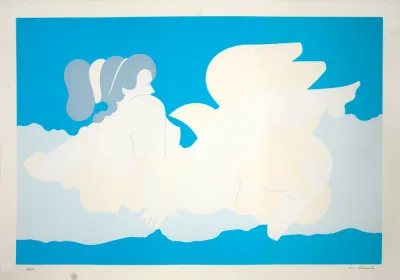
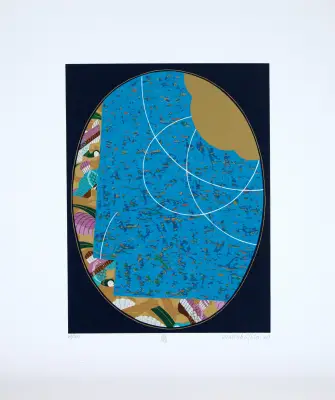
In the 1950s, Sérvulo Esmeraldo develops figurative work and, according to art critic Frederico Morais, he "represents leaves and fish from very simplified and synthetic (...) the form and not the theme are interested in it".1 In this way, Esmeraldo moves gradually towards abstraction, making his first decidedly abstract engravings in 1957, which maintain a close relationship with the production of Lívio Abramo (1903 - 1992).
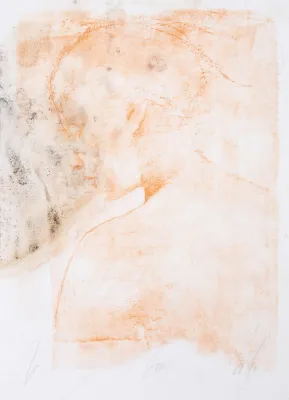
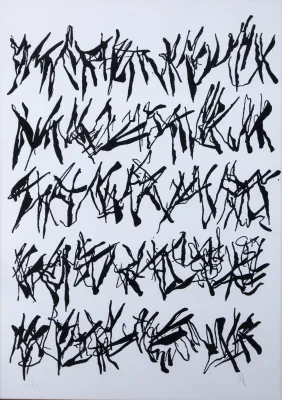
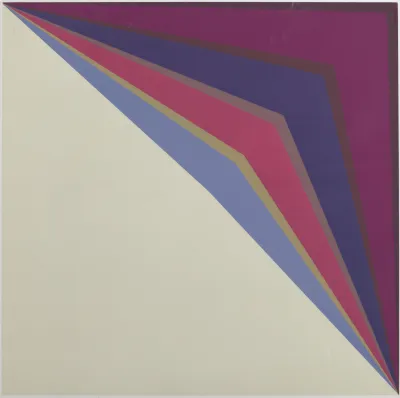
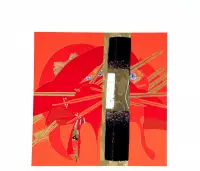
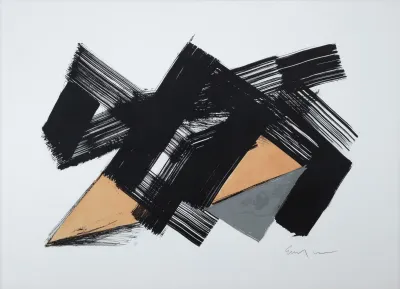
In the same year, he moved to Paris, where he attends metal engraving classes with Johnny Friedlaender (1912 - 1992). At first he makes abstract and lyrical works, almost informal. His engravings, like Friedlaender's works, are full of graphics. Progressively, he is interested in constructive production and starts to deal with more regular forms. It accompanies the production of artists linked to kinetic art, such as Julio Le Parc (1928) and Jesús Rafael Soto (1923 - 2005). In the 1960s, he stopped dedicating himself exclusively to engraving and began to try other languages. In 1962, he produced the first kinetic works, made with magnets. Two years later, it creates the excitables, kinetic objects made of acrylic, which react to the viewer's touch and change color. In the same period, he made the first sculptures.
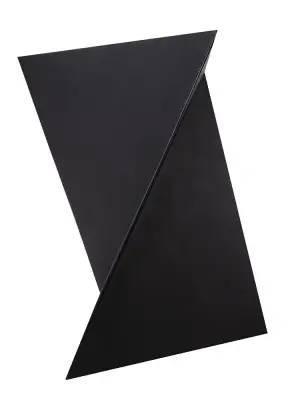
When he returned to Fortaleza, in 1978, he worked with lacquered steel plates, producing sculptures with folded and painted planes. In 1981, he made a series of white pieces in which he inscribes hollow geometric shapes. Despite dealing with flat objects, his work suggests volume.
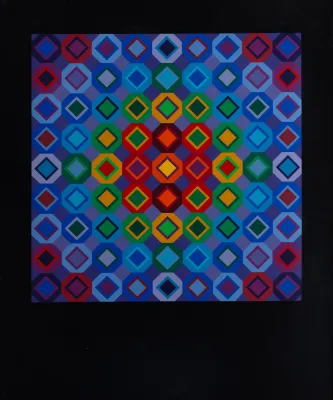
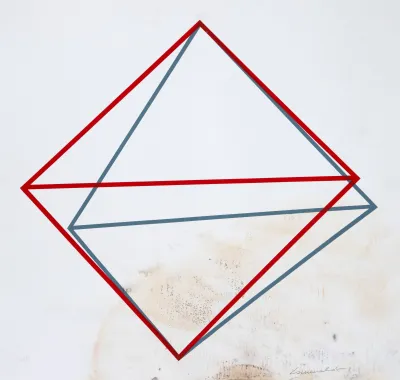
In 1986, he idealized and organized the 1st Exhibition of Ephemera Sculpture in Fortaleza. At the same time, it creates discrete reliefs, the third dimension is suggested by the interaction of the faces, although the work is almost flat. Esmeraldo says that in the late 1980s, he realized that, many times, the volume of his sculptures "is a support to highlight the lines".2 In the 1990s, among other works, he makes reliefs in which he furrows rigorous lines on surfaces two-dimensional steel. In 2001, it radicalized this principle. He works with regular steel lines, with which he draws three-dimensional geometric shapes in space.
Notes
1 Morais Frederico. In: Esmeraldo, Servulus. Sérvulo Esmeraldo - Engravings. Salvador: Workshops of the Solar do Unhão Fine Arts Center, 1989. (Folded leaf).
2 AMARAL, Aracy. Sérvulo Esmeraldo's personality. In: Esmeraldo, Servulus. the line as a determining factor. São Paulo: Multiple Art, 2001.
Criticism
"Sérvulo Esmeraldo's sculptures surreptitiously attract a confrontation between the objectivity of the work's visible and a balance Essentially subjective, enigmatic, the modern unconscious takes care of the cultural investments intended for its apprehension and experimentation. of perfection and appropriation of luminosity. They arise for the look, loose, emancipated, but they were invented as part of a system, a story. It is necessary to circulate around them to perceive their specific subtleties. The artist works from a few formal variations, but intimately Together with the work of art, not only the materials and technique used but also the data of the story, light and space are articulated as a result of a work experience, each sculpture is a sum of volume and light. A stylized and dense silence, resistant to speeches and definitions. Behind this almost imperturbable balance, there is a process of obsessed knowledge about inventing with the simplest solids in the universe of art objects/monuments of art that, in addition to living harmoniously with light and shadow, accentuates the passion for a kind of 'classic beauty', free of restlessness, a beautiful pure and distilled, close to the ecstasy of perfection. moments of humor".
Almandrade
Almandrade. The stylized fantasy of solids. Esmeraldo, Sérvulo. Sérvulo Esmeraldo.
"(...) In the early 1980s we see linearity reign with unparalleled lightness in its almost two-dimensional compositions, such as magnified mockups, folded plates, plane twists, the surface of bent steel and painted white, or sometimes dispensing with a base, pure form lodged on the floor, free space, always the angle to give character to the piece through the projected shadow (...) without concessions, but dry, rigor of conception and execution, while absorbing the extravagant ambient light of Fortaleza on the surfaces of its planes, and on them obtaining the nuances of the most luminous grises (...). In the game with light, or aware of its weight in the tropical climate (...), Sérvulo, disciplined experimenter, discards the white, chooses the intense graphite tone for the faceted surfaces of the prisms, obliques, in his serial approach to the 'solids', hexahedrons playing with the ambient luminosity (...). The cubes, or coupled triangles, or the asymmetry of the parallelogram emerges, at the same time, suggesting a view of perspective that is also illusory, in the forms it contains in this phase of 'solid bodies', space limited by surfaces". Aracy Amaral
Text Aracy Amaral Sérvulo Esmeraldo. São Paulo: Skultura Art Gallery, 1986.
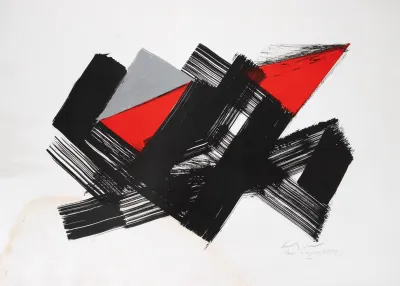
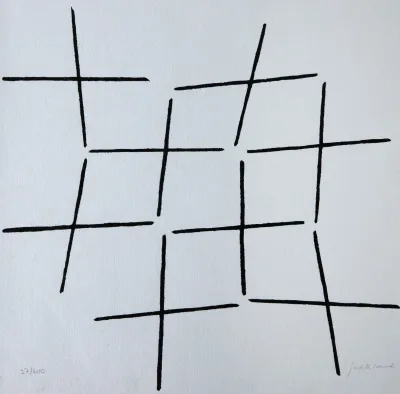
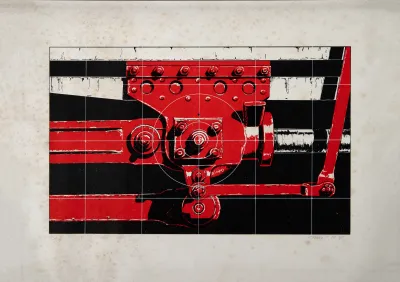
"Servulus Esmeraldo structures its woodcuts with geometric shapes: they are signs that are ordered in the support, also geometric, therefore, inseparable from the composition. Support paper is therefore thought of as an element, since in the concepts there is no distinction between the white of the paper and the black printed. Therefore, Sérvulus states that in his woodcut there is no transition from the figurative to the non-figurative, with only evaluative change. In the history of Sérvulo Esmeraldo's reflection, it is therefore important to highlight that the abstract form is seen by him in the clear of his figurative engravings; With this, he starts to value, not the clear ones, but the forms, which, abstract, build the engraving.
After studies in Paris with Friedlaender, Sérvulus composes engravings with geometric figures, which, cut, duplicated, deformed or even batted, fulfill their desire for conjunction of white and black".
Leon Kossovitch and Mayra Laudanna
Kossovitch, Leon; Laudanna, Mayra. Concretos. In: Engraving: Brazilian art of the 20th century. São Paulo: Itaú Cultural: Cosac & Naify, 2000. p. 20-21.
Testimonies
"My references in of plastic arts were paintings, or mediocre reproductions of paintings. And they were always figurative. [...] In the Public Library of Crato, Ceará, there was little about visual arts. There was a history of art, by Van Loon, and another publication on American art (which stopped in the 1920s), another about sculptures in Italian cemeteries. Van Loon made interesting considerations [...]. He also warned that in addition to the look, he has the perception, directing him. It was a good book, but as iconographic documentation it was restricted [...]. I wanted to learn. He knew that doing was through learning to do. It seems so evident. Things however transcend knowledge - the concept is something vague, it is a "feather in the wind". You have developed your thought and concept, which can be experienced and enriched. but it is not doctrine. Everything can be contested. Opening is the key. Adequacy is between science and consciousness. I could never be a surrealist. A figurative, yes, because it does not condition or goes beyond the shapes and their solutions in the supports. It was only many years later that I had access, through books, to the drawings of Picasso, Matisse, Dufy, in many of which the line prevails; Impeccable, dry, dynamic writing that does not denote effort in doing, as something that had been ready since the beginning of time, like the moon, the sun, which surprise us at every moment. [...] the woodcut was very important. Instead of complicating, it was simplifying. The drawing shows the importance of observation. From there I started to build my 'file'. [...]
The woodcut is the simplest means of engraving. A simplicity that requires a lot of discipline and economics. Pure paper white and equally pure matrix black dispute support. White may tend to be a hole. Masters Munakata and Goeldi understood the problem and circumvented it. This is, perhaps, the most difficult thing to control. What is in the plan is in the plan and does not go further. [...] The incision on the wood can result in a beautiful object, in a relief, the resultant, that is, the final product - the engraving may not reach the objective. Until it is understood that the matrix has a function in which the component, the support-paper, has the final word, a lot of water rolls under the bridge. The white that was supposed to be a light can appear as a hole, or like snow on tropical roofs. Anyway, the engraving is always amazing. You write and read the opposite. The xylo hardly allows for corrections. That's why I appreciate that for me it was a great lesson. I remain a woodcutter learner. The woodcut is a thought concentrate. My first xilos were figurative, like the drawings. The clear open in the wood resulted in abstract shapes. Suddenly, the 'unrepresented' ended up being the main, the valued. I want to refer to the juxtaposed forms that generate forms. In a work there is nothing secondary. The main thing is the whole. I ended up opting for what I saw as casual. Forms are born from forms, paraphrasing Bruno Munari. [...]
[I] never moved on to the abstract. My writing has always been concrete. The referral started with vegetables, leaves, branches. From them I took my geometry. It was only much later that I discovered that the snails and the leaves that recorded were polished equations. Just imagine, I saw that the snail was a logarithm! Knowledge is learned. Understanding is a result. One can learn and not understand. There is a universe between the primary and the primitive. Did the painters of Altamira or Seven Cities learned? They invented and certainly understood and passed on to us. They saw the bison on a rock ledge and showed it with lines. Who did they learn from? We are between the eyes and the seeing".
Servulo Esmeraldo A Dodora Guimarães (July 2000)
Esmeraldo Sérvulo. In: Engraving: Brazilian art of the century XX. São Paulo: Itaú Cultural: Cosac & Naify, 2000. p. 132.
Individual exhibitions
1951 - Crato CE - Individual, in the Society of Culture Artistic
1956 - São Paulo SP - Individual, at the Clube dos Artistas Modernos
1957 - Fortaleza CE - Individual, at UFCE
1957 - São Paulo SP - Individual, at MAM/SP
1960 - Recife PE - Individual, at the Lemac Gallery
1961 - Lausanne (Switzerland) - Individual, at Galerie Maurice Bridel
1961 - Paris (France) - Individual, at Galerie La Hune
1961 - Salvador BA - Individual, at MAM/BA
1962 - Fortaleza CE - Individual, at MAUC
1962 - Recife PE - Individual, at the Recife Art Gallery
1962 - Rio de Janeiro RJ - Individual, at the gallery Relief
1962 - Salvador BA - Individual, at MAM/BA
1963 - Lausanne (Switzerland) - Individual, at Maurice Bridel Gallery
1964 - Venice (Italy) Galleria il Canale
1966 - Lisbon (Portugal) - Individual, at Gallery Engraving
1966 - Milan (Italy) - Individual, at the Instituto Brasil-Italy
1966 - Paris (France) - individual, at the Galerie Nouvelle Gravure
1967 - Belo Horizonte MG - Individual, at Galeria Itatiaia
1967 - Fortaleza CE - Individual, at MAUC
1968 - Lausanne (Switzerland) - Individual, at the Maurice Brindel Gallery
1969 - São Paulo SP - Individual, at the Cosme Velho Gallery
1971 - Cannet-Plage (France) - Individual, at the Galerie La Pierre de Lune
1971 - Lausanne (Switzerland) - Individual, at White Gallery
1971 - Lion (France) - Individual at Galerie 32
1971 - Paris (France) - Individual at Galerie LA Pochade
1971 - Le Cannet (France) - Individual, at Galerie La Pierre de Lune
1973 - Fortaleza CE - Individual, at the Galerie Ignez Fiuza
1974 - Collioure (France) - Sérvulo Esmeraldo: engravings 1953 to 1973, at the Galerie Sanguine Art
1975 - Brasília DF - Individual, at the Hotel Nacional
1975 - Fortaleza CE - Individual, at Galerie Ignez Fiuza
1975 - Lausanne (Switzerland) - Individual, at White Gallery
1975 - Lion (France) - Individual, at Galerie 32
1975 - Luxembourg (Luxembourg) - Individual, at Galerie Paul Bruck
1975 - São Paulo SP - Individual, at the Graphic Arts Office
1976 - Belo Horizonte MG - Individual, at the Palácio das Artes Foundation
1976 - Rio de Janeiro RJ - Individual, at Petite Gallery
1976 - São Paulo SP - Individual, at the Graphic Arts Office
1977 - Belo Horizonte MG - Individual, at the Memory Gallery
1977 - Crato CE - individual, in the Society of Artistic Culture
1977 - Recife PE - Individual, at Gatsby Arte
1979 - Bogotá (Colombia) - Individual, at the Venezelano Center for Culture
1979 - São Luís MA - Individual, At Hotel Quatro Rodas
1980 - Fortaleza CE - Sérvulo Esmeraldo: Sculpture, at Galerie Ignez Fiuza
1981 - Rio de Janeiro RJ - Sérvulo Esmeraldo: Sculptures, in the gallery Aktuell
1982 - São Paulo SP - Individual, at Skultura Art Gallery
1984 - São Paulo SP - Individual, at Paulo Figueiredo Art Gallery
1985 - Fortaleza CE - Sérvulo Esmeraldo: trajectory 1947-1985, in the art gallery
1986 - Fortaleza CE - Individual, in the art gallery
1986 - São Paulo SP - Sérvulo Esmeraldo: Sculptures, at Skultura Galeria of Art
1988 - Brasília DF - Individual, at Itaugaleria
1988 - Rio de Janeiro RJ - Sérvulo Esmeraldo: Engravings - Trajectory, in MNBA
1988 - São Paulo SP - Individual, At the Art Office Raquel Arnaud
1989 - Rio de Janeiro RJ - Sérvulo Esmeraldo: sculpture and reliefs, in the gallery triad
1989 - Salvador BA - Sérvulo Esmeraldo: engravings, at Solar do Unhão
1989 - São Paulo SP - Individual, at Paulo Figueiredo Art Gallery
1999 - Fortaleza CE - Individual, at the Centro Cultural da Abolíção
2001 - São Paulo SP - The line as a factor Determinant, in the Multiple Art Gallery
Collective Exhibitions
1950 - Fortaleza CE - 6th Salon of April - Honorable Mention
1951 - Fortaleza CE - 7th Salon of April - Mention Honorable
1956 - São Paulo SP - 5th Salão Paulista de Arte Moderna, at the Prestes Maia Gallery - Acquisition Award
1957 - Krakow (Poland) - 5th International Exhibition of Krakow
1957 - Fortaleza CE - National Salon of Plastic Arts - 1st Prize
1957 - São Paulo SP - 6th São Paulo Salon of Modern Art, at the Prestes Maia Gallery - Acquisition Award and Bronze Medal
1959 - Paris (France) - Salon Le Trait, in the Balzac
1959 - São Paulo SP - 5th São Paulo International Biennial, at the Ciccilo Matarazzo Sobrinho Pavilion
1960 - Paris (France) - Jeune Gravure Contemporaine
1961 - Paris (France) - Salão de Maio
1961 - São Paulo SP - 6th São Paulo International Biennial, at the Ciccilo Matarazzo Sobrinho Pavilion
1962 - Amsterdam (Netherlands) - Art of America y España
1962 - Barcelona (Spain) - Art of America y España
1962 - Bern (Switzerland) - Art of America y España
1962 - Brussels (Belgium) - Art of America y España
1962 - Madrid (Spain) - Art of America y España
1962 - Milan (Italy) - Art of America y España
1962 - Munich (Germany) - Arte de América y España
1962 - Paris (France) - Art of America y España
1962 - Paris (France) - Brazilian tape recorders Schmidt
1962 - Paris (France) - Salon Le Trait, at the Musée d'Art Moderne de la Ville de Paris
1962 - São Paulo SP - Selection of Brazilian works of art from the Ernesto Wolf collection, in the MAM/SP
1963 - São Paulo SP - 7th São Paulo International Biennial, at Fundação Bienal
1965 - Krakow (Poland) - 5th International Engraving Exhibition
1965 - Paris (France) - Grands et Jeunes d'Aujourd'hui
1966 - Krakow (Poland) - 6th International Engraving Exhibition
1966 - Florence (Italy) - 2nd Biennial Graphics
1966 - Havana (Cuba) - Havana Exhibition
1966 - Madrid (Spain) - Engravers of Paris
1966 - Paris (France) - Latin American artists Paris
1966 - Viana do Castelo (Portugal) - Viana do Castelo Festival
1967 - Krakow (Poland) - 7th International Engraving Exhibition
1967 - Milan (Italy) - 14th Milan Triennale
1968 - Menton (France) - Menton Biennial
1968 - Nottingham (England) - Six Latin American Countries, Midland Art Group Gallery
1969 - Menton (France) - Graphic Art 20th Century
1969 - Oregon (United States) - Contemporary engravers at the University of Oregon
1970 - Krakow (Poland) - International Engraving Exhibition
1970 - Florence (Italy) - 2nd Biennale Internazionale d'Arte d'Arte
1970 - Paris (France) - Salon des Realités Nouvelles
1970 - Spoleto (Italy) - 5th Festivale dei Due Mondi
1970 - Zurich (Switzerland) - La Peu du Lion, at Kunsthaus Zürich
1971 - Geneva (Switzerland) - The engraving of America
1971 - São Paulo SP - 3rd Panorama of Current Brazilian Art, at MAM/SP
1972 - Montbéliard (France) - A Art of Multiplication
1972 - Paris (France) - 2000 Years of French Goldsmith: From Roman Rooster to Pop Art
1972 - Paris (France) - Creations and Techniques, at Galerie Christofle
1972 - São Paulo SP - 6th Young Contemporary Art, at MAC/USP
1972 - St. Etienne (France) - René Bertholo, Lourdes Castro, Esmeraldo, Guidot, at the Museum of St. Etienne
1972 - Venice (Italy) - 2000 years of French jewelery: from rooster to pop art
1973 - Paris (France) - Semaine Latino-Americaine de Paris, Galerie Cefral
1974 - Paris (France) - The Idea and Matter, at Galerie Denise Rene
1974 - Paris (France) - Salon Comparaisons
1974 - San Juan (Porto Rico) - San Juan del Grabado Latino - American Biennale y del Caribe
1974 - San Juan (Puerto Rico) - 3rd Bienal de San Juan del Grabado Latinoamericano y Del Caribbean, at the Instituto de Cultura Puertorriqueña
1974 - São Paulo SP - Panorama of Current Brazilian Art, at MAM/SP
1974 - São Paulo SP - Prospectiva' 74, at MAC/USP
1975 - Palazzolo (Italy) - by Alexandris, Morandini, Esmeraldo and Sircana, at Galeria F22
1978 - São Paulo SP - 10th Panorama of Current Brazilian Art, in the MAM/SP
1979 - Paris (France) - Marius Rey Collection, at CNAC
1979 - Rio de Janeiro RJ - Brazilian sculptors, at Galeria Aktuell
1981 - Havana (Cuba) - Art by Nuestra América, at the Latin American Gallery
1981 - São Paulo SP - 13th Panorama of Current Brazilian Art, at MAM/SP
1982 - Penápolis SP - 5th Visual Arts Salon of the Northwest, at the Educational Foundation of Penápolis. Faculty of Philosophy, Sciences and Letters of Penápolis
1982 - São Paulo SP - a century of sculpture in Brazil, at MASP
1983 - Olinda PE - 2nd Exhibition of the Abelardo Rodrigues Collection of Plastic Arts, in the mac/olinda
1983 - Rio de Janeiro RJ - Art on Rua 2
1984 - Belém PA - 3rd Salão Arte Pará - 1st Prize
1984 - Buenos Aires (Argentina) - Masters of Brazilian Abstractionism
1984 - Curitiba PR - 6th Mostra da Engraving Cidade de Curitiba, at the Cultural Foundation of Curitiba
1984 - Havana (Cuba) - 1st Bienal de Havana, at the National Museum of Bellas Artes
1984 - Lisbon (Portugal) - Masters of Brazilian Abstractionism
1984 - London (England) - Masters of Brazilian Abstractionism
1984 - Paris (France) - Masters of the Brazilian abstractionism
1984 - Rio de Janeiro RJ - The paper papers, at Funarte. Arts Center
1984 - Rome (Italy) - Masters of Brazilian Abstractionism
1984 - São Paulo SP - Geometry 84, at Paulo Figueiredo Art Gallery
1984 - Washington (United States) - Masters of Brazilian Abstractionism
1985 - Belo Horizonte MG - Geometry Today, at MAP
1985 - Fortaleza CE - Aldemir Martins, Floriano Teixeira, Pietrina Checcacci, Sérgio Lima and Sérvulo Esmeraldo, At Galeria Ignez Fiuza
1985 - Penápolis SP - 6th Northwest Plastic Arts Hall, at the Penápolis Foundation of the Arts
1985 - São Paulo SP - 16th Panorama of Current Brazilian Art, in the MAM/SP
1985 - São Paulo SP - Highlights of Brazilian Contemporary Art, at MAM/SP
1985 - São Paulo SP - Artist Book Trends in Brazil, at CCSP
1986 - Fortaleza CE - 1st Exhibition International Ephemeral Sculptures, at Fundação Demócrito Rocha
1986 - Fortaleza CE - Esmeraldo/Krajcberg, in Art Gallery
1986 - Fortaleza CE - Imagine: The planet welcomes the comet, in the art Gallery
1986 - Havana (Cuba) - 2nd Havana Biennial
1986 - Recife PE - 1st Exhibition of Sculpture and Object Pernambucano, at the Metropolitan Gallery
1987 - Rio de Janeiro RJ - The Brazilian engraving: towards abstractionism, at the MNBA
1987 - São Paulo SP - 19th São Paulo International Biennial, at the Bienal Foundation
1988 - Campinas SP - 13th Contemporary Art Salon of Campinas, at MacC
1988 - Polomar (Venezuela) - Polamar Biennale: Ephemera Sculptures
1988 - São Paulo SP - 19th Brazilian current art panorama, MAM/SP
1988 - São Paulo SP - MAC 25 years: Acquisitions and recent donations, at MAC/USP
1989 - Belo Horizonte MG - 21st UFMG Winter Festival
1989 - Fortaleza CE - 10th Plastic UNIFOR
1989 - Fortaleza CE - Salão de Abril
1989 - São Paulo SP - 10 sculptors, at the Art Office Raquel Arnaud
1990 - Curitiba PR - 9th Artists Guests: Lithographies, at Casa Romário Martins
1990 - Fortaleza CE - 41st Salon de Abril, at the Raimundo Cela - Palácio da Abolíção
1991 - Fortaleza CE - 42nd Salon de Abril - Sculpture Award
1991 - Fortaleza CE - SCAP: 50 years, at the Imperial Othon Palace Hotel. Salão Juazeiro
1991 - São Paulo SP - A Mata, at MAC/USP
1991 - São Paulo SP - Man and Nature, at MAC/USP
1991 - São Paulo SP - Project: 100 years of Paulista, at Casa das Rosas
1992 - Belém PA - 11th Salão Arte Pará, at the Romulo Maiorana Foundation
1992 - Brasília DF - 43rd Salon of April, at the ECT Art Galeria
1992 - Curitiba PR - 10th Engraving Exhibition City of Curitiba/Mostra América, at the Engraving Museum
1992 - Fortaleza CE - 43rd April Salon, at the UFC Museum of Art
1992 - Recife PE - 43rd Salon of April, at Galeria Metropolitana de Arte
1992 - São Paulo SP - 43rd Salão de Abril, at Casa das Rosas
1992 - São Paulo SP - The seduction of volumes: The three-dimensional MAC, at MAC/USP
1993 - João Pessoa PB - Xylograph: From Cordel to Galeria, at Funesc
1993 - São Paulo SP - Works for illustration of the literary supplement: 1956-1967, at MAM/SP
1994 - São Paulo SP - Bienal Brasil Século 20th Century, at the Bienal Foundation
1994 - São Paulo SP - Woodcut: From Cordel to the Gallery, in the Metro
1995 - Fortaleza CE - D'Aprés Dürer: recorders from Ceará, at the Centro Cultural da Abolíção
1996 - Brasília DF - Art and Urban Space: Fifteen Proposals, in the Ministry of Foreign Affairs. Palácio do Itamaraty
1996 - Porto Alegre RS - 1st Sesc Sculpture: International Exhibition of Outdoor Sculptures, at Sesc Campestre
1996 - Rio de Janeiro RJ - Constructive trends in the MAC/USP collection: Construction, measure and proportion, at CCBB
1996 - São Paulo SP - Ex Libris/Home Page, at Paço das Artes
1997 - Rio de Janeiro RJ - Air: Exhibition of plastic arts, toys, objects and mockups, in the Paço Imperial
1997 - São Paulo SP - Diversity of Contemporary Brazilian Sculpture, at Av. Paulista - Realization Ministry of Culture/Itaú Cultural
1997 - São Paulo SP - Three-dimensionality in Brazilian art of the 20th century, at Itaú Cultural
1998 - Belo Horizonte MG - Three-dimensionality in Brazilian art of the 20th century, at Itaú Cultural
1998 - Brasília DF - Three-dimensionality in Brazilian art of the 20th century, at the Itaú Cultural Gallery
1998 - Penápolis SP - Three-dimensionality in 20th Century Brazilian Art, at Galeria Itaú Cultural
1998 - Rio de Janeiro RJ - 16th National Salon of Plastic Arts, at MAM/RJ
1998 - São Paulo SP - Collection 98 Skultura, NA Skultura Art Gallery
1999 - Fortaleza CE - 50th April Salon, at the Centro Cultural da Abolíção
1999 - Paris (France) - Viva Brasil, at Galerie 1900 - 2000
1999 - Rio de Janeiro RJ - Rio Engraving Show. Guita and José Mindlin Collection at the Espaço Cultural dos Correios
1999 - Rio de Janeiro RJ - Exhibition Rio Engravura. Brazilian modern engraving: Collection National Museum of Fine Arts, in the MNBA
1999 - São Paulo SP - daily life/art. Technique, at Itaú Cultural
2000 - São Paulo SP - Conceptual Art and Concepts: 70's in the MAC/USP collection, at the SESI Art Gallery
2000 - São Paulo SP - Brazil + 500 years: Show of the rediscovery, at the Bienal Foundation
2000 - São Paulo SP - Brazilian sculpture: from the Pinacoteca to the Jardim da Luz, at the Pinacoteca do Estado
2000 - São Paulo SP - Investigations. The Brazilian engraving, at Itaú Cultural
2001 - Brasília DF - Investigations. The Brazilian engraving, at Galeria Itaú Cultural
2001 - Penápolis SP - Investigations. The Brazilian engraving, at Galeria Itaú Cultural
2002 - Fortaleza CE - Ceará Rediscovers the, at Centro Dragão do Mar de Arte e Cultura
2002 - São Paulo SP - Who makes the biennials, at the Multiple Art Gallery
2003 - Rio de Janeiro RJ - BrazilianArt Project, at Almacén Art Gallery
2004 - São Paulo SP - Gesture and Expression: Informal abstractionism in the JP Morgan Chase and MAM collections, at MAM/SP
Source: Itaú Cultural