Henrique Oliveira (Ourinhos - sp;1973)
Lives and works in São Paulo
Aracy Amaral - The Urban Art of Henrique Oliveira (2011)
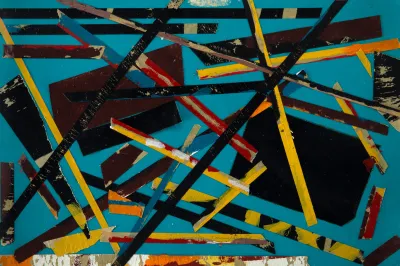
My first contact with the environmental poetics of Henrique Oliveira took place in Ibirapuera Park, on the occasion of the Parallels event of the Bienal de São Paulo, in 2006. The audacity of the scale, the tumultuous forces of its forms in the conventional space They immediately made an impact, distinguishing their work, energetically, from the other participants. It was an achievement at first sight due to the wide movement of forms and their aggressive rusticity. I was able to see his works, both installation and paintings, later, in individual, in São Paulo, and since then I have followed his quick trajectory. During this period, he still observed with suspicion a certain parallelism that he seemed to perceive between his paintings and the facilities. How to establish a bond between these two forms of expression - one of painting and the other vigorously three-dimensional? Despite my difficulty, the "conversation" between the volumiest strokes and the almost dancing acrylic spatulates on the two-dimensional surface was clearly visible, as well as the colorful plates of bent and superimposed plywood chips in their facilities. If the paintings captivate us as magnified marbled guards of precious books, they visually attract us as projections of masses, burning magmas suspended for a short of a second, the agitation captured by olive trees comparing to the whirlwind of their three-dimensional. Today I see with some clarity two moments in the trajectory of this artist - who still has an almost adolescent appearance (!) - and which seems, day and night, absorbed by his work: a moment, which he calls "laiders", because he uses the material used in the plywood fences that delimit the constructions in execution on the streets of cities in Brazil. It is these "tapomes", objects of cover, like modern painting, as he himself remembers, without an illusion of depth, having implicit the principle of planarity, and then painted in a somewhat aqueous way, without major formal concern, but containing a very strong force in his movements. torn off, "torn". It is Oliveira's affirmation phase, when the violently encapsulated waves of its surfaces suggest the most fascinating movement for the audacious surfer. Organic, true tsunami always, by the almost vertigo of their environments. It is the phase elaborated with remains, waste picked up, sought, found and assembled in its facilities.
Henrique Oliveira is definitely an artist of the full generation of urban, suburban, peripheral consumption, as pointed out by his materials and the form of use them - and despise them after their presentation at events or exhibitions - . Its first and strong installations take place on the wall, or the wall or later, at the Mercosul Biennial (2009), brutally built, as Colada, on the facade of a residence at the beginning of the 20th century in Porto Alegre, in the south of Brazil. In its trajectory, in a second moment, the sculptural object emerges, as a natural development in the sequence of individual exhibitions, the sculptural object, parallel to the installation and painting, as a derivation of the three-dimensional wall. When insertions of geometric elements are attached to the body of the piece (a rational form in contrast to the visceral brutality of the context - as in "cacambocytosis" - ) he will call it "boxoplasmosis", as the work he presents in this exhibition. In fact, the nomenclature used by Henrique Oliveira is peculiar, as the artist uses titles that refer to the medical sciences, such as the "Xilonoma chamusquius", to refer, with humor, in a pseudo-scientific way, to a calcined wood tumor. This attraction to "scientific" will also lead you to look for shapes for your three-dimensional objects, leafing through the Atlas of Gross Pathology. Thus, it does not consider itself an orphan of influences. He himself simply recognizes his admiration for Willem de Kooning and Frank Auerbach, the latter especially in his "xylempastos", a name he gives to wooden panels, where the volumes are built "by taking as a model textures of paintings, in particular the Oil Stacking" inspired by Auerbach (the artist's testimonial to the author, 24 jun.2011). And he adds, in that same statement: "The idea behind my works is that of "packs" made of wood, a combination of two opposing elements in the same image: soft, fluid paste, and hard, dry wood". It is necessary, at the same time, to emphasize the relevance of the drawing in the universe of Henrique Oliveira.
The graphic record, in this artist, anticipates, in particular, his three-dimensional works. It is its poetic side par excellence, a directed trait, which sensitively formats the compositions in the project, proving that the mental exercise predicts the movements and shape of the pieces to be developed. Thus, in recent years, Oliveira's work process has undergone a change. Before it was the waste. Today, the "constructive" material stands out in his creations. What would have changed? In fact, the waste gave way to the "urban epidermis". The most glaring and torn installations gradually give way to constructions in more modeled shapes. This without altering the fact that, as he says, his work will always be "about creating tension in space", and being a mid-path "between painting, architecture and sculpture" (interview with Kimberly Davenport, Rice Gallery, Houston, 2009). In other words: it relates to each of these arts, in its need to "find the limits of space". But in the current process, a systematic already occurs: after the preparatory drawings, it proceeds to the placement of the frame and the beginning of the composition with the flexible plywood with screws, before the coating of the piece with cardboard soaked in glue. The visible application of plywood chips or flexible fine plywood ribbons, therefore, new industrialized material and no longer just construction waste, are stapled with glue on the structures, these staples removed after the gum has dried. Oliveira emphasizes the hybridity of materials that characterizes this current phase: "The wooden blades that cover these pieces are still collected from the garbage.
What changed from the beginning of the installations of the Tapumes series to today, was the additional use of constructive elements that allowed me greater control and Plasticity for the development of more complex shapes The PVC tubes, cardboard, glue, screws and especially flexible plywood, these are new industrial materials. They are used to build the parts, since the plywood blades used only enter at the end, coating Everything as an "urban epidermis" (depoim.cit.). Another relevant fact to draw our attention is its ability to face a space, the freedom to think "macro", to conceive its transfiguration through projects such as the Smithsonian Institution, (Washington, 2010), or its insertion/fusion with architecture (Bienal de Monterrey, 2009), or even by demonstrating the fusion of its painting/three-dimensional chromatic delusions (Rice Gallery, Houston, 2009). And the color? How does the painting visible on these undulating, visceral or baroque forms arrive? Now, the painter's palette is on the floor, as he says, on the floor, neatly arranged in strips, the color being pinched by the artist as the progress of the assembly of the piece. Hence why, we conclude, it is probably one of its greatest difficulties to determine the closure of the work. We mentioned considering Oliveira an eminently urban artist.
By the constructive character of his work, at the same time bearing an aggressive organicity that attracted us from the first moment, as he distinguished himself from the fatigued concrete/neoconcrete/conceptual academy in which he still Today Brazilian art is so plunged since the 50s-60s. At the same time, due to the scale and manualness of the execution of his works, broad and spatial, he seems distant from his Brazilian contemporaries. Although a graduate of a school of visual arts, where the preponderance of teachers of trends that were once formalist than expressive is clear, there is an architectural-constructive content in their conceptions that refer us to the plastic audacities of a Frank Gehry, while at the same time The recurrence and manipulation of disposable materials seem to point us to a certain affinity with the "art povera", specifically urban like that of Jacques Villeglé or Mimmo Rotella of the 1960s. We speak of a very young artist, with a dynamic trajectory, from an open country and looking forward to the new. Henrique Oliveira analyzes space and populates, deconstructing it in a passionate way. And with heterogeneous techniques and materials reconstructs this space with an unusual energy charge, constantly changing shapes. Isn't it a nice bet? AMARAL, Aracy: "The Urban Art of Henrique Oliveira". Text published in the catalog of the exhibition Henrique Oliveira, Galerie Georges-Philippe & Nathalie Vallois, Paris, 2011.
Ricardo Resende - Tapumes (2010)
In a pause to reflect on what direction to take in life, the artist Henrique Oliveira, after a season in São Paulo, where he studied Social communication, at the Escola Superior de Propaganda e Marketing, returned to her hometown, Ourinhos, in the interior of the state of São Paulo, and set up a studio next to her father's carpentry shop, which was half abandoned. This change took place in 1997, the year in which he decided that he would dedicate himself to painting. But how do you decide to be a painter? What drives a person to call themselves an artist and then become a painter? And, finally, to dawn that his painting would be art? These questions were formulated by Richard Wolheim, in the book A Painting as Art. According to the author, the painting would be in "certain acts of painting. acts that would create certain paintings in particular". The title of the book alludes, according to Wolheim, "to the different ways people paint... and what makes a painting a painting is what the artist does and not what he says". Henrique Oliveira has a very peculiar way of painting, which makes him a painter. The decision of whether what he does is painting, he is not the one who says it, in this case. And it is this peculiar way of working, or his artistic process, that makes what he makes a very special painting. unconventional. This would justify the unfolding of his plastic research, which has wood as a material in its facilities and which I dare to call paintings. It's not paint, but the wood debris itself that gives the color to their "paintings". Woods that carry the discoloration of time. They become paintings that do not remain in the planarity of a canvas. They are engineering works of complex pictoriality and consequent visual precariousness. They would pass away from formal constructive paintings. they would be more for the gestural abstract art in the face of the apparent lack of concern in the overlapping of the wooden blades. In the eyes, it is more like a visual disorder characteristic of the place that inspires it and from where the remains of this matter originate that in the artist's creative gesture becomes pictorial.
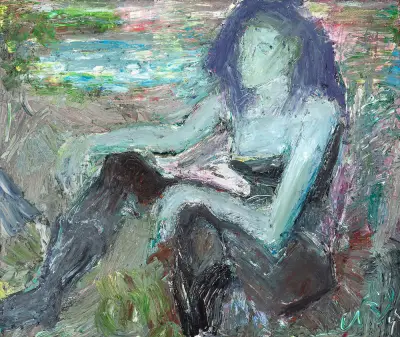
The plasticity and sophistication of the movements in the curves and amoeboid shapes of Large proportions seen in these works are a profusion of this shapeless wood of faded colors that, in certain situations, seems to swallow us up. They are more for form deconstructions, as if they were melting in Henrique Oliveira's pictorial gesture. They are the same waves as the raging seas seen in the paintings of the Englishman William Turner (1775-1851). or the same detachment of the gesture of painting or intervening on the surface of the canvas seen in the work of the American Jackson Pollock (1912-1956), with his paintings of action that record the gesture of throwing himself on the canvas. But these works made of pieces of wood came later. Before that, the artist literally painted on the canvas. Currently, when he paints on this support, he uses large brushes or even brooms on the canvases extended in the plane, on the floor of his studio. They have the same gesture that would bring him even closer to the paintings of the Dutch based in the United States, Willem de Kooning (1904-1997) and Pollock, but with a pop bias, in the artist's own words.
What would distinguish it from the expressive informality seen in the works of these two artists and other expressionists of the group that graduated in New York in the late 1940s and early 1950s. In Henrique Oliveira's paintings there would be a formal control that would dismiss his pictorial gestures of expression. In that initial phase of Ourinhos, the wood was only in its surroundings. It was not yet part of his "form" of painting. He would come later, by allowing himself to experiment with the language and appropriate the wood remains found on the city streets as pictorial matter. Remains like those leftovers used to cover the characteristic shacks of the favelas on the side of highways or riversides in large cities. These are time-aged fences in urban civil constructions. They are the faded hues of these precarious constructions between the ashes, the yellowish or the reddish ones that work as ink on the surface of these "paintings". Back in São Paulo after the season in Ourinhos, in mid-1998, Henrique Oliveira went to study at the Brazilian Museum of Sculpture, enrolling in the art courses at that institution to take classes with the artists Paulo Whitaker and Nuno Ramos. It is there that the "traditional" painter's "misleadings" from the beginning of this text would begin to become no longer a painter or sculptor, but simply an artist. positive insistence on language with a painting that remains on the surface of the canvas. Paints with conviction. The second, Nuno Ramos, is the artistic "chaos", in the good sense that this word can carry. Nuno's work is the very deconstruction of the idea of painting. In the 1980s, his painting was materic and dripped from the canvas. The volumes were made of grease, oil paint, burlap, pieces of wood, among other materials at hand. In the 1990s, his painting definitively came out of the wall, adding all sorts of matter to give the color and shapes to its great pictorial surfaces. Both Whitaker and Ramos, in a dichotomy, contaminated him both for evil, in the sense of what would be a conventional painting, and for the good, in the sense of an experimental painting, if we observe the work of Henrique Oliveira in his most recent facilities.
could To say that he learned to paint with Paulo Whitaker and "unlearned" with Nuno Ramos, in a good way. Without ceasing to be painting, Oliveira's works question our notion of language by taking them to three-dimensionality, even if hanging on the wall or directly on the floor, as seen in the presentation of the works of the Marcantonio Vilaça Award of 2009 and 2010. Finally, it radicalized in its facilities that they dialogue with the architecture of the place where they expose. In the facilities of the 2009 Mercosul Biennial and the 2010 Bienal de São Paulo, the three-dimensionality of the previous works, still fixed in the wall plane, exploded definitively. These are pieces or installations that could no longer be seen just like sculptures or paintings. The most recent works are more for facilities where wood is no longer necessarily that found as rest in cities. In some more recent works, the material undergoes treatments to give more malleability and accentuation of colors, now controlled, in order to give them the desired tones. In others, the natural color of the wood ends up giving them the tone of the human epidermis. Resuming his trajectory, after the MUBE courses, Henrique Oliveira went to study at the School of Communications and Arts at the University of São Paulo. In 2003, he presented, at that school, the first work of the Tapumes series. A large 2 x 5-meter painting worked on the planarity of what would be a canvas.
The Fine Arts course ended in 2004 and it is in that year that it presents in the Projéteis Program, of the National Arts Foundation, at Palácio Gustavo Capanema, Rio de Janeiro, its painting-installation to stand out, with wood, from the Tapumes series, which occupied an area of 4 x 12 meters. Another show to be remembered is the 1st Exhibition of the Exhibition Program of the Centro Cultural São Paulo (2006). In that edition, the artist was awarded the Acquisition - Centro Cultural São Paulo award, with another installation of the Tapumes series, which occupied 3.5 x 12 x 1.5 meters in area. After attending the Mube's ateliers, the decision for a second college came from an old desire and also from the circumstances in which he found himself - this represented the possibility of being able to continue to take classes with good artists-teachers and theorists. Graduate studies were an option that emerged in the wake of a scientific initiation scholarship. The master's degree was defended in 2007, at the School of Communications and Arts of the University of São Paulo, in the area of Visual Poetics. Following this brief chronology, in 2009 the artist participates in the 7th Mercosul Biennial, in Porto Alegre, with a large urban scale work, also from the Tapumes series - Casa dos Leões, which occupied an old mansion in the center of the city. He had the house as a body. Henrique Oliveira built a large installation that took place in downtown Porto Alegre.
The great sculpture or the large installation or the great painting came out of an old house, as if it were regurgitating its living memory for the city. It was a frightening sight. a situation that was seen from outside, from the street or from the opposite sidewalk. When walking through there or through the windows of the cars, it was a surprise to see the installation. And, finally, in 2010, he participated in his first Bienal de São Paulo, with a work that we could say is one of his most important facilities. In this three-dimensional work, the viewer's position was reversed. It was seen from the inside out. like a body that opened up to the public. It refers to the installation held at Itaú Cultural, in São Paulo, in 2007, at the Itaú Contemporânea show - Arte no Brasil 1981-2006, when the artist for the first time created an installation with the idea of a house, or rather, a cave, in a clear inspiration in the first Installation that is known, Merzbau (presented in Hannover, in 1937). Masterpiece by the German artist Kurt Schwitters (1887-1948), a decisive artist in the unfolding of the artistic process of Henrique Oliveira. The approach could take place with their delicate collages made of cutouts and pieces of paper, newspapers and posters that resemble the dirty walls and posts of the cities and that aesthetically would be very close to the "collages" with olive wood. Merzbau would roughly deal with the idea of a large constructive and three-dimensional collage, a house made with pieces of wood. A collage-sculpture reminiscent of the interior of caves. or even the constitutive cavernous bodies of the vagina. The Installation The Origin of the Third World, from the 2010 Bienal de São Paulo, in a way takes back the idea of Merzbau or even the installation of Itaú Cultural.
It is as if we were thrown into the tunnel where Alice fell, in the country of wonders. an endless cave. It is as if we were thrown into the abyss, in the bowels of a painting, with all its pigments on a large scale. They would be gigantic brushstrokes. It's like a Pollock painting became three-dimensional, it's like we're being thrown into the human body. a female body more precisely. inside a huge uterus. Situation already obtained, as on screen The Origin of the World (from 1866) by Gustave Courbet (1819-1877). It is as if we enter the body of that figure that we only partially see. A "half" woman's body that has in its half, sex covered by a dense layer of black pubic hair. For the time, it was a scandalous painting that has still caused strangeness to some since 1995, when it was first presented at the Dorsay Museum in Paris. The frontal view of a vagina is exposed before the eyes. It is a small oil on canvas of 46 x 55 centimeters, which represents a closed plan on the sex and belly of a woman lying naked on a bed, with her thighs apart, exposing her vagina, in its fullness, without any bias, even if subtle, sensuality. Differently, Oliveira's "painting" is pasteled and gigantic. It's a painting that pulses. A living body that seems to grow and expand. It takes on ghostly features of a cave that makes us curve to cross it. But it also welcomes like a fetus inside, as if we were in the maternal uterus. There's nothing erotic about it. It is raw like Courbet's canvas, which does not incite a sexual desire - reveals an anatomical aspect of the female genitalia. It is not the image of the beauty of a desirable woman who reveals her intimate sexual parts. The woman in Courbet presents herself more as a pictorial radicalization of the exposed female image. In Oliveira's work, what we see is a process of transformation of women into an organic object that generates life from the origin of life and the world, although it carries in the title an irony that makes a political allusion to the condition of the existence of a "third world". In the case of Oliveira, the exposure of the female body takes place more explicitly, exposing what is inside - the internal parts of what would be the woman's sexual organ. Courbet's painting, before arriving at the Dorsay Museum, belonged to the French psychoanalyst Jacques Lacan (1901-1981), being the last owner, before being finally acquired by that French institution, in 1994.
Even Lacan had a hard time leaving her exposed in her house, given her explicitness. The psychoanalyst ordered another painting from the surrealist André Masson, a kind of landscape stylizing the female forms in order to cover the canvas with the origin of the world. Lacan covered Courbet's painting, revealing it only to the privileged few. Henrique Oliveira, on the contrary, with his Origin of the Third World, exposes it in its fullness at the 29th Bienal de São Paulo, evidently in another historical and social context. The idea of the origin of the Third World can have a political bias when referring to the theory of the worlds, coined by the Frenchman Alfred Sauvy. What would be a proposal for the Earth's revolution became an expression to define poor Latin American, African and Asian countries in a purely geopolitical division. But the issue in Oliveira's work may be different. more literal. Attractive and at the same time repulsive, the facility also makes reference to a cave, which is a constant theme in psychoanalytic studies when they make a reference to the female sexual organ. But what are the relationships established by Lacan, in his studies, based on his interpretation of this work by Courbet? Why did Lacan keep this piece for so long from the eyes of the general public? These are the questions I ask here and would reproduce a psychoanalyst. Why does the vision of the female sexual organ still cause so much strangeness, even if it is observed without any bias of eroticism in the eye of the beholder? And Courbet's relationship with Henrique Oliveira is not restricted to these two works. Courbet has also painted many caves and raging seas, in which frozen waves can be seen, as in a photographic flash. They are landscapes and sea views with a romantic bias and caves that invite us to penetrate their dark and moist interiors. It is the immensity of the world in its paintings with endless horizons to subdue us as insignificant beings on the surface of the Earth. Very romantic visions, but also very realistic situations that foreshadowed the themes of the coming impressionist and surrealist artists.
Courbet's work aroused not only the interest of Henrique Oliveira, but also that of great masters of painting impressionist like Paul Cézanne and Édouard Manet. Masters of modern painting, such as Picasso, and surrealism, such as Giorgio de Chirico, and also of Max Beckman and Marcel Duchamp. Also like Courbet, who portrayed many caves, Henrique Oliveira has a special interest in them, particularly after having visited many of them in Vale do Ribeira, when he was still a teenager. experiences that still generate fascination and reverberate in his work. Coincidentally, while writing this text, I came across at the Museum of Modern Art in Frankfurt, Germany, with a retrospective by Gustave Courbet. His screen The Origin of the World was not exposed. It seems to remain excluded even from a great retrospective of such importance, like this one in Frankfurt. Although quoted in the wall text, the taboo in relation to this work still remains alive, giving subsidy to those who see in this work a kind of "curse" ingrained in it. A good work of art is a constant dialogue between the public and the artist's work, causing, or not, estrangement, as in The Origin of the World or the Origin of the Third World, which transform those who observe them into simple voyeurs. A good painting or a good installation is therefore capable of an endless dialogue or a search for endless answers. This is the case of this text that, like so many others, does not present answers, but more questions about Henrique Oliveira's work. I believe that the artist is capable of producing this noise with his artwork. noises making us think without the end. RESENDE, Ricardo: "Tapumes", 2010. In: CNI SESI Marcantônio Vilaça Award 2009/10. Authors: Alcino Leite Neto, Luiz Camillo Osório, Paulo Herkenhoff, Ricardo Resende. Brasilia, Sesi, pp. 68-71, 2011.
Juliana Monachesi - The Pulse of Contemporary Painting (2006)
I Swear I"ll give it back tomorrow but for now I think that i"ll just borow all the chords from that song and all the words from that other song i heard yesterday [The Strokes, "ElectricityScape"] Henrique Oliveira has a musical parallel in the songs of the Strokes: both deviate from the rules of the tradition without postmodern irony, rather, using the tools and parameters of the tradition itself they do not accommodate to the working patterns of their respective languages (painting and rock music) and this rupture is evident especially in the abrupt passages that both make. A Strokes song begins and ends without preambles or endings. Oliveira's paintings too. Other possible parallels with the Strokes: Despite being a rock band, they manage to be a pop band at the same time, just as Henrique Oliveira's paintings are based on historical references of 20th century art, but they contain influences from mass culture. Strokes appropriate the best in the rock tradition and make it sound current, as much as Oliveira makes use of the most successful formal solutions of different moments of abstraction, updating them. "Thinking about the gestural painting done in the 20th century, it is as if procedures such as brushstrokes, drains, veggies, could be decontextualized from history, separated, cataloged and then reconditioned in the search for another pictorial order. Recognize as just one more possibility, manage to emancipate yourself from the jargon that constitute your own foundations", explains the artist in an analytical text about his work. Based on this thought, Henrique Oliveira's painting would be almost a collage, since the overlapping layers have no communication or continuity with each other. But, unlike a Caetano de Almeida, which overrides geometric abstraction, informal abstraction to create a postmodern pastiche also different from a Beatriz Milhazes, which accumulates layers of signs without even touching the brush, producing a commentary on the Baroque or about The decorative, olive painting is made of brushstrokes, scrapings, dusting, drips and drains. What kind of collage is this that the artist makes, so far from the collage procedures of Caetano de Almeida and Beatriz Milhazes? Strokes' songs can give a clue: they are collages, as they themselves confess in the lyrics of the song "Electricityscape" - on the new album, "First Impressions of Earth" (2006)-, of chords of this song and words from that other, borrowed one day and returned the next. Oliveira lends from here and from there, returns everything "reconditioned", but still betting on painting, on the "the enjoyment of its materiality" and on the "constructive possibilities inherent to its environment", according to the artist. For him, painting can be considered an area of suspension of a certain media determinism in our perception of reality, a space - finally - where "a gap in the interpretation of the world" dares the painter. MONACHESI, Juliana: "The Pulse of Current Painting". Bien"Art. Fundação Bienal de São Paulo. São Paulo, n. 18, p. 51, April 2006.
Public Collections
Queensland Art Gallery / Gallery of Modern Art, Brisbane, Australia.
Museum of Contemporary Art of Rio Grande do Sul, Porto Alegre. Museum of Modern Art - Rio de Janeiro.
Municipal Pinacoteca - Art Collection of the City of São Paulo.
Collection Cultural Center of the Federal University of Goiás, Goiânia.
Itaú Collection, São Paulo Metropolis Collection / TV Cultura, São Paulo Afro-Brazil Museum Collection, São Paulo
Formation
Graduate 2007 Master in Visual Poetics - School of Communications and Arts, University of São Paulo.
Graduation 2004 Fine Arts, Bachelor of Arts - School of Communications and Arts - University of São Paulo.
Individual exhibitions
2012 Municipal Center of Art Hélio Oiticica, Rio de January.
2012 Liquid Reality - Millan Gallery, São Paulo.
2012 Ursulinens Prolapse - Offens Kulturhaus, Linz, Austria.
2011 Galerie Georges-Philippe & Nathalie Vallois, Paris, France.
2011 Boulder Museum of Contemporary Art, Boulder, USA.
2010 Collages - Alejandra von Hartz Gallery, Miami, USA. 2010 Galeria Silvia Cintra & Box 4, Rio de Janeiro, Brazil.
2009 Tapumes - Rice University Art Gallery - Houston, USA.
2009 Flying Circus Gallery - Monterrey, Mexico.
2008 Project season - Paço das Artes - São Paulo.
2008 Baró Cruz Gallery - São Paulo.
2007 11th English Culture Festival - British Council - São Paulo.
2007 Exhibition Program - Funarte - São Paulo.
2006 1st Exhibition Program Exhibition - Centro Cultural São Paulo.
2006 Galeria Baró Cruz - São Paulo.
2005 Tapumes - House of Culture of Latin America - Brasília.
2000 Drawings and Paintings - Funarte - São Paulo.
1998 Paintings - State University of Londrina. Collective Exhibitions 2012 OIR (other ideas for the river) - Parque da Madureira, Rio de Janeiro.
2012 Inside Outfrom the Ground Up - Museum of Contemporary Art, Cleveland, USA.
2012 Sculpture is everything - Queensland Gallery of Modern Art, Brisbane, Australia.
2012 Travessias Project - Favela da Maré, Rio de Janeiro.
2011 Travessias Project, Galpão das Artes, Favela da Maré, Rio de Janeiro, Brazil. Beaux-Arts, Bozar, Brussels, Belgium.
2011 Artists in Dialogue 2: Sandile Zuluhenrique Oliveira - Smithsonian National Museum of African Art, Washington DC, USA. 2010 29th International Biennial of São Paulo, Brazil.
2010 IX Bienal Monterrey Femsa - Casa de la Cultura de Puebla, Mexico.
2010 3rd Edition CNI Sesi Marcantonio Award Vilaça for the plastic arts. Museum of Modern Art, Salvador, Brazil.
2010 IX Bienal Monterrey Femsa - Tijuana Cultural Center, Mexico.
2010 3rd Edition CNI SESI Marcantonio Vilaça Award for Plastic Arts. Museum of Modern Art, Rio de Janeiro, Brazil.
2010 3rd Edition CNI SESI Marcantonio Vilaça Award for Visual Arts. Museum of Contemporary Art, São Paulo, Brazil.
2010 3rd Edition CNI SESI Marcantonio Vilaça Award for Visual Arts. Juvenal Antunes Gallery, Rio Branco, Brazil.
2010 3rd edition CNI SESI Marcantonio Vilaça - Cultural Center of the Federal University of Goiás, Goiânia, Brazil.
2010 1 out of 1 - Galeria Silvia cintra & Box 4, Rio de Janeiro, Brazil.
2009 IX Bienal Monterrey Femsa - Centro de las Artes, Monterrey, Mexico.
2009 7th Mercosul Biennial - Porto Alegre, Brazil.
2009 Nova Arte Nova - Centro Cultural Banco do Brasil, São Paulo.
2009 Cabinet - Vítor Meireles Museum - Florianópolis, Brazil.
2008 Nova Art Nova - Centro Cultural Banco do Brasil, Rio de Janeiro.
2008 Be Marginal, Be a Hero - Galerie Vallois and Galerie Seroussi, Paris, France.
2008 Something from nothing - Contemporary Arts Center, New Orleans, USA.
2008 Summer Exhibition - Galeria Silvia Cintra/ Box4 - Rio de Janeiro.
2008 Art for the Amazon - Fundação Bienal de São Paulo - São Paulo.
2008 Project Studio - Galeria Baró Cruz - São Paulo.
2007 Future of the Present - Instituto Itaú Cultural - São Paulo.
2007 Ctrl _ C + Ctrl_V/ Crop and Paste - SESC Pompéia - São Paulo.
2007 La Espiral de Moebius Los Limitos de la Pintura - Centro Cultural Parque de España - Rosário, Argentina.
2007 UT Pictura Diversitas, Galeria Marta Traba, Memorial da América Latina - São Paulo.
2007 Itaú Contemporâneo - Art in Brazil 1981-2006, Instituto Itaú Cultural - São Paulo.
2007 Arte BA / Open Space - Buenos Aires, Argentina.
2006 13th Bahia Salon - Salvador.
2006 FIAT Exhibition Brazil - Porão das Artes, Pavilion of the Bienal - São Paulo.
2006 Paralela 2006 - Parque do Ibirapuera - São Paulo.
2006 Collective of the Exhibition Program - Centro Cultural São Paulo.
2006 Viva Cultura Viva of the Brazilian people - a look at Brazilian art - Afro Brasil Museum, Ibirapuera Park - São Paulo.
2006 FUNARTE PROJÉTELES FUNARTE Award for Contemporary Art - Palácio da Cultura Gustavo Capanema - Rio de Janeiro. Projectiles Dart Contemporain at Espace Brésil / Funarte / Year of Brazil in France - Paris.
2005 5th Flamboyant National Salon of Art of Goiás - Goiânia. 2005 Visuality Nascente - Centro Universitário Maria Antonia- São Paulo.
2005 in transit - Artists graduated from ECA/USP - Galeria Olido - São Paulo. Culture Gustavo Capanema - Rio de Janeiro.
2004 9th Santos Visual Arts Biennial.
2004 Exhibition Program - Ribeirão Preto Art Museum.
2003 New Millennium Art - Cultural Center Guimarães Rosa - Jundiaí-SP.
2003 Interiores - 4 students from ECA/USP - Funarte - São Paulo.
2002 5th Revelation Award - Contemporary Art Museum of Americana.
2002 Collective Espaço Miolo - São Paulo.
2002 Miolo - Funarte - São Paulo.
1999 31st Salon of Contemporary Art in Piracicaba.
Awards
2011 APCA Award (São Paulo Association of Art Critics) - Highlight of the Year, São Paulo.
2009 CNI SESI Marcantonio Vilaça Award for Plastic Arts.
2007 English Culture Festival Award - Council British, São Paulo.
2007 Water Tower Trophy Category Plastic Arts - English Culture Festival - São Paulo.
2006 Acquisition Award - Centro Cultural São Paulo.
2006 FUNARTE CONTEMPORARY ART PROJÉTEIS AWARD - Rio de Janeiro.
2006 Fiat Shows Brazil Award.
2005 Visuality Nascente Award - Centro Universitário Maria Antonia.
Bolsas and Residences
2013 Sam Art Projects - Paris, France.
2010 The Fountainhead Residency - Miami, USA.
2009 Artist Research Fellowship - Smithsonian Institute - Washington DC, USA.
2008 Cité Internationale des Arts - Studio Residence - Paris, France.
2005 FAPESP - Master's Scholarship - Painting and Pictorial Language Project - Techniques and Materials in Brazilian Contemporary Art.
2005 Yellow Atelier - Residency Studio - São Paulo.
2004 FAPESP - Scientific Initiation Scholarship - Matter and Image Project - A pictorial research from a material point of view.
Source: henriqueoliveira.com