
Florian Raiss (Rio de Janeiro RJ 1955)
Florian Raiss is a draftsman, painter and sculptor. He studied at the Accademia di Belle Arti di Firenze, in Italy, between 1973 and 1974. That same year he enrolled at the Accademia di Belle Arti di Roma, where he remained until 1975. He moved to Mexico, where he studied drawing from 1975 to 1977 with Gilberto Aceves Navarro at the Academia de San Carlos of the Universidad Nacional Autónoma de México (Unam), in Mexico City. He has held several solo exhibitions in São Paulo and taken part in group shows in Brazil and abroad, including Germany, Sweden, Venezuela, the Netherlands, Portugal and the United States.
Highlights include the exhibitions MAM na OCA – Arte Brasileira do Acervo do Museu de Arte Moderna de São Paulo [MAM at OCA – Brazilian Art from the Collection of the Museu de Arte Moderna de São Paulo] (2006) and Modernos, Pós-Modernos, 80/90 [Moderns, Postmoderns, 80s/90s] (2007), at the Instituto Tomie Ohtake, also in São Paulo.
Critical Commentary
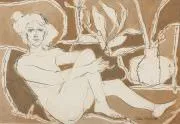
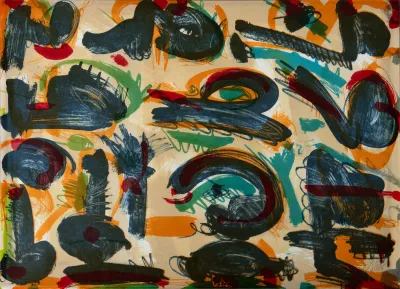
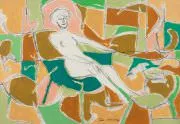
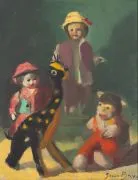
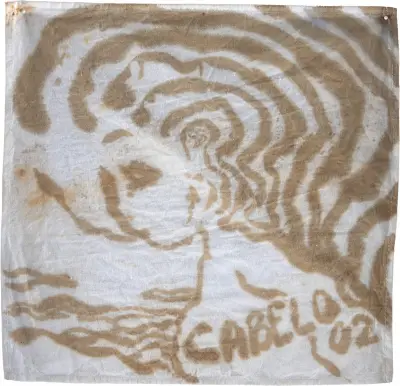
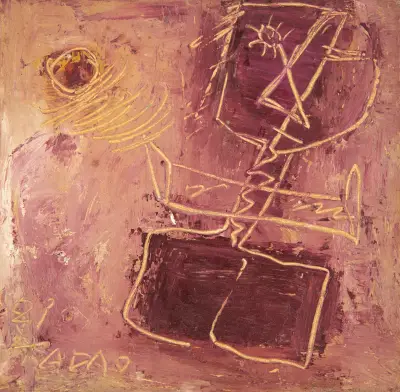
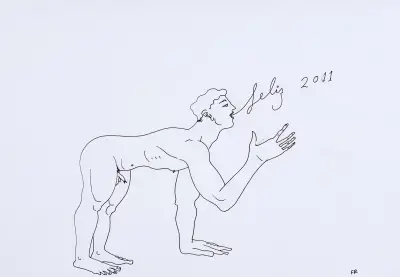
Florian Raiss's work begins with drawing and then moves into space: "Drawing led me to sculpture, which arose as a need, as a desire to materialize figures I had in mind." For his three-dimensional works, Raiss uses a variety of materials, such as bronze, polychrome clay and underglaze. In both drawing and sculpture, there are quadruped men, erotic themes and figuration set in a certain fantastic or bizarre atmosphere. Art historian Aracy Amaral points to a sweet realism, with an insinuatingly perverse atmosphere, in Florian Raiss's monstrous characters. Curator Emanoel Araújo, in turn, sees in these same animal-like characters suggestions of man and his deepest and darkest desires. Critic Fernando Oliva, for his part, identifies in Raiss's work one of the quintessential subjects of Baroque sculpture: the clash of civilization versus nature. And, further, the imposition of culture versus the resistance of the primitive; the struggle between the need for restraint, on the one hand, and animal, uncontrollable desire, on the other. Raiss's production is marked by the possibility of the unexpected emergence of the fantastic, in which it is impossible to separate the real from the imaginary or the past from the present. From this arise not only the fantastic beings but also the evocation of Greek art in drawings and pieces made with underglaze.
Critiques
"Florian's work raises the hypothesis that men, although they have freed themselves from the muscle bundle that ancestrally bound their cranial cavity, preventing the growth and widening of their brain, have still not attained, even today, the fullness of cosmological understanding. For all this, the artist makes quadruped bodies, on four legs, topped by heads whose diverse countenances, with their varied gazes, signify that all the work done or dreamed by humanity over thousands of years has been worth nothing.
The works also give rise to another critical hypothesis, contrary to the first, that the quadrupeds represent the real image of ancestral men. In this case, the sculptures reveal that, since man appeared on Earth, he has pursued a goal, trying to stand up in order to understand and face the world in a different way."
Radha Abramo
Abramo, Radha. Demasiado humano: Florian Raiss expõe cabeças e quadrúpedes. IstoÉ Senhor, n. 1080.
"Having emerged in the last decade, Raiss surprised from the start with his ability to combine in his clay production a high degree of craft skill with a refined and extremely singular poetics, based on the sensitive filtering of icons from the mass media and art history. The Baroque pieces, in their drama, formed a forceful counterpoint both to the complacent painting being made at the time and to the three-dimensional production of the period, bound by minimalist and post-minimalist dictates.
Since his first works, the artist has broadened his repertoire, investing in a mythology less attached to the best-known icons and opting instead for the creation of bizarre forms, in which the figure of man has never been so close to its animal essence. These clay works can now be seen precisely in the context of his two-dimensional production. A great opportunity for the public to reflect on the paths taken, and still to be taken, by this highly original artist."
Tadeu Chiarelli
Chiarelli, Tadeu. Florian inaugura exposição. O Estado de S. Paulo.
Testimonials
"'... Drawing led me to sculpture, which arose as a need, as a desire to materialize figures I had in mind. The first sculptures were faces of film actresses. It was in a way a means of going beyond the mask, because in photos they are always retouched. So I made portraits of four actresses. That gave rise to the sculpture.'
Considering the portrait the strong point of his work, Florian is concerned with establishing an identification between the public and the work:
'... I could work the material itself more, leave the material more visible, but what really matters is reaching this very close form, a realistic form. The intention, in fact, is not so much to create a relationship on an aesthetic level alone; it is a matter of contact, of identification. I want the work to be a presence for the viewer. In the same way that he sees the work, the work also perceives him...'"
Florian Raiss
IMAGENS de segunda geração. Apresentação de Ana Mae Barbosa. Texto de Tadeu Chiarelli. São Paulo: MAC/USP, 1987. p. 20.
Solo Exhibitions
1984 - São Paulo SP - Solo, Mônica Filgueiras Almeida Galeria
1985 - Rio de Janeiro RJ - Solo, Centro Cultural Cândido Mendes
1986 - São Paulo SP - Solo, Galeria Mônica Filgueiras Almeida
1990 - São Paulo SP - Solo, Galeria Subdistrito
1991 - São Paulo SP - Solo, Galeria Subdistrito
1994 - São Paulo SP - Solo, Escritório de Arte Adriana Penteado
2000 - São Paulo SP - Solo, Galeria Francine
2002 - São Paulo SP - Solo, Galeria Francine
2003 - São Paulo SP - Solo, Mônica Filgueiras Galeria de Arte
2005 - Lisbon (Portugal) - Solo, Art Lounge
2005 - São Paulo SP - Solo, Mônica Filgueiras Galeria de Arte
2006 - São Paulo SP - Florian Raiss: obras recentes [Florian Raiss: Recent Works], Mônica Filgueiras Galeria de Arte
2009 - São Paulo SP - Solo, Mônica Filgueiras Galeria de Arte
Group Exhibitions
1976 - Mexico City (Mexico) - Coletiva de esmaltes [Group Show of Enamels], Galeria da Escola Nacional de Artes Plásticas da Universidade do México
1981 - São Paulo SP - 2º Salão Paulista de Artes Plásticas e Visuais [2nd São Paulo Salon of Plastic and Visual Arts], Paço das Artes
1982 - São Paulo SP - Áreas e Comentários [Areas and Comments], Paço das Artes
1984 - São Paulo SP - Áreas e Comentários [Areas and Comments], Paço das Artes
1984 - São Paulo SP - Arte Xerox Brasil [Xerox Art Brazil], Pinacoteca do Estado
1987 - São Paulo SP - Imagens de Segunda Geração [Second-Generation Images], MAC/USP
1988 - Berlin (Germany) - Workshop Berlim - São Paulo [Berlin - São Paulo Workshop], Staatliche Kunsthalle
1988 - São Paulo SP - Workshop Berlim - São Paulo [Berlin - São Paulo Workshop], Masp
1990 - Stockholm (Sweden) - Viva Brasil Viva, Kulturhuset
1990 - São Paulo SP - Esculturas [Sculptures], Subdistrito Comercial de Arte
1991 - Caracas (Venezuela) - Brasil: la nueva generación [Brazil: The New Generation], Fundación Museo de Bellas Artes
1991 - São Paulo SP - 22º Panorama de Arte Atual Brasileira [22nd Panorama of Current Brazilian Art], Museu de Arte Moderna
1992 - Caracas (Venezuela) - 1ª Bienal Barro de América [1st Clay of America Biennial], Museo de Arte Contemporáneo de Caracas Sofía Imber
1992 - São Paulo SP - João Sattamini/Subdistrito, Casa das Rosas
1993 - Germany - Art Frankfurt and Art Cologne, Galeria Delta
1993 - Amsterdam (Netherlands) - Barro en América [Clay in America], Galeria Delta
1994 - Lisbon (Portugal) - Além da Taprobana: a figura humana nas artes plásticas dos países de língua portuguesa [Beyond Taprobana: The Human Figure in the Visual Arts of Portuguese-Speaking Countries], Sociedade Nacional de Belas Artes
1994 - São Paulo SP - Ainda a Figura [Still the Figure], MAM/SP
1995 - Rio de Janeiro RJ - Além da Taprobana: a figura humana nas artes plásticas dos países de língua portuguesa [Beyond Taprobana: The Human Figure in the Visual Arts of Portuguese-Speaking Countries], Museu de Arte Moderna
1995 - São Paulo SP - Anos 80: o palco da diversidade [The 1980s: The Stage of Diversity], Galeria de Arte do Sesi
1995 - São Paulo SP - Coletiva 34 [Group Show 34], Adriana Penteado Arte Contemporânea
1998 - São Paulo SP - O Moderno e o Contemporâneo na Arte Brasileira: Coleção Gilberto Chateaubriand - MAM/RJ [The Modern and the Contemporary in Brazilian Art: Gilberto Chateaubriand Collection - MAM/RJ], Museu de Arte de São Paulo
1999 - São Paulo SP - Dezenove Cabeças [Nineteen Heads], Adriana Penteado Arte Contemporânea
2001 - Rio de Janeiro RJ - Espelho Cego: seleções de uma coleção contemporânea [Blind Mirror: Selections from a Contemporary Collection], Paço Imperial
2001 - São Paulo SP - 4ª Bienal Barro de América [4th Clay of America Biennial], Fundação Memorial da América Latina
2001 - São Paulo SP - Espelho Cego: seleções de uma coleção contemporânea [Blind Mirror: Selections from a Contemporary Collection], Museu de Arte Moderna
2003 - São Paulo SP - 2080, Museu de Arte Moderna
2003 - São Paulo SP - Meus Amigos [My Friends], Espaço MAM-Villa-Lobos
2003 - São Paulo SP - Palmo Quadrado [Square Span], Associação Alumni
2005 - Belo Horizonte MG - Coletiva de Acervo 2005 [Collection Group Show 2005], Galeria Murilo Castro
2005 - São Paulo SP - Erótica: os sentidos na arte [Erotica: The Senses in Art], Centro Cultural Banco do Brasil
2006 - Rio de Janeiro RJ - Erótica: os sentidos na arte [Erotica: The Senses in Art], Centro Cultural Banco do Brasil
2009 - São Paulo SP - Branco & Preto [White & Black], Galeria Daslu
2009 - São Paulo SP - Memorial Revisitado: 20 anos [Memorial Revisited: 20 Years], Galeria Marta Traba
Source: Itaú Cultural