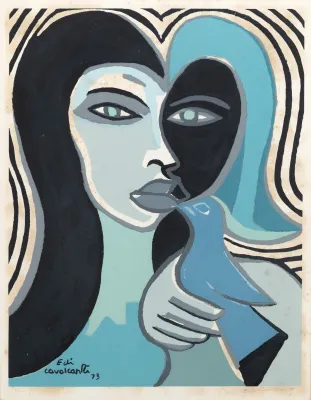


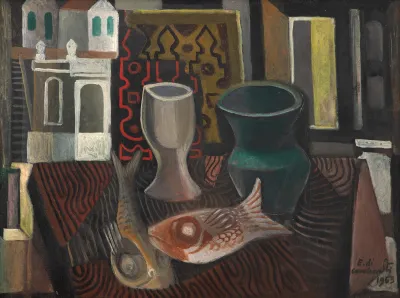

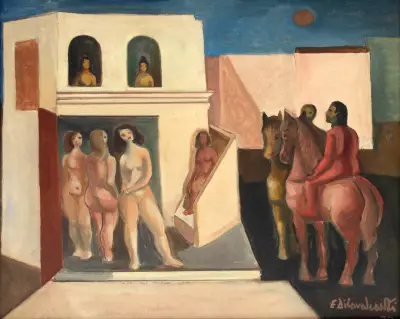
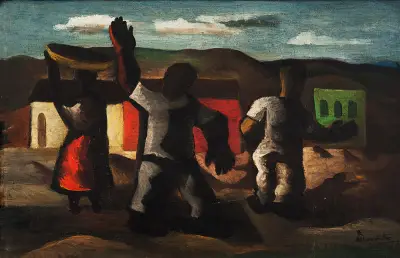



Di Cavalcanti (Rio de Janeiro RJ 1897 - idem 1976)
Di Cavalcanti was one of the most important artists of Brazilian modernism, working as a painter, illustrator, caricaturist, printmaker, muralist, draftsman, journalist and writer. Born in downtown Rio de Janeiro, in a house that had belonged to the abolitionist José do Patrocínio, Di Cavalcanti grew up in an intellectually privileged environment, in the company of figures such as Joaquim Nabuco, Olavo Bilac and Machado de Assis.
From an early age, Di Cavalcanti showed an interest in the visual arts, beginning his studies at the age of eleven with the painter Gaspar Puga Garcia. After his father's death in 1914, he began his professional career as an illustrator for the magazine Fon-Fon, standing out for his social and political criticism through caricature.
“Brazilian art depends on Brazilian reality
and at the same time reveals that reality.
That is why our expression is still largely lyrical.
How can Brazil have a tragic and grand art
without a social revolution?”
Di Cavalcanti

Cover of Fon-Fon magazine illustrated by Di Cavalcanti.
In 1917, Di Cavalcanti held his first solo exhibition in São Paulo, consolidating his presence on the art scene. A few years later, he became one of the main creators of the 1922 Modern Art Week, held at the Theatro Municipal in São Paulo. This event was decisive for the aesthetic renewal of Brazil and marked the consolidation of Brazilian modernism, placing Di Cavalcanti at the center of the movement.
Between 1923 and 1925, Di Cavalcanti lived in Paris, where he came into contact with the European avant-gardes. He studied at the academy of Paul-Élie Ranson and met artists such as Pablo Picasso, Henri Matisse and Fernand Léger. Di Cavalcanti reinterpreted these influences from a Brazilian perspective, resulting in a singular artistic language marked by an appreciation of national culture.
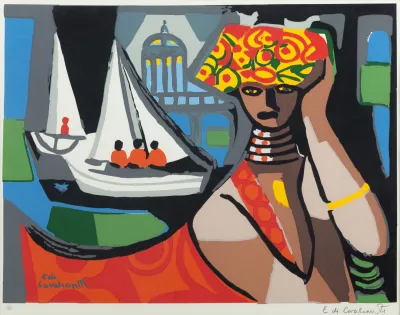
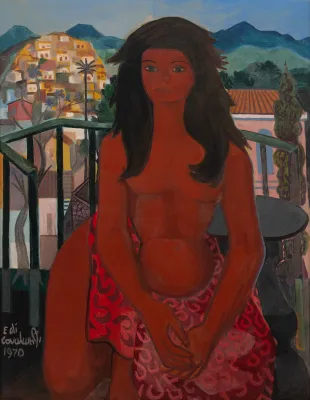
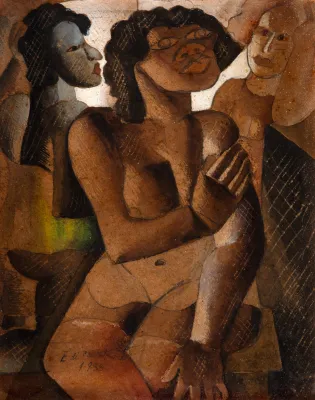
Throughout his career, Di Cavalcanti stood out for his depiction of popular themes such as samba, carnival, urban daily life and the female figure. His works, such as Samba, Mangue and Cinco Moças de Guaratinguetá, feature vibrant colors, sinuous forms and a strong Brazilian identity, in dialogue with movements such as Expressionism and Cubism.
In the 1930s, his political activity also came to the fore, leading him to face persecution and imprisonment. Even so, Di Cavalcanti remained very active in national and international exhibitions. In 1953, he was awarded best Brazilian painter at the São Paulo Biennial, alongside Alfredo Volpi, consolidating his institutional recognition.
Over the following decades, Di Cavalcanti continued to paint, write and exhibit, and took a critical stance against abstractionism. His work remained deeply linked to the representation of Brazilian cultural identity, becoming a reference for researchers, collectors and scholars of art.
Di Cavalcanti died on October 26, 1976, in Rio de Janeiro. His legacy remains fundamental to understanding modern art in Brazil and is widely recognized for its contribution to the construction of an authentically Brazilian aesthetic.
Commented Works
Di Cavalcanti, the artistic name of Emiliano Augusto Cavalcanti de Albuquerque e Melo (1897–1976), is widely recognized as one of the leading names of Brazilian modernism. His role in the 1922 Modern Art Week established him as a driving force behind a new artistic language in the country, aligned both with the European avant-gardes and with the construction of a Brazilian cultural identity.
According to Di Cavalcanti himself, the idea for the 1922 Week was inspired by Marinette Lebrun da Silva Prado, based on the artistic seasons held in Deauville, France. This episode reveals not only his place in international circles, but also his ability to adapt these references to the Brazilian context.

Cover of the "Week" catalogue designed by Di.
One of the most striking aspects of Di Cavalcanti's work is his recurrent depiction of the female figure, especially mulatas, which the artist saw as a symbol of racial mixing and of the formation of Brazilian society. This theme, central to his production, is directly linked to his nationalist ideals and his search for an authentically Brazilian aesthetic.
From his earliest works — such as the portraits of Maria — to emblematic pieces such as Samba (1925), Di Cavalcanti shows a strong dialogue with movements such as Cubism and the so-called return to order. His contact with artists such as Pablo Picasso, Georges Braque, Henri Matisse, Fernand Léger and Giorgio de Chirico helped him assimilate formal elements that he reinterpreted from a perspective of his own, lyrical and deeply connected to everyday life in Rio de Janeiro.
Di Cavalcanti's production covers a wide range of themes, including carnival scenes, urban settings, brothels, landscapes and still lifes. However, his aim was not a faithful depiction of reality, but its recreation through visual signs expressing a symbolic and cultural narrative. As the artist stated:
“From carnival I drew my love of color, rhythm and the sensuality of an original Brazil.”
Among his most representative works is A Gamboa, in which Di Cavalcanti portrays a typical Rio de Janeiro scene, with vernacular architecture, stairways and figures in everyday situations. The composition evokes a city in transformation, now distant in time but preserved in the artist's visual memory.
The work is marked by a vibrant palette and diffuse light, recurring features of Di Cavalcanti's mature phase, especially from the 1950s onward. In this period, the artist reached full aesthetic maturity, consolidating a language that synthesizes international influences and a singular vision of Brazilian culture.
Di Cavalcanti's works thus not only document aspects of urban and popular life, but also construct a poetic and critical interpretation of Brazil, making them essential for researchers, collectors and scholars of modern art in the country.
Valerio Pennacchi-Pennacchi, 2004.
Florilegium
Di Cavalcanti's art was always guided by freedom. He was one of the first artists in Brazil to stand out as a social painter, always rebellious and restless in the face of the impositions of his time. Murilo Mendes, in 1949, described the artist as a man who, despite appearances, lived through a constant intellectual drama, seeking visual, political and critical solutions, and debating the “Brazilian question” and his own artistic path.
Walmir Ayala (1973) goes further, stating that Di Cavalcanti is a painter of extroverted, irreverent and independent sensibility, whose works unsettle the viewer by touching the deepest passions, portraying a Brazil pulsating with color, naive and sad at the same time.

P. Picasso, Two Women Running on the Beach, oil on canvas, 1922
José Roberto Teixeira Leite (1973) joins in this praise, recognizing Di Cavalcanti as one of the greatest and most original interpreters of Brazilian art. He is a sensual and expressive artist whose career of more than 50 years created visual myths that are pillars of national art.
For Carlos Zílio (1982), the sensuality of Di Cavalcanti's work lies not only in the figure of the mulata, but in his treatment of color, one of the great strengths of his painting. From 1926 onward, he worked with strong chromatic contrasts, while always attentive to the relationship between volumes and planes.
Luís Martins (1983) notes Di Cavalcanti's tendency toward Fauvism and Expressionism, emphasizing that his painting was an instinctive reaction against the artistic banality of the time, a quest to destroy conventions and an affirmation of his nonconformity and rebelliousness.
Jacob Klintowitz observes that Di Cavalcanti's drawing revealed his personality, always seeking to express his vision of life and creation. The sensuality of his art depends not only on color and composition, but on line, which is often more deliberate and baroque.
Finally, Olívio Tavares de Araújo (1998) stresses that, regardless of the phases of his production, Di Cavalcanti will remain one of Brazil's greatest painters, uniquely capturing the loving and sensual essence of the country. His essential humanism and his focus on man as the subject of his art are the key to his career.
In homage to him, Vinícius de Moraes (1963) expresses his admiration and affection for Di Cavalcanti in these words:
"Que bom que existas, pintor
Enamorado das ruas
Que bom vivas, que bom sejas
Que bom lutes e construas
Poeta o mais carioca
Pintor o mais brasileiro
Entidade mais dileta
Do meu Rio de Janeiro"
("How good that you exist, painter / In love with the streets / How good that you live, that you are / How good that you fight and build / The most Carioca of poets / The most Brazilian of painters / The dearest of beings / Of my Rio de Janeiro")
Vinícius de Moraes, 1963
Chronology, Exhibitions and Awards
1903/1915 - Rio de Janeiro RJ - Completes his early schooling at Colégio de Aldéia Noronha and at the Colégio Militar
1900/1914 - Lives in the São Cristóvão neighborhood, Rio de Janeiro RJ
1908 - Takes lessons from the painter Gaspar Puga Garcia
1914 - Publishes his first work as a caricaturist in the magazine Fon-Fon
1915 - Illustrates the cover of the magazine A Vida Moderna
1916 - Rio de Janeiro RJ - 1st Salon of Humorists, at the Liceu de Artes e Ofícios
1916 - Rio de Janeiro RJ - Enrolls at the Faculty of Law
1917 - São Paulo SP - Works as a proofreader for the newspaper O Estado de S. Paulo
1917/1920 - Lives in São Paulo SP
1917/1976 - Illustrates books by Brazilian and foreign authors, including Álvares de Azevedo, Cassiano Ricardo, Guilherme de Almeida, Horácio Andrade, Jorge Amado, Manuel Bandeira, Mário de Andrade, Mário Mariani, Menotti Del Picchia, Newton Belleza, Oscar Wilde, Oswald de Andrade, Ribeiro Couto, Rosalina Coelho Lisboa and Sérgio Milliet.
1917 - São Paulo SP - Transfers to the Faculty of Law at Largo São Francisco
1917 - São Paulo SP - Solo exhibition: Di Cavalcanti: Caricatures, at the offices of the magazine A Cigarra
1918 - São Paulo SP - Attends the studio of Georg Elpons, a German painter and teacher associated with European Impressionism
1918 - São Paulo SP - Art director of the magazine Panóplia
1918 - São Paulo SP - Joins a group of São Paulo artists and intellectuals including Oswald de Andrade, Mário de Andrade and Guilherme de Almeida, among others
1919 - São Paulo SP - Solo exhibition: Di Cavalcanti: Paintings, at Casa Editora O Livro
1920/1976 - Lives in both São Paulo and Rio de Janeiro, with frequent stays abroad
1920 - Rio de Janeiro RJ - Illustrator for several magazines, including the newly founded Guanabara. Uses the pseudonym Urbano as a cartoonist
1920 - São Paulo SP - Solo exhibition: Di Cavalcanti: Caricatures, at Casa Di Franco
1921 - São Paulo SP - Releases the album Fantoches da Meia-Noite, with a preface by Ribeiro Couto, published by Monteiro Lobato, and illustrates The Ballad of Reading Gaol by Oscar Wilde
1921 - São Paulo SP - Solo exhibition: Di Cavalcanti: Drawings, at Casa Editora O Livro
1922 - São Paulo SP - Leaves law school
1922 - São Paulo SP - One of the creators and organizers of the Modern Art Week. Illustrates the cover of the program and exhibition catalogue, held at the Theatro Municipal
1922 - São Paulo SP - Modern Art Week, at the Theatro Municipal
1923/1925 - Settles in Paris as correspondent for the newspaper Correio da Manhã; returns to Rio de Janeiro when the newspaper is closed during the 1924 Revolution. Meets Brecheret, Anita Malfatti and Sérgio Milliet
1923 - Travels to Italy to see the works of Italian masters such as Titian, Michelangelo and Leonardo da Vinci
1923 - Lives in Montparnasse (France), where he sets up a small studio
1923 - Paris (France) - Correspondent for the Rio de Janeiro newspaper Correio da Manhã
1923 - Paris (France) - Attends the Académie Ranson
1924 - Paris (France) - Comes into contact with avant-garde European works, artists and writers such as Picasso, Cocteau, Blaise Cendrars, Léger, Unamuno, Georges Braque, Henri Matisse and others
1925 - Returns to Brazil and lives in Rio de Janeiro RJ
1925 - Rio de Janeiro RJ - Solo exhibition, at Casa Laubisch & Hirt
1926 - São Paulo SP - Illustrates the cover of O Losango Cáqui, by Mário de Andrade
1926 - Works as a journalist and illustrator for Diário da Noite
1927 - Works as a designer for the Teatro de Brinquedo of Eugênia and Álvaro Moreyra
1928 - Joins the Communist Party of Brazil
1929 - Rio de Janeiro RJ - Decorates the foyer of the Teatro João Caetano
1930 - São Paulo SP - Exhibition of a Modernist House
1930 - New York (United States) - The First Representative Collection of Paintings by Brazilian Artists, at the International Art Center, Roerich Museum
1931 - Rio de Janeiro RJ - Revolutionary Salon, at Enba
1932 - São Paulo SP - One of the founders of CAM, Clube dos Artistas Modernos, led by Flávio de Carvalho, with Noêmia Mourão, Antonio Gomide and Carlos Prado
1932 - São Paulo SP - Imprisoned for three months as a Getúlio Vargas supporter during the Constitutionalist Revolution
1932 - São Paulo SP - Solo exhibition: Di Cavalcanti, at A Gazeta
1933 - São Paulo SP - Marries the painter Noêmia Mourão, his student
1933 - São Paulo SP - Publishes the album A Realidade Brasileira, a series of twelve drawings satirizing the militarism of the time
1933 - Rio de Janeiro RJ - Writes an article in Diário Carioca (October 15) on the relationship between artistic work and social issues, on the occasion of Tarsila do Amaral's exhibition
1933 - São Paulo SP - 2nd SPAM Modern Art Exhibition
1933 - Rio de Janeiro RJ - 3rd Pró-Arte Salon, at Enba
1934 - Rio de Janeiro RJ - 4th Pró-Arte Salon, at Enba
1934 - Lives in Recife PE
1935 - Rio de Janeiro RJ - Joins the editorial committee of the weekly Marcha, in an office in Cinelândia, alongside Caio Prado Júnior, Carlos Lacerda, Newton Freitas and Rubem Braga
1935 - Rio de Janeiro RJ - Social Art Exhibition, at the Clube de Cultura Moderna do Rio de Janeiro
1935 - At the end of the year, for political reasons, takes refuge with his wife, Noêmia Mourão, and Newton Freitas at the house of Battistelli (an anti-fascist exiled in Brazil, linked to Plínio Melo and Mário Pedrosa), in Mangaratiba
1937/1940 - Lives in Europe
1937 - Paris (France) - International Exhibition of Arts and Techniques, at the Pavilion of the Franco-Brazilian Company - gold medal
1938 - Paris (France) - Works for the Diffusion Française radio on the Portuguese-language Paris Mondial broadcasts, with Noêmia Mourão
1938 - São Paulo SP - 2nd May Salon, at the Esplanada Hotel de São Paulo
1939 - Trip to Spain
1939 - São Paulo SP - 3rd May Salon, at the Esplanada Hotel de São Paulo
1940/1941 - Lives in São Paulo SP
1942 - Trip to Montevideo (Uruguay) and Buenos Aires (Argentina)
1944 - Belo Horizonte MG - Modern Art Exhibition, at MAP
1946 - Goes to Paris (France) to recover works and paintings left behind in 1940
1946 - Rio de Janeiro RJ - Two of his poems are published in the Antologia de Poetas Brasileiros Bissextos Contemporâneos, edited by Manuel Bandeira (Ed. Z. Valverde)
1947 - Serves on the painting jury of the Grupo dos 19 exhibition, with Anita Malfatti and Lasar Segall
1948 - São Paulo SP - Solo exhibition: Emiliano Di Cavalcanti: Retrospective 1918-1948, at IAB/SP
1947 - Rio de Janeiro RJ - Exhibition, at Galeria Domus
1948 - São Paulo SP - Solo exhibition: Retrospective, at Masp
1948/1949 - Returns to Europe for six months
1949/1950 - Trip to Mexico - Takes part in the Congress of Intellectuals for Peace, representing the Communist Party
1950 - São Paulo SP - Separates from Noêmia Mourão
1951 - Rio de Janeiro RJ - Teaches a set design course at the Serviço Nacional de Teatro
1951 - São Paulo SP - 1st São Paulo International Biennial, at MAM/SP - guest artist
1952 - Rio de Janeiro RJ - Exhibition of Brazilian Artists, at MAM/RJ
1952 - São Paulo SP - Donates more than 550 drawings, produced over thirty years, to MAM/SP
1952 - São Paulo SP, Rio de Janeiro RJ - Draws cartoons for the São Paulo edition of Última Hora. At the Rio de Janeiro edition of Última Hora, writes the column Preto no Branco and paints five murals for the newsroom
1953 - São Paulo SP - 2nd São Paulo International Biennial, at MAM/SP - best Brazilian painter award, shared with Alfredo Volpi
1954 - São Paulo SP - Designs costumes for the ballet A Lenda do Amor Impossível, staged by the 4th Centenary Ballet Company
1954 - Rio de Janeiro RJ - Solo exhibition: Di Cavalcanti: Retrospective, at MAM/RJ
1954 - São Paulo SP - Solo exhibition: Emiliano Di Cavalcanti: Drawings, at MAM/SP
1955 - Trip to Montevideo (Uruguay) and Buenos Aires (Argentina)
1955 - Rio de Janeiro RJ - Invited to design the set and costumes for Villa-Lobos' ballet As Cirandas, by the Municipal Theatre Ballet Company
1955 - Rio de Janeiro RJ - Publishes Viagem da Minha Vida: Memórias (Ed. Civilização Brasileira), his first book of memoirs, planned in three volumes: V.1 O Testamento da Alvorada - V.2 O Sol e as Estrelas - V.3 Retrato de Meus Amigos e... dos Outros
1956 - Venice (Italy) - 28th Venice Biennale
1956 - Trieste (Italy) - Trieste Sacred Art Exhibition - 1st prize
1958 - Paris (France) - Creates tapestry cartoons for the Palácio da Alvorada (music and reception halls), commissioned by Niemeyer
1958 - Brasília DF - Paints the Stations of the Cross for the Cathedral of Brasília
1959 - Rio de Janeiro RJ - 30 Years of Brazilian Art, at Enba
1959 - Receives from Carlos Flexa Ribeiro the title of The Patriarch of Modern Brazilian Painting
1960 - Mexico City (Mexico) - Paints a mural on canvas for the offices of Aviação Real
1960 - Mexico City (Mexico) - 2nd Inter-American Biennial of Mexico, at the Palacio de Bellas Artes - special room - gold medal
1960 - São Paulo SP - Leirner Collection, at Galeria de Arte da Folha
1961 - Rio de Janeiro RJ - Solo exhibition, at Petite Galerie
1962 - Trip to Paris (France) and Moscow (Russia) - Takes part in the Peace Congress at the encouragement of his friend Emilio Gustino, to whom he soon gives his own 1948 painting Pescadores
1962 - Córdoba (Argentina) - 1st American Art Biennial
1962 - Rabat (Morocco) - Exhibition of Brazilian Artists
1963 - Paris (France) - Nominated by President João Goulart as Brazil's cultural attaché. Does not take office because of the 1964 coup
1963 - São Paulo SP - 7th São Paulo International Biennial, at Fundação Bienal - special room
1964 - Rio de Janeiro RJ - Publishes Reminiscências Líricas de um Perfeito Carioca (Civilização Brasileira) - illustrations and text
1964 - Rio de Janeiro RJ - Solo exhibition: Di Cavalcanti: 40 Years of Painting, at Galeria Relevo
1964 - Rio de Janeiro RJ - The Nude in Contemporary Art, at Galeria Ibeu Copacabana
1964 - Curitiba PR - 21st Paraná Salon of Fine Arts
1964 - Rio de Janeiro RJ - Designs jewelry made by the jeweler Lucien
1966 - São Paulo SP - Half a Century of New Art, at MAC/USP - traveling exhibition
1969 - Illustrates Federal Lottery tickets for the Inconfidência Mineira, São João, Independence and Christmas draws
1971 - São Paulo SP - Solo exhibition: Di Cavalcanti Retrospective, at Masp
1971 - São Paulo SP - 11th São Paulo International Biennial, at Fundação Bienal
1971 - Receives the ABCA Prize
1972 - São Paulo SP - Art/Brazil/Today: 50 Years Later, at Galeria Collectio
1972 - Lives in Salvador BA
1972 - Salvador BA - Publishes the album 7 Xilogravuras de Emiliano Di Cavalcanti, by Editora Chile, with a presentation by Luís Martins
1972 - Receives the Moinho Santista Prize
1973 - Salvador BA - Receives an honorary doctorate from UFBA
1974 - São Paulo SP - Time of the Modernists, at Masp
1974 - Exhibition of recent works at Bolsa de Arte, Rio de Janeiro
1975 - São Paulo SP - Modernism from 1917 to 1930, at the Museu Lasar Segall
1975 - São Paulo SP - SPAM and CAM, at the Museu Lasar Segall
1976 - São Paulo SP - The city renames Rua 4, in Alto da Mooca, as Rua Emiliano Di Cavalcanti
1976 - Rio de Janeiro RJ - Di Cavalcanti: Retrospective, at MAM/RJ
1976 - Rio de Janeiro RJ - Di Cavalcanti: Retrospective, at MNBA
1976 - São Paulo SP - The Salons: Família Artística Paulista, May Salon and the São Paulo Visual Artists' Union, at the Museu Lasar Segall
1976 - Dies in Rio de Janeiro RJ - October 26
1977 - Glauber Rocha makes the film Di, which receives the Special Jury Prize at the 1977 Cannes Film Festival
1977 - São Paulo SP - Di Cavalcanti: 100 Works from the Collection, at MAC/USP
1979 - São Paulo SP - 15th São Paulo International Biennial, at Fundação Bienal
1980 - Rio de Janeiro RJ - Tribute to Mário Pedrosa, at Galeria Jean Boghici
1982 - São Paulo SP - 80 Years of Brazilian Art, at MAB/Faap
1982 - Salvador BA - Brazilian Art from the Odorico Tavares Collection, at the Museu Carlos Costa Pinto
1982 - São Paulo SP - From Modernism to the Biennial, at MAM/SP
1983 - Olinda PE - 2nd Exhibition of the Abelardo Rodrigues Collection of Visual Arts, at MAC/PE
1983 - Rio de Janeiro RJ - Brazilian Self-Portraits, at Galeria de Arte Banerj
1984 - São Paulo SP - Gilberto Chateaubriand Collection: Portrait and Self-Portrait in Brazilian Art, at MAM/SP
1984 - Rio de Janeiro RJ - 7th National Salon of Visual Arts - The 1931 Salon
1984 - São Paulo SP - Tradition and Rupture: Synthesis of Brazilian Art and Culture, at Fundação Bienal
1985 - São Paulo SP - 100 Obras Itaú, at Masp
1985 - São Paulo SP - 18th São Paulo International Biennial, at Fundação Bienal
1985 - São Paulo SP - Drawings by Di Cavalcanti in the MAC Collection, at MAC/USP
1985 - Rio de Janeiro RJ - Six Decades of Modern Art in the Roberto Marinho Collection, at Paço Imperial
1987 - Rio de Janeiro RJ - Between Two Centuries: 20th-Century Brazilian Art in the Gilberto Chateaubriand Collection, at MAM/RJ
1987 - Paris (France) - Modernity: 20th-Century Brazilian Art, at the Musée d'Art Moderne de la Ville de Paris
1987 - São Paulo SP - The Craft of Art: Painting, at Sesc
1987 - Rio de Janeiro RJ - Publication of a book of the artist's letters, Cartas de Amor à Divina / E. Di Cavalcanti. Rio de Janeiro: Cor Editores, 5th ed.
1988 - Rio de Janeiro RJ - Hedonism: Gilberto Chateaubriand Collection, at Galeria Edifício Gilberto Chateaubriand
1988 - São Paulo SP - Modernity: 20th-Century Brazilian Art, at MAM/SP
1989 - Lisbon (Portugal) - Six Decades of Brazilian Modern Art: Roberto Marinho Collection, at the Fundação Calouste Gulbenkian, Centro de Arte Moderna
1991 - São Paulo SP - 21st São Paulo International Biennial, at Fundação Bienal
1991 - Santos SP - 3rd National Biennial of Santos, at Centro Cultural Patrícia Galvão
1991 - Belo Horizonte MG, Brasília DF, Curitiba PR, Porto Alegre RS, Recife PE, Rio de Janeiro RJ, Salvador BA and São Paulo SP - Two Portraits of Art, at MAP, the Palácio Itamaraty, the Fundação Cultural de Curitiba, Margs, the Museu do Estado de Pernambuco, MAM/RJ, the Museu de Arte da Bahia and MAC/USP
1992 - Paris (France) and Seville (Spain) - Latin American Artists of the Twentieth Century
1992 - São Paulo SP - Sérgio's View of Brazilian Art: Drawings and Paintings, at the Biblioteca Municipal Mário de Andrade
1992 - São Paulo SP - First Anniversary of Grifo Galeria de Arte, at Grifo Galeria de Arte
1992 - Zurich (Switzerland) - Brasilien: Entdeckung und Selbstentdeckung, at the Kunsthaus
1993 - São Paulo SP - 100 Masterpieces from the Mário de Andrade Collection: Painting and Sculpture, at IEB/USP
1993 - São Paulo SP - Brazilian Art in the World, a Trajectory: 24 Brazilian Artists, at Dan Galeria
1993 - Rio de Janeiro RJ - Brazil 100 Years of Modern Art: Sérgio Fadel Collection, at MNBA
1993 - Poços de Caldas MG - Mário de Andrade Collection: Modernism in 50 Works on Paper, at the Casa da Cultura de Poços de Caldas
1993 - Rio de Janeiro RJ - Emblems of the Body: The Nude in Brazilian Modern Art, at CCBB
1993 - New York (United States) and Cologne (Germany) - Latin American Artists of the Twentieth Century, at The Museum of Modern Art
1993 - São Paulo SP - Modern Drawing in Brazil: Gilberto Chateaubriand Collection, at Galeria de Arte do Sesi
1993 - São Paulo SP - Modernism at the Museu de Arte Brasileira: Painting, at MAB/Faap
1993 - São Paulo SP - Works Illustrating the Literary Supplement: 1956-1967, at MAM/SP
1994 - São Paulo SP - Brazilian Modern Art: A Selection from the Roberto Marinho Collection, at Masp
1994 - São Paulo SP - Bienal Brasil Século XX, at Fundação Bienal
1994 - Poços de Caldas MG - Unibanco Collection: Exhibition Celebrating Unibanco's 70th Anniversary, at the Casa de Cultura de Poços de Caldas
1994 - Rio de Janeiro RJ - Modern Drawing in Brazil: Gilberto Chateaubriand Collection, at MAM/RJ
1994 - São Paulo SP - Poetics of Resistance: Aspects of Brazilian Printmaking, at Galeria de Arte do Sesi
1995 - Rio de Janeiro RJ - Unibanco Collection: Exhibition Celebrating Unibanco's 70th Anniversary, at MAM/RJ
1995 - São Paulo SP - Emiliano Di Cavalcanti: Restored Drawings, at Galeria Sinduscon
1996 - São Paulo SP - Brazilian Art: 50 Years of History in the MAC/USP Collection: 1920-1970, at MAC/USP
1996 - São Paulo SP - 1st Off Bienal, at MuBE
1996 - Rio de Janeiro RJ - Visions of Rio, at MAM/RJ
1997 - Rio de Janeiro RJ - Di Cavalcanti 100 Years: The Women of Di, at CCBB
1997 - Rio de Janeiro RJ - Di Cavalcanti 100 Years: Di, Meu Brasileiro, at MAM/RJ
1997 - Santiago (Chile) - Di Cavalcanti, at the Museo Nacional de Bellas Artes de Santiago
1997 - São Paulo SP - Official Opening Exhibition of the Di Cavalcanti Centenary Celebrations, at Dan Galeria
1997 - São Paulo SP - Great Names in Brazilian Painting, at Jo Slaviero Galeria de Arte
1997 - São Paulo SP - Masters of Expressionism in Brazil, at Masp
1997 - São Paulo SP - The Young Di: 1917-1935, at IEB/USP
1997 - A work by Di Cavalcanti, "Flores", reaches a bid of R$ 724,500.00 (US$ 677,100) at a Bolsa de Arte auction in Rio de Janeiro.
1998 - São Paulo SP - The Costantini Collection at MAM, at MAM/SP
1998 - São Paulo SP - MAM Bahia Collection: Paintings, at MAM/SP
1998 - São Paulo SP - Highlights of the Unibanco Collection, at the Instituto Moreira Salles
1998 - São Paulo SP - Brazilian Fantasy: The IV Centenary Ballet, at Sesc
1998 - São Paulo SP - The Modern and the Contemporary in Brazilian Art: Gilberto Chateaubriand Collection - MAM/RJ, at Masp
1999 - Porto Alegre RS - 2nd Mercosur Visual Arts Biennial - special room
1999 - São Paulo SP - The Female Figure in the MAB Collection, at MAB/Faap
1999 - Rio de Janeiro RJ - Rio Gravura Exhibition: Banerj Collection, at the Museu Histórico do Ingá
1999 - Rio de Janeiro RJ - Rio Gravura Exhibition: Modern Brazilian Printmaking: Collection of the Museu Nacional de Belas Artes, at MNBA
1999 - São Paulo SP - Works on Paper: From Modernism to Abstraction, at Dan Galeria
2000 - São Paulo SP - The Human Figure in the Itaú Collection, at Itaú Cultural
2000 - São Paulo SP - The Female Figure in the MAB Collection, at MAB/Faap
2000 - São Paulo SP - Brazil + 500 Rediscovery Exhibition. Modern Art and Black in Body and Soul, at Fundação Bienal
2000 - Brasília DF - Brazil Europe Exhibition: Encounters in the 20th Century, at the Conjunto Cultural da Caixa
Bibliography
“Retrospectiva Di Cavalcanti”; Coordination: Diná Lopes Coelho; MAM-SP, 1971. “Emiliano di Cavalcanti”; Luis Martins and Paulo Mendes de Almeida, Aleksander B. Landau, São Paulo, 1976.
“Dicionário Crítico da Pintura no Brasil”; José Roberto Teixeira Leite, Artlivre, São Paulo, 1988.
“Di Cavalcanti – 1897-1976”; Ferreira Gullar, Edições Pinakotheke; RJ, 2006.
“Di Cavalcanti, um perfeito carioca”; Curator: Denise Mattar, Consultant: Elisabeth Di Cavalcanti, RJ, 2006[10].
[1] “Retrospectiva de di Cavalcanti”; MAM-SP, Organization: Diná Lopes Coelho, 1971
[2] “Fon-Fon – Os automóveis invadem as ruas da cidade e o som de fon-fon é uma das vozes da modernidade” (Fon-Fon – automobiles invade the city streets and the sound of “fon-fon” is one of the voices of modernity). A Brazilian illustrated weekly of customs and daily news, with an emphasis on Rio de Janeiro, launched in Rio de Janeiro in 1907 and published until 1958. See: Revista Internética João do Rio; "A voz anônima das ruas", Year 10 - Issue no. 59, June 2013.
[3] Deauville is in Lower Normandy and, since the 19th century, has been considered one of the most prestigious seaside resorts in France, frequented by international high society, who enjoyed the many festivals that enlivened its long seasons.
To borrow a contemporary paraphrase – “Houston, we have a problem” – I note that in Dr. José Mindlin's well-conducted lecture (Natal, 1977), “... the idea of the ‘Modern Art Week’ arose, which Di Cavalcanti claimed – without being contradicted – to have suggested to Paulo Prado...”. In 2013, with the benefit of hindsight, neither version is especially important; what really matters is that the idea was carried forward... .
In “Di Cavalcanti – 1897-1976”; Edições Pinakotheke, pp. 14-18, RJ, 2006.
[4] Yan, in his 1972 testimony, states that the firm decision to hold the Week was made at the home of Paulo Prado, who, like his family, was a coffee grower, a business investor (banks, industries, real estate) and, above all, a patron and writer. He wrote “Retrato do Brasil - Ensaio sobre a tristeza brasileira” (c. 1926-1928), a book that caused great controversy among intellectuals and which, as one of the fundamental works on Brazilian culture, is still widely read and discussed by sociologists, anthropologists, professors and university students.
Among the many writers, draftsmen and merchants were René Thiollier, Guilherme de Almeida and Di Cavalcanti, newly arrived from Rio to try his luck in São Paulo. When Di presented the idea, Dona Marinette, the host's wife, suggested that the planned event should have something of the spectacular women's fashion shows of Deauville. But São Paulo at the time was very short of big names. Di suggested inviting Graça Aranha from Rio. Graça Aranha was already an old acquaintance of the Prados. Paulo had even
helped the author of "Canaã" acquire a newspaper in Paris. A retired diplomat, the novelist was one of the society stars of his time. "As you see – and Yan's remark cuts deep – the Week was nothing more than a lark of wealthy landowners".
[5] In a 1972 testimony, Yan – João Fernando de Almeida Prado – recalls Di Cavalcanti's early days in São Paulo. “At that time illustrations were important, because news photography was only just beginning. Di Cavalcanti got to know Paulo Prado, who bought his 'Fantoches da Meia-Noite', a work of very good quality, and paid handsomely. Before that, the future painter had held an exhibition and sold nothing at all. Later, Di Cavalcanti returned to Rio, from where, with the help of 'Correio da Manhã', he went to Paris.” Yan recalls a letter from Sérgio Milliet (da Costa e Silva) reporting that “Di, to stretch the meager funds sent to him by 'Correio da Manhã', worked as a fashion illustrator.”
[6] Bibliography of the period:
“Il Novecento Milanese”; Rossana Bossaglia, Parole di Carta III, Edizioni Charta, Milano, 1995.
“Il Novecento Italiano”; a cura di Elena Pontiggia; Carte d’Artisti 33, Abscondita, Milano, 2003.
“Il Ritorno all’Ordine”: a cura di Elena Pontiggia, Carte d’Artisti 64, Abscondita, Milano, 2005.
“Modernità e Classicità”; Elena Pontiggia, Bruno Mondadori, Milano, 2008.
[7] José Roberto Teixeira Leite's “Dicionário Crítico da Pintura no Brasil” (pp. 159-163) describes in detail the “stylistic relationship between Picasso and Di”, as well as the defense written by Sérgio Milliet in 1944, and comments by the critic Luiz Martins, who acknowledges that “...What is intrinsically Brazilian in Di Cavalcanti, or rather Carioca, led him to a personal interpretation, a translation into mulatto women of Picasso's classical and somewhat Olympian women, giving them a thrill, a languor and an indolence they did not have.”
[8] Information taken from the page www.dicavalcanti.art.br/critica.htm
[9] Information taken from the page www.dicavalcanti.art.br/critica.htm
[10] This monograph reproduces 10 of the 16 prints from the album “Fantoches da Meia-Noite”, published by Monteiro Lobato in 1921. We know that Paulo Prado – one of the financial backers of the 1922 Week – acquired the collection.