Carlos Cruz-Diez (Caracas, Venezuela 1923 - Paris, França 2019)
Cruz-Diez was a Venezuelan painter, sculptor and teacher whose art evolved from social realism through kinetic art to geometric abstraction and the phenomenology of color. Between 1940 and 1945, Carlos Cruz-Diez studied at the Escuela de Bellas Artes in Caracas, also qualifying as a teacher. In 1944 and 1945, he worked as a designer for the publications of the Creole Petroleum Corporation (Esso) and then, until 1951, as art director of the McCann-Erickson advertising agency in Caracas. In 1946, he won first prize in the Cartel de Alfabetización [Literacy Poster] competition in Caracas. He held his first solo exhibition at the Instituto Venezolano-Americano in 1947 and traveled to New York for advertising training. In 1952 and 1953, he received awards at the Salón de Arte Venezolano. He worked as an illustrator for the newspaper El Nacional and took part in the 2nd São Paulo Biennial, returning for the 4th, 7th, 9th (when he won an award), 15th and 25th editions of the event.
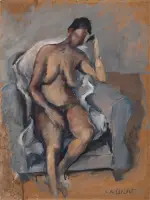
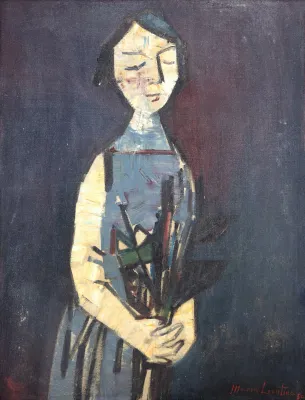
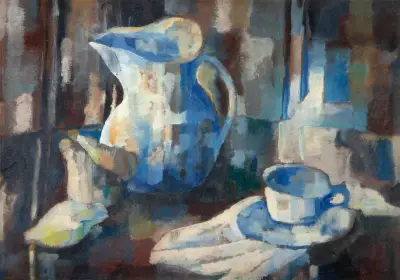
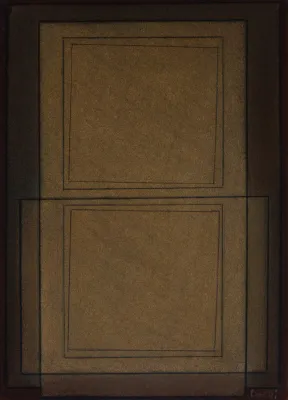
In 1955, Cruz-Diez began teaching history of the applied arts at the Escuela de Bellas Artes in Caracas. During this period, he combined teaching with advertising work and an artistic output marked by social realism. After 1954, he abandoned figuration and began working on the optical phenomena of color. That same year, he moved to Barcelona, where he stayed until 1956 and began the research into kinetic art that led to the series Fisiocromías [Physichromies].
In 1957, the artist returned to Venezuela and founded the Estudio de Artes Visuales, devoted to graphic arts and industrial design. He also became an illustrator for the publications of the Ministry of Education and for the magazine Mene. Between 1958 and 1960, he taught at and was deputy director of the Escuela de Bellas Artes in Caracas, and taught typography and design at the School of Journalism of the Universidad Central de Venezuela.
In 1960, he settled in Paris, where he continued his artistic and teaching career. In 1962, he exhibited at the 31st Venice Biennale, returning in 1970 and in 1986, when he was a special guest. In 1966, he received the Grand Prize at the 3rd American Art Biennial in Córdoba, Argentina. In Paris, in 1967, he took part in the exhibition Lumière et Mouvement with the Venezuelan Jesús Rafael Soto and the Argentine Julio Le Parc. In 1969, he won second prize at the International Painting Festival in Cagnes-sur-Mer, France, and in 1971 the National Visual Arts Prize in Venezuela.
In the 1970s, he developed famous series such as Color aditivo, Fisiocromías, Inducciones cromáticas, Cromointerferencias and Cabinas de cromosaturación [Additive Color, Physichromies, Chromatic Inductions, Chromointerferences and Chromosaturation Cabins]. From 1972 to 1973, he taught kinetic techniques at the École Supérieure des Beaux-Arts in Paris. He was a full professor and director of the Instituto Internacional de Estudios Avanzados (IDEA) in Caracas. In 1992, he showed work in the exhibition Latin American Art of the Twentieth Century in New York, at Expo Seville 92 in Spain, and in L'Art en Mouvement at the Centre Georges Pompidou in Paris. In 1997, he was named lifetime president of the Fundación Museo de la Estampa y del Diseño Carlos Cruz-Diez. Two years later, he opened the exhibition El Rojo, el Verde y el Azul, entre la Luz y las Tinieblas [Red, Green and Blue, Between Light and Darkness] in Havana, and donated a large public sculpture, Inducción cromática para La Habana [Chromatic Induction for Havana], for the 40th anniversary of the Casa de las Américas, in Cuba.
Source: Wiki Latino America, Text: Francisco Alambert