
Skull (SP – 1982)
Skull, known as Fábio de Oliveira Parnaíba, is one of the main representatives of contemporary Brazilian urban art. Born in 1982 in the north of São Paulo, his artistic trajectory was built on the streets of the city, where he began to express himself through graffiti. Since 1998, when he was still a teenager, young Fábio dedicated himself to street art, creating his own and innovative language that mixes social criticism, vibrant aesthetics and irreverent humor.
Skull art has developed in a self-taught way. Growing up in the periphery of São Paulo, he felt naturally attracted by the urban energy of the city, the cultural diversity and the effervescence of artistic manifestations on the street. His first drawings and interventions in the public space used the spray technique, a tool that he came to dominate over time. Initially, his influences were the graphics of traditional graffiti and the artistic expressions present in the streets of São Paulo, but over the years, Cranio began to incorporate elements of other cultural and artistic manifestations, such as surrealism, pop art and the aesthetics of cartoons.
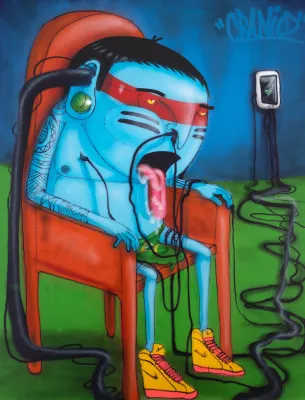
One of the first striking features of his work was the creation of the blue Indian character, a central figure in his works. This character, who became his signature, was a skull choice to represent a Brazil that mixes tradition and modernity. The Blue Indian, a being that dialogues with the country's indigenous cultures, constantly appears in situations that reflect contemporary issues, such as consumerism, social inequality, environmental destruction and cultural conflicts. The blue color that characterizes the Indian in its representations adds a surreal and universal element to his work, making it accessible to audiences from different parts of the world. Shape your unique aesthetic. Among them, the influence of Salvador Dalí, the master of surrealism, stands out, whose dreamlike and at the same time disturbing compositions inspired the artist to explore a visual world where absurdity and social criticism meet. In addition, skull work also reflects a clear approximation with pop culture and cartoons, visual influences that he has absorbed since he was young and that continue to be an important part of his iconography.
The use of spray as the main tool for creating murals was a of the first technical characteristics of his art. However, over time, skull diversified its techniques, also starting to work with acrylic painting, digital drawings and installations. His ability to work on large scales is evident in his murals, which gain imposing proportions and become interventions with great impact on cities. Skull has a special ability to integrate his works into the urban context, using architecture and public space as part of the work, expanding his message.
The marked line, the saturated color and the exaggerated shapes are central characteristics of his style. The figures he creates, especially the blue Indians, are always vibrant and charged with an energy that mixes graphic simplicity with symbolic depth. The firm line and the dynamic composition are recurring characteristics that make their works easily recognizable.
Thematic and social criticism
Skull work is a direct reflection of the social and cultural issues of contemporary Brazil, but also of global problems. One of the central themes of his production is the criticism of consumerism. In several of his works, the Blue Indian appears wrapped in symbols of capitalism, such as products of famous brands, elements of mass culture and other icons of the consumer society. These elements are used ironically, creating a contrast between the ancestral character of the Indian and the invasion of capitalism in all aspects of human life. natural problems, a particularly relevant problem in Brazil due to the growing exploitation of the Amazon and other biomes. The figures of blue Indians in absurd and chaotic situations are a powerful visual metaphor to show the consequences of environmental destruction and the alienation of the human being in relation to nature.
Social inequality is also a constant theme in his works. Brazil, with its immense disparities between social classes, is a fertile scenario for skull to explore the division between elites and marginalized populations. His murals often expose the tensions between luxury and misery, creating an atmosphere of harsh criticism of the contrasts present in Brazilian society. graffiti, his works soon began to be exhibited in galleries and museums, both in Brazil and internationally. His urban interventions, which began to gain visibility in the streets of São Paulo, were quickly recognized in the contemporary art circuit. The artist started to participate in collective and individual exhibitions in several cities around the world, including New York, London, Berlin, Paris, Barcelona and Miami. important museums dedicated to urban art in Europe. The exhibition consolidated its presence on the international scene and confirmed its relevance as one of the main names in Brazilian street art. In recent years, the artist has been dedicated both to interventions in the public space and exhibitions in galleries, always focusing on his messages of social and environmental criticism. of its generation, both in Brazil and abroad. His ability to transform walls and public spaces into screens of reflection and questioning made his work recognized by art critics and collectors around the world. His works, always provocative and vibrant, have the power to attract the attention of the public and invite him to reflect on issues that are often neglected by contemporary society. influenced other graffiti artists and urban artists around the world. His work is a fusion of aesthetics and message, creating a visual language that is both accessible and deep. As he himself stated, the street was his biggest school, and she taught him to observe, question and react to the reality around him. new forms of visual communication. His murals and gallery works are a true celebration of Brazilian culture, while offering an incisive critique of the globalized world and the economic and social system that governs our lives. Growing recognition around the world, especially for its ability to dialogue directly with the public and transform the public space into a field of reflection and contestation. His art not only beautifies the urban space, but transforms it into a stage for social, political and environmental debate, making him one of the most important artists in the contemporary scene.