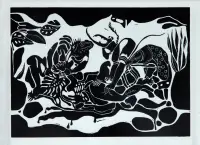
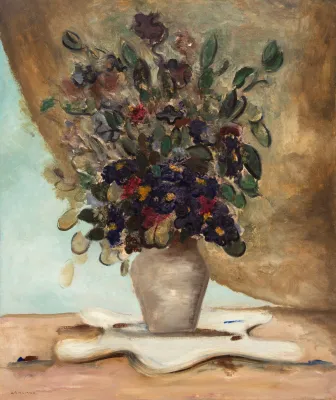
Carlos Pertuis (Rio de Janeiro RJ 1910 - Idem 1977)
Painting, designer, sculptor, recorder.
In 1939, he was admitted to the Hospital da Praia Vermelha, in Rio de Janeiro, after a cosmic view of the "Planetary of God" - according to his report -, which occurs from a reflection of the sunlight in the mirror of his room. inside the hospital, he makes drawings on paper towels and packs them in shoeboxes. In 1946, when he learned of this production, the painter Almir Mavignier (1925) sent him to the studio of the Occupational Therapy and Rehabilitation Sector - STOR, of the Municipal Institute of Health Care Nise da Silveira (formerly Psiquiátrico Pedro II). Pertuis frequents the painting studio and the binding workshop and watches over the cleaning of the institution's museum. It produces around 21,500 works, from drawings to engravings, and participates in individual and collective exhibitions in Brazil and abroad. Part of his work - preserved by the Museum of Images of the Unconscious - Integra, in 2005, an exhibition that took place in the Year of Brazil in France. The artist's life is told in Leon Hirszman's A Barca do Sol (1937 - 1987).
Critical Comment
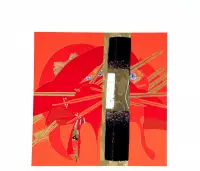
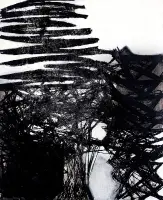
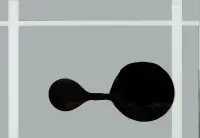
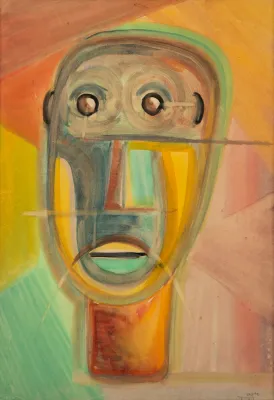
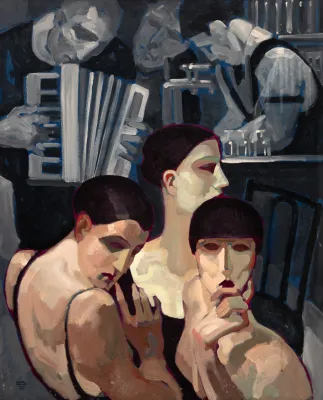
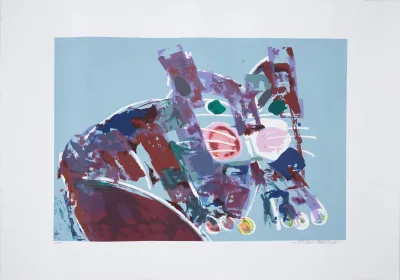
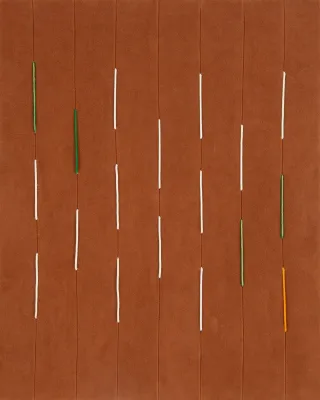
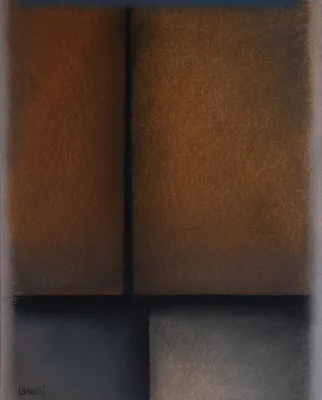
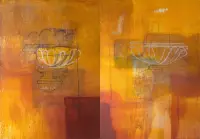
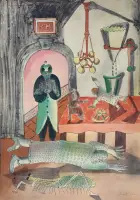
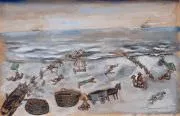
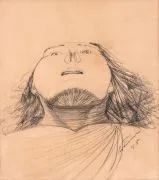
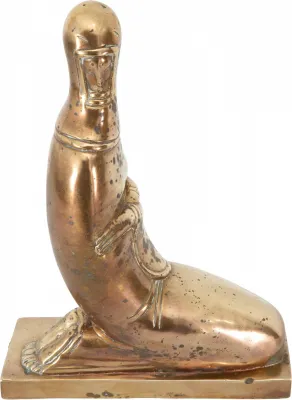
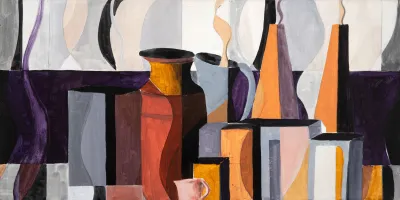
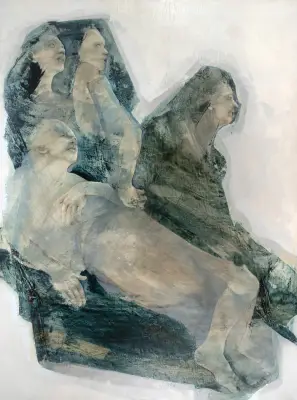
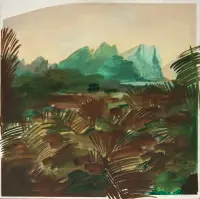
Carlos Pertuis produces his artistic works between 1946 and 1977 in the studio of the Occupational Therapy and Rehabilitation Sector - STOR of the current of the Municipal Health Care Institute Nise da Silveira (formerly Psiquiátrico Pedro II), in Rio de Janeiro. He works alongside other studio artists, such as Adelina (1916 - 1984), Arthur Amora, Emygdio de Barros (1895 - 1986), Fernando Diniz (1918 - 1999), Isaac (1906 - 1966), Octávio Ignacio (1926 - 1980) and Raphael (1912 - 1979). The paintings and drawings he makes stand out for their wide mastery of the use of color and geometric shapes, for the repertoire of images of fantastic beings and imaginary landscapes. The series Fantastic Seres, s.d., for example, presents in each painting a figure that occupies almost the entire area of the paper, usually highlighted by a dotted background. The images in the series make references to parts of the human body, animals and celestial elements that mix (tails, ridges, stars, legs, etc.), resulting in an invariably bipedal hybrid being.
The critic Mário Pedrosa (1900 - 1981) refers to Carlos Pertuis as "the man of the precise contours, the clear, well-marked shapes, in which the modeled is almost none and the style is given by the play of contrasts and the symmetrical demands (...) Carlos (...) The universe is a pure spatial order, a kind of eternity without succession, always present, updated, stripped of any temporal notion (...)".1
Nota
1 See PEDROSA, Mário. In: MELLO, Luiz Carlos; SILVEIRA, Nise da; CUNHA, Marcia Leitão da. Brazil Museum of Images of the Unconscious: Bilder des Unbewussten aus Brasilien = images of the unconscious from Brazil =. São Paulo: Brazilian Book Chamber, 1994. p. 161.
Criticism
"Carlos (...) is the man of precise contours, of clear shapes, in which the modeled is almost none and the style is given by the play of contrasts and the symmetrical demands In it the objective and the subjective tend to unite under a dominating architectural organization. In it, the objective or concrete forms, when they remain intact, are folded in the service of order, of an ideal unconscious purpose of the artist. Together vision generally sharp, out of time and without any connection with time. For Carlos this one does not exist. The universe is a pure spatial order, a kind of eternity without succession, always present, updated, stripped of any temporal notion. formalistic and spatial. There is no time evaluations or reasons for reminiscences. (...) The problem that excites him is space".
Mário Pedrosa
museum of images of the unconscious. Text by Nise da Silveira et al. Rio de Janeiro: National Institute of Plastic Arts, 1980. (Brazilian Museums, 2).
Individual exhibitions
1977 - Rio de Janeiro RJ - Thirty years of painting by Carlos Pertuis - 1947/1977, at the Museum of Images of the Unconscious
Collective exhibitions
1949 - São Paulo SP - 9 artists from Engenho de Dentro, at MAM/SP
1950 - Rio de Janeiro RJ - 9 artists from Engenho de Dentro, in the main hall of the City Council
1955 - Neuchâtel (Switzerland) - Brazilian primitive and modern art show, at the Ethnography Museum
1963 - Rio de Janeiro RJ - Exhibition, at Galeria Vila Rica
Posthumous exhibitions
1987 - Rio de Janeiro RJ - Innumerable States of Being, in the Imperial Palace
1999 - São Paulo SP - Transcendence: Caixas do Ser, at Casa das Rosas
2000 - Rio de Janeiro RJ - Brazil + 500 Rediscovery Exhibition. Images of the Unconscious, at Paço Imperial
2000 - São Paulo SP - Brazil + 500 Rediscovery Exhibition, at the Bienal Foundation
Source: Itaú Cultural