

Alex Vallauri (Asmara Ethiopia 1949 - São Paulo SP 1987)
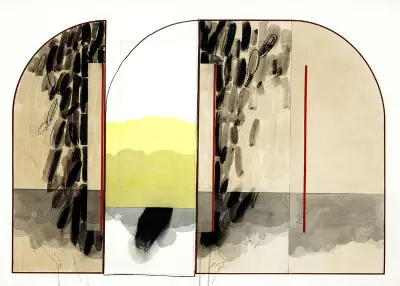
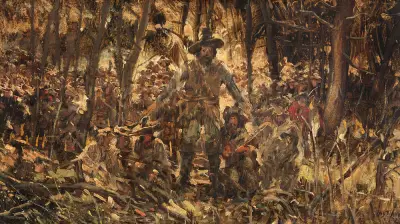
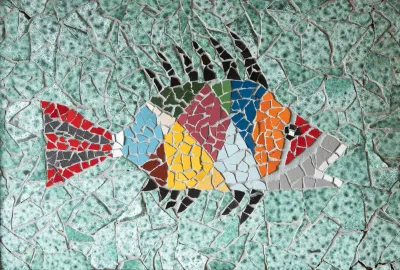
Alex Vallauri was a graffiti artist, graphic artist, engraver, painter, draftsman and set designer. He arrived in Brazil in 1965 and initially settled in Santos, São Paulo, later transferring to the capital of São Paulo. Still in Santos, he started in woodcutting and was awarded at the Young Art Salon in 1968.
In 1970, he held an individual exhibition at the Associação Amigos do Museu de Arte Moderna de São Paulo (MAM-SP). The following year, he graduated in Visual Communication from Fundação Armando Alvares Penteado (FAAP) and, two years later, began to teach an observation drawing and free expression at the same institution. In 1975, he specialized in lithography at the Litho Art Center, in Stockholm, Sweden.
From 1978 onwards, back in Brazil, he started to make graffiti and work with stencils in São Paulo. In 1981, he held an individual exhibition at the Pinacoteca do Estado de São Paulo. Between 1982 and 1983, he lived in New York, where he studied graphic arts at the Pratt Institute. He participated in the São Paulo International Biennial in 1971, 1977, 1981 and 1985, being in the last year that he presented the series A Rainha do Frango Assado, the theme of an installation. In 1988, his work was the theme of the Viva Vallauri retrospective, held at the Museum of Image and Sound (MIS), in São Paulo. settles in Santos. At that time, he produces high-contrast graphic records, whose themes are characters from Porto, such as dockers and prostitutes. Large woodcuts that gain public space, such as Boca com Alfinete (1973), of evident political content. objects and the human body - or fragments of it - are privileged themes of these interventions.
At the end of this decade, and continuing the same exploration of an iconography that refers to the mass culture of the 1950s, it adopts graffiti as a language, conceiving characters that refer to to those in comic books and, in particular, to pin-ups. The stencil is widely used. It also appropriates known figures from comic books, such as the character Mandrake, by Lee Falk. The images are transferred to paper and gain the space of postal art and artist books.
In 1985, he presents at the Bienal Internacional de São Paulo the installation of the Festa da Rainha do Frango Assado, a meeting of the graffiti with which he had been working together. to objects, simulating the environments of a house full of icons of the consumer society. The irony of the work is shown in this conception of a space of frivolities based on an absolutely precarious scenography, pointing to the disposable character of modernity.
Notes
1 cardboard molds with masks that receive ink in Spray.
Source: Itáu Cultural