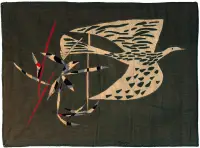
Yuji Tamaki (Fukui, 1916 - São Paulo, 1979)
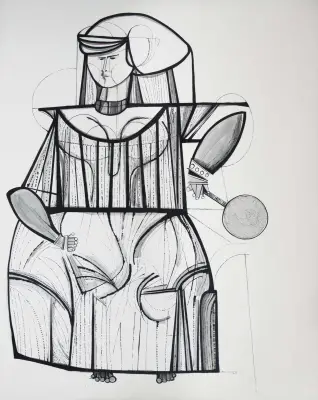
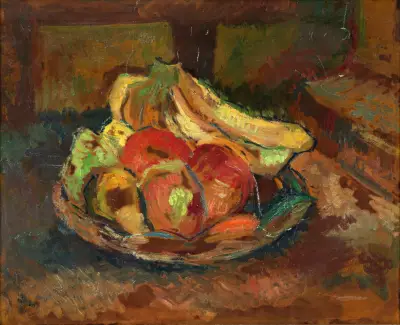
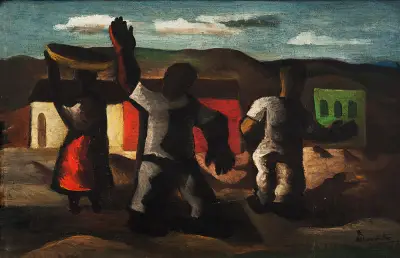
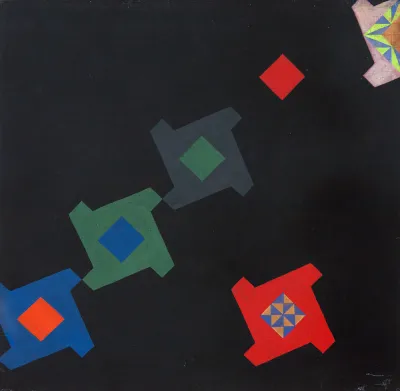
Yuji Tamaki was a painter, designer and Japanese-Brazilian teacher whose trajectory is inscribed among the fundamental names of the first generation of Japanese artists living in Brazil. His work, marked by constructive discipline and contained lyricism, dialogues with post-impressionism and with the legacy of Paul Cézanne, always seeking the synthesis between oriental sensibility and western formal structure. He participated in important artistic movements, such as Núcleo Bernardelli, Grupo Seibi, Grupo 15 and Grupo Guanabara, in addition to having been awarded in salons and prominent exhibitions in the Brazilian scene. Japan, Yuji Tamaki grew up in a traditional environment, amid the political and cultural transformations of the pre-war period. From a young age, he showed an interest in the visual arts and drawing, influenced by the Japanese aesthetic principles of simplicity, contemplation and harmony with nature. At the age of sixteen, in 1932, he immigrated to Brazil, following the migratory flow of thousands of Japanese who sought new opportunities in São Paulo agriculture. He initially established himself in the interior of São Paulo, where he worked in the fields and had direct contact with the Brazilian landscape — an experience that would deeply mark his artistic vision, due to the intimate relationship with the natural space and tropical light.
A few years later, Yuji Tamaki moved to the capital of São Paulo. There he met artists of Japanese origin who would become his trajectory companions, such as Shigeto Tanaka, Yoshiya Takaoka and Tomoo Handa. The contact with these names aroused in him the desire to delve deeper into artistic studies. Moved for this purpose, he traveled to Rio de Janeiro around 1934, where he joined the classes of Bruno Lechowski (1887–1941), a Polish master based in Brazil and one of the central figures in the formation of a generation of painters Modernists.
During his permanence in Rio, Yuji Tamaki actively participated in the Bernardelli core — a group of independent artists who advocated the free practice of art, the direct study of nature, the live model sessions and the removal of academic conventions. In the nucleus environment, he lived with names like José Pancetti, Ado Malagoli, Edson Motta and Takaoka himself. This coexistence was decisive for the maturation of his language: he learned from Lechowski the rigor of the composition, the balance between volume and color and the importance of structure in painting. It was also during this period that he approached the ideas of post-impressionism and Cézanne's chromatic research, which would remain constant references in his career.
Career and artistic groups
In 1935, Back To São Paulo, Yuji Tamaki became one of the founders of the Seibi group, a collective formed by Japanese-Brazilian artists who played a crucial role in the cultural integration between Japan and Brazil. The group sought to spread modern art among immigrants and promote the exchange of ideas with Brazilian artists. Tamaki participated in several exhibitions organized by the group, in which he presented works that revealed his concern with the structure and compositional serenity.
In the same year, he participated in the 3rd Salão Paulista de Belas Artes, where he obtained recognition for his technical maturity and the consistency of his work. In 1937 and 1938, he received awards at the National Salon of Fine Arts, in Rio de Janeiro — a significant achievement, considering the difficulties faced by immigrant artists in establishing themselves in the Brazilian artistic milieu at the time.
In 1948, Yuji Tamaki He was part of Group 15, which brought together painters interested in exploring the possibilities of color and form in the context of modern art. The group's first exhibition took place at the Institute of Architects of Brazil (IAB), in São Paulo, in 1949, and was received carefully by critics, who highlighted the coherence and formal refinement of their painting.
In the 1950s, participated in the activities of the Guanabara group, exhibiting in 1950, 1958 and 1959. At this stage, its palette became more restrained, and its compositions began to reflect a more constructive thought. The short and controlled strokes, the subtle transitions between tones and the harmony between the plans show a search for balance between emotion and reason, an essential characteristic of his work.
During the 1960s, Yuji Tamaki obtained new awards in the Salons Seibi (1963 and 1964) and participated in several editions of these events, which became an important space for affirmation for Japanese-Brazilian artists. In 1966, his works were included in the exhibition Artists Japanese-Brazilian, at the Museum of Contemporary Art of the University of São Paulo (MAC/USP), a show of great relevance for institutionally recognizing the Japanese contribution to modern art in Brazil.
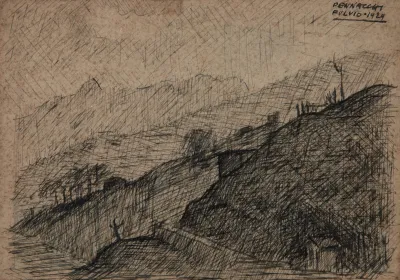
In the following years, he held individual exhibitions at the gallery Cosme Velho, in São Paulo (1969 and 1970), presenting a series of urban landscapes and compositions in which chromatic sensitivity and constructive precision stood out. In 1977, he participated in the show Grupo Santa Helena: Decade 35 to 45, at the Museu de Arte Brasileira of the Armando Alvares Penteado Foundation (MAB/FAAP), integrating a generation of artists that marked the consolidation of modern painting in São Paulo.
After His death, in 1979, MAC/USP and other institutions promoted exhibitions and studies dedicated to his work. In 1980, a retrospective held at the Galeria Place des Arts, in Rio de Janeiro, reaffirmed its importance in the panorama of Brazilian modern art.
Critical Comment
Yuji Tamaki's painting reveals a rare synthesis. between European constructive thinking and Japanese aesthetic sensibility. Learning with Bruno Lechowski consolidated his structural vision of painting, based on balance and the disciplined observation of nature. Tamaki absorbed the idea that the painting should be built, and not just represented — each plane, each color, each line participating in a general order.
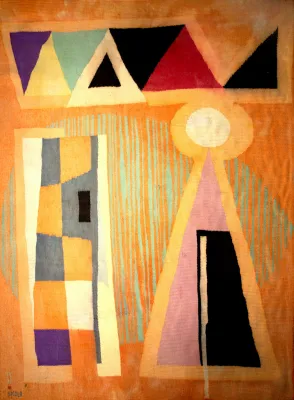
Paul Cézanne's influence is particularly visible in the way he organizes the pictorial space. In works such as the acclimatization landscape (c. 1938), the construction takes place through volumes and articulated geometric planes, in which both controlled gestuality and the geometrization of solids are perceived. In circus (1950), the artist shows a more lyrical approach, with delicate tones and soft rhythms, evoking the meditative and contemplative sense typical of oriental art.
Yuji Tamaki did not seek the radicalism of Abstract vanguards, remaining faithful to traditional genres, such as landscapes and portraits. He developed an essentially modern painting, supported by the tension between form and color, between analysis and emotion. Color, in his work, has structural value: lowered, earthy tones are common, which give the canvas a climate of serenity and introspection. Light does not appear as an atmospheric effect, but as a pictorial matter that defines volume and depth.
As a teacher, Yuji Tamaki was respected for his rigor and dedication, transmitting to his students not only painting techniques, but also a work ethic based on in discipline and sensitivity. His formative influence extended to a generation of Japanese-Brazilian artists who found in him an example of aesthetic coherence and artistic integrity.
Legacy and influence
The legacy of Yuji Tamaki is inseparable from the history of art Japanese-Brazilian and the consolidation of modernism in São Paulo. Its trajectory illustrates the fusion between the eastern contemplative spirit and Western constructive rationalism. Alongside artists such as Tomoo Handa, Tikashi Fukushima and Manabu Mabe, he was one of those responsible for establishing a deep dialogue between the traditions of Japan and Brazilian artistic modernity.
Yuji Tamaki represented a point of balance between two cultures, expressing in his painting a universal harmony. His work is marked by the absence of excessive gestures, by the economy of means and by the expressive containment, characteristics that reflect both Zen-Buddhism and the rigor of European modernism.
After his death, his production continued to be studied and recognized by art critics and historians. His works appear in private collections and in collections dedicated to the Japanese presence in Brazil, such as the Historical Museum of Japanese Immigration and MAC/USP. Retrospective expositions and academic studies have been rescuing its importance, placing it among the discrete but decisive protagonists of Brazilian modern painting.
Criticism
“Yuji Tamaki's work reflects a structural serenity Rare. His painting starts from a rigorous observation of the real, but he transcends his appearance to achieve an inner order. In his landscapes and urban compositions, we can see the search for harmony between gesture and reason, between East and West. Silent, an essential painter.”
José Roberto Teixeira Leite
LEITE, José Roberto Teixeira. Critical Dictionary of Painting in Brazil. Rio de Janeiro: Artnova, 1989.
“Yuji Tamaki belongs to the generation of Japanese-Brazilian artists who knew how to unite the technical rigor of the Japanese tradition with the experimentalism of modern painting. Its production reveals a constant concern with the structure and the synthesis, characteristics that They bring him closer to Cézanne, but also distinguish him by his lightness and restraint, his work is an exercise in balance and silence.”
Itaú Cultural Encyclopedia. entry: Tamaki. São Paulo: Itaú Cultural, 2023.
“Yuji Tamaki builds his landscapes with the same discipline as a calligrapher. Each brush stroke seems to seek the harmony of the set, the breath of space. superfluous, but a constant meditation on the visible. Its art is discreet, but of a silent intensity that makes it perennial.” 1966.