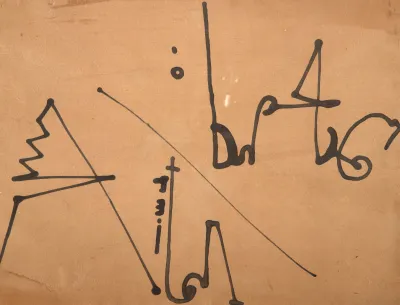
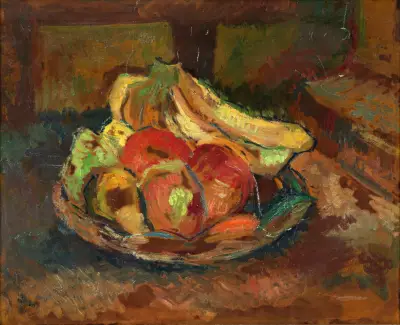
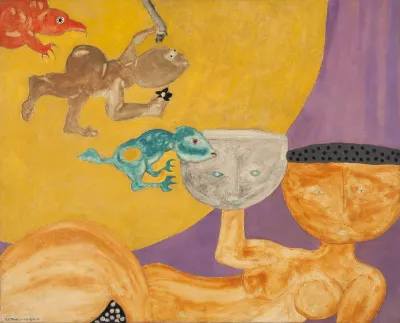
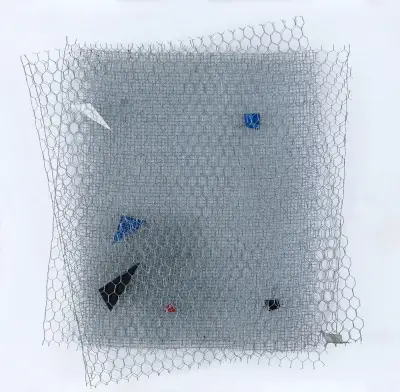
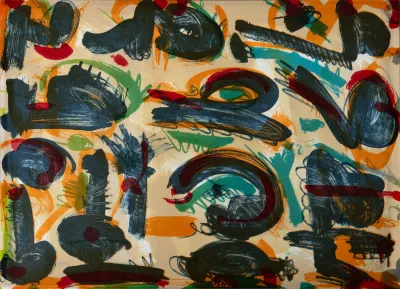
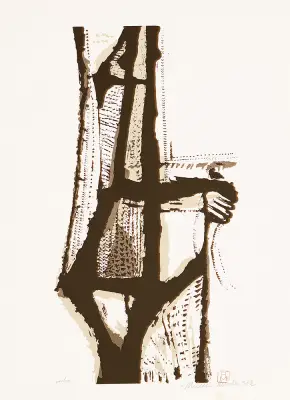
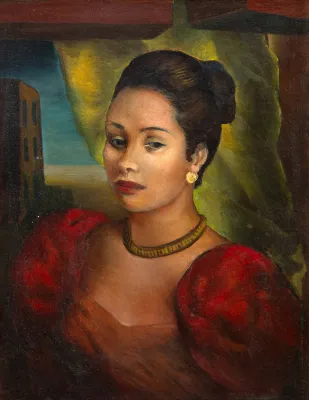
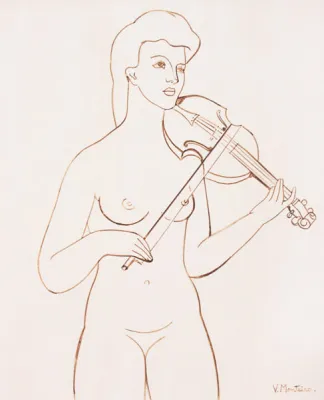
Waldomiro de Deus (Itagibá BA 1944)
Waldomiro de Deus is an internationally recognized painter and designer as one of the most creative representatives of the naïve art. Of humble origin, he had a childhood and youth marked by an itinerant life through the hinterland of Bahia and the north of Minas Gerais, before establishing himself in São Paulo, in 1959, where he initially worked as a shoeshine boy. His contact with art came about in an unusual way, in 1961, when he began to paint using materials found in the house of an antique shop where he worked as a gardener. After being fired, he took his first work to exhibit on the tea viaduct and, surprisingly, sold two of them on the first day.
The support of the decorator Terry della Stuffa, who provided him with materials and space to paint, was fundamental for his artistic evolution. In 1966, he held his first solo exhibition at the Armando Álvares Penteado Foundation (FAAP). Waldomiro gained notoriety both for his talent and for his irreverent personality, as when he paraded in a mini-skirt on Rua Augusta at the height of the hippie movement. His works caused controversy by portraying religious figures in modern and sensual attire, such as Nossa Senhora in a mini-skirt and Jesus in Bermuda, which even provoked their persecution by members of the TFP organization. Even so, he remained firm in his freedom of artistic expression.
Throughout his career, he exhibited in several countries such as England, Italy, Belgium, Germany and the United States, gaining international recognition. Since the 1960s, he has lived exclusively on his art, portraying with vibrant colors and his own style, the folklore and legends of the northeastern interior, such as the headless mule and the werewolf, in addition to eschatological and erotic. A striking feature of his work is the constant presence of three puppies on all screens, as well as the representation of human figures that are always mulatto, never white or black.
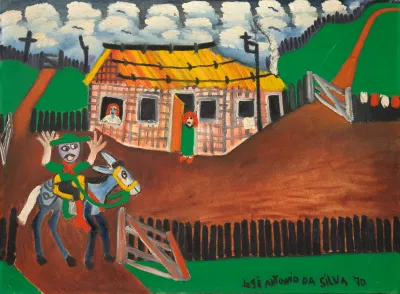
Considered, alongside José Antônio da Silva and Djanira, one of the greatest Primitivist artists of Brazil, Waldomiro de Deus received, in 1983, the Award of the Statue of Victory, awarded by the Centro Studi and Ricerche delle Nazioni, in Italy. His work remains a vibrant and authentic record of Brazilian popular culture, marked by originality and creative freedom.
Criticism
"The painting by Waldomiro de Deus aspires, above all, communication with the other. Report, of implicit story, of record of facts, image that tells to those who observe, know, guess or hear and imagine through the eyes. characters, the circumstances and the details of the facts he wishes to communicate, and the painting of illustration or record according to the pictorial of so many peoples of humanity. Painting linked to the reality of man, his life and his death. Anxiety of good transmitting and, on the religious foundation on which his art is based, of trying to exorcise evil, to attract benefits, to also obtain peace for a tumultuous world. In his works, the drawing flows, populating each space, because as long as there is an untouched area, the artist will have a detail to add to the desire to better explain his message. Limited the shapes by the dark line, or free in the pure color-with-color relationship, 'painted painting, with brunette meats', as Walmyr Ayala has already recorded and there is no need to redeem, Waldomiro paints Brazilian people as protagonists of passages biblical. which he reinterprets tastyly, with powerful vitality, giving them updates through a caboclo treatment."
Aracy Amaral
Waldomiro of God: Criticism. Paulo: S.ed., 1979.
"Waldomiro de Deus Souza is probably the greatest revelation of recent times in Brazilian primitivist painting. In less than two years, he produced numerous works, notable for pictorial quality, as well as for his variety. It also revealed an artistic personality of an unusual type among Brazilian primitivistists, which promises a great future development. (...) Brazilian primitivist painters of rural origin, in general, are characterized by a lagging vision of several centuries in relation to contemporary civilization. Artists from the Romantic or Gothic era often appear. Waldomiro surprised by its modernity. He became known for his paintings with astronautical themes, being called the rocket painter. On the other hand, much of his work is related to the life of the interior of Bahia. In some, he has dealt with aspects of the São Paulo metropolis. Waldomiro has an exceptional interest in the supernatural, which is one of the most frequent themes of his paintings. Like most Brazilian primitivistists, he is deeply religious. There are, however, very peculiar traits in their religiosity, violent and loaded with eschatological forebodings. He has a prophetic temperament, little contemplative. curiously combines apocalyptic eschatology with its interest in interplanetary travel".
Mário Schenberg
SCHENBERG, Mário. Thinking about Art. São Paulo: Nova Stella, 1988.
"Waldomiro is a chronicler who uses brushes. His work articulates social observation, eschatology, eroticism, religion, mystical fantasy and political criticism. His extravagant imagination does not distinguish the real from the imaginary, approaching with the same ease the triviality of everyday life or utopia. Intuitive, Waldomiro's art has deep roots in rural life, combined with urban elements, reflecting the artist's path. Its universe is composed of strong and at the same time naive images, represented with vibrant colors. The compositions have no perspective, the characters seem to float in space. The figures represented are always mulattos, like the artist himself, who so designates Brazilian racial and cultural mestize. Italian critic Lino Cavallari told him that he looks like Gauguin, who went to live in Polynesia and only painted the natives, with brown skin."
Alexandre Agabiti Fernandez
FERNANDEZ, Alexandre Agabiti "Waldomiro de Deus, a Chronicler of Brushes". In: Valor Econômico, São Paulo, September 24, 2001.
Testimonies
"I never went to school. This made me miss in life. But even so, from the beginning, my painting springs like a gift... I found my second angel: the physicist and art critic Mário Schemberg. He read my works as if they were a book... he loved those beautiful clothes stores. One day, I saw a miniskirt in a window. I didn't know what it was. I tried it and saw that it was for women. The store owner challenged me. He said he paid me if I went out with her in the middle of the street. I didn't think twice. They cursed me of everything that was an ugly name... I painted Our Lady in a miniskirt with a garter belt and boots... like me, Van Gogh was a rebel....Gauguin's dark figures fascinate me. I don't like to paint whites or blacks. yes drawing of Brazil mulattos and mestizos of the year 2050".
Waldomiro de Deus
Deus, Waldomiro de. "The Brazilian of the Year 2050". Available at: [www.waldomirodedeus.com.br]
"I could do decorative painting and get rich, but I prefer to live in Osasco, among the simple people. I come from this people, I am part of it. I see the problems and the joys of the people, which are themes that are always present in my painting".
Waldomiro of God
God, Waldomiro of God. (Testimony given to Alexandre Agabiti Fernandez). In: Valor Econômico, São Paulo, September 24, 2001.
Individual exhibitions
1961 - São Paulo SP - Expo His works on cardboard at Viaduto do Chá
1964 - São Paulo SP - Individual, at Galeria Directa
1964 - São Paulo SP - Individual, at Galeria São Luís
1965 - Rio de Janeiro RJ - Proposals, at Galeria Meia Pataca
1966 - Campinas SP - Individual, at the Campinas Museum of Art
1966 - São Paulo SP - Individual, at FAAP
1966 - São Paulo SP - Individual, at the direct gallery
1967 - Santos SP - Individual, at the Kiart Gallery
1967 - São Paulo SP - Individual, at Galeria da Vinci
1967 - São Paulo SP - Individual, at the SESC Paulista Gallery
1968 - São Paulo SP - Individual, at the Aliança França Galeria
1969 - Paris (France) - Individual, at Galeria Antoinette
1969 - Rio de Janeiro RJ - Individual, at Galeria Voltaico
1970 - London (England) - Individual, at the Brazilian Embassy Gallery
1970 - Paris (France) - Individual, at the Laval Museum
1970 - Paris (France) - La Maison et Son Dócor
1971 - Alabama (United States) - Individual, at the Gallery Courtney
1971 - Bernardi (Italy) - Individual, at Galleria d'Arte D.
1971 - Bologna (Italy) - Individual, at Galleria d'Arte La Colonna
1971 - Florence (Italy) - Individual, at Galleria d'Arte Arno
1971 - Hollywood (United States) - Individual, at the Municipal Art Gallery
1971 - Jerusalem (Israel) - Individual, at the home of the artist in Jerusalem
1971 - Telavi (Israel) - Individual, at Zoa-House
1972 - Brussels (Belgium) - Individual, at the Isy Brachot Gallery
1973 - Bologna (Italy) Cherrry
1973 - Bologna (Italy) - Individual, at the National Gallery
1973 - Rio de Janeiro RJ - Individual, at MNBA
1974 - Italy - Individual, at the Aldebaran Gallery
1974 - Milan (Italy) - Individual, at Galeria Fel Barcando
1974 - Milan (Italy) - Individual, at Galeria La Grande Domenica
1974 - Munich (Germany) - Individual, Charlotte Galerie Fuer Naive
1974 - São Paulo SP - Individual, at Galeria Sesc
1976 - Paris (France) - Individual, at Galeria L'Oeil de Boeuf
1976 - Salvador Ba - Individual, at the Panorama Gallery
1977 - Osasco SP - Individual, at the Osasco Museum
1978 - Osasco SP - Individual, at the Faculty of Law of Osasco
1978 - São Paulo SP -Individual, at Galeria Jardim das Artes
1979 - Brasília DF - Individual, at the Hotel Eron
1979 - Piracicaba SP - Individual, at the Municipal Theater
1979 - Salvador BA - Individual, at the gallery Panorama
1979 - São Bernardo do Campo SP - Individual, at the Cacilda Becker Theater
1980 - São Paulo SP - Individual, at Galeria Cravo e Canela
1980 - São Paulo SP - Individual, at Paço das Arts
1981 - Rio de Janeiro RJ - Individual, at the Jean-Jacques Gallery
1981 - São Bernardo do Campo SP - Individual, at the Pinacoteca de São Bernardo do Campo
1981 - São Paulo SP - Individual, at the São Paulo Public Ministry Association of São Bernardo do Campo SP - Individual, at the Pinacoteca de São Bernardo do Campo
1982 - São Paulo SP - Individual, at the Municipal Palace
1984 - São Paulo SP - Individual, Galeria Jacques Ardies
1986 - Campinas SP - 25 years of painting, at Macc
1987 - Florianópolis SC - Individual, at MASC
1987 - Joinville SC - Individual, in the Museum of Art
1989 - São Paulo SP - Individual, in Itaugaleria
1990 - São Paulo SP - Individual, at the Galeria de Arte Portal
1991 - Goiânia GO - Individual, at the Casa Grande Art Galeria
1991 - Paris (France) - Individual, at La Grande Bouveche Cultural Centre André Malraux Ville d'Orsay
1995 - São Bernardo do Campo SP - The mysterious world in the paintings of Waldomiro de Deus, City Hall
1999 - Rio de Janeiro RJ - Millennium Crossing, at the Museum of Fine Arts in Rio de Janeiro
2001 - Osasco SP - Deforestation, at Osasco Plaza Shopping
2001 - São Paulo SP - Individual, at IPREN
2004 - São Paulo SP - Individual, at MuBE
2005 - Osasco SP - Waldomiro: Exhibition of Desagravo, at UnifiEo
Exhibition Collectives
1962 - São Paulo SP - 1st Folklore Fair, at the Água Branca Park Hall
1963 - Alabama (United States) - Collective, organized by Itamaraty
1963 - Texas (United States) - Collective, organized by Itamaraty
1963 - Washington D.C. (United States) - Collective, organized by Itamaraty
1965 - São Paulo SP - Proposals 65, MAB-FAAP
1966 - Belo Horizonte MG - Belo Horizonte Art Salon
1966 - Campinas SP - Campinas Contemporary Art Salon
1966 - Moscow (Soviet Union, current Russia) - press conference Brazilians
1966 - Paris (France) - Brésil Imprévu, organized by Itamaraty
1966 - Salvador BA - 1st National Biennial of Fine Arts
1966 - São Paulo SP - 15th Salão Paulista de Arte Moderna, at Galeria Prestes Maia
1966 - Warsaw (Poland) - Collective of Brazilian Artists
1967 - São Paulo SP - 9th São Paulo International Biennial, at the Bienal Foundation
1968 - Salvador BA - 2nd Bahia Bienal
1969 - Brussels (Belgium) - Collective, at the Isy Brachot Gallery
1970 - Madrid (Spain) - Brazilian Naives
1970 - Paris (France) - Collective, at Galeria Antoinette
1972 - Brasiléia (Switzerland) - Third International Art Fair
1972 - Bratislava (formerly Czechoslovakia, current) Slovakia) - Bratislava Triennale - Award for Best National Collection
1972 - Jaffa (Israel) - Collective
1973 - Denmark - Collective, at the Louisiana Museum
1973 - Rio de Janeiro RJ - Collective, at the Museum of Fine Arts
1974 - Munich (Germany) - Individual, at Charlotte Galerie Fuer Naive
1975 - Rio de Janeiro RJ - Collective, at the Museum of Fine Arts
1975 - São Paulo SP - Color Festival, at Masp
1976 - Erba (Italy) - Biennale Internazionale Naif
1976 - Montevideo (Uruguay) - 1st Encuentro Uruguayo-Brasileño de Arte Naif
1978 - Florida (United States) - Collective at the Grinter Gallery at the University of Florida
1979 - London (England) Hamiltons Fine Art Gallery
1980 - Atami (Japan) - Brazil-Japan Salon
1980 - Brussels (Belgium) - Collective, at Dierickx Gallery
1980 - Nice (France) - Collective, at the Musée International d'Art Naif Anatole Jakovsky
1981 - Jacareí SP - Salão de Jacareí
1981 - São Bernardo do Campo SP - Mostra, Pinacoteca de São Bernardo do Campo
1981 - São Paulo SP - 2nd Salão Paulista de Artes Flásticas e Visuals, at Paço das Artes
1981 - Tokyo (Japan) - Brazil-Japan Salon
1982 - Naples (Italy) - Myth and Magic of the Colore
1982 - Nice (France) - Collective, at the Musée International d'Art Naif Anatole Jakovsky
1982 - Paris (France) - Le Genie de Naifs, at the Grand Palais
1982 - São Paulo SP - 3rd São Paulo Salão de Artes Visual and Visual
1983 - Santo André SP - Tennis Salon Clube de Santo André
1983 - São Paulo SP - Re-reading Project, at the Pinacoteca do Estado
1984 - Bologna (Italy) - L'Arte Popolares Sudamericana - Circolo Sardegna
1984 - São Paulo SP - Arte na Rua
1985 - São Paulo SP - 18th São Paulo International Biennial, at Fundação Bienal
1986 - Campinas SP - 25 years of painting at MACC
1986 - São Paulo SP - Zumbi da 4th Bienal
1988 - Rio de Janeiro RJ - The fascinating world of naïve painters, at Paço Imperial
1988 - São Paulo SP - Brazilian art, at Pinacoteca do Estado
1988 - São Paulo. Paulo SP - Brasiliana: O Homem e a Terra, at the Pinacoteca do Estado
1988 - São Paulo SP - Afro-Brazilian Hand, at MAM/SP
1994 - Piracicaba SP - 2nd Brazilian Biennial of Art NAIF, at SESC
1995 - Osasco SP - 2nd Art Exhibition, at Centro Universitário FIEO
1995 - São Paulo SP - Contact, at Sesc Pompéia
1995 - São Paulo SP - Project Contact, at Galeria Sesc Paulista
1996 - São Paulo SP - O Mundo de Mário Schenberg, at Casa das Rosas
1997 - Rio de Janeiro RJ - Air: Fine Arts Exhibition, Toys, Objects and Models, in Paço Imperial
1998 - Assis SP - In the ways of the university
1998 - Franca SP - On the paths of the University
1998 - Marília SP - On the paths of the university
1998 - President Prudente SP - on the paths of the University
1998 - Rio Claro SP - on the University Paths
1998 - São José dos Campos SP - On the University Paths
2000 - Piracicaba SP - 5th NAIFS Biennial Brazil
2000 - São Paulo SP - Brazil + 500 Rediscovery Exhibition, at Fundação Bienal
2002 - Piracicaba SP - 6th Naifs do Brasil Biennial, at SESC
2002 - São Paulo SP - Pop Brazil: Popular Art and the Popular in Art, at CCBB
2002 - São Paulo SP - Santa Ingenuidade, at Unifieo
2004 - Rio de Janeiro RJ - Tudo É Brasil, Paço Imperial
2004 - São Paulo SP - Arte Naif, at Galeria Jacques Ardies
2004 - São Paulo SP - New acquisitions: 1995 - 2003, at MAB-FAAP
2004 - São Paulo SP - Tudo é Brasil, at Itaú Cultural
2005 - Brasília DF - Meetings and reunions in Naïve Art: Brasil-Haiti, at CCBB
2005 - São Paulo SP - Meetings and Reunions in Naïve Art: Brasil-Haiti, at Mab-Faap
Source: Itaú Cultural