Tomoo Handa (Utsunomiya, Japan 1906 - s.l. 1996)
Pintor and teacher. 1917. goes to the Santo Antônio farm, near Botucatu, to work in the coffee plantation. In 1921, he moved to a Capital, where he began his artistic training at the Escola Profissional Men's do Brás, between 1927 and 1929. He attends the School of Fine Arts of São Paulo from 1932 to 1935, where he receives guidance from Lopes de Leão (1889-1964). He founds with other artists, in 1935, the Seibi group (Seibi-Kai), which aims to share experiences and stimulate artistic debates, in weekly meetings between Japanese-Brazilian painters. In 1936, he held his first solo show at the Nippon Club, and in the same year he won recognition outside his community, receiving an honorable mention at the São Paulo hall of Fine Arts. He also participates in other important groups in the Japanese colony, such as the Jacaré Group or 15, between 1948 and 1949, and the Guanabara Group, from 1950 to 1959. Domus Gallery, in São Paulo (1950, 1951, 1953, 1958, 1959). Participates in the 1st International Biennial of São Paulo, in 1951, the 1st Salão de Arte Modern Art of São Paulo and the 1st Salão de Arte Modern Art in Rio de Janeiro, both in 1952. Paulo, in 1952. After his death, the retrospective exhibition of Tomoo Handa is held at the Museum of Japanese-Brazilian Art, São Paulo, in 1997.
Critical Comment
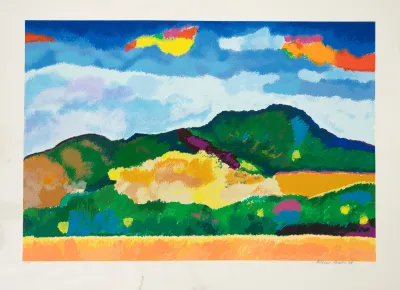
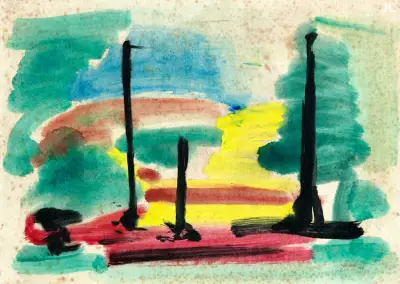
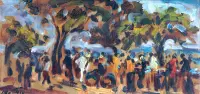
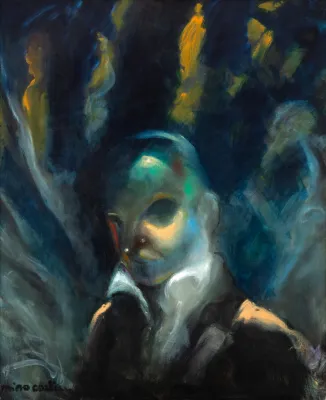
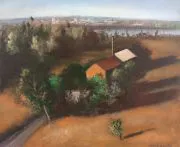
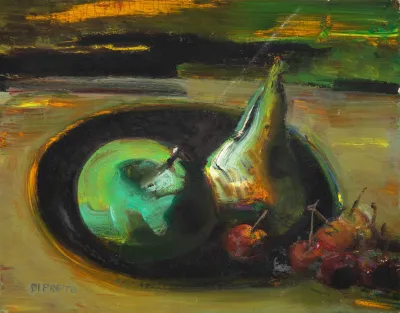
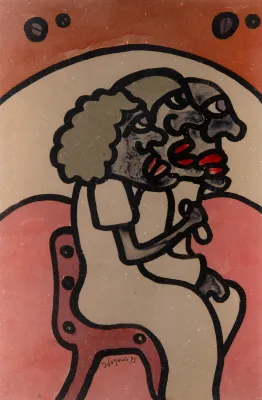
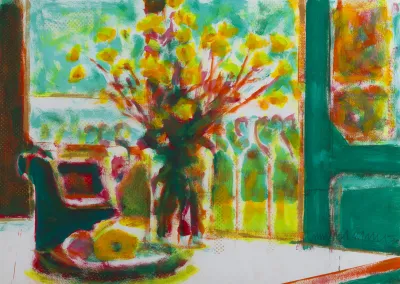
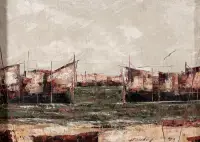
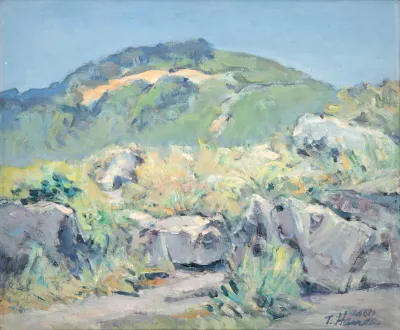
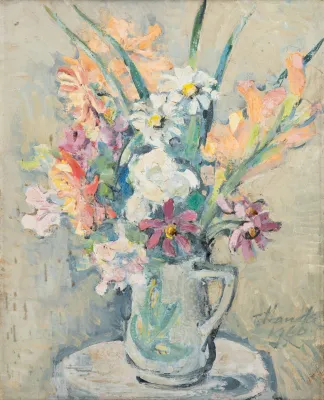
Essentially Pictorial, the work of Tomoo Handa consists mainly of landscapes and portraits, with oil and watercolor being the preferred means by the artist. In its landscapes, it takes a close look at the local vegetation and shows interest in the chromatic elaboration. Handa paints the surroundings of São Paulo and nearby cities, building rich and delicate canvases, as in the landscape of Vila Sônia (1947). The childhood lived on the farms in the interior of São Paulo, next to the newly formed Japanese colony, is evoked on canvases such as Cafezal (1952) and The Harvest of Coffee (1955). In a 1968 text, Handa comments: "...without having the visual arts found the barrier of language to expression, artists could develop questions about what the beauty is, what the fine arts of Japan are, as well as what the art that the immigrant could create is. [...] in Brazil. [...] it is possible to say with certainty that all his effort [of the Japanese immigrant] was never in the sense of imitating the forms of the Japanese fine arts and that they will not be left with the sad shadows of them". Handa also dedicates himself to portraying the people of his socializing. In 1937, two years after completing his training at the School of Fine Arts, he painted a portrait of a woman, in which a young Japanese woman appears. Invoice screen still somewhat conventional, but already showing the search for balance and subtlety in the use of colors. Between 1940 and 1945, he performed the oil portrait of the painter Tamaki. This work, observes the curator Ana Paula Nascimento, already presents as a common characteristic of her production the use of dark lines contouring the figure and all objects, in an expressive way.
Criticism
"For him, the landscape speaks to him and he The revives on her canvases, a painter of light colors, because she concludes that she is not a tragic man, says that not even the war and the countless social problems she went through had influenced her work. visit in terms of softness and subtlety, but the inspiration is really in nature, in the forms. So many years have passed since the first work sold and its simple lyricism remains in bloom: 'My paintings remain the same, as I have. 'The brushstroke and chromatism They are carefully elaborated, not lacking an oriental accent due to the technical rigor and the transparency of the mass used, which characterize it as a professional component of this craft. The themes of nature govern their intention, communicating inexhaustible shortcuts and sources; With great wisdom he knows how to listen to this advice."
Ciça França Lourenço
Lourenço, Ciça França. In: In the art of the Japanese colony in Brazil. São Paulo: Masp, 1988.
Individual exhibitions
1936 - Arujá SP - Individual, at the Nippon Club
1948 - São Paulo SP - Individual, at the Domus Gallery
Collective exhibitions
1934 - São Paulo SP - 1st Paulista Salon of Fine Arts, at Rua 11 de Agosto
1935 - São Paulo SP - 3rd São Paulo Salon of Fine Arts
1936 - São Paulo SP - 4th Paulista Salon of Fine Arts
1937 - São Paulo SP - 5th Paulista Salon of Fine Arts
1937 - São Paulo SP - 1st Salon of May, at Esplanada Hotel de São Paulo - at the invitation of Mário de Andrade
1938 - São Paulo SP - 1st Exhibition of the Seibi Group
1939 - São Paulo SP - 6th Paulista Salon of Fine Arts
1949 - São Paulo SP - Group 15 exhibition, IAB/SP 
1950 - São Paulo SP - 1st Exhibition of the Guanabara Group, at the Domus Gallery
1951 - São Paulo SP - 2nd Exhibition of the Guanabara Group, at the Domus Gallery
1953 - São Paulo SP - 3rd Exhibition of the Guanabara Group, at the Domus Gallery
1958 - São Paulo SP - 4th Exhibition of the Guanabara Group, at the Domus Gallery
1959 - São Paulo SP - 5th Exhibition of the Guanabara Group, at the Domus Gallery
1951 - São Paulo SP - 1st São Paulo International Biennial, at the Trianon Pavilion
1951 - São Paulo SP - 1st São Paulo Modern Art Salon
1952 - São Paulo SP - 2nd Salão Paulista de Arte Moderna
1952 - Rio de Janeiro RJ - 1st National Salon of Modern Art
1960 - São Paulo SP - Exhibition of the Seven, at Cooperativa Agrícola de Cotia
1962 - Bragança Paulista SP - Exhibition of the Six, at Clube Dois
1965 - Washington (United States) - Itinerant collective painting Japanese-Brazilian painting Current
1965 - Oakland (United States) - itinerant press conference Current Japanese-Brazilian Painting
1965 - Tokyo (Japan) - Itinerant collective painting Japanese-Brazilian current
1966 - São Paulo SP - Japanese-Brazilian artists, at MAC/USP
1966 - São Paulo SP - 10th Salon of the Seibi Group of Plastic Artists, at the Brazilian Society of Japanese Culture
1976 - São Paulo SP - The Salons: from the São Paulo Artistic Family, in May and the São Paulo Plastic Artists Union, at the Lasar Segall Museum
1977 - São Paulo SP - Seibi Group - Santa Helena Group: Decade 35 to 45, at MAB-FAAP
1982 - São Paulo SP - From Modernism to the Biennial, at MAM/SP
1984 - São Paulo SP - Tradition and Rupture: Synthesis of Brazilian Art and Culture, at the Fundação Bienal
1986 - São Paulo SP - Six Times: 80 years, at the Pinacoteca do Estado
1987 - São Paulo SP - Primavera, at Liberdade Garô Galeria of Art
1988 - São Paulo SP - Life and Art of the Japanese in Brazil, at Masp
1988 - São Paulo SP - Brasiliana: O Homem e a Terra, in the Pinacoteca do Estado
1988 - Manaus AM - Heritage of Japan: Aspects of Japanese-Brazilian Visual Arts, at the State Pinacoteca
1988 - Brasília DF - Japan Heritage: Aspects of the Japanese-Brazilian Visual Arts
1988 - Belém PA - Heritage of Japan: Aspects of the Arts Japanese-Brazilian visuals, at the Romulo Maiorana Foundation
1988 - São Paulo SP - Japan Heritage: Aspects of the Japanese-Brazilian Visual Arts, at MAB-FAAP
1988 - Recife PE - Heritage of Japan: aspects of Japanese-Brazilian Visual Arts, at the Joaquim Nabuco Foundation/Instituto de Cultura
1988 - Curitiba PR - Inheritance from Japan: Aspects of the Japanese-Brazilian Visual Arts, at MAC/Curitiba
1988 - Porto Alegre RS - Inheritance From Japan: Aspects of the Japanese-Brazilian Visual Arts, at Margs
1989 - Rio de Janeiro RJ - Inheritance from Japan: Aspects of the Japanese-Brazilian Visual Arts, at MNBA
1992 - São Paulo SP - Grupo Guanabara: 1950-1959, at Renato Magalhães Gouvêa Art Office
1993 - São Paulo SP - Luso-Nipo-Brazilian Exhibition, at MAB-FAAP
1995 - São Paulo SP - Brazil-Japan Art, at Fundação Mokiti Okada M.O.A.
1995 - Niigata (Japan) - Exhibition of contemporary Japanese-Brazilian painters, at The Niigata Prefectual Museum of Modern Art
1995 - Tokushima (Japan) - Exhibition of contemporary Japanese-Brazilian painters, at the Tokushima Cultural Center
Posthumous exhibitions
1996 - Gifu (Japan) - Exhibition of Contemporary Japanese-Brazilian painters at The Museum of Fine Art Gifu
1996 - Tokyo (Japan) - Exhibition of contemporary Japanese-Brazilian painters, at Azabu Art Museum
1996 - São Paulo SP - Exhibition of contemporary Japanese-Brazilian painters, at MASP
1997 - Jacareí SP - Exhibition of Contemporary Japanese-Brazilian Painters, at the Santa Helena Arts Workshop
1997 - São Paulo SP - Retrospective Exhibition by Tomoo Handa, at the Japanese-Brazilian Art Museum
1998 - São Paulo SP - Grupo Seibi, at Jo Slaviero Art Gallery
1998 - São Paulo SP - São Paulo: Vision of the Japanese-Brazilians, at the Lasar Museum Segall
1998 - São Paulo SP - São Paulo iconography in private collections, at the Museu da Casa Brasileira
2001 - São Paulo SP - Japanese-Brazilian art: moments, at the Euroart Castelli gallery São Paulo SP - New acquisitions: 1995 - 2003, at MAB-FAAP
Source: Itaú Cultural