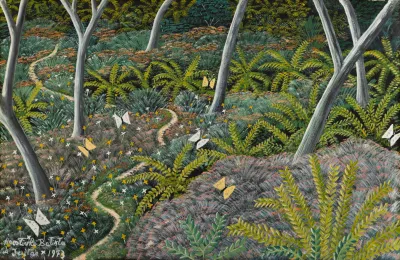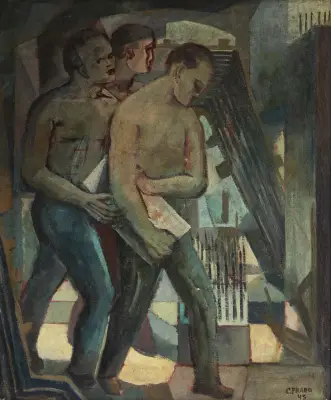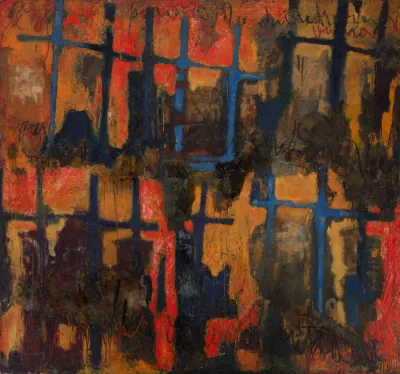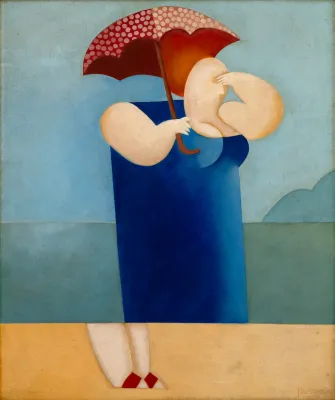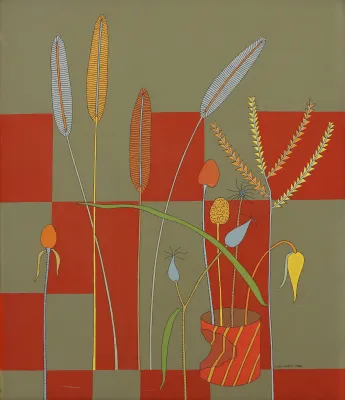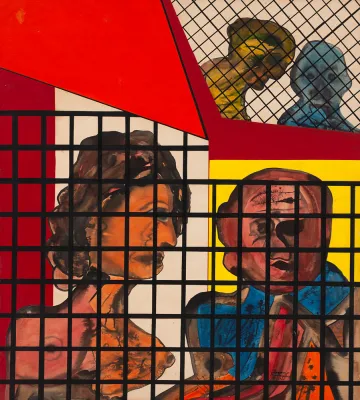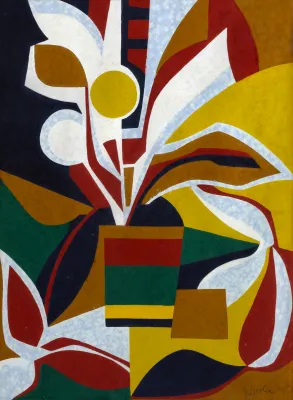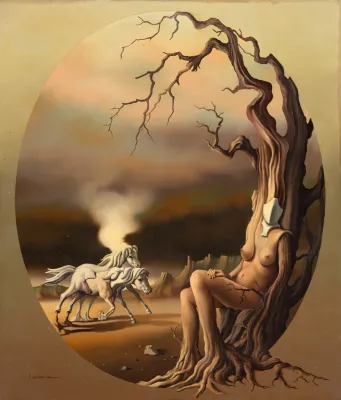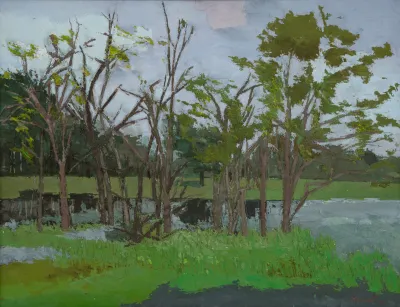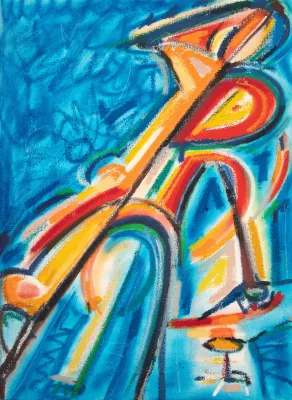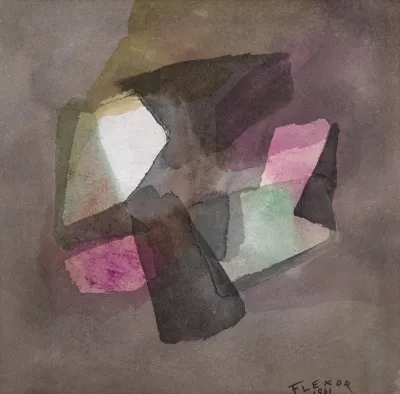
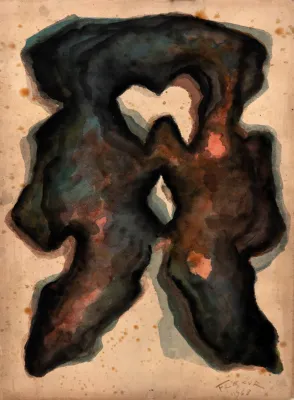
Samson Flexor (Soroca, Bessarábia, Rússia 1907 - São Paulo SP 1971)
Samson Flexor was a painter, draftsman, muralist and teacher, recognized for his contribution to abstraction in Brazil. Born in Moldova, he began his artistic training in 1922, when he traveled to Belgium and studied painting at the Académie Royale des Beaux-Arts, while also studying chemistry. Two years later, he moved to Paris, where he furthered his studies at the École Nationale Supérieure des Beaux-Arts under the guidance of Lucien Simon, as well as attending the art history course at the Sorbonne.
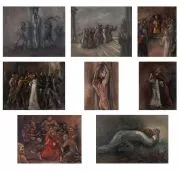
Between 1926 and 1927, he attended the La Grande Chaumière and Ranson academies, taking classes with Roger Bissière, which deeply shaped his grounding in European modernism. His first solo exhibition was held in Paris in 1927. In 1929, he founded the Salon des Surindépendants, of which he was director until 1938. After his conversion to Catholicism in 1933, he began producing religious murals, a phase that intensified during World War II, when, serving in the French Resistance, he was forced to flee Paris. During this period, his works began to adopt somber tones, reflecting expressionist and cubist influences, with themes related to the Passion of Christ.
In 1946, Flexor arrived in Brazil and held an exhibition at Galeria Prestes Maia in São Paulo. Two years later, he settled permanently in the city, where he played a fundamental role in the renewal of Brazilian modern art. At the invitation of critic Léon Dégand, then director of the Museu de Arte Moderna de São Paulo, he turned to geometric abstraction and, in 1951, founded the Atelier-Abstração [Abstraction Studio]. The space became an important center for the dissemination of abstract art in Brazil, training students such as Wega Nery, Norberto Nicola, and Jacques Douchez, among others.
In the 1960s, his work began to incorporate elements of lyrical abstraction and figuration, highlighting Flexor's constant search for new forms of artistic expression. With a trajectory marked by transitions and experimentation, he left a significant legacy in the history of modern Brazilian art, both for his work and for his role as a mentor of new talent.
Critical Commentary
When he settled in Brazil in 1948, Flexor was already a mature artist with a wealth of artistic experience. His training included a two-year stint at the Académie Royale des Beaux-Arts in Brussels (1922-1924), studies at the Ecole Nationale Supérieure des Beaux-Arts [National School of Fine Arts], and an art history course at the Sorbonne, both in Paris (starting in 1924). With a production reminiscent of the School of Paris, the artist gained critical acclaim in his first solo exhibition (1927). In 1929, he participated in the creation of the Salon des Surindépendants, of which he was director until 1938. He participated in the resistance against the Nazi occupation and was forced to leave the French capital in 1940. He experienced enormous difficulties during the war, returning to Paris only in 1945. Postwar difficulties, combined with the success of his trip to São Paulo accompanying an exhibition by the Grupo dos Pintores Independentes and his solo show at the Galeria Prestes Maia (1946), led him to decide to immigrate with his family to Brazil in 1948.
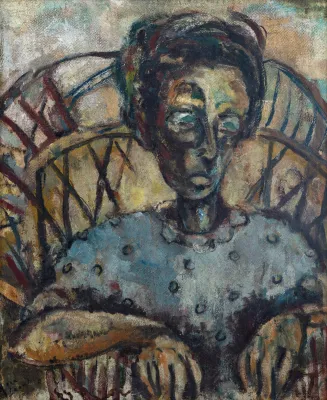
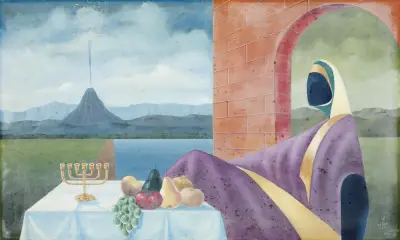
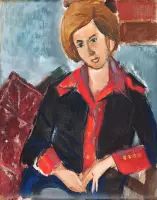
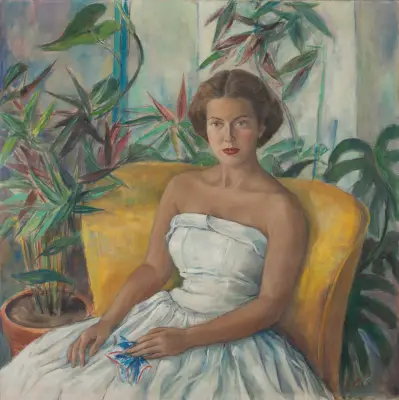
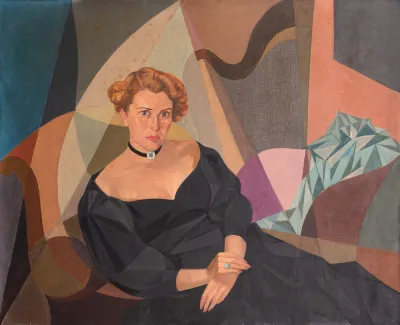
Considered one of the pioneers of abstractionism in Brazil, Flexor was an artist with a varied and independent output. From Cubist figuration to geometric abstraction, and from there to lyrical abstraction, he returned late in life to a kind of organic and anthropomorphic figuration, without neglecting religious painting and portraits. It should be noted that, just as he played an important role in Brazilians' acceptance of abstract movements, contact with the country's environment in the late 1940s was fundamental to the full development of abstract tendencies outlined in his painting since the end of World War II (1939-1945). He found an artistic milieu in which the dispute between the proponents of abstraction and the defenders of nationalist figurative painting was raging. He participated in the historic inaugural exhibition of the Museu de Arte Moderna de São Paulo (MAM/SP), Do Figurativismo ao Abstracionismo [From Figurativism to Abstractionism], in 1949, at the invitation of the Belgian critic and director of the newly founded museum, Léon Dégand (1907-1958), and was encouraged by him to venture down the path of pure geometric abstraction.
In turn, the feeling of crisis in humanism typical of the postwar period (Flexor declared in 1948: "Wars force man to rediscover the universe he thought he knew"), together with the contagious experience of the developmental boom that São Paulo was experiencing at the time, where, as the artist declared to Sérgio Milliet (1898-1966), "everything tends toward the future and proclaims its contempt for the colonial past," were decisive elements in the future paths taken by Flexor in Brazil.
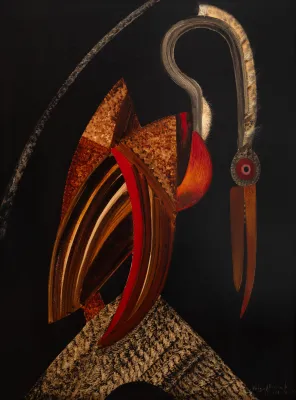
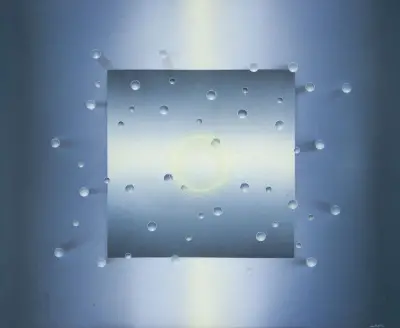
Thus, his semi-abstract painting of Neo-Cubist origin from the late 1940s, in which, as Mário Pedrosa (1900-1981) observed, "the superimposition of planes still has a figurative function"—see, for example, Xícaras [Cups] (1945), Violão [Guitar] (1948) and Cristo na Cruz [Christ on the Cross] (1949)—gradually turns into purely abstract geometric compositions in which the planes become autonomous, integrated by an "orthogonic or diagonal approach." Flexor's abstract canvases seek dynamism through the combination of vertical, diagonal, and horizontal planes and lines, and rhythmic points through the placement of warm tones alongside subdued tones, with the intention of achieving harmony within asymmetry. This abstraction, more musical than mathematical, is constructed through the study and application of Renaissance methods of proportion and harmony, as Alice Brill (1920) observes. Flexor would teach these rigorous studies from 1951 onward in the Atelier-Abstração (first phase 1951-1959), in which Alberto Teixeira (1925), Emílio Mallet, Izar do Amaral Berlinck, Jacques Douchez (1921), Leyla Perrone, Leopoldo Raimo (1912), Renée Malleville and Wega Nery (1912) took part.
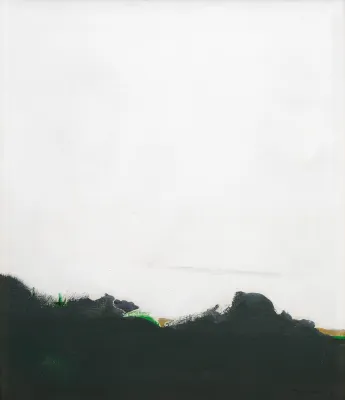
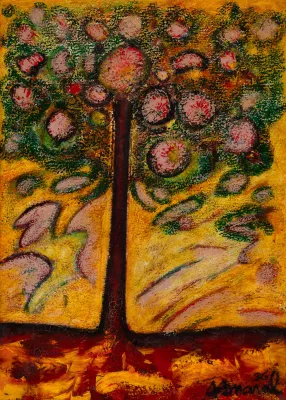
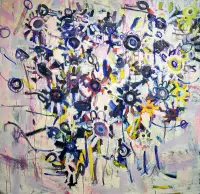
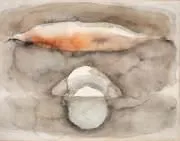
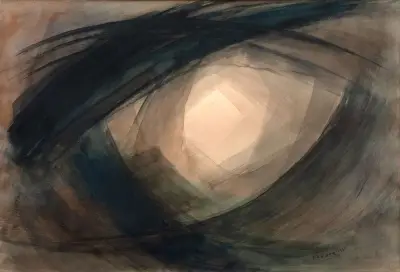
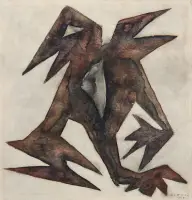
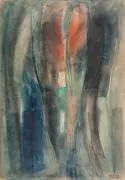
In the late 1950s, a series of factors, including a trip to the United States (1957) and the closure of the Atelier, influenced Flexor's shift toward a lyrical abstraction of organic forms. "At the same time as he immersed himself in an inner search, Flexor investigated matter, the rhythm of forms and light," as Denise Mattar points out. In 1967, the artist surprised by creating large "figurative-abstract" paintings entitled Bípedes [Bipeds] for the 9th Bienal Internacional de São Paulo. Regarding the coexistence of abstraction and figuration in Flexor's work, Tadeu Chiarelli shows that even in some so-called "pure abstract" works, illusionistic schemes are present, in an unquestionable commitment to traditional painting. In this sense, his work presents itself as a "privileged object of study on the problematic aspects involved in the absorption of non-figurative poetics in the field of Brazilian art."
Note
1 In 1812, with the signing of the Peace Treaty between the Russian and Turkish empires, the eastern part of Moldova, located between the Prut and Nistru rivers, called Bessarabia, and where the city of Soroca is located, was annexed to the Russian Empire, becoming a province of Russia until 1918. In that year, the Bessarabians decided to unite with Romania. This union lasted until 1940, the year in which the country was annexed by the Soviet Union as a consequence of the Ribbentrop-Molotov Pact of 1939. Moldova functioned as a territorial entity within the former Soviet Union until 1991, when it declared its independence.
Critiques
"(...) Like every painter in whom creative intelligence does not distance itself from or succumb to instinctive force, drawing has always been of decisive importance. It can be said that Flexor was, from his beginnings as a painter, a direct descendant of Synthetic Cubism. His large figurative compositions or compositions of sacred themes owe their complex structures to the Cubist experience of the second Parisian wave, in the predominance of planes over everything else. When he entered the geometric phase, these planes became autonomous of any representational idea, becoming intertwined either through an orthogonic or a diagonal approach. The structural complexity of the composition absorbed the artist to such an extent that color was, in general, merely a supplement of pink or green or any other semitone to white".
Mário Pedrosa
PEDROSA, Mário. Flexor, artista e pintor. In: FLEXOR. São Paulo: MAM, 1961.
"In 1963, Jacques Lassaigne referred to his art as a 'balanced synthesis between construction and lyricism,' and René Deroudille, in 1965, commented on his evolution: '(...) his first Brazilian works, dedicated to tropical abstractions, convey a formal and colorful lyricism, followed by a moment of serenity in which, guided by religious beliefs, Samson Flexor achieves an expressive synthesis (...) Next comes a period of cold and creative abstraction, close to constructivism and the optical and ambiguous concerns of op art. Finally comes the take-off toward very current research, where the eye 'listens' to the pulsations of the elements and causes strange craters, poisonous flowers, untamed waves to erupt across the canvas—signs of a plastic and poetic tonality to which Samson Flexor aspires.' Referring to his last works, Clarival Valadares said in 1968: 'In the example of Flexor, after reaching an unsurpassed level of virtuosity in the technique of superposition and tonal diaphanization, under rigid ordering of formal units (...) we see him transpose himself to the configuration of something of the human condition (...)' ".
Roberto Pontual
PONTUAL, Roberto. Flexor. In:______. Dicionário das artes plásticas no Brasil. Rio de Janeiro: Civilização Brasileira, 1969. p. 218.
"Flexor asserts that his decisive orientation toward abstraction stems not only from an intellectual process but also from the daily contemplation of the spectacle offered by the frenetic development of São Paulo, 'where everything tends toward the future and proclaims its contempt for the colonial past.' Thus, in his view, there would be an intimate connection between the progressive forces of civilization and the achievements of painters. The latter, freed from the imitation of nature, emancipated from conventions and traditions, would be the natural expression of atomic civilization. (...)
In Flexor's case, whether or not his painting derives from his settling in São Paulo, we will not judge it through that prism, especially since he never intended to interpret anything. We must view it simply as painting, verifying what new things it brings us, what solutions it presents, to what extent it escapes clichés, conventions and tricks. Its starting point and most immediate solution is geometric composition, a play of rectangles or circles, of diagonal, vertical and horizontal lines in harmonious yet lively balance. And concomitantly, coloristic expression through hue, in more refined accords than the Neoplasticists demanded.
But Flexor does not want to lose the more lyrical solutions of abstractionist hedonism in his discipline, because he does not want to impoverish painting by rigidifying it, and here he is, giving the material special care.
Neither concretist nor hedonist, but personal and lyrical, although disciplined in his abstractionism, Flexor shows how free and complex a tendency that so many already accuse of being academic can be, having barely begun to produce some tasty fruits. One quality, in any case, is authenticity, and it is indisputable, because what characterizes authenticity in art, painting, music, or architecture, is the work's intimate connection to its time".
Sérgio Milliet
MILLIET, Sérgio. Diário crítico: 1955/1956. 2. ed. São Paulo: Martins: Edusp, 1982. v. 10, p. 53; 55-56.
"Samson Flexor was one of these independent artists, seeking a path without compromise. Considered the most important introducer of abstractionism in Brazil, he works here as a teacher, lecturer, and visual artist. For Flexor, life and art always go hand in hand; in his own words: 'I will try to translate, as I feel, the relationship that exists in this triangle: artist, life, work, a triangle whose base is given by the points artist and life, with the work being the culminating point...' It is significant that he expresses his ideas in geometric terms. Flexor then elaborates a synthesis of the entire history of art, reminiscent of the manifestos of the avant-garde, now historical, and their basic positions. In painting and art in general, 'what is most moving is and remains... this Promethean tendency to wander along the edge of abysses, surpassing the limits of the possible.' Works of art are 'a crystallization of humanity's thought and aspirations in the process of realization... a testimony to our dignity and man's imperishable desire to retain universal life, which escapes him at every moment, in the attempt to define it forever.' Finally, the history of art arrives in our day 'at this autonomy... which we call ABSTRACT ART - abstract to everything that is not itself...' Flexor cites Kandinsky, Delaunay, Mondrian, Paul Valery, and many other artists and intellectuals who broke with all tradition in search of an innovation capable of giving legitimate expression to new situations. Significantly, Flexor, who began teaching upon his definitive arrival in São Paulo in 1948, officially opened his Atelier Abstração in the year of the establishment of the São Paulo Biennials, in 1951. Undoubtedly, he played a pioneering role among the Brazilian abstractionists who promoted this trend, considering that abstract ideas in art only began to be introduced here with the 1st and 2nd Bienal Internacional de São Paulo".
Alice Brill
BRILL, Alice. Reflexão sobre Arte Abstrata. In: ______. Samson Flexor: do figurativismo ao abstracionismo. São Paulo, Indústrias Freios Knorr/MWM Motores Diesel/EDUSP, 1990, p. 79.
"It should be noted, however, that Flexor's art never achieved, as a pictorial expression, the radicalism manifested in his ideas. While it is true that he was a pioneer of the abstract movement in Brazil, he worked as a painter within certain limits, which the Concrete Artists and particularly the Neo-Concrete Artists largely surpassed. This is explained, among other factors, by the previous path taken by Flexor's painting, which differed from the geometric tendencies that gave rise to Concrete Art: Flexor's abstractionism has its origins in Neo-Cubism and the School of Paris, while Brazilian Concretism drew on Max Bill and the theses of the Ulm School. The difference is visible in the stages Flexor took to reach abstraction, which range from the stylization of figures to the gradual elimination of figurative allusions, while Concrete painting already starts with pure geometric forms, free of any reference to the outside world".
Ferreira Gullar
GULLAR, Ferreira. A Pintura de Flexor: cosa mentale. In: FLEXOR. Modulações. São Paulo: Instituto Moreira Salles, 2003. p. 32.
"Perhaps one of the highest points of Flexor's work was precisely that series of works produced in the late 1940s. There, the artist, undoubtedly impacted by the formulations proposed by lyrical abstraction—then spreading fiercely across Europe and the United States—equally experiments with certain solutions achieved by the surrealist Picasso and with certain 'freedoms' arising from the practice of psychic automatism. His heads, his créoles, his landscapes, and still lifes demonstrate how the artist moves freely between the geometric structure of the pictorial plane and the sensuality of the gesture, sometimes affirmative and masculine, sometimes ornamental, full of sincere eroticism. The excellent painter—holder of a mastery of pictorial technique until then rarely found in Brazil—thus freely navigates an abstract poetics, whose conciliatory character between figuration and abstraction does not represent a weakness, but rather a way of resolving, through the strategy of gestural fusion, what, for many, would be impossible".
Tadeu Chiarelli
CHIARELLI, Tadeu. A Conciliação dos Opostos. In: FLEXOR. Modulações. São Paulo: Instituto Moreira Salles, 2003. p. 29.
Testimony
It may seem artificial to explain a posteriori the successive phases of an artist by linking them with a common thread that ensures a continuity satisfying to the mind. How could Flexor, the painter of broad, mathematically constructed geometric compositions within the refined chromaticism of the 1950s, conceive the Bípedes [Bipeds] of the 1960s, at once heavy and evanescent reflections of some subhumanity glimpsed on the threshold of nightmare? Or rather, how could the serene Flexor of the 1950s create at the same time that admirable and tragic Paixão de Cristo [Passion of Christ] series that plunges us into a universe of pain and cruelty? Gathered in the same room of an imaginary museum, these different aspects
of the artist's genius would certainly disorient anyone who, beneath such diverse artistic achievements, sought to discover the secret thread that unites them, the deep personality of Flexor the man.
This problem would not exist for his friends and family, to whom he explained the motivation behind his works with admirable lucidity. For Flexor, there were none of the contradictions common to certain artists who,
unable to ensure the unity of their being, feverishly move from one style to another, today renouncing the aesthetic creed of which they were champions yesterday. The same Flexor was always there, coherent, lucid, true. However, his personality and culture were so rich that, as the musician he was, he could modulate his tones according to his intellectual concerns, his state of mind and, in the final phase of his life, his state of health.
The painter Flexor, who, after the sufferings of war, came to Brazil in 1948 to try a new life, was strongly influenced by his French intellectual and artistic training. Just like his great Brazilian friend Sérgio Milliet, an avid reader of Montaigne, he was above all a humanist, eager to know everything about humanity. Nothing escaped his thirst for knowledge: mathematics, philosophy, music, and, of course, the visual arts. Like the great masters of the Renaissance, he believed that beauty in a painting could only be achieved by subjecting the composition to privileged mathematical relationships, such as the golden ratio, for example.
His ardent, intellectually restless temperament led him to take his pictorial experiments to their ultimate consequences. It wasn't Malevich's "white square on a white ground," but something similar, perhaps more rigorous. An excellent pianist, he marveled at the rational organization of a Bach sonata and wanted his paintings to be similarly composed. He spoke, at heart, a language close to that of Piero della Francesca: however, in him, only the "abstracted" structures of reality remained. This intellectual rigor dominated the outbursts of a sensitivity, sometimes revealed by the lyricism of certain preparatory pencil sketches. A religious theme could, however, free him from the Apollonian hedonism acquired in Paris. We then have the remarkable series of the Passion of the Christ, a poignant cry that blends the pain of the Christian facing the death of the Son of Man, that of the Jew, who experienced totalitarian oppression, and that of the human being crushed by his condition. It is, nonetheless, unmistakably Flexor. The expressionist, even baroque, composition (Jesus between the two thieves) is learned, and the chromaticism obeys the rules of liturgy and traditional psychological symbolism.
But nothing human is indifferent to him. A great cultural rupture is brewing in these postwar years. Paris and its demands for rational balance fade before the new American generation, intoxicated with unbridled ardor. It is 1957, Flexor discovers New York, the exaggerations of action painting, and the intricacies of oriental calligraphy. What image of Man and of art will it give him? Flexor is too restrained to surrender himself to the freedom of line and brushstroke. He masters his technique too well to forget it for even a moment. It is in his sketches or watercolors that he can most sincerely move toward spontaneity and gestural expression. In the large, more elaborate oil compositions, the emotion of the graphic or the stain yields somewhat to the hardness and perfection of crystal. The end is approaching. The artist is only 64, but the ardent apostle of geometric abstraction, the leader, is tired. Tired of what he believed to be the incomprehension of the art world, tired of the illness from which he would die. For the first time, Flexor surrenders—did he know it?—to his inner demons. His painting seeks to rediscover
the broad compositions of the great era, but they are not the vigorous, geometric forms with the luminous colors of yesteryear; they are vast, livid areas, bordered by strands of putty, worked with a palette knife. Mathematical coherence has given way to a different logic: the large stains organize themselves into figurative obsessions, crushed giants, heavy, spineless beings, emerging from the weary brush, a brush that refuses to give up. The master of old, who would move enthusiastically from piano to easel, is now the weakened man who, sometimes, with tears in his eyes, returns to his canvas where these Bipeds are born, images at once powerful and miserable of a life that abandons him. Here and there, still a vibrant note: a small, geometric rectangle, vigorously colored, sometimes black [...]
Livro Flexor
Jacques Douchez - Janeiro 1990
Solo Exhibitions
1927 - Paris (France) - First solo exhibition, at Galerie Campagne Première
1928 - Paris (France) - Solo, at Galerie Jeune Peinture
1929 - Brussels (Belgium) - Solo, at Galerie Le Cadre
1929 - Paris (France) - Solo, at Galerie Jeune Peinture
1930 - Paris (France) - Solo, at Galeria George Dupuis
1933 - Paris (France) - Solo, at Galerie Jeune Peinture
1935 - Paris (France) - Solo, at Galerie A. Barreiro
1937 - Paris (France) - Solo, at Galeria La Fenêtre Ouverte
1939 - Paris (France) - Solo, at Galerie Carmine
1946 - Paris (France) - Solo, at Galerie Carmine
1946 - São Paulo SP - Solo, at Galeria Prestes Maia - Salão Almeida Júnior
1948 - Paris (France) - Flexor: peintures et dessins, at Galerie Roux-Hentschel
1948 - São Paulo SP - Solo, at Galeria Domus
1950 - São Paulo SP - Solo, at Galeria Domus
1950 - São Paulo SP - Solo, at MAM/SP
1952 - Salvador BA - Solo, at Galeria Oxumaré
1952 - São Paulo SP - Solo, at Livraria Francesa - Sociedade Inter-Franco-Brasil
1952 - São Paulo SP - A Stained-Glass Window by Flexor, at MAM/SP
1953 - Santos SP - Solo, at Associação Franco-Brasileira
1954 - São Paulo SP - Solo, at MAM/SP
1955 - Rio de Janeiro RJ - Solo, at MAM/RJ
1956 - Rio de Janeiro RJ - Solo, at Galeria Montmartre-Jorge
1957 - New York (United States) - Solo, at Roland de Aenlle Gallery
1958 - São Paulo SP - Solo, at Galeria de Arte das Folhas
1960 - Belo Horizonte MG - Solo, at MAP
1960 - São Paulo SP - Solo, at Galeria São Luís
1961 - Campinas SP - Solo, at Galeria Aremar
1961 - Rio de Janeiro RJ - Solo, at MAM/RJ
1961 - São Paulo SP - Solo, at MAM/SP
1961 - São Paulo SP - Solo, at Casa do Artista Plástico
1962 - Montevideo (Uruguay) - Solo, at Ministério de Instrucción Publica y Prevision Social
1962 - São Paulo SP - Solo, at Galeria Astréia
1963 - Düsseldorf (Germany) - Solo, at Galeria Gunar
1963 - Kassel (Germany) - Solo, at Kasseler Kunstverein
1963 - Lisbon (Portugal) - Solo, at Embaixada do Brasil
1963 - Paris (France) - Samson Flexor: peinture et aquarelles récentes, at Galerie George Bongers
1963 - Stuttgart (Germany) - Solo, at Galerie Hans Maercklin
1964 - Lisbon (Portugal) - Solo, at Câmara do Comércio do Brasil em Portugal
1964 - Rio de Janeiro RJ - Solo, at Galeria Bonino
1964 - São Paulo SP - Recent Works by Flexor, at Galeria São Luís
1965 - Geneva (Switzerland) - Solo, at Museu Rath
1966 - Santos SP - Solo, at Clube de Arte
1966 - São Paulo SP - Solo, at Chelsea Art Gallery
1966 - São Paulo SP - Solo, at Galeria 4 Planetas
1967 - São Paulo SP - Flexor 1947-1967, at Banco de Minas Gerais
1968 - Rio de Janeiro RJ - Flexor: 30 Years of Painting, at MAM/RJ
1969 - São Paulo SP - Solo, at Documenta Galeria de Arte
1970 - Campinas SP - Solo, at Galeria Girassol
1970 - São Paulo SP - Solo, at Chelsea Art Gallery
Group Exhibitions
1927 - Paris (France) - 20th Salon d'Automne, at Grand Palais
1929 - Paris (France) - 40th Salon des Indépendants, at Société des Artistes Indépendants
1929 - Paris (France) - Salon d'Automne, at Grand Palais
1929 - Paris (France) - Salon des Tuileries
1930 - Paris (France) - Exhibition, at Les Surindépendants
1930 - Paris (France) - Salon d'Automne, at Grand Palais
1932 - Paris (France) - Salon des Échanges
1933 - Brussels (Belgium) - Dispensaire des Artistes
1934 - Paris (France) - Salon des Échanges, at Parc des Expositions, Porte de Versailles
1935 - Nevers (France) - Exhibition, at Galerie d'Art Jack
1935 - Paris (France) - Salon des Échanges, at Parc des Expositions, Porte de Versailles
1936 - Paris (France) - Salon des Tuileries
1937 - Paris (France) - Paul Guillaume Prize, at Galeria Bernheim-Jeune
1937 - Paris (France) - Paris International Exposition, at Pavillon d'Art Français
1937 - Paris (France) - Salon des Échanges, at Parc des Expositions, Porte de Versailles
1938 - Nevers (France) - 26th Exposition du Groupe d'Emulation Artistique du Nivernais
1938 - Paris (France) - 8th Salon des Échanges, at Parc des Expositions, Porte de Versailles
1938 - Paris (France) - Exhibition, at Maison de La Culture
1938 - Paris (France) - Salon des Tuileries
1939 - Paris (France) - Paul Guillaume Prize, at Galeria Bernheim-Jeune
1940 - Normandy (France) - Salon des Artistes Bas-Normands
1946 - Paris (France) - Artistes de la Résistance, at Musée d'Art Moderne de la Ville de Paris
1949 - São Paulo SP - 13th Salon of the Visual Artists' Union
1949 - São Paulo SP - From Figurativism to Abstractionism, at MAM/SP
1950 - São Paulo SP - Composition on the Themes of the Passion, at MAM/SP
1951 - Salvador BA - 3rd Bahia Visual Arts Salon
1951 - São Paulo SP - 1st Bienal Internacional de São Paulo, at Pavilhão do Trianon
1951 - São Paulo SP - 1st São Paulo Salon of Modern Art, at Galeria Prestes Maia
1951 - São Paulo SP - Exhibition, at Livraria Francesa
1952 - Havana (Cuba) - 2nd Hispano-American Biennial
1952 - Rio de Janeiro RJ - 1st National Salon of Modern Art, at MAM/RJ
1952 - Santiago (Chile) - French Exhibition, at Universidad de Santiago de Chile
1953 - Caracas (Venezuela) - Pan-American Salon
1953 - São Paulo SP - 2nd Bienal Internacional de São Paulo, at Pavilhão dos Estados
1953 - São Paulo SP - Atelier Abstração, at IAB/SP
1954 - São Paulo SP - Atelier Abstração, at MAM/SP
1954 - Venice (Italy) - 27th Venice Biennale
1955 - Montevideo (Uruguay) - Brazilian Art Exhibition
1955 - Paris (France) - Brazilian Art Exhibition, at Maison de l'Amérique Latine
1955 - São Paulo SP - 3rd Bienal Internacional de São Paulo, at Pavilhão das Nações
1955 - São Paulo SP - Atelier Abstração, at Instituto Mackenzie
1956 - São Paulo SP - 50 Years of Brazilian Landscape, at MAM/SP
1956 - São Paulo SP - Atelier Abstração, at MAM/SP
1957 - Buenos Aires (Argentina) - Modern Art in Brazil, at Museo de Arte Moderno
1957 - Lima (Peru) - Modern Art in Brazil, at Museo de Arte
1957 - Paris (France) - 50 Ans de Peinture Abstraite, at Galerie Creuze
1957 - Rosario (Argentina) - Modern Art in Brazil, at Museo Municipal de Bellas Artes Juan B. Castagnino
1957 - Santiago (Chile) - Modern Art in Brazil, at Museo de Arte Contemporáneo
1957 - São Paulo SP - 12 São Paulo Artists, at Galeria de Arte das Folhas
1957 - São Paulo SP - 4th Bienal Internacional de São Paulo, at Pavilhão Ciccilo Matarazzo Sobrinho
1958 - New York (United States) - Atelier Abstração of São Paulo, at Roland de Aenlle Gallery
1959 - Leverkusen (Germany) - First Group Exhibition of Brazilian Artists in Europe
1959 - Munich (Germany) - First Group Exhibition of Brazilian Artists in Europe, at Kunsthaus
1959 - Vienna (Austria) - First Group Exhibition of Brazilian Artists in Europe
1960 - Concórdia SC - Clube Concórdia Fine Arts Salon
1960 - Hamburg (Germany) - First Group Exhibition of Brazilian Artists in Europe
1960 - Kassel (Germany) - Brazilian Art Today
1960 - Lisbon (Portugal) - First Group Exhibition of Brazilian Artists in Europe
1960 - Madrid (Spain) - First Group Exhibition of Brazilian Artists in Europe
1960 - Paris (France) - First Group Exhibition of Brazilian Artists in Europe
1960 - São Paulo SP - Leirner Collection, at Galeria de Arte das Folhas
1960 - Teresópolis RJ - Contemporary Art Exhibition, at Prefeitura Municipal de Teresópolis
1960 - Utrecht (Netherlands) - First Group Exhibition of Brazilian Artists in Europe
1961 - Rio de Janeiro RJ - 10th National Salon of Modern Art
1961 - Rio de Janeiro RJ - Group show, at MAM/RJ
1961 - São Paulo SP - 10th São Paulo Salon of Modern Art, at Galeria Prestes Maia - gold medal
1961 - São Paulo SP - 6th Bienal Internacional de São Paulo, at Pavilhão Ciccilo Matarazzo Sobrinho
1962 - Curitiba PR - Paraná Salon, at Biblioteca Pública do Paraná
1962 - Kassel (Germany) - Brasilianische Künstler der Gegenwart, at Kasseler Kunstverein
1962 - São Paulo SP - 11th São Paulo Salon of Modern Art, at Galeria Prestes Maia
1962 - São Paulo SP - Selection of Brazilian Artworks from the Ernesto Wolf Collection, at MAM/SP
1963 - Berlin (Germany) - Sudamerikanische Malerei der Gegenwart, at Akademie der Künste
1963 - Campinas SP - Contemporary Painting and Sculpture, at Museu Carlos Gomes
1964 - Paris (France) - Salon Comparaisons, at Musée d'Art Moderne de la Ville de Paris
1965 - Osaka and Sakata (Japan) - Group show, at Galeria Nunu and Honma Art Museum
1966 - Osaka (Japan) - International Society of Plastic and Audiovisual Arts
1966 - Paris (France) - Artistes Brésiliens de Paris, at Galeria Debret
1966 - São Paulo SP - Group show, at MAC/USP
1966 - São Paulo SP - Stains, at Galeria 4 Planetas
1966 - São Paulo SP - Three Premises, at MAB/Faap
1967 - Montevideo (Uruguay) - Brazilian Art Exhibition
1967 - São Paulo SP - 9th Bienal Internacional de São Paulo, at Fundação Bienal
1968 - Rijeka (Yugoslavia, now Croatia) - Exposition Internationale des Dessins Originaux, at Museum of Modern and Contemporary Art
1968 - São Paulo SP - 17th São Paulo Salon of Modern Art
1969 - Rio de Janeiro RJ - 7th JB Art Summary, at MAM/RJ
1969 - São Paulo SP - 1st Panorama of Current Brazilian Art, at MAM/SP
1969 - São Paulo SP - The 5 Greats, at Banco Nacional, organized by Chelsea Art Gallery
1970 - Montevideo (Uruguay) - 1st Uruguay Biennial - Pan-American grand prize for painting
1970 - Sakata (Japan) - International Society of Plastic and Audiovisual Arts
1970 - São Paulo SP - 2nd Panorama of Current Brazilian Art, at MAM/SP
1970 - São Paulo SP - Group show, at Galeria Azulão
1971 - São Paulo SP - 11th Bienal Internacional de São Paulo, at Fundação Bienal
1971 - São Paulo SP - Works by Brazilian Artists Donated to the Museum of Contemporary Art of Skopje, at Paço das Artes
Posthumous Exhibitions
1972 - Campinas SP - Solo, at Galeria Girassol
1972 - São Paulo SP - Solo, at Chelsea Galeria de Arte
1972 - Thailand - International Society of Plastic and Audiovisual Arts
1973 - Santos SP - 2nd Visual Arts Biennial
1973 - São Paulo SP - Solo, at Igreja Nossa Senhora do Perpétuo Socorro. Salão Nobre
1974 - Campinas SP - Samson Flexor, Lothar Charoux, Raul Porto, Paulo Roberto Leal, at Banco Lar Brasileiro
1975 - Campinas SP - Solo, at Banco Lar Brasileiro
1975 - Rio de Janeiro RJ - Solo, at Galeria Montmartre-Jorge
1975 - São Paulo SP - 13th Bienal Internacional de São Paulo, at Fundação Bienal
1975 - São Paulo SP - Solo, at MAM/SP
1975 - São Paulo SP - Solo, at Masp
1976 - São Paulo SP - Immigrants in the Visual Arts of São Paulo, at Masp
1977 - São Bernardo do Campo SP - Solo, at Paço Municipal
1977 - São Paulo SP - Highlight of the Month, at Pinacoteca do Estado
1978 - Recife PE - Gouaches and Watercolors by Samson Flexor, at Casa de Cultura de Pernambuco
1978 - Salvador BA - Gouaches and Watercolors by Samson Flexor, at MAM/BA
1978 - São Paulo SP - Gouaches and Watercolors by Samson Flexor, at Galeria Arte Global
1978 - São Paulo SP - Art and Its Processes: Paper as Support, at Pinacoteca do Estado
1978 - São Paulo SP - The Biennials and Abstraction: The 1950s, at Museu Lasar Segall
1980 - Londrina PR - Solo, at UEL
1980 - Marília SP - Solo, at Galeria Flexor
1980 - São Paulo SP - Pinacoteca Project, at Galeria Sesc Paulista
1981 - São Paulo SP - Solo, at Jockey Club de São Paulo
1982 - São Paulo SP - Samson Flexor: Lyrical and Geometric Abstraction, at Galeria de Arte São Paulo
1983 - São Paulo SP - Solo, at Galeria de Arte São Paulo
1983 - São Paulo SP - A Selection from the Collection at the Cidade Universitária, at MAC/USP
1983 - São Paulo SP - A Selection from the Collection: From Cubism to Abstractionism, at MAC/USP
1984 - Rio de Janeiro RJ - Solo, at Galeria Saramenha
1984 - São Paulo SP - Gilberto Chateaubriand Collection: Portrait and Self-Portrait of Brazilian Art, at MAM/SP
1984 - São Paulo SP - Tradition and Rupture: A Synthesis of Brazilian Art and Culture, at Fundação Bienal
1985 - São Paulo SP - 18th Contemporary Art Exhibition, at Chapel Art Show
1987 - Paris (France) - Modernity: 20th-Century Brazilian Art, at Musée d'Art Moderne de la Ville de Paris
1987 - Rio de Janeiro RJ - Geometric and Informal Abstractionism: Aspects of the Brazilian Avant-Garde of the 1950s, at Funarte
1987 - São Paulo SP - The Craft of Art: Painting, at Sesc
1988 - Rio de Janeiro RJ - 2nd Geometric Abstraction, at Funarte. Centro de Artes
1988 - São Paulo SP - MAC 25 Years: Highlights of the Initial Collection, at MAC/USP
1988 - São Paulo SP - Modernity: 20th-Century Brazilian Art, at MAM/SP
1988 - São Paulo SP - Samson Flexor: Works 1921-1971, at Espaço Cultural José Duarte Aguiar e Ricardo Camargo
1989 - São Paulo SP - 20th Bienal Internacional de São Paulo, at Fundação Bienal
1990 - São Paulo SP - Flexor and Abstractionism in Brazil, at MAC/USP
1991 - São Paulo SP - Geometric and Informal Abstractionism: Aspects of the Brazilian Avant-Garde of the 1950s, at Pinacoteca do Estado
1992 - Rio de Janeiro RJ - 1st On the Way to Niterói: João Sattamini Collection, at Paço Imperial
1993 - Rio de Janeiro RJ - Brazil 100 Years of Modern Art, at MNBA
1994 - São Paulo SP - Bienal Brasil Século XX, at Fundação Bienal
1996 - Niterói RJ - Brazilian Contemporary Art in the João Sattamini Collection, at MAC/Niterói
1996 - São Paulo SP - Brazilian Art: 50 Years of History in the MAC/USP Collection: 1920-1970, at MAC/USP
1998 - Niterói RJ - Mirror of the Biennial, at MAC/Niterói
1998 - São Paulo SP - Constructive Art in Brazil: Adolpho Leirner Collection, at MAM/SP
1998 - São Paulo SP - MAM Bahia Collection: Paintings, at MAM/SP
1998 - São Paulo SP - The Collector, at MAM/SP
1998 - São Paulo SP - Lines and Forms, at Jo Slaviero Galeria de Arte
1999 - Rio de Janeiro RJ - Constructive Art in Brazil: Adolpho Leirner Collection, at MAM/RJ
1999 - São Paulo SP - The Female Figure in the MAB Collection, at MAB/Faap
1999 - São Paulo SP - The 1950s and Their Involvements, at Jo Slaviero Galeria de Arte
2000 - São Paulo SP - The Female Figure in the MAB Collection, at MAB/Faap
2000 - São Paulo SP - The Human Figure in the Itaú Collection, at Itaú Cultural
2000 - São Paulo SP - Brasil + 500 Rediscovery Exhibition, at Fundação Bienal
2000 - São Paulo SP - The Role of Art, at Galeria de Arte do Sesi
2001 - São Paulo SP - Museu de Arte Brasileira: 40 Years, at MAB/Faap
2002 - Niterói RJ - Dialogue, Antagonism and Replication in the Sattamini Collection, at MAC-Niterói
2002 - Rio de Janeiro RJ - Brazilian Art in the Fadel Collection: From the Restlessness of the Modern to the Autonomy of Language, at CCBB
2002 - Rio de Janeiro RJ - Paths of the Contemporary 1952-2002, at Paço Imperial
2002 - São Paulo SP - Brazilian Art in the Fadel Collection: From the Restlessness of the Modern to the Autonomy of Language, at CCBB
2002 - São Paulo SP - Map of Now: 50 Years of Brazilian Art in the Sattamini Collection, at Instituto Tomie Ohtake
2002 - São Paulo SP - Modernism: From the Week of '22 to Sérgio Milliet's Art Section, at CCSP
2003 - Brasília DF - Brazilian Art in the Fadel Collection: From the Restlessness of the Modern to the Autonomy of Language, at CCBB
2003 - Rio de Janeiro RJ - Order x Freedom, at MAM/RJ
2003 - Rio de Janeiro RJ - Samson Flexor: Modulations, at Instituto Moreira Salles
2003 - São Paulo SP - Samson Flexor: Modulations, at Galeria de Arte do Sesi
2004 - Niterói RJ - Transitive Modernity, at MAC/Niterói
2004 - São Paulo SP - Paper Cabinet, at CCSP
2004 - São Paulo SP - Gesture and Expression: Informal Abstraction in the JP Morgan Chase and MAM Collections, at MAM/SP
2004 - São Paulo SP - The Price of Seduction: From Corset to Silicone, at Itaú Cultural
2004 - São Paulo SP - Collection Room, at Ricardo Camargo Galeria
2004 - São Paulo SP - Everything Is Drawing, at CCSP
Source: Itaú Cultural