Rubens Matuck (São Paulo SP 1952)
Rubens Matuck is an illustrator, printmaker, painter, sculptor, draftsman, graphic designer and teacher. He graduated in architecture from the Faculdade de Arquitetura e Urbanismo of the Universidade de São Paulo (FAU/USP) in 1977. He attended painting studios with Aldemir Martins and Flexor, printmaking studios with Evandro Carlos Jardim and Renina Katz, and sculpture with Van Acker. In the 1980s, he completed his training with courses in photogravure with Thereza Miranda, photographic language with Cláudio Kubrusly, handmade papermaking with Otávio Roth and oil painting with Jorge Mori. Between 1968 and 1994, he worked as an illustrator for several newspapers and magazines, such as Última Hora, Jornal da Tarde, Folha da Tarde, O Estado de S. Paulo, Playboy, Visão, Exame, Cláudia and IstoÉ, among others.
He produced logos and typographic work, as well as illustrations and covers for children's books. In 1979, he founded the publishing house Editora João Pereira in São Paulo, with Feres Lourenço Khoury, Luise Weiss and Rosely Nakagawa. He wrote and illustrated a series of children's books, such as O Cerrado, O Pantanal, A Amazônia (series from 1987), Tudo É Semente [Everything Is a Seed] (1993, with Carlos Matuck), Plantando uma Amizade [Planting a Friendship] (1996) and Aldemir Martins (1999, with Nilson Moulin). In 1993, he received the Prêmio Jabuti for his illustrations for the children's book O Sapato Furado [The Shoe with a Hole], by Mario Quintana.
Critical Commentary
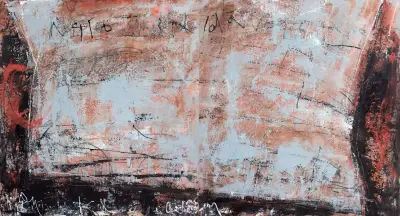
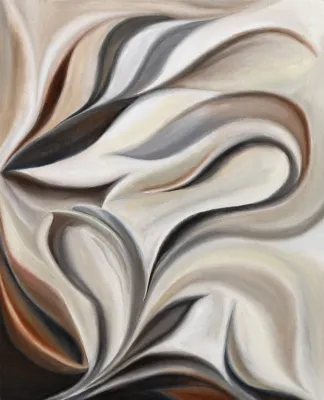
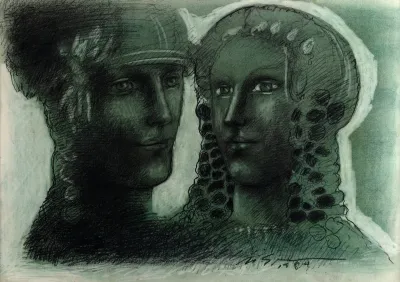
Rubens Matuck's work benefits from his learning and experience in different forms of artistic expression: painting, watercolor, drawing, printmaking and photography. Printmaking, which holds a prominent place in his output, begins in 1972. His work shows a preference for direct techniques (such as drypoint), which dispense with acids and with any mediating elements between the gesture and the wood or metal plate. Regarding his graphic work, critics note the draftsman's technical precision and his concern with composition. Landscapes, human figures and animals, as in Peixes [Fish], 1985/1987, signal the artist's preferences; he also makes portraits.
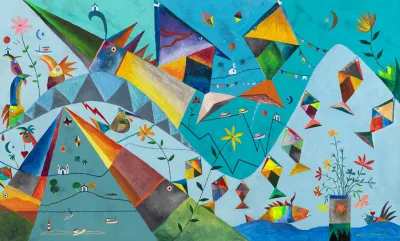
His interest in Brazil - its physical environment, human types and ways of life - appears early and gives rise to a series of journeys across the country, which become the central axis of his work. For each trip there is a notebook (more than 80 in all), in which topographies, morphologies, ecosystems, plants and animals of every kind are recorded. Along the routes he traces, the artist-traveler, with a strong ethnographic bent, collects and classifies what he finds: seeds, tree leaves, photos, writings, folk toys, etc. And, like a bricoleur, he builds his works with the help of various techniques: watercolor, pastel, colored pencil, photography. The writings complement the visual records. In this sense, there is continuity between his visual and literary output, produced in parallel and complementary ways and strongly committed to education and the defense of the environment. It is no accident that children are a privileged audience for Rubens Matuck's formative and engaged work.
Critiques
"He collects various objects and tools, seeds and leaves, magazine clippings, photos of animals, folk toys, which are often the starting point for his works, exhibitions and publications. He loves paper, and often makes his own sheets, on which he draws and calligraphs poems. He has a special fondness for Japanese papers, which can be cut and dyed."
Flávio Motta
RUBENS Matuck. Apresentação de João Cândido Galvão. São Paulo: Galeria de Arte São Paulo, 1987.
"A draftsman of the finest kind and master of the hand that reveals the mysteries of things and beings. A connoisseur of fish, birds, animals and people. Here, in full, is Rubens Matuck, who knows and captures the lightness of line and the rawness of dreams, the map of friendship, and brings to paper the doubts and certainties of the arts. Here is my friend, who knows and travels the roads of the Northeast and traces on silk the routes of Marco Polo, in the poetry of the ages, as caravaneer and artist. From the dust of time he draws portraits, explores souls, master of black and white, owner of the riches of color, master of Arab warmth, the crucible of friendship blended into these dreams. My friend."
Aldemir Martins
MATUCK, Rubens. Rubens Matuck. São Paulo, Escritório de Arte Val de Almeida Jr., 1993.
"Rubens Matuck's printmaking belongs to the passages: what is conceived in it extends to the other arts, in him governed and proportionate. The passage thus manifests the power of analogy, which also brings together figure and letter, drawing and calligraphy, nature and artifice, everything, in short, for, as in Terence, nothing human is alien to Matuck. Everything conspires with everything, so that printmaking does not stand out as a first art, but as the first example of the others. Lines, systems: printmaking exemplarily centers the other arts and, eccentric, highlights artist and artist, Leonardo, whose drawings and texts of a hyperbolized nature in the Bull or the whirlwind reverberate on Matuck's gold-leaf support; Matuck admires him and, as an emulator, mimics the scene that prevents any plunge beyond the support; ricocheting, the gold makes Leonardo's perspective opaque in its glow, refusing his century and its window open onto history. In the passage, time can circulate, floating, like the past, figures of mastery: the printmaker Rubens Matuck sees himself beginning in 1972 with Marcelo Grassmann, continuing with Evandro Jardim in mastering technique, then finding his balance with Guyer Salles, who relieves him of the weight of attachment, and shaking off cultural limitations with Renina Katz. In this memorializing line, the passage proves inclusive, bringing together terms that outside it would be arbitrary, drawing out systems that are only virtual within some multiplicity: analogy is the evidence of the homology of systems and sequences. An example is Rubens Matuck's preference for direct techniques over indirect ones, in which the acid of etching and aquatint wounds without a hand. In excluding the latter, the inclusion of the chosen techniques as a whole is strengthened, so that even those hardest to reconcile come together, such as mezzotint with rocker, burnisher or scraper and the drypoints or burins of immediate incisions. This alliance extends to the tools - classified, collected, sharpened, loved - in a shifting movement that does not settle on a center, attracting partnerships, such as that of the printer Roberto Grassmann, very active in the work."
Leon Kossovitch e Mayra Laudanna
INVESTIGAÇÕES: A Gravura Brasileira. Apresentação Ricardo Ribenboim; texto Leon Kossovitch, Mayra Laudanna. São Paulo: Itaú Cultural, 2000.
Solo Exhibitions
1973 - São Paulo SP - Works on Paper, at FAU/USP
1978 - São Paulo SP - Watercolors, at Galeria Tenda
1978 - São Paulo SP - Paper as Support, at Pinacoteca do Estado
1979 - São Paulo SP - Solo, at Galeria Kairós
1980 - São Paulo SP - Solo, at Galeria Lácio
1981 - São Paulo SP - Solo exhibition of intaglio prints, at Galeria Sesc Paulista
1981 - São Paulo SP - Art on Paper, at Galeria Suzana Sassoun
1982 - São Paulo SP - Solo, at Galeria Tenda
1983 - Asunción (Paraguay) - Solo, at Instituto Cultural Brasil-Paraguai
1983 - São Paulo SP - Calligraphic Landscapes, at Galeria Anos 50
1987 - São Paulo SP - Wood, Instruments and Objects, at Sesc Pompéia
1987 - São Paulo SP - Solo, at Galeria de Arte São Paulo
1990 - São Paulo SP - Caricatures, at Sé subway station
1993 - São Paulo SP - Paintings, at Escritório de Arte Val de Almeida Jr.
1993 - São Paulo SP - Paintings, at Casa da Cultura São Carlos
1994 - São Paulo SP - URUPIN, at Museu de Arte de São Paulo - Masp
1995 - São Paulo SP - Tribute to Leonardo da Vinci, at Escritório de Arte Val de Almeida Jr.
1995 - São Paulo SP - Dada Poems, at Teuto Escola de Idiomas
1997 - São Paulo SP - Passion for Lettering, at PUC/SP - Biblioteca Nadir Gouvêa Kfouri
1998 - São Paulo SP - Califilografosofia: Nietzsche Calligraphies, at Pontifícia Universidade Católica de São Paulo. Faculdade de Comunicação e Filosofia
1998 - São Paulo SP - Tribute to Leonardo da Vinci, at Galeria Compasso
2000 - São Paulo SP - Oil, Gold and Silver, at Galeria Val de Almeida
Group Exhibitions
1969 - São Paulo SP - Press Caricatures, at Colégio Equipe
1970 - São Paulo SP - Students of Samson Flexor, at Galeria Chelsea
1971 - São Paulo SP - Caricaturists, at Paço das Artes
1973 - São Paulo SP - FAU/USP Students, at Serviço Social do Comércio - Sesc
1974 - São Paulo SP - 4 Caricaturists from O Estado de São Paulo, at Galeria Azulão
1975 - Angoulême (France) - International Comics Show
1975 - São Paulo SP - 4 New Artists, at Galeria 167
1975 - São Paulo SP - Woodcut, at FAU/USP
1977 - Porto Alegre RS - Printmaking, at Sesc
1978 - São Paulo SP - Art and Its Processes: Paper as Support, at Pinacoteca do Estado
1979 - Belo Horizonte MG - Watercolors of Brazil, at Fundação Clóvis Salgado. Palácio das Artes
1979 - Brasília DF - Panorama of Young Brazilian Watercolor, at Galeria Oscar Seraphico
1979 - São Paulo SP - Wood, at Galeria Tenda
1981 - San Juan (Puerto Rico) - Bienal de San Juan del Grabado Latinoamericano y del Caribe
1981 - São Paulo SP - Group show, at MAC/USP
1981 - São Paulo SP - Retrospective Exhibition of Edições João Pereira, at Pinacoteca do Estado
1981 - São Paulo SP - Whale Protection, at Instituto de Arquitetos do Brasil. Departamento de São Paulo - IAB/SP
1981 - São Paulo SP - Works on Paper, at Galeria Suzana Sassoun
1982 - São Carlos SP - Watercolor, at Universidade Federal de São Carlos - UFSCar
1982 - São Paulo SP - 15 Artists, at Galeria Sesc Paulista
1982 - São Paulo SP - Works in Wood, at Galeria Tenda
1983 - San Juan (Puerto Rico) - Bienal de San Juan del Grabado Latinoamericano y del Caribe
1984 - São Paulo SP - Intaglio Printmaking, at Metrô
1984 - São Paulo SP - The Book as a Work of Art, at CCSP
1984 - São Paulo SP - Reencontre, at Livraria Pena Azul
1985 - São Paulo SP - Prints, at Traço Galeria de Arte
1987 - São Paulo SP - The Fabric of Taste: Another Look at Everyday Life, at Fundação Bienal
1987 - São Paulo SP - 18th Visual Arts Panorama, at MAM/SP
1987 - Taipei (Taiwan) - Group show, at Escola de Belas Artes
1988 - Belo Horizonte MG - 10th National Watercolor Salon - guest artist
1988 - São Paulo SP - Group show, at Escola Ibeji Equipe
1988 - São Paulo SP - Juréia, at Sadalla Galeria de Arte
1988 - São Paulo SP - 1st FASM National Watercolor Salon, at Faculdade Santa Marcelina
1989 - São Paulo SP - João Pereira 10 Years Exhibition, at Pinacoteca do Estado
1990 - São Paulo SP - 1000 Words, at Galeria Box Blue
1991 - São Paulo SP - The Forest, at MAC/USP
1992 - São Paulo SP - Legal Amazon, at Fundação Memorial da América Latina - Fmal
1992 - São Paulo SP - Tribute to Aldemir Martins, at Galeria Forma
1992 - São Paulo SP - The Araweté - A Tupi People in the Amazon, at CCSP
1993 - São Paulo SP - 100 Years of Football and Art, at Pinacoteca do Estado
1994 - São Paulo SP - Flags: 60 Artists Celebrate USP's 60th Anniversary, at MAC/USP
1995 - Bratislava (Slovakia) - Biennial of Illustration Bratislava
1995 - São Paulo SP - 16 Years of Edições João Pereira, at Galeria Alliance Française
1995 - São Paulo SP - Children's Book Illustration in Brazil and Germany, at Biblioteca Infanto-Juvenil Monteiro Lobato
1995 - São Paulo SP - Illustration Snail, at Goethe Institut
1995 - São Paulo SP - Ateliê Calcográfico Iole: 15 Years, at Sesc Pompéia
1996 - Mexico City (Mexico) - Watercolor of Brazil, at Museo Nacional de la Acuarela
1996 - São Paulo SP - One Hundred Years of Belmonte, at Espaço Cultural Citibank
1996 - São Paulo SP - Ubu, the Pataphysics of the Tropics, at Fundação Armando Álvares Penteado - Faap
1996 - São Paulo SP - Flags, at Galeria de Arte do Sesi
1996 - São Paulo SP - Ex Libris/Home Page, at Paço das Artes
1997 - Budapest (Hungary) - Group Show of the Fasm Watercolorists' Group, at Galeria Panónia
1997 - São Paulo SP - 10 Years of the Faculdade Santa Marcelina Watercolorists' Group, at Fasm
1997 - Sichuan (China) - Group Show of Brazilian Artists
1998 - Maracaibo (Venezuela) - 3rd Bienal Barro de América, at Centro de Arte de Maracaibo Lia Bermúdez
1998 - São Paulo SP - Impressions: The Art of Brazilian Printmaking, at Espaço Cultural Banespa-Paulista
2000 - Berlin (Germany) - Man/Nature/Technology, at Instituto Cultural Brasileiro na Alemanha
2000 - Penápolis SP - Man/Nature/Technology, at Galeria Itaú Cultural
2000 - São Caetano do Sul SP - Art and Craft, at the 1st Circuito de Artes Visuais de São Caetano do Sul
2000 - São Paulo SP - Intaglio Print Collection, at Espaço Cultural Banespa-Paulista
2000 - São Paulo SP - Image and Violence/The Invisible Body, at Sesc Vila Mariana
2000 - São Paulo SP - Investigations. Brazilian Printmaking, at Itaú Cultural
2000 - São Paulo SP - Investigations: The Artist's Work, at Itaú Cultural
2000 - São Paulo SP - Plates for Art, at Museu Lasar Segall
2000 - São Paulo SP - Tipografia Brasilis, at Faap
2001 - Brasília DF - Man/Nature/Technology, at Galeria Itaú Cultural
2001 - Penápolis SP - Investigations. Brazilian Printmaking, at Galeria Itaú Cultural
2001 - Brasília DF - Investigations. Brazilian Printmaking, at Galeria Itaú Cultural
2001 - Rio de Janeiro RJ - Brazilian Watercolor, at Centro Cultural Light
2001 - São Paulo SP - Tipografia Brasilis, at Faap
2001 - São Paulo SP - Rubens Matuck and Cláudia Simões, at Galeria Val de Almeida Júnior
2003 - São Paulo SP - Meeting Place: Amélia Toledo among Us, at Unicid
Source: Itaú Cultural