Raphael Domingues Filho (São Paulo SP 1912 - Rio de Janeiro RJ 1979)
Draftsman, painter.
As a child, he lived with his family in Rio de Janeiro. As a teenager, he studied at the Liceu Literário Português, where he attended academic drawing classes. At the same time, he worked as a designer of posters, advertising and decoration. During this period, he won a prize in a drawing competition held by the American multinational Standard Oil Company. At 15, he showed the first symptoms of schizophrenia. He continued to produce figurative works of a realistic nature, sometimes using family members as models. In 1932, he was admitted to the Hospital da Praia Vermelha in Rio de Janeiro and then transferred to the Hospital Psiquiátrico Pedro II in the Engenho de Dentro neighborhood. At this institution, in 1946, the psychiatrist Nise da Silveira created the Occupational Therapy Section - STOR, where, among other activities, she set up a visual arts workshop. Raphael began attending the studio and drawing under the guidance of the artist Almir Mavignier. At first, his works were limited to series of crossed lines forming small squares. Still in the 1940s, he began drawing figures, especially faces and household objects such as vases and kettles. The drawings show no academic technique but stand out for their ornamental character combined with a continuous line drawn with precision and assurance. Some works are colored and have backgrounds painted with patches. In 1947, he took part in the exhibition of Engenho de Dentro patients at the Ministry of Education and Health in Rio de Janeiro, an event that attracted the attention of critics such as Mário Pedrosa, Sérgio Milliet and Antonio Bento. Raphael was included in the exhibition 9 Artistas do Engenho de Dentro [9 Artists from Engenho de Dentro] at the Museu de Arte Moderna de São Paulo - MAM/SP in 1949. After Almir Mavignier moved to Europe in 1951, Raphael went back to drawing repeated series of hatchings. In 1968, his contact with the monitor Martha Pires Ferreira again stimulated his graphic production, and he returned to depicting human faces, animals and flowers. Pedrosa organized the retrospective Raphael: Desenhos [Raphael: Drawings] at the Museu de Arte Moderna do Rio de Janeiro - MAM/RJ in 1980.
Critical Commentary
In the late 1940s, the work of psychiatrist Nise da Silveira's patients in the visual arts studio of the occupational therapy section of the Hospital Psiquiátrico Pedro II, in the Engenho de Dentro neighborhood of Rio de Janeiro, aroused the interest of intellectuals and artists working in Brazil. Through Almir Mavignier, a monitor in the therapy section, painters such as Ivan Serpa, Abraham Palatnik and Geraldo de Barros began frequenting the hospital. The critic Mário Pedrosa became an important collaborator of Nise da Silveira, helping her organize publications and exhibitions and defending the artistic dimension of the Engenho de Dentro patients' production in press articles. Years later, Pedrosa assessed the occupational therapy workshop as one of the events that anticipated the changes in the Brazilian art scene brought about by the 1st São Paulo International Biennial in 1951.1 For the critic, the aesthetic quality of this production, made without academic training, influenced the renewal of local artistic taste and the establishment of new parameters for modern art in the country, which until then had been predominantly figurative.
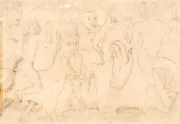
Made in this context, Raphael's works stand out for their concise yet ornamental line. According to Nise da Silveira, his production was stimulated above all by the emotional bond he formed with the monitors Mavignier and Martha Pires Ferreira.2 Notable in his career are the drawings made under Mavignier's supervision: two-dimensional graphic works in which a thin, sinuous line outlines open forms alternating with areas filled with textures and arabesques.
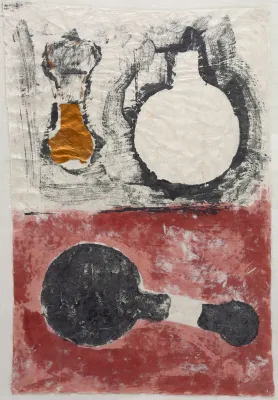
In his adolescence, when he studied at the Liceu Literário Português, his drawings were characterized by the illusion of three-dimensionality created by perspective and shading techniques. In the Engenho de Dentro studio, although Raphael started from the observation of faces or everyday objects such as teapots and vases, his works do not amount to a naturalistic representation of appearances. The result shows balance and command of space, as the drawing is often the outcome of a single continuous gesture. Most are made in black India ink, but even when the background is covered with colored patches or the lines are drawn with a broad brush, the graphic aspect prevails.
Notes
1 PEDROSA, Mário. A Bienal de cá para lá. In: ______. Forma e percepção estética: textos escolhidos II. São Paulo: Edusp, 1996. p. 252.
2 SILVEIRA, Nise da. O mundo das imagens. São Paulo: Ática, 1992. p. 37.
Critiques
"(...) Its expressive elements have a spontaneous purity. They flow from the arabesques, the lines, the planes, fluidly, unhindered. It is an unsullied melody, only lightly touched by external harmonizations. Here melody dictates its will to rhythm. The structure is so Ariel-like that it barely pauses at cadenced intervals for rest and breath. Yet it is rigorously articulated, though more delicate than the vein of a petal and more vibrant than a butterfly's wings. It gushes out in a single stream, yet it is neither uncontrolled nor impulsive, and it balances miraculously just when everything suggests it could not withstand the profusion of details and would fall apart at the breath of the bizarre breezes of imagination, like a rose in excessive heat. It carries within it an innate measure. It is a classicism such as there never was, springing from an unconscious impulse. It is a classicism in which balance is achieved through inner rhythm, through the natural exhaustion of the initial movement itself. (...)".
Mário Pedrosa
Museu de Imagens do Inconsciente. Apresentação de Mário Pedrosa e Afonso Henriques Neto. Editado por INSTITUTO NACIONAL DE ARTES PLÁSTICAS, Rio de Janeiro, RJ. Texto de Nise da Silveira et al. Rio de Janeiro: 1980. (Museus brasileiros, 2).
"(...) Raphael plays with lines, plays with the imitation of the real: he imitates it playfully, displaying a virtuosity that need not follow it step by step; he unsettles our habit of seeing and gives us another beauty, one that only drawing can give us - the drawing of Raphael, anonymous master of Engenho de Dentro".
Ferreira Gullar
GULLAR, Ferreira. Relâmpagos: dizer o ver. Coordenação editorial Augusto Massi; apresentação Ferreira Gullar. São Paulo: Cosac & Naify, 2003.
Group Exhibitions
1947 - Rio de Janeiro RJ - Exhibition of patients of the Centro Psiquiátrico Nacional, at MEC
1949 - Rio de Janeiro RJ - 9 Artistas de Engenho de Dentro [9 Artists from Engenho de Dentro], at Salão Nobre da Câmara Municipal
1949 - São Paulo SP - 9 Artistas de Engenho de Dentro [9 Artists from Engenho de Dentro], at MAM/SP
1955 - Neuchâtel (Switzerland) - Exhibition of Brazilian Primitive and Modern Art, at Museu de Etnografia
Posthumous Exhibitions
1981 - São Paulo SP - 16th São Paulo International Biennial, at Fundação Bienal
2000 - Rio de Janeiro RJ - Brasil + 500 Rediscovery Exhibition. Images of the Unconscious, at Paço Imperial
2000 - São Paulo SP - Brasil + 500 Rediscovery Exhibition, at Fundação Bienal
Source: Itaú Cultural