Nelson Leirner (São Paulo 1932 - Rio de Janeiro 2020)
Nelson Leirner was a prominent intermedia artist in Brazilian contemporary art, known for his critical and provocative stance towards the artistic system. Between 1947 and 1952, he lived in the United States, where he started the Textile Engineering course at the Lowell Technological Institute in Massachusetts, although he did not complete it.
Back to Brazil in 1956, began to study painting with Joan Ponç and, in 1958, attended the atelier-abstraction, coordinated by Samson Flexor. Since the beginning of his career, Leirner developed a production marked by the criticism of art institutions and their mechanisms of legitimation.
In 1966, he founded the Rex group alongside artists such as Wesley Duke Lee, Geraldo de Barros, Carlos Fajardo, José Resende and Frederico Nasser. The group promoted actions that questioned the traditional artistic circuit, such as the exhibition-non-exhibition, held in 1967, in which the artist offered his works for free to the public.
In the same year, it generated a strong repercussion by sending a stuffed pig to the 4th Brasília Modern Art Salon, in direct criticism of the jury selection criteria. He was also one of the pioneers in the use of billboards as an artistic support and developed multiple canvas and zipper work on chassis.
During the 1970s, he deepened his political criticism through series such as the Animal rebellion, presented in 1974, which addressed the context of the military regime in Brazil. The work won him the award for best proposal of the year by the São Paulo Association of Art Critics. In 1975, he returned to his position critically by protesting against the refusal of a work in Xerox by the institution itself. influenced different generations of Brazilian artists. In 1997, he moved to Rio de Janeiro and began to coordinate the basic course of the Parque Lage Visual Arts School until the following year.
Critical Commentary
Nelson Leirner is the son of the sculptor Felícia. Leirner and businessman Isaí Leirner. Since childhood, modern art has been very present in his life. His parents help to found the Museum of Modern Art of São Paulo - MAM/SP and live with a good part of the Brazilian vanguard. However, this proximity does not immediately arouse Leirner's interest in art. Decides to become an artist only in the 1950s, stimulated by Paul Klee's works. In 1956, he took painting classes with Joan Ponç. Two years later, he attends, for a short time, the Atelier-Abstraction, of Flexor. Don't get excited about the courses. His canvases approach the informal abstraction of painters such as Alberto Burri and Antoni Tàpies. Between 1961 and 1964, he continued with the research of materials, but in another direction. Interested in the poetics Dadaistas, he produces his paintings with objects collected on the street, generating the appropriations series.
In 1964, the artist abandons the painting and starts to work with ready-made elements, manufactured industrially. It collects objects of use and displaces its meaning, as in Que Horas São D. Candida, 1964. His works are between the sculpture and the object. Two years later, the spectator's participation is incorporated in works such as Você á Part I and II, 1966. Still in 1966, he founded the Rex Group, with Wesley Duke Lee, Geraldo de Barros, Frederico Nasser, José Resende and Carlos Fajardo. The collective promotes Happenings and publishes the Rex Time newspaper. The group turns to problems such as the relations of art with the market, institutions and the public. All this addressed based on the radical languages of the 1960s.
In 1967, he sets up the exhibition of the mass production of a painting. It shows the series Homage to Fontana, one of the first series of multiples in the country. The "paintings" are industrially produced. Made of zippers and fabrics, objects that traditionally have no artistic properties. In the same year, he sent his stuffed pig, 1966 to the 4th Salon of Modern Art in Brasília. The jury accepts the work. Leirner questions the result and asks for an explicit manifestation of the exhibition's admission criteria, creating controversy with critics such as Mário Pedrosa and Frederico Morais, known as "critic haappening".
From the 1970s onwards, the questioning content of work migrates from direct action to an allegorical sense, which often involves eroticism. Happening has less presence than drawing and installation. At that time, Leirner dedicates himself to other languages, such as design, multiples and experimental cinema.
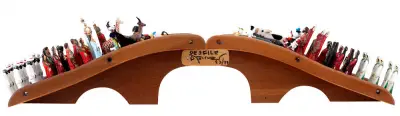
The presence of elements of Brazilian popular culture, which has been striking since the 1960s, grows from the 1980s onwards. 1985, the Great Combat is installed, in which it uses images of saints, Afro-Brazilian deities, children's dolls and animal replicas. intends to convert into art what is considered banal. Since 2000, his work has appropriated artistic images trivialized by the consumer society. In a good-natured way, he deals with the reproductions of Gioconda [Mona Lisa], 1503/1506 by Leonardo da Vinci and A Fonte, 1917 by Marcel Duchamp as an artistic theme. With the same irony, the artist replicates about cowhide images of the Brazilian concrete tradition, in the series Rural Constructivism. With the presentation of a pork stuffed inside a crate and tied to a ham, evidently soon stolen by the public, before the jury of the 1967 Salão de Brasília - or even with the altar of Roberto Carlos, from the same period, conceiving an environment of Adoration and recollection in which the main image, mixed with popular religiosity, was of the musical idol of the youth at the time, this artist was also the author of an unusual happening of violence, by setting a day and time to offer the public whatever there was inside the gallery Rex, from Sao Paulo, which closed its activities during these days, at the same time Nelson Leirner had a special predilection for the appropriation of industrialized objects, transfigured into artistic objects with a fine sense of humour. In this option, the eminently urban character that permeates his work is observed, of which his creative series tribute to Fontana is an example. This intimacy with industrial media would lead him to design, parallel to the graphic production he has developed in recent years, in drawings of painful erotic load."
Aracy Amaral
AMARAL, Aracy. Nelson. Leirner. In: Modernity: Brazilian art of the 20th century. São Paulo: Hamburg, 1988.
"The idea of appropriation, central to the production of Nelson Leirner, would be finished and acquire a particular feature around the year 1965, with his exhibition at the Atrium gallery, with Geraldo de Barros. In his works, this idea would contain both the notion of object-trouve (understood as an object already ready and which, by its predicates, stands out in the eyes of the artist of the mass of anonymous objects) and that of Readymade (of an object made in series, without any attribute that the differentiate from its similar and by which a radical indifference is nurtured). (...) If the first contemplates the artist's taste (not good taste, it is worth highlighting), the second tends to annul him. The coexistence between the two is possible, as Leirner has proven, thanks to a reasoning that will permeate the entire set of his work and that consists of holding a meeting (we could call it a copulation, the artist calls it a checkmate) between two objects and ends up generating a third. This formula goes back to Lautréamont's famous aphorism: 'Beautiful as the fortuitous encounter of an umbrella with a sewing machine, at a dissection table'".
Agnaldo Farias
FARIAS, Agnaldo. Nelson Leirner. In: Three-dimensionality in Brazilian art of the 20th century. More precisely, Leirner is in tune with the theme of the commercialization of art, from the production procedures to the critical reception of art. What is the underlying 'business' of the artist's signature, the various certificates and documents that legitimize the manufacture of an authenticity, were recurring questions in Yves Klein, Ben Vautier (from the Fluxus group) and Claes. Oldenburg. They sought to curb a guarantee of truth from the art. Le Magasin (early 1960s) and The Store (1961-62), of the last two respectively, involved Leirner's family procedures. Each in his own way sought to establish a parity between the object of art and a product of consumption in capitalist society. belongs to this lineage of happenings Leirner's invitation to offer his works free of charge to the public who went to the exhibition-non-exhibition event, at the end of Rex Gallery & sounds.
The need to demystify the artistic object continued in the series Homage to Fontana (1967), large colored tarpaulins in which the zipper mocks the already canonized tear: anyone can open or close the plan pictorial. To conceptualize the value of the art (territory of the 'own name'), Leirner put up his 'fontanas' ('common name') according to the criticism resulting from his cost spreadsheet, submitting, therefore, the work to a domestic economics class. Thus, he shifted the discussion of art as an inaugural gesture (the nostalgic myth of the original) for the repeated, serial gesture. Years later, following the same treadmill, he made use of a widely circulated newspaper to convey the way of making multiples of its multiples. It was about extracting the auratic process from creation and bringing art closer to the simplicity of 'everyday technology'. democratizing the artist's product deserves a spectacle. In this sense, it is necessary to compare Leirner's slogan with 1959 Jean Tinguely's Méta-Matics by proclaiming 'Do it yourself and create your own abstract painting'. To the question of Michel Foucault, 'What is an author?', Leirner countered with a practical reflection, which includes a dense experience as a teacher, and initiated a troubled relationship with the ideological apparatus responsible for the institutionalization of art (the criticism, the museum, the gallery, the market)".
Lisette Lagnado
Lagnado, Lisette. The combat between the fetishistic nature of art and its historicization. In: PEDROSA, Adriano (org. ). Leirner and [and]) Iran do Espírito Santo: 48. Biennale di Venezia - Padiglione Brasile. São Paulo: Fundação Bienal de São Paulo, 1999. p. 42-43.
"For an analysis of the authorship of the work and authority, of the artist's electoral gesture, it is necessary to emphasize that despite appropriating preexisting images and objects, Leirner has no interest in the silence and neutrality of the original readymades. Flagrant example of this intention is provided by the three facilities carried out between 1984 and 1986, bringing together hundreds of objects ranging from garden dwarves, cheap toys, rubber insects, plaster saints to plastic animals, organized by categories such as winding procession spread across the exhibition space. Handcrafted and industrialized objects, with intense coloring and kitsch appeal, arranged with solemnity, evoked a sense of humor away from the coldness of Duchamp's rationalism. Each of the chosen objects was because it was invested with an emotional charge, either by the allusion to religious piety (understood in the most ecumenical sense possible), or by the naive aspiration to the pseudo-refinement, the playful sense or the realism caricatured. In this way, the same pieces can be repeated at different times, but they start to compose in O Grande Parade, 1984, the fetishes of a triumphant march; In The Great Combat, 1985, they become an epic with plastic bombings at the forefront, and the plaster of the guardian angels in the rear, which in The Great Burial, 1986, became members of a compunged procession. (...)
The desacralization of art appears in its path as one of the ways to make the existence of art itself viable. Changes and satirical references to a work considered an indisputable landmark of the history of art are always accompanied by manipulations with exclusion and addition of elements, configuring a situation of checkmate. If the limiting situation shows the annihilation of its target, according to Leirner's theory, the union of two elements must generate a third that even has its own meaning when the operation comes to an end."
Maria Isabel Branco Ribeiro
RIBEIRO, Maria Isabel Branco. Nelson Leirner. In: Why Duchamp? Duchampiana readings by Brazilian artists and critics São Paulo: Itaú Cultural: Paço das Artes, 1999. p. 60-61.
Testimonies
"(...) For three or four years, many things began to happen with my career; Stunning things, though strange. I noticed, for example, that with six months of painting I was awarded in a salon. With a year of work, I exhibit in the best gallery in São Paulo, São Luiz, who presented my drawings without seeing them before. another six months and I enter the Bienal; And Stanislawsky, a Polish critic of international fame, adds to my work a long critique. Gradually, we realize the reason for everything. The quality of my work did not have the importance given to it. It was a pure issue of social prestige. He had a vision of what he was doing then, and I know it was really bad. Those who work for six months cannot suddenly arise and have their work accepted. It can only show that it has talent. With the awareness of what was happening, questions arose about judgment criteria and the work of art itself. All this called into question and in doubt the value of things. I understood that you can build some guy; Even without seeing your work. It was natural for him to begin to release everything inside me, logically in a sense of contestation. That was my beginning."
Nelson Leirner
Leirner, Nelson. O Porco, or the Happening of Criticism. In: ___. Retrospective Nelson Leirner. São Paulo: Paço das Artes, 1994. p. 41-42.
Individual exhibitions
1960 - São Paulo SP - Individual, Leaves Art Gallery
1961 - São Paulo SP - Individual, Galeria São Luís
1964 - São Paulo SP - Individual, at Galeria Solarium
1965 - Buenos Aires (Argentina) - Individual, Modern Art Museum
1965 - Rio de Janeiro RJ - Individual, Espaço ABC
1965 - São Paulo SP - Individual, Atrium Art Gallery
1967 - São Paulo SP - Exhibition-Non-Exhibition, Rex Gallery & Sounds
1967 - São Paulo SP - Homage to Fontana, Seta Art Gallery
1968 - Rio de Janeiro RJ - Love Life of a Gorilla, Museum of Modern Art
1968 - São Paulo SP - Learn coloring enjoy the color, 100 billboards Spread across the city
1968 - São Paulo SP - Learn to color cum/enjoy coloring, Galeria Art-Art
1969 - Rio de Janeiro RJ - Playground, at the Museum of Modern Art of Rio de Janeiro - MAM/RJ
1969 - São Paulo SP - Playground, at the São Paulo Museum of Art - MASP
1970 - São Paulo SP - Nelson Leirner: Plastics, University of São Paulo. Faculty of Architecture and Urbanism
1971 - Rio de Janeiro RJ - Multiples Ao Cubo, Art Gallery Ipanema
1971 - Rio de Janeiro RJ - Technology of everyday life, Gallery of the Group B
1971 - São Paulo SP - Multiple Ao Cube, Inter-Design Gallery
1972 - São Paulo SP - Technologies of everyday life, Museum of Contemporary Art of the University of São Paulo
1973 - Rio de Janeiro RJ - Standards and Drawings, Galeria Grupo B
1974 - Austin (United States) - The Animal Rebellion, University of Texas at Austin. University Art Museum
1974 - São Paulo SP - The Animal Rebellion, São Paulo Museum of Art
1974 - Washington DC (United States) - The Animal Rebellion, Brazilian-American Cultural Institute
1975 - São Paulo SP - Esporte é Cultura, Galeria Arte Global
1977 - São Paulo SP - Nelson Leirner: Aquarelas, Galeria Luisa Strina
1977 - São Paulo SP - The artist and the company, São Paulo Museum of Art
1978 - São Paulo SP - a hard line, Galeria Luisa Strina
1978 - São Paulo SP - Individual, Galeria Luisa Strina
1978 - São Paulo SP - a non-hard line, Galeria Luisa Strina
1980 - São Paulo SP - Pay to View, Multiple Art Gallery
1983 - São Paulo SP - Checkmate and Puzz, Galeria Luisa Strina
1984 - Rio de Janeiro RJ - The great parade, Espaço ABC
1984 - São Paulo SP - expose yourself to art, São Paulo Art Gallery
1984 - São Paulo SP - The great parade, at MAC/USP
1985 - Rio de Janeiro RJ - Vignettes, baseboards and monograms, GB Art
1985 - São Paulo SP - O Grande Combate, Galeria Luisa Strina
1987 - São Paulo SP - Exhibition to be... Read, Galeria Luisa Strina
1989 - São Paulo SP - Project Aula, Galeria Luisa Strina
1990 - São Paulo SP - The Last Supper, Luisa Strina Gallery
1991 - New York (United States) - Individual, at Gray at Gallery and Study Center
1992 - São Paulo SP - State Performance, at the State Pinacoteca
1993 - São Paulo SP - Jardim das Delícias, Morumbi Chapel
1994 - São Paulo SP - Homage to Fontana, São Paulo Art Gallery
1994 - São Paulo SP - Nelson Leirner: Retrospective, Paço das Artes
1995 - São Paulo SP - Oswaldo Bazar, Oswaldo Art Office Kathalian
1997 - Rio de Janeiro RJ - Nelson Leirner: A Viagem... , Centro Cultural Light
1998 - Rio de Janeiro RJ - Works done in a balance chair watching television, at the Brito Cimino Gallery
1998 - São Paulo SP - Nelson Leirner: an installation, Galeria Brito Cimino
1999 - Rio de Janeiro RJ - Nelson Leirner: Clonings, Anna Maria Niemeyer Gallery
2001 - São Paulo SP - Wall design. Nelson Leirner, Museum of Modern Art
2002 - Brasília DF - Adoration
2002 - Recife PE - Adoration, Museum of Modern Art Aloísio Magalhães
2002 - São Paulo SP - Art and not Art, Brito Cimino Contemporary and Modern Art
2002 - São Paulo SP - Nelson Before N. Leirner, Centro Universitário Maria Antonia
2003 - Paris (France) - That's it... If it seems to you, Galerie Gabrielle Maubire
2003 - Porto (Portugal) - One + two + thousand, Culturgest
2003 - São Paulo SP - So it is... If it seems to you, Galeria Brito Cimino
2004 - Curitiba PR - n.Leirner 1994+10, Oscar Niemeyer Museum
2004 - Rio de Janeiro RJ - Variations, Chácara do Céu Museum
2004 - São Paulo SP Brito Cimino Gallery
2004 - São Paulo SP - N.Leirner1994+10: From Drawing to Installation, Instituto Tomie Ohtake
2004 - São Paulo SP - The multiple faces of Nelson Leirner, Instituto Tomie Ohtake
2004 Tomie Ohtake
2005 - Niterói RJ - Why Museum?, Museum of Contemporary Art of Niterói
2005 - Rio de Janeiro RJ - Hilarious Concert, Chácara do Céu Museum
2006 - Porto Alegre RS - Individual, Porto Alegre Art Scholarship
2006 - São Paulo SP - A LOT (E), Galeria Brito Cimino
2007 - Porto Alegre RS - Individual, Porto Alegre Art Bag
2007 - Rio de Janeiro RJ - Individual, Silvia Cintra Art Gallery
2007 - Rio de Janeiro RJ - Power and affectivity, Galeria Box 4
2008 - São Paulo SP - For sale, Celma Albuquerque Art Gallery
2008 - Vila Velha ES - Dressed in White, Vale de Rio Doce Museum
2009 - São Paulo SP - Occupation Nelson Leirner, Itaú Cultural
2010 - Rio de Janeiro RJ - Stripencores and others, Silvia Cintra Art Gallery
Collective exhibitions
1958 - São Paulo SP - 7th Salão Paulista de Arte Moderna, at Galeria Prestes Maia - Bronze Medal
1959 - Rio de Janeiro RJ - 8th National Salon of Modern Art, at MAM/RJ
1959 - São Paulo SP - 8th Paulista Salon of Modern Art, at the Prestes Maia Gallery
1960 - Belo Horizonte MG - 15th Salão de Belas Artes of the city of Belo Horizonte, at MAP
1960 - São Paulo SP - 9th Salão Paulista de Arte Moderna, at the Prestes Maia Gallery
1960 - São Paulo SP - Nelson Leirner, Ismênia Coaracy, Yara Tupynambá, Fernando Odriozola, at the Folhas Art Gallery
1960 - São Paulo SP - 9th Salão Paulista de Arte Moderna, at the Prestes Maia Gallery
1961 - Belo Horizonte MG - 16th Salon of Fine Arts of the city of Belo Horizonte, at MAP
1961 - Curitiba PR - 2nd Annual Hall of Curitiba, at the Paraná Art Museum
1961 - São Paulo SP - 10th São Paulo Salon of Modern Art, at the Prestes Maia Gallery - Acquisition Award
1962 - São Paulo SP - 11th São Paulo Salon of Modern Art, at the Prestes Maia Gallery
1963 - Rio de Janeiro RJ - 12th National Salon of Modern Art
1963 - São Paulo SP - 12th Salão Paulista de Arte Moderna, at the Prestes Maia Gallery - Silver Medal
1963 - São Paulo SP - 7th São Paulo International Biennial, at the Bienal Foundation
1963 - São Paulo SP - Salão do Trabalho, at the Folhas Art Gallery
1964 - Porto Alegre RS - Nelson Leirner and Giselda Leirner, at Margs
1964 - São Paulo SP - Nelson Leirner and Giselda Leirner, at Galeria Solarium
1965 - Rio de Janeiro RJ - 1st Esso Salon of Young Artists, at MAM/RJ
1965 - São Paulo SP - 8th International Biennial of São Paulo, at Fundação Bienal
1965 - São Paulo SP - Geraldo de Barros and Nelson Leirner, at Atrium Art Gallery
1965 - São Paulo SP - Proposals 65, at MAB/FAAP
1965 - São Paulo SP - 1st Esso Salon of Young Artists, at MAC/USP
1966 - São Paulo SP - Rex Gallery: Inaugural Exhibition, at Rex Gallery & Sounds
1966 - São Paulo SP - Discovery of America, at Rex Gallery & Sounds
1966 - São Paulo SP - Flash Back, at Rex Gallery & Sons
1967 - Brasília DF - 4th Salon of Modern Art of the Federal District, at the Cláudio Santoro National Theater
1967 - Rio de Janeiro RJ - New Brazilian Objectivity, at MAM/RJ
1967 - São Paulo SP - 9th São Paulo International Biennial, at Fundação Bienal - Itamaraty Award
1967 - São Paulo SP - Flags in the square, on the corner of Avenida Brasil and Rua Augusta
1967 - São Paulo SP - Exhibition-non-exhibition
1967 - Tokyo (Japan) - 9th Tokyo Biennial - Mainichi Shimbum Award
1968 - Rio de Janeiro RJ - Flags in the square, in Praça General Osório
1968 - Rio de Janeiro RJ - The Brazilian artist and mass iconography, at ESDI
1968 - Salvador BA - 2nd National Biennial of Fine Arts, at MAM/BA
1968 - São Paulo SP - 2nd Young Contemporary Art, at MAC/USP
1968 - São Paulo SP - First São Paulo Fair of Opinion, at the Ruth Escobar Theater
1968 - São Paulo SP - 17th São Paulo Salon of Modern Art
1969 - Porto Alegre RS - 2nd Young Contemporary Art, at Margs
1969 - São Paulo SP - 3rd Young Contemporary Art, at MAC/USP
1970 - Belo Horizonte MG - Object and participation, at Palácio das Artes
1972 - São Paulo - Art/Brazil/Today: 50 years later, at Galeria Collectio
1972 - São Paulo SP - 4th Brazilian current art panorama, at MAM/SP
1972 - São Paulo SP - Brazilian multiplied art, in Multiple of Art
1972 - São Paulo SP - Art/Brazil/Today: 50 years later, at the gallery of Collectio
1972 - São Paulo SP - São Paulo National Biennial, at the Bienal Foundation
1972 - São Paulo SP - Multiple Brazilians, at the Multiple Art Gallery
1973 - Brussels (Belgium) - Image du Brésil, at the Manhattan Center
1974 - São Paulo SP - Galeria Luisa Strina: Gallery Luisa Strina
1975 - Birmingham (United States) - Brazilian Graphics, at the Birmingham Museum of Art
1975 - Curitiba PR - Art in the City, at MAC/PR
1976 - Campinas SP - 10th Contemporary Art Salon of Campinas, at MACC
1976 - Rio de Janeiro RJ - Document/Debate, at MAM/RJ
1976 - Salvador BA - Brazilian Art of the 60s/70s In the Gilberto Chateaubriand Collection, at MAM/BA
1976 - São Paulo SP - Art at Centro Campestre, at Sesc Pompéia
1977 - Brasília DF - Brazilian art from the 60s/70s in the Gilberto collection Chateaubriand, at the Cultural Foundation of the Federal District
1977 - Recife PE - Brazilian art of the 60s/70s in the Gilberto Chateaubriand collection, in the mansion of João Alfredo
1977 - Washington (United States) - Recents Latin American Drawings 1969-1976: Lines of Vision
1978 - São Paulo SP - 10th Panorama of Current Brazilian Art, at MAM/SP
1978 - São Paulo SP - The object Art: Brasil 60s, at MAB/FAAP
1979 - Curitiba PR - 2nd Annual Engraving Exhibition City of Curitiba, at the Creativity Center
1979 - São Paulo SP - Multiples and Objects, at the Multiple Art Gallery
1979 - São Paulo SP - Return to the figure: 60's, at the Lasar Segall Museum
1981 - São Paulo SP - Brazilian contemporary artists, at the São Paulo Art Gallery
1982 - Lisbon (Portugal) - Brazil 60 years of modern art: Gilberto Chateaubriand Collection, at the José de Azeredo Perdigão Modern Art Center
1982 - London (England) - Brazil 60 years of modern art: Gilberto Chateaubriand collection Gallery
1982 - Rio de Janeiro RJ - Football universe, at MAM/RJ
1982 - São Paulo SP - Artemicro, at MIS/SP
1984 - São Paulo SP - Gilberto Chateaubriand Collection: Portrait and Self-Portrait of Brazilian Art, at MAM/SP
1984 - São Paulo SP - Tradition and Rupture: Synthesis of Brazilian Art and Culture, at Fundação Bienal
1985 - São Paulo SP - 16th Panorama of Current Brazilian Art, at MAM/SP
1985 - São Paulo SP - Arte Novos Meios/Multimeios: Brasil 70/80, at MAB/FAAP
1985 - São Paulo SP - Trends of the book by artist in Brazil, in the CCSP
1986 - Fortaleza CE - 1st International Exhibition of Ephemeral Sculptures, at Fundação Demócrito Rocha
1986 - São Paulo SP - XX-XXI: a turn in the century, at the Pinacoteca do Estado
1987 - São Paulo SP - The plot of taste: another look at everyday life, at the Fundação Bienal
1987 - Paris (France) - Modernity: Brazilian art of the 20th century, at the Musée d'Art Moderne de la Ville de Paris
1988 - Rio de Janeiro RJ - 88 x 68: A balance of the years
1988 - Rio de Janeiro RJ - Le Déjeuner sur l'art: Manet in Brazil, at EAV/Parque Lage
1988 - São Paulo SP - 19th Panorama of Current Brazilian Art, at MAM/SP
1988 - São Paulo SP - 34 contemporary Brazilian artists, in the commercial sub-district of art
1988 - São Paulo SP - 63/66 Figure and object, at the Millan Gallery
1988 - São Paulo SP - Modernity: Brazilian art of the 20th century, at MAM/SP
1989 - São Paulo SP - 20th International Biennial of São Paulo, at Fundação Bienal
1989 - São Paulo SP - Travel to paper in Brazilian biennials, at MAM/SP
1990 - Brasília DF - Brasília Award for Visual Arts, at MAB/DF
1990 - São Paulo SP - 21st Panorama of Current Brazilian Art, at MAM/SP
1990 - São Paulo SP - Brazilian Art, at MAC/USP
1990 - São Paulo SP - Bardi: 45 artists from São Paulo honor the teacher's 90th birthday, at MASP
1991 - New York (United States) - Brazilian Art Today, at the Gray Art Gallery
1991 - São Paulo SP - 22nd Brazilian current art panorama, at MAM/SP
1992 - Rio de Janeiro RJ - Today... Avenida Central, at MNBA
1992 - São Paulo SP - The seduction of volumes: The three-dimensional MAC, at MAC/USP
1992 - São Paulo SP - years 60/70: Gilberto Chateubriand Collection - MAM/RJ, at the SESI Art Gallery
1993 - São Paulo SP - The presence of ready-made: 80 years, at MAC/USP
1994 - Belo Horizonte MG - The Ephemeral in Brazilian Art: 60s/70s
1994 - Fortaleza CE - Artist's Book, at the Raimundo Cela Visual Arts Center
1994 - Penápolis SP - The Ephemeral in Brazilian Art: 60/70, at Galeria Itaú Cultural
1994 - São Paulo SP - Flags: 60 artists honor the 60th anniversary of USP, at MAC/USP
1994 - São Paulo SP - Bienal Brasil Século 20th, at the Fundação Bienal
1994 - São Paulo SP - Gilberto Chateaubriand Collection: Portrait and Self-Portrait of Brazilian Art, at MAM/SP
1994 - São Paulo SP - The Ephemeral in Brazilian Art: 60's/70's, At Itaú Cultural
1995 - Rio de Janeiro RJ - Perverse Childhood: Fables on Memory and Time, at MAM/RJ
1995 - Salvador BA - Perverse Childhood: Fables on Memory and Time, in the MAM/BA
1995 - São Paulo SP - The drawing in São Paulo: 1956-1995, at the Nara Roesler Gallery
1995 - São Paulo SP - Projeto Contacto, at Galeria Sesc Paulista
1995 - São Paulo SP - 1st United Artists, at Casa das Rosas
1996 - Brasília DF - The ephemeral in Brazilian art: 60s/70s, at the Itaú Cultural Gallery
1996 - Buenos Aires (Argentina) - Latin America'96 me El Museo Nacional de Bellas Artes, at the Museo Nacional de Bellas Artes
1996 - São Paulo SP - 4th Studio UNESP SESC SENAI of Image Technologies, at SESC Pompéia
1996 - São Paulo SP - Brazilian art: 50 years of history at the MAC/USP collection 1920-1970, at MAC/USP
1996 - São Paulo SP - Bandeiras, at the Art Gallery of Sesi
1996 - São Paulo SP - Ex Libris/Home Page, at Paço das Artes
1996 - São Paulo SP - Not everything that shines is gold, at Galeria Nara Roesler
1996 - Uberlândia MG - Art at the Hospital, at UFU
1997 - Rio de Janeiro RJ - Autograph Night, at EAV/Parque Lage
1997 - São Paulo SP - The City of Artists, at MAC/USP
1997 - São Paulo SP - Ao Cubo, at Paço das Artes
1997 - São Paulo SP - Arte Computing Support, at Casa das Rosas
1997 - São Paulo SP - Brito Cimino Contemporary Art: Inaugural Exhibition, at the Brito Cimino Gallery
1997 - São Paulo SP - 1st Contemporary Heritage, at MAC/USP
1997 - São Paulo SP - Three-dimensionality in Brazilian art of the 20th century, at Itaú Cultural
1998 - Belo Horizonte MG - Three-dimensionality in Brazilian Art of the 20th century, at Itaú Cultural
1998 - Brasília DF - Futebol Arte, at the Ministry of Foreign Affairs
1998 - Brasília DF - Three-dimensionality in Brazilian art of the 20th century, at the Itaú Cultural Gallery
1998 - Niterói RJ - Mirror of the Bienal, at MAC/Niterói
1998 - Penápolis SP - Three-dimensionality in Brazilian art of the 20th century, at the Itaú Cultural Gallery
1998 - Rio de Janeiro RJ - 16th Salon National Plastic Arts, at MAM/RJ
1998 - Rio de Janeiro RJ - OVO, at EAV/Parque Lage
1998 - Rio de Janeiro RJ - thirty years of 68, at CCBB
1998 - São Paulo SP - 30th Annual Art, at FAAP
1998 - São Paulo SP - Canibáliafetiva, at A Estufa
1998 - São Paulo SP - Figures: 30 years in Brazilian art, in the MAC/USP
1998 - São Paulo SP - Fronteiras, at Itaú Cultural
1998 - São Paulo SP - Cultural iconoclasses, at Casa das Rosas
1998 - São Paulo SP - Multiples, at Valu Oria Art Gallery
1998 - São Paulo SP - The modern and the contemporary in Brazilian art: Gilberto Chateaubriand Collection - MAM/RJ, at MASP
1998 - São Paulo SP - Selection, at the Brito Cimino Gallery
1999 - Paris (France) - International Contemporary Art Fair
1999 - Porto Alegre RS - Cloning, in the art bag
1999 - Rio de Janeiro RJ - The image of the sound of Chico Buarque, in the Paço Imperial
1999 - Rio de Janeiro RJ - Cloning, at A. M. Niemeyer - Gallery
1999 - Rio de Janeiro RJ - Daily life/art. Object 60s/90s, at MAM/RJ
1999 - Rio de Janeiro RJ - Hierarchy?, at Paço Imperial
1999 - Rio de Janeiro RJ - Johnnie Walker Award, at MNBA
1999 - São Paulo SP - Daily life/art. Consumption, at Itaú Cultural
1999 - São Paulo SP - daily life/art. Object 60s/90s, at Itaú Cultural
1999 - São Paulo SP - Enigmas, at the Brito Cimino Gallery
1999 - São Paulo SP - The sleep of reason, at MAM/SP
1999 - São Paulo SP - 26th Panorama of Brazilian Art, at MAM/SP
1999 - São Paulo SP - Parallèle, at the Brito Cimino Gallery
1999 - São Paulo SP - Why Duchamp?, at Paço das Artes
1999 - Venice (Italy) - 48th Venice Biennale
2000 - Belo Horizonte MG - Investigations: Are they or are they not engravings?, at Itaú Cultural
2000 - Brasília DF - Investigations: Are they or are they not? engravings?, at the Itaú Cultural Gallery
2000 - Düsseldorf (Germany) - The Fifth Element: Money and Art, at the Kunsthalle Grabbetlaz
2000 - Fortaleza CE - 26th Panorama of Brazilian Art, at the Centro Dragão do Mar de Arte e Cultura
2000 - Lisbon (Portugal) - with an entire ocean for swimming, at Culturgest
2000 - Lisbon (Portugal) - 20th century: Art of Brazil, in the José de Azeredo Perdigão Modern Art Center
2000 - Niterói RJ - 26th Panorama of Brazilian Art, at MAC/Niterói
2000 - Rio de Janeiro RJ - Brasilidades, at Centro Cultural Light
2000 - Rio de Janeiro RJ - Black humor in the female universe, at the Anna Maria Niemeyer Gallery
2000 - Rio de Janeiro RJ - O Bardi dos Artistas, at the Espaço Cultural dos Correios
2000 - Rio de Janeiro RJ - Situations: Brazilian Arts 70s, at Fundação Casa França-Brasil
2000 - Salvador BA - Visual ironies, at Paulo Darzé Art Galeria
2000 - São Paulo SP - Year Three, at the Brito Cimino Gallery
2000 - São Paulo SP - Conceptual Art and Conceptualisms: 70's at the MAC/USP collection, at the SESI Art Gallery
2000 - São Paulo SP - Art and eroticism, at the Nara Roesler Gallery
2000 - São Paulo SP - Brazil + 500 Rediscovery Exhibition, at Fundação Bienal
2000 - São Paulo SP - Cá Entre Nós, at Paço das Artes
2000 - São Paulo SP - cows parade
2000 - São Paulo SP - Black humor in the female universe, at the Paço das Artes
2000 - São Paulo SP - Illy Collection/Artistas do Brasil, at Mube
2000 - São Paulo SP - O Bardi dos Artistas, at the Memorial from Latin America. Galeria Marta Traba
2000 - São Paulo SP - The role of art, at the SESI Art Gallery
2000 - São Paulo SP - Nova Obra, at MAC/USP
2000 - São Paulo SP - Os Anjos are back, at the Pinacoteca do Estado
2000 - São Paulo SP - 2nd Expanded Territory, at Sesc Pompéia
2000 - São Paulo SP - Três, at the Brito Cimino Gallery
2000 - Uberlândia MG - Flags at the Museum, at the University Museum of Art
2001 - Basel (Switzerland) - 32nd Basel International Art Fair
2001 - Juazeiro do Norte CE - 1st Biennial of Art of the Cariri
2001 - Madrid (Spain) - ARCO/2001, at Parque Ferial Juan Carlos I
2001 - Beijing (China) - 11 Brazilian artists in China
2001 - São Paulo SP - 70's: Trajectories, at Itaú Cultural
2001 - São Paulo SP - Recortes, at the Brito Cimino Gallery
2001 - São Paulo SP - The Overexcited Body: Art and Sport in Contemporary Society, at SESC Pompéia
2001 - São Paulo SP - Trajectory of Light in Brazilian Art, at Itaú Cultural
2001 - Washington (United States) - Virgin Territory: Women, Gender, and History in Contemporary Brazilian Art, National Museum of Women in the Arts
2002 - Brasília DF - Fragments to its magnet, in the contemporary cultural space Venâncio
2002 - Fortaleza CE - Ceará rediscovered Brazil, at the Dragão do Mar Center of Art and Culture
2002 - Liverpool (England) - Pot
2002 - Niterói RJ - Sattamini Collection: modern and contemporary, at MAC/Niterói
2002 - Niterói RJ - Dialogue, Antagonism and Replication in the Sattamini Collection, at MAC/Niterói
2002 - Porto Alegre RS - Appropriations and Collections, at Santander Cultural
2002 - Rio de Janeiro RJ - Walking with faith... , at Galeria Sesc Copacabana
2002 - Rio de Janeiro RJ - Caminhos do Contemporânea 1952-2002, at Paço Imperial
2002 - São Paulo SP - 25th International Biennial of São Paulo, Biennial Foundation
2002 - São Paulo SP - Appropriate images, at MAM/SP
2002 - São Paulo SP - Map of the Now: Recent Brazilian Art in the João Sattamini Collection of the Museum of Contemporary Art of Niterói, at Instituto Tomie Ohtake
2002 - São Paulo SP - Multiple Brazilians 30 years later, at Multipla de Arte
2002 - São Paulo SP - Open Opera: Celebration, at Casa das Rosas
2002 - São Paulo SP - Parallel, in the shed located at Avenida Matarazzo, 530
2002 - São Paulo SP - Pot, at Galeria Fortes Vilaça
2003 - Iowa City (United States) - Layers of Brazilian Art, Faulconer Gallery
2003 - Niterói RJ - Appropriations: Short circuit of participatory experiences, at MAC/Niterói
2003 - Recife PE - see again/see the new, in MAMAM
2003 - Rio de Janeiro RJ - Art in Motion, at the BNDES Space
2003 - Rio de Janeiro RJ - Fiat Lux: Luz na Arte, at the Federal Justice Cultural Center
2003 - Rio de Janeiro RJ - Grupo Rex/Escola Brasil, at MAM/RJ
2003 - São Paulo SP - The subversion of the media, at Itaú Cultural
2003 - São Paulo SP - Approaches to the pop spirit: 1963-1968, in the MAM/SP
2003 - São Paulo SP - Art and Society: a controversial relationship, at Itaú Cultural
2003 - São Paulo SP - ArtworkSknowledge: 70 years USP, at MAC/USP
2003 - São Paulo SP - Constructivism and the Way of Clothing, at MAM/SP
2003 - São Paulo SP - MAC USP 40 years: Contemporary Interfaces, at MAC/USP
2003 - São Paulo SP - my friends, MAM/SP
2003 - São Paulo SP - Ordination and vertigo, at CCBB
2003 - São Paulo SP - Tomie Ohtake in the spiritual plot of Brazilian art, at Instituto Tomie Ohtake
2004 - Rio de Janeiro RJ - In art everything can be true and everything can be false, at Anna Maria Niemeyer Art Gallery
2004 - Rio de Janeiro RJ - Tomie Ohtake in the Spiritual Plot of Brazilian Art, at MNBA
2004 - Rio de Janeiro RJ - True or False, at the Anna Maria Niemeyer Gallery
2004 - São Paulo SP - Paper Office, at CCSP
2004 - São Paulo SP - Reincarnated painting, at Paço das Artes
2004 - São Paulo SP - Sala de Arte, at the Brito Cimino gallery
2004 - São Paulo SP - Brazilian version, at the Brito Cimino gallery
2005 - Rio de Janeiro RJ - Coletiva 2005, at Mercedes Viegas Art Office
2005 - São Paulo SP - The body in Brazilian contemporary art, at Itaú Cultural
Source: Itaú Cultural