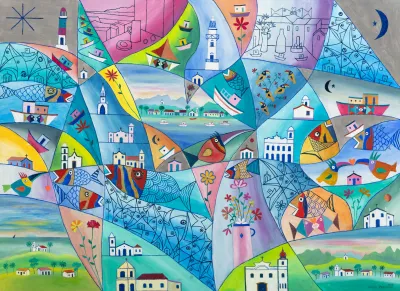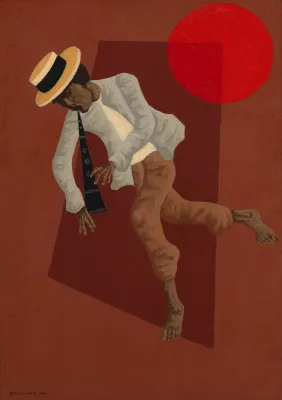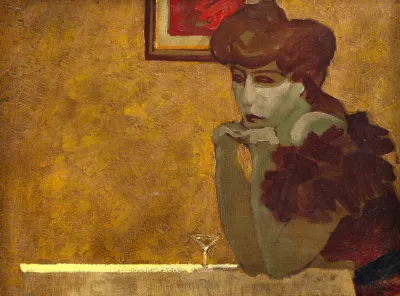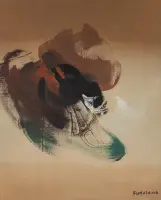


Mário Gruber (Santos SP 1927 - Cotia SP 2011)
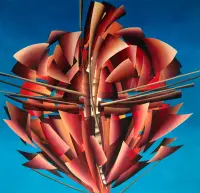
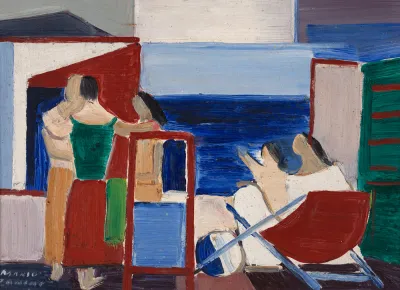
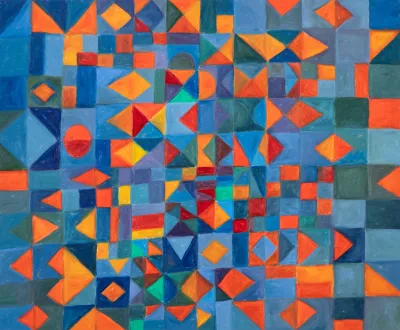
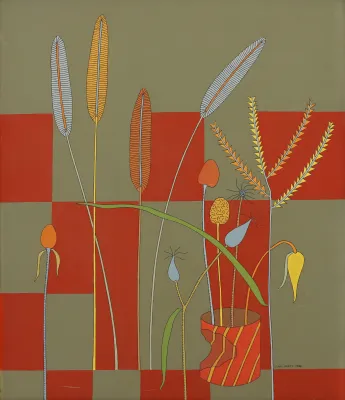
Mário Gruber was a painter, engraver, sculptor and muralist, with an artistic career characterized by versatility and acting in various languages. Self-taught, he started painting in 1943. In 1946, he moved to São Paulo and joined the School of Fine Arts, where he had as a teacher the sculptor Nicolau Rollo. The following year, he won the first painting award at the group 19 painters exhibition, highlighting his expressive talent since the beginning of his trajectory.
In 1948, he held his first solo exhibition and deepened his studies in engraving with Poty, in addition to starting a collaboration with the renowned artist Di Cavalcanti. In 1949, he received a scholarship and moved to Paris, where he studied at the École Nationale Supérieure des Beaux-Arts with the Édouard Goerg engraver and worked with Candido Portinari. He returned to Brazil in 1951 and founded the Engraving Club in his hometown, which would later become the art club.
He was an engraving teacher at the São Paulo Museum of Modern Art in 1953 and taught metal engraving in Fundação Armando Álvares Penteado (FAAP) between 1961 and 1964. In 1970, he installed his engraving studio in São Paulo. Between 1974 and 1978, he lived again in Paris and, when he returned to Brazil, he settled in Olinda, Pernambuco. In 1979, he set up a studio in New York, further expanding his international artistic exchange. Even in the 2000s, Mário Gruber maintained an intense production, creating between 100 and 120 works per year.
Critical Comment
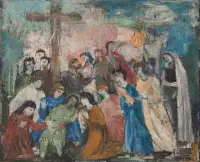
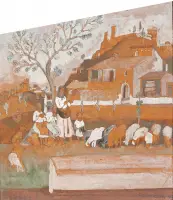
self-taught, Mário Gruber begins to paint in the middle of the decade of 1940, presenting a production linked to expressionism. In 1949, he received a scholarship from the French government, and travels to Paris, where he is dedicated to the study of painting and engraving. He returned to Brazil in 1951. In his graphic work at that time, he approaches the social realism practiced by other artists linked to engraving clubs. The city, its streets and houses are themes for its graphic production.
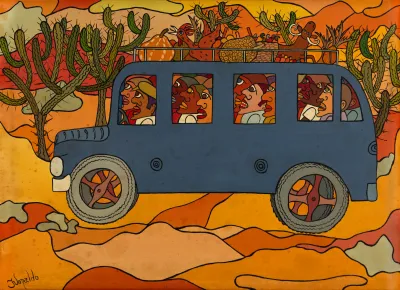
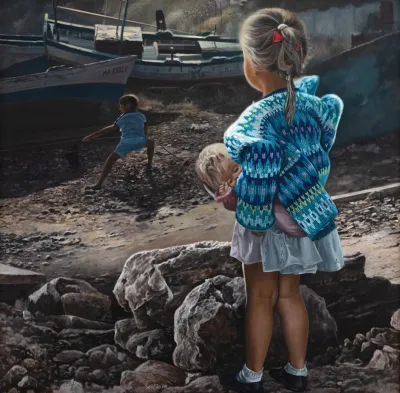
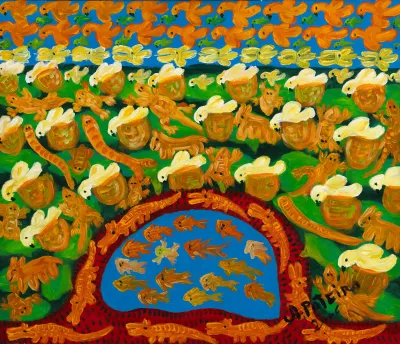
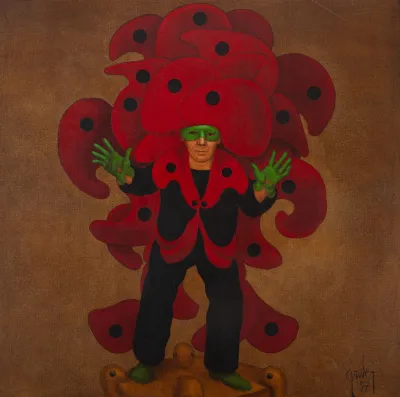
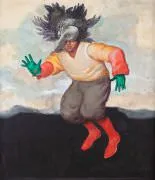
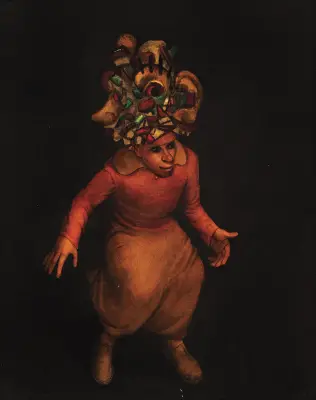
Mário Gruber also makes figurative paintings, starting from everyday images, such as life in the metropolises, to involve them in games of imagination. The artist creates fantastic characters, using contrasting colors that refer to the production of Dutch painter Rembrandt van Rijn (1606-1669) and the Spanish Diego Velázquez (1599-1660). From the 1970s onwards, he began to use resources from the photographic process, such as the expansion, to create new types of images. It also researches the languages of television and cinema. It maintains a constant dialogue with the tradition of the history of art, as in the 1985 exhibition, in which it recreates canvases by the Italian painter Michelangelo Merisi by Caravaggio (1571-1610) and the Frenchman Georges de la Tour (1593-1652), carrying out expansions from the paintings of these artists and apprehending the drama and dynamics of light present in his works.
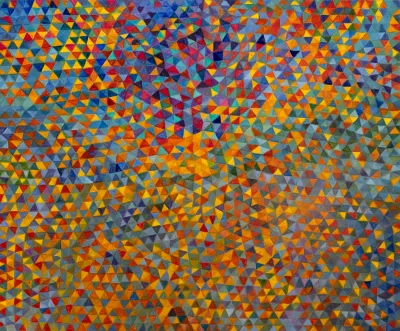
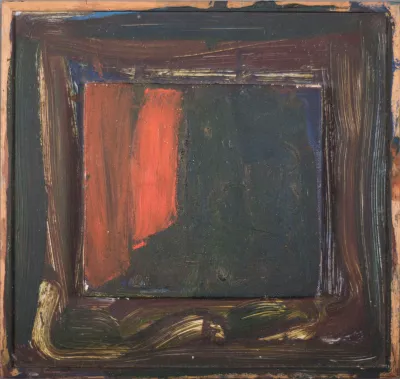
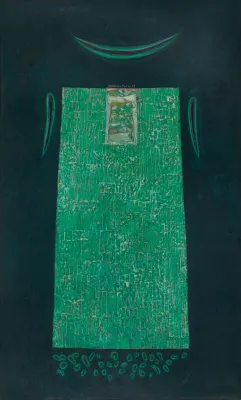
The keen luminosity, the very controlled chromatic range and the free brushing are present in later paintings, such as green and black balloon (1996). Creating characters who are often masked, wizards, angels and robots, Gruber produces works that cause strangeness and relate to a theme linked to fantastic realism.
Criticism
"Mário Gruber is one of the personalities more singular artistic activities in the São Paulo movement. He began his career shortly after the Second World War as a young vanguard artist of boldly expressionist tendencies. So Gruber was taken over by a passion for the art of oil painting by Rembrandt, Velásquez, Rubens, Goya, Delacroix and Courbet, whose last chords he found in Van Gogh. And from a methodical patience as a researcher, Gruber acquired a surprising mastery of the pictorial technique of the great masters of the European tradition (...). The purpose of Gruber's technical improvement, carried out in a sense apparently contrary to that of the currents of 20th century painting, was generally misunderstood by both the their admirers as well as their opponents. (...). Gruber was probably motivated by obscure and deep intuitions and premonitions, largely foreign to the realistic conceptions he verbally advocated. He already unconsciously tended towards a fantastic realism of a very personal type. (...)"
Mario Schenberg
Gruber. São Paulo: Portal Galeria de Arte, 1970.
"As Antonio Cândido de Melo e Souza, the whole Restlessness and variety of Mário Gruber's work can be summarized in the dichotomous attraction by the maximum realism and the forms of dream transcendence of the real. They are, in fact, two different ways that it uses to arrive at the same purpose of touching, understanding and reflecting the world of today in which it lives, also reflecting the accumulation of layers of the past, necessarily implicit in it. Its thematic scope, conveyed mainly through the engraving in metal and painting, has therefore covered a diversified series of interests, although the greater constant still focuses on the figurative demand (...). In the rising density of the symbolic scale, Gruber starts from the most current everyday iconography - beings from big cities or cosmic conquests, usual and recognizable landscapes, objects of every day - for little by little to involve it in games of imagination, he returns to his own childhood or the past times of humanity, simultaneously exercising the projection in the future, between hope and anxiety. This results in its fantastic characters, of aggressive colors and volumes (...)".
Roberto Pontual
PONTUAL, Roberto Art/ Brazil/ Today: 50 years later. São Paulo: Collectio, 1973.
"In the initial prints of Mário Gruber, the city stands out, its excerpts, as well as houses, under various approaches and illuminations, which highlight its relationship with some recorders from São Paulo, such as Renina Katz and the gaucho group of the engraving club. What brings these recorders together is realism, making the exhibition in May 1956, shortly before, therefore, the invasion of Hungary and the dissolution of the club. While most of the realists, from north to south, privilege woodcut and lineogravure, Gruber values calcography. To this technical distinction corresponds another, which, although it does not singularize it, brings it closer to some recorders, equally socialist, such as Renina Katz or Vasco Prado, in which the city is the theater of the class struggle as opposed to the countryside, a scene where custom attenuates it, being the peasant Shown late. The exposition of the city, its streets and houses is, therefore, a trace of Gruber's realism in metal. As early as 1956, he states that technical research is essential for his art, an analogous thesis is proposed in 1992, when the figurative, which Gruber defends without compromising, distinguishes the human figure, who walks the razor's edge, as he says, the form and the essence. This requirement, necessarily conceived in a figurative horizon, places the technical research in Mário Gruber's calcography at the intersection of a broad figurativeness. A virtuoso researcher of the technique, Gruber does not allow himself to be virtuosity, because, even though he elevates it, he does not isolate it, because he crosses it with figuration functions". Kossovitch, Leon; Laudanna, Mayra. Engraving in the 20th century In: Engraving: Brazilian art from the 20th century. São Paulo: Itaú Cultural : Cosac & Naify, 2000. p.24.
Testimonies
"I was one of the first metal engravers in São Paulo. Today, tidying up my studio, I review the first signs, from 1946-1947, and all the later work. Engraving is a constant passion that will continue. A practically unprecedented fact is that I have all my engraving. (...)
It is a bomb for the market, because the artist who owns his work can put it with discretion. It doesn't mean I'm going to sell for a fortune. (...)
I made few prints in color. I disciplined myself to only make engravings in color when I had the right conditions. As a metal engraving - copper - and here there is no steel bath, copper works as an abrasive. A yellow, for example, will always turn green. Out of respect for my work, I stop using color, because it is very stupid to do a work that will disappear later, or that is a different expression from the one I conceived it. But there is also another reason: I think, in particular, that engraving is black-and-white, as I saw in Rembrandt's house, in originals engraved by him, incredible effects, almost inexplicable. (...)
In an exhibition I made, in 1967, I gathered one-year work, which led me to think about my paths. There are three forms close to the sphere: the egg, the planet, the nave. The first is the universe of germination, from our ancestral past, an internal content that I situate as my interest in knowing a person's story when I portray it. The planet is the level of an old predilection of mine, realism. Many feathers I suffered for this, at the time of abstraction, because it was only with Pop Art that the image was once again consecrated. (...)
My technique has nothing to do with Renaissance, and I haven't finished it yet. Since I started until today, I worry the language of the printed and the museum, the mass communication, the language of the media. (...) The artist who expresses himself well has good technique. I seek, in art, a media language, which fascinates, without explanation".
Mário Gruber (22 December 1975)
engraving: Brazilian art of the 20th century. Cosac & Naify, 2000. p.160.
"For me, black-and-white metal engraving is chamber music, while the painting has the sound of the symphonic orchestra. Approaching the engraving is always more difficult, it requires attention, acuity, and a certain eye for the detail. But those who can approach immediately realize that it is not a minor technique; On the contrary, like every chamber, it is dense, deep, and has its own light. A light that, in my case, also serves as a reference for painting. It works, let's say, as a 'critical judgment' of the paintings I paint. Because the engraving has, concisely, everything that plastic art must have: drawing, movement, expression and intensity. (...) Unlike painting, engraving cannot be apprehended only by its outer and allegorical side. It acts on the edge of the razor, at the exact intersection between the essence and the form. In addition to being a magic mirror, as it is unique and many at the same time. Therefore, it requires a more difficult understanding, elaborated, and there it can also be one of the causes of prejudice. But the engraving resists. It is not the first time that it has been passed over by current taste and fashion".
Mário Gruber (September 1992)
engraving: 20th century Brazilian art. & Naify, 2000. p.160.
Individual exhibitions
1947 - São Paulo SP - Mário Gruber: Metal engravings, Artists Club and Friends of Art
1967 - Rio de Janeiro RJ - Mário Gruber: Paintings, Galeria Ibeu Copacabana
1967 - São Paulo SP - Mário Gruber: Paintings, Galeria Atrium
1970 - São Paulo SP - Mário Gruber: Paintings, Portal Art Gallery
1973 - Rio de Janeiro RJ - Mário Gruber: Paintings, Art Gallery Ipanema
1975 - São Paulo SP - Mário Gruber: Engravings, Arcádia Arts and Decorations
1976 - São Paulo SP - Mário Gruber: Paintings, Renato Magalhães Gouvêa - Art Office
1979 - Santos SP - Mário Gruber: Engravings, Ucbeu
1979 - São Paulo SP - Mário Gruber: Paintings, Renato Magalhães Gouvêa - Art Office
1983 - São Paulo SP - Mário Gruber: Paintings, Galeria Art Selection
1985 - São Paulo SP - Mário Gruber: Arqueologoa da Painting - Year 85, Montesanti Roesler Gallery
1987 - São Paulo SP - Mário Gruber, Galeria Millan
1992 - Poços de Caldas MG - Mário Gruber: Retrospective of Engravings 1940-1990, Casa da Cultura
1993 - São Paulo SP - Mário Gruber: Paintings, Renato Magalhães Gouvêa - Art Office
1996 - São Paulo SP - Mário Gruber: Paintings, Renato Magalhães Gouvêa - Art Office
2005 - Campinas SP - Survivor, Art Gallery of the Institute of Arts of Unicamp
2006 - São Paulo SP - Mario Gruber and the metaphysics of the plans, Memorial Foundation of America Latina
2007 - Curitiba PR - Mário Gruber, 80 years old, Galeria IMS - Unibanco Arteplex
2010 - Santos SP - Anjos da Renascença Brasileira, Pinacoteca Benedicto Calixto
2010 - São Paulo SP - Mário Gruber: engravings, pantemporaneous place
Collective exhibitions
1947 - Araraquara SP - 1st Salon Araraquarense
1947 - São Paulo SP - 19 painters, Prestes Maia Gallery - 1st Prize in Painting
1948 - Rio de Janeiro RJ - Painters from São Paulo, Ministry of Education and Culture
1948 - Salvador BA - 1st National Salon of Modern Art of Bahia
1948 - São Paulo SP - Aldemir Martins, Mario Gruber and Enrico Camerini, Galeria Domus
1948 - São Paulo SP - 12th Hall of the Plastic Artists Union, Domus Gallery
1954 - Goiânia GO - Exhibition of the National Congress of Intellectuals
1954 - São Paulo SP - 3rd Salão Paulista de Arte Moderna, Galeria Prestes Maia - Brass Engraving Medal
1955 - São Paulo SP - 4th Salão Paulista de Arte Moderna, Galeria Prestes Maia
1958 - São Paulo SP - Eduardo Sued, Marcelo Grassmann, Gruber and Darel
1959 - São Paulo SP - 8th Salão Paulista de Arte Moderna, Galeria Prestes Maia - Prize Acquisition
1962 - São Paulo SP - Exhibition, Gallery Residency
1965 - São Paulo SP - 2nd National Youth Drawing Exhibition, Museum of Contemporary Art of the University of São Paulo
1966 - São Paulo SP - Three premises, Museum of Art Brazilian
1968 - Portland (United States) - 39th International Exhibition Northwest Print Makers, Portland Art Museum
1968 - São Paulo SP - 19 painters, art gallery theme
1968 - Seattle (United States) - 39th International Exhibition Northwest Print Makers, Seattle Art Museum
1969 - São Paulo SP - 1st Panorama of Current Brazilian Art, Museum of Art Moderna
1970 - Medellín (Colombia) - 2nd Art Biennial of Medellín, Museo de Antioquia
1970 - Portland (United States) - 41 International Exhibition Northwest Printmakers, Portland Art Museum
1970 - San Juan (Porto Rico) - 1st Bienal de San Juan del Grabado Latinoamericano y Del Caribe, Institute of Culture Puertorriqueña
1970 - Seattle (United States) - 41 International Exhibition Northwest Printmakers, Seattle Art Museum Pavillion
1972 - São Paulo SP - Art/Brazil/Today: 50 years later, Collectio Gallery
1972 - São Paulo SP - 2nd International Engraving Exhibition, Museum of Modern Art
1976 - São Paulo SP - The young design of the 40s, Pinacoteca do Estado
1977 - São Paulo SP - The groups: The 40's, Lasar Segall Museum
1977 - São Paulo SP - 9th Panorama of Current Brazilian Art, Museum of Modern Art
1978 - São Paulo SP - 19 painters, Museum of Modern Art
1979 - São Paulo SP - Figurative Artists, Itaúgaleria
1979 - São Paulo SP - 11th Panorama of Current Brazilian Art, Museum of Art Moderna
1980 - New York (United States) - Exhibition of Print and Drawings of Latin American Artists, El Museo del Barrio
1980 - São Paulo SP - Images of Dance, Paço das Arts
1982 - Penápolis SP - 5th Northwest Plastic Arts Hall, Penápolis Educational Foundation. Faculty of Philosophy, Sciences and Letters of Penápolis
1982 - São Paulo SP - From Modernism to Bienal, Museum of Modern Art
1982 - São Paulo SP - Marines and Ribeirinhas, Lasar Segall Museum
1983 - Paris (France) - Art Against Apartheid, Foundation Nationale des Arts Graphiques et Plastiques
1983 - Paris (France) - Jeune Gravure Contemporaine et ses invités
1984 - Mexico City (Mexico) - 4th Iberoamerican Art Biennial
1984 - Copenhagen (Denmark) - Art Against Apartheid, Museum Charlottenborg
1984 - Curitiba PR - 6th Mostra da Engraving Cidade de Curitiba, at the Cultural Foundation of Curitiba
1984 - Lund (Sweden) - Art Against Apartheid, Lunds Konsthall
1984 - São Paulo SP - Tradition and rupture: Brazilian art and culture synthesis, Biennial Foundation
1984 - Tampere (Finland) - Art Against Apartheid, Tampereen Nyktaiteen Museo
1985 - Amsterdam (Holland) - Art Against Apartheid, Thenew Church
1985 - Barcelona (Spain) - Art Against Apartheid, Palau Marc
1985 - Berlin (Germany) - Art Against Apartheid
1985 - Bologna (Italy) - Art Against Apartheid, Galleria d'Arte Moderna
1985 - Cáceres (Spain) - Art Against Apartheid, Museo Casa de Los Caballos
1985 - Hamburg (Germany) - Art Against Apartheid
1985 - Hammamet (Tunisia) - Art Against Apartheid, Center Culturel International d'Hammamet
1985 - Madrid (Spain) - Art Against Apartheid, Circle of Bellas Artes
1985 - Marseilles (France) - Art Against Apartheid, La Maison de L'Etranger
1985 - São Paulo SP - 100 Obras Itaú, São Paulo Museum of Art
1985 - São Paulo SP - The Art of the Imaginary, Galeria Encontro das Artes
1985 - São Paulo SP - 18th São Paulo International Biennial, Biennial Foundation
1985 - Stuttgart (Germany) - Art Against Apartheid
1985 - Cologne (Germany) - Art Against Apartheid
1986 - Paris (France) - Los Americans: Peitres et Sculpteurs D'Amerique Latine, Galerie Center d'Art Plastique Contemporaine
1986 - São Paulo SP - 30 Highlights of Brazilian Engraving, Trilema Cultural Space
1986 - São Paulo SP - A Urbs in the vision of eight artists, Montesanti Roesler Gallery
1986 - São Paulo SP - Before and Now: 8 painters, Cásper Líbero Foundation
1987 - Brasília DF - Paulistas in Brasília, Brasília Museum of Art
1987 - São Paulo SP - 20th Exhibition of Contemporary Art, Chapel Art Show
1987 - São Paulo SP - The craft of art: painting, SESC
1987 - São Paulo SP - 18th Panorama of Current Brazilian Art, Modern Art Museum
1988 - Curitiba PR - Marcelo Grassmann and Mário Gruber, Casa Romário Martins
1988 - São Paulo SP - 21st Chapel Art Show, Chapel Art Show
1990 - Goiânia GO - 20 years of the Goiânia Museum of Art, Museum of Art of Goiânia
1991 - São Paulo SP - 24th Exhibition of Contemporary Art, Chapel Art Show
1992 - Poços de Caldas MG - Brazilian Modern Art: Collection of the Museum of Contemporary Art at the University of São Paulo, Casa da Cultura
1992 - São Paulo SP - 25th Exhibition of Contemporary Art, Chapel Art Show
1992 - São Paulo SP - Polarities/Perspectivas, Paço das Artes
1993 - João Pessoa PB - Woodcut: From Cordel to the Gallery, Espaço Cultural da Paraíba Foundation
1994 - Poços de Caldas MG - Unibanco Collection: Commemorative Exhibition of the 70th Anniversary of Unibanco, House of Culture
1994 - São Paulo SP - Bandeiras: 60 artists honor the 60th anniversary of USP, Museum of Contemporary Art of the University of São Paulo
1994 - São Paulo SP - Bienal Brasil Século 20th, Biennial Foundation
1994 - São Paulo Paulo SP - Unit and Confrontation, Panamerican School of Art
1994 - São Paulo SP - Woodcut: From Cordel to Galeria, São Paulo Museum of Art
1994 - São Paulo SP - Woodcut: From Cordel à Gallery, Companhia do Metropolitano de São Paulo
1995 - Rio de Janeiro RJ - Unibanco Collection: Exhibition commemorating the 70th anniversary of Unibanco, Museum of Modern Art
1995 - São Paulo SP - Three Masters of Metal Engraving: Darel, Grassmann, Gruber, Banespa Museum
1995 - São Paulo SP - Visual Road, Renato Magalhães Gouvêa - Art Office
1996 - São Paulo SP - The World of Mario Schenberg, Casa das Rosas
1996 - São Paulo SP - 1st OFF Bienal, Brazilian Museum of Sculpture
1997 - São Paulo SP - The City of Artists, Museum of Contemporary Art of the University of São Paulo
1997 - São Paulo SP - Two recorders Paulistas, Instituto Moreira Salles
1998 - Marseille (France) - Football Art
1998 - Paris (France) - Football Art
1998 - Rio de Janeiro RJ - Football Art, Fundação Casa França-Brasil
1998 - São Paulo SP - Futebol Arte, Galeria Marta Traba
1998 - São Paulo SP - Os Collectors - Guita and José Mindlin: Matrices and Engravings, SESI Art Gallery
1999 - Rio de Janeiro RJ - Show River engraving. Brazilian modern engraving: Collection National Museum of Fine Arts, National Museum of Fine Arts
2000 - São Paulo SP - The human figure in the Itaú Cultural Collection, Itaú Cultural
2000 - São Paulo SP - Sociarte collective, Clube Atlético Monte Líbano. Cultural Space
2000 - São Paulo SP - Investigations. The Brazilian engraving, Itaú Cultural
2001 - Brasília DF - Investigations. The Brazilian engraving, Itaugaleria
2001 - Penápolis SP - Investigations. The Brazilian engraving, Itaugaleria
2001 - São Paulo SP - 4 Decades, Nova André Galeria
2003 - São Paulo SP - The Art Behind the Art: Where they stay and how they travel the works of art, MAM space - Villa-Lobos
2003 - São Paulo SP - Arte & Artists: Exhibition of the nineteen painters, MASP. Prestes Maia Gallery
2003 - São Paulo SP - Art and Society: a controversial relationship, Itaú Cultural
2008 - São Paulo SP - BM&F Collection Bovespa, Espaço Cultural BM&F Bovespa
2009 - São Paulo SP - Memorial revisited: 20 years old, Galeria Marta Traba
2009 - São Paulo SP - Critical look: award-winning ABCA art and the artistic collection of palaces, Palace of Bandeirantes
2010 - São Paulo SP - Self-portraits and "self-portraits", pantemporaneous place
2011 - São Paulo SP - Brazilian papers: the art of engraving - MASP collection, São Paulo Museum of Art
Source: Itaú Cultural