Maria Martins (Campanha MG 1894¹ - Rio de Janeiro RJ 1973)
Sculptor, designer, record company and writer.
Maria de Lourdes Martins Pereira de Souza developed a large part of his career abroad due to the activities of his husband, Ambassador Carlos Martins. He started in the sculpture in 1926 and was perfected in Belgium with the sculptor Oscar Jespers (1887 - 1970), in 1936. In 1939, he moved with Carlos Martins to Washington. D.C. Later, he rents an apartment in New York where he studies sculpture with Jacques Lipchitz (1891 - 1973), performing work in bronze. In 1941, he held his first solo exhibition at the Corcoran Art Gallery in New York. He meets André Breton (1896 - 1966), who introduces her to European artists linked to surrealism and Dadaism, such as Michel Tapiè (1909 - 1987), André Masson (1896 - 1987), Yves Tanguy (1900 - 1955), Max Ernst (1891 - 1976) and Marcel Duchamp (1887 - 1968). In 1947, André Breton signs the preface to the catalog of his individual exhibition, held at the Julien Lery Gallery in New York. In 1948, he moved to Paris, where his studio became a meeting place for intellectuals and artists. He definitely returns to Brazil in 1950. He collaborates in the organization of the first international biennials of São Paulo and in the foundation of the Museum of Modern Art of Rio de Janeiro - MAM/RJ. As a writer, she signs a column at Correio da Manhã and publishes among other books, India and the New World, Asia Major and Planet China. Brazilian. Due to his marriage to Ambassador Carlos Martins, in 1926, he spends most of his adult life abroad. He studies music and painting in his youth, and begins to dedicate himself entirely to sculpture in Belgium, in 1936, under the guidance of Oscar Jesper. He moved to Washington D.C. in 1939, remaining in the United States until 1948. In this country he develops most of his artistic production and obtains recognition of the vanguard circles of the time. known as one of the main sculptors linked to the surrealist movement. However, in his first exhibition, in 1941, at the Corcoran Art Gallery, in Washington D.C., he presents realistic figurative sculptures with themes taken from Brazilian culture or religious themes, of different materials (plaster, wood, terracotta and bronze). In the same year, he established a studio in New York, where he studies with Jacques Lipchitz (1891 - 1973) and Stanley William Hayter (1901 - 1988). At that moment, the city is experiencing a climate of artistic effervescence due to the emigration of several European artists who settle there to escape the Second World War (1939-1945). Such an experience likely leads the artist to absorb new content, incorporating surreal elements.
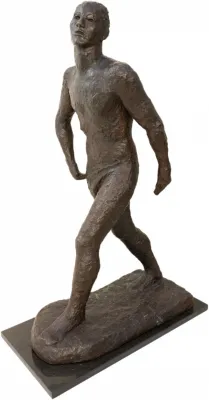
The change becomes visible in her second solo exhibition, in 1942, at the Valentine's Gallery, in New York, in which she presents surreal dreamlike forms of inspiration made in bronze. Due to this show he knows exponents of surrealism such as the critic and writer André Breton (1896 - 1966), the artists André Masson (1896 - 1987), Yves Tanguy (1900 - 1955), Marcel Duchamp (1887 - 1968),2 Max Ernst (1891 - 1976) and Michel Tapiè (1909 - 1987). His second exhibition at the New York Gallery, in 1943, Amazonia, is a real success.3 The artist continues to work with themes arising from Brazilian myths and traditions, and the reference to nature is now made as a symbol of the power of the savage and desire, in contrast to the dominated nature. of Western civilization. With bronze, Maria Martins creates organic forms that are increasingly free from any realistic figuration, using suggestive titles, as is characteristic of other surrealist artists. In this period, works such as Don't Forget Never That I come from the tropics (1942), Cobra Grande (1943) and Sem Echo (1943) stand out. Breton, who in 1947 text writes: "Mary, and behind her - that is to say, in her - the wonderful Brazil where on the widest spaces ... still hangs the wing of the unrevealed one. untouched, completely new, of the future, they hide. (...) The anguish, the temptations, the agitations, but also the auroras, the happiness and even the pure delights, and even the pure delights, is what Mary, in bronzes like Yaci, Bouina and Yemanjá, knew how to capture like no one in its primitive source. (...) It owes nothing to the sculpture of the past or the present". French.
In Maria Martins, the evocation of a nature not dominated by technique joins elements of the unconscious to create images of strong visual impact, loaded with eroticism, violence, but also of a certain docility and lyricism. In the work Impossible (1944), which had several versions of bronze, one of them acquired by the Museum of Modern Art of New York - MOMA, in 1946, hybrid beings (man and woman with the appearance of ancestral animals) are placed face to face, suggesting a situation of Deep desire, but also of aggression and death, as if pointing to the limits of the full union between beings.5 In this sense, certain animals such as the snake and the spider leave the mythological universe of the Amazonian legends to embody symbols related to the artist's experience. In However (1944), the Serpent of Desire compresses the woman's body, imprisoning her. In the case of the woman lost her shadow (1946), two snakes leave the head of a stiff female body, probably as a reference to lewd thoughts.
In 1948 she moved to Paris and became friends with Constantin Brancusi. (1876 - 1957), Benjamin Péret (1899 - 1959), Amédée Ozenfant (1886 - 1966) and Michel Seuphor (1901 - 1999). 1950 definitely returns to Brazil. Help in the organization of the 1st International Biennial of São Paulo, in which he participates as a guest artist. However, his surrealist poetics would not be well received in the Brazilian artistic milieu of the first half of the 1950s, dominated by the issues of constructivism and abstract art. This entails the artist's marginal position in relation to the dominant version of Brazilian modern art.
Its last individual takes place in 1956, at the Museum of Modern Art in Rio de Janeiro - MAM/RJ, an institution that helps to found. From what can be seen from the exhibition's catalog, this already occurs in a climate of hostility, as Maria Martins publishes a text that defends the artist's freedom of expression. (1901 - 1975). It is interesting to note that both critics point to the challenge of uniting the surrealist technique of "psychic automatism" with the work with bronze. It is also noted that the sculptures made in this period become more abstract, but without losing the allusive meaning of the titles (for example O Canto do Mar, 1952, and the sum of our days, 1954/1955).
Notes
1 In different sources the year of birth appears as being 1900.
2 The artist maintains an intense romantic relationship with the French artist. CF: CANTON, Katia. Maria Martins: The woman lost her shadow. In: São Paulo International Biennial, 24., 1998, São Paulo, SP. Historical core: anthropophagy and stories of cannibalism. São Paulo: Fundação Bienal de São Paulo, 1998. p. 288.
3 On that occasion, Maria Martins shared the gallery's space with friend Piet Mondrian (1872-1944). While the Brazilian managed to sell almost all the works, Mondrian's exhibition of the New York series was a failure. At the end of the show, Maria Martins decides to buy from her friend the Broadway canvas Boogie-Woogie, which donates to MOMA, from New York. (1947), and later republished in the book by Breton Le Surréalisme et la Peinture.
5 About the work The artist stated: "The world is complicated and sad, it is almost impossible for people to understand each other". Dictionnaire de la Sculpture Moderne, presents Maria Martins as the great sculptor of surrealism.
7 In this catalogue, texts by André Breton, Benjamin Péret and Murilo Mendes are also published. Quotes from Marcel Duchamp and Rainer Maria Rilke speak of the artist's freedom and his relationship of hostility with criticism. concern of stripping and do not fail to place it in the antipodes of an art that - alongside Brancusi, ARP and Giacometti - did not cease in these thirty years of resecting intellectualism. Doute, the farewell given to the anecdote is such that one could not in any way interpret as a change of your orientation. But (the important thing is that) the démarche of Mary brought her from the macrocosm to the microcosm, instead of making her walk the path inverse, which, it is known, has only ambushes and deceptions. Yeah, it will never be repeated enough, the universe that must be interrogated first and from man and not man from the universe. Maria, the tour de force of this total malleability in the rigid, is not the 'lost wax', it's the saps".
André Breton
Breton, André. Maria Martins. A Phala - Revista do Movimento Surrealismo. v. 1, p. 112-113.
"The organic expansions and contractions of Maria Martins' sculpture - it, in fact, the only one to have had a connection with the surrealist movement - point to another area of interest to the fantastic. The obstinacy of this work marked by excess, by the uncontrollable profusion of a discursive figuration in a context - that of Brazil in the 1950s - that strives to impose a visuality governed by abstract, rational and generalizing principles, which must account for the disorder originating from the Brazilian reality.
The work of Maria does the inverse work: she naively expresses this disorder in two types of figuration. of a generous and exuberant nature, but at the same time uncultivated and indomitable. It is significant to observe here the series of works that the artist dedicated to the Amazon. rhetoric of your images. In both, the belief of being able to immediately materialize the overflowing unconscious, a primordial nature that will be installed as an unfathomable viscosity in an orderly and controlled world. Due to this lack of restraint, this almost inelegance, Mário Pedrosa pointed out the absence of monumentality in his sculpture. He aspires to something great, majestic, but is torn apart in the impossibility of the very greatness of his speech. Therefore, he lives on this threshold, always a step further or below sculpture: he lives in this doubt, desiring incessantly to boast a power that goes beyond infinity".
Sônia Salzstein and Ivo Mesquita
SALZSTEIN, Sônia; MESQUITA, Ivo. Singular Imaginaries. In: Singular Imaginaries.
"The volumes in his sculpture, in bronze, polished metal or wood, have no consistency, articulation or hierarchy of planes. They tend to match each other, treated as if they were just a drained surface or a porous surface. (...) In later phases, the massive volumes are empty, gaps open in them and the surrounding space tends to penetrate them. That's when the sculptor is best realized. It then gives us a plot made of branches, lianas, trunks in which the sensuality of the chosen material, porous, verdoengo, in a consistency of rotten stick, expresses, with less sentimental strokes and more plastically, its spirit tortured".
Mário Pedrosa
Pedrosa. Mário. Maria the sculptor. In: Bienal Brasil Século 20th. Catalog. São Paulo: Fundação Bienal de São Paulo, 1994. p. 145-146.
Testimonies
"This or that form of expression matters as long as the artist conveys the message that is his own and in his own language, and do not use this kind of 'fad', often responsible for the great poverty of artists of real value. To better explain to me, I would say that, for me, when in a painting or sculpture, it highlights at first sight the school or movement to which its author intends to join, without such a sculpture or such painting arousing a greater interest of admiration or even repulsion, this work is nothing more than 'fad' and will die, still who knows momentary success."
Maria Martins
MARTINS, Maria. Maria. Rio de Janeiro: MAM, 1956.
Individual exhibitions
1941 - Washington (United States) - Individual, at Corcoram Art Gallery
1942 - New York (United States) - Individual, at Valentine Gallery
1943 - New York (United States) - Individual, Valentine Gallery
1944 - New York (United States) - Individual, at Valentine Gallery
1946 - New York (United States) - Individual, at Valentine Gallery
1947 - New York (United States) - Individual, at Julien Lery Gallery
1947 - New York (United States) - Maria: Recent Sculptures, at Julien Lery Gallery
1949 - Paris (France) - Individual, at Galerie René Drouin
1950 - Rio de Janeiro RJ - Individual, at ABI/RJ
1950 - São Paulo SP - Individual, at MAM/SP
1956 - Rio de Janeiro RJ - Maria, MAM/RJ
Collective exhibitions
1940 - Philadelphia (United States) - Collective, at International Philadelphia
1941 - New York (United States) - 3rd Latin America Exhibition of Fine Arts
1942 - New York (United States) - Hommage fait à Rodin, at Buchhlz Gallery
1942 - New York (United States) - Maria Martins at Valentine Gallery
1943 - New York (United States) - Maria Martins, at Valentine Gallery
1944 - Ohio (United States) - Religious Art of Today at Dayton Ohio
1946 - Saint Louis (United States) - Origins of Modern Sculpture, at the City Art of St. Louis
1947 - Paris (France) - Exposition International and Surréaliste, at Galerie Maeght
1949 - Paris (France) - From Rodin to the Jours, at the Maison de la Culture Française
1949 - Salzburg (Austria) - Music and the fine arts
1951 - São Paulo SP - 1st São Paulo International Biennial, at the Trianon Pavilion - Guest Artist
1953 - São Paulo SP - 2nd São Paulo International Biennial, at MAM/SP - 2nd Sculpture Award
1954 - São Paulo SP - Contemporary Art: Exhibition of the collection of the Museum of Modern Art of São Paulo, at MAM/SP
1955 - São Paulo SP - 3rd International Biennial of São Paulo, at MAM/SP - Best National Sculptor Award
1959 - Leverkusen (Germany) - First collective exhibition of Brazilian artists in Europe
1959 - Munich (Germany) - First collective exhibition by Brazilian artists in Europe, at Kunsthaus
1959 - Vienna (Austria) - First collective exhibition of Brazilian artists in Europe
1960 - Hamburg (Germany) - First collective exhibition by Brazilian artists in Europe
1960 - Lisbon (Portugal) - First collective exhibition of Brazilian artists in Europe
1960 - Madrid (Spain) - First collective exhibition of Brazilian artists in Europe
1960 - Paris (France) - First collective exhibition by Brazilian artists in Europe
1960 - Utrecht (Holland) - First collective exhibition by Brazilian artists Europe
1967 - São Paulo SP - 1st Surrealist Exhibition, at Teatro Italy
Posthetic exhibitions
1973 - São Paulo SP - 12th International Biennial of São Paulo, at the Bienal
1978 - Rio de Janeiro RJ - Brazilian sculpture in urban space: 50 years
1979 - São Paulo SP - 15th São Paulo International Biennial, at the Biennial Foundation
1982 - São Paulo SP - A century of sculpture in Brazil, at Masp
1984 - Petrópolis RJ - Individual, at Palácio de Cristal
1984 - São Paulo SP - Tradition and rupture: synthesis of Brazilian art and culture, at the Bienal Foundation
1985 - Belo Horizon MG - Rio: Constructive Strand, at MAP
1985 - Rio de Janeiro RJ - Rio: Surrealist Strand, at the Banerj Art Gallery
1985 - São Paulo SP - The Art of the Imaginary, at the Encontro das Artes Galeria
1985 - São Paulo SP - Rio: Constructive slope, at MAC/USP
1987 - São Paulo SP - 19th São Paulo International Biennial - Sala Imaginários Singulares, at the Biennial Foundation
1987 - São Paulo SP - The biennials in the MAC collection: 1951 to 1985, at MAC/USP
1987 - Paris (France) - Modernity: 20th century Brazilian art, at the Musée d'art moderne de la Ville de Paris
1988 - New York (United States) - The Latin American Spirit: Art and Artists in the United States: 1920-1970, at The Bronx Museum of the Arts
1988 - São Paulo SP - MAC 25 years: Highlights of the initial collection, at MAC/USP
1988 - São Paulo SP - Modernity: 20th century Brazilian art, at MAM/SP
1989 - El Paso (United States) - The Latin American Spirit: Art and Artists in the United States: 1920-1970, at the El Paso Museum of Art
1989 - San Diego (United States) - The Latin American Spirit: Art and Artists in the United States: 1920-1970, at the San Diego Museum of Art
1989 - San Juan (Porto Rico) - The Latin American Spirit: Art and Artists in the United States: 1920-1970, At the Puertorriqueña Institute of Culture
1990 - Miami (United States) - The Latin American Spirit: Art and Artists in the United States: 1920-1970, at the Center for the Fine Arts Miami Art Museum of Date
1992 - Poços de Caldas MG - Brazilian Modern Art: Collection of the Museum of Contemporary Art of the University of São Paulo, at the Casa da Cultura de Poços de Caldas
1992 - São Paulo SP - The Seduction of Volumes: The three-dimensional MAC, at MAC/USP
1992 - Zurich (Switzerland) - Brasilien: Entdeckung und Selbstendeckung, at Kunsthaus
1993 - Rio de Janeiro RJ - Brazil 100 years of modern art, at the MNBA
1994 - São Paulo SP - Brazilian modern art: a selection of the Roberto Marinho collection, at Masp
1994 - São Paulo SP - Bienal Brasil Século XX, at the Bienal Foundation
1996 - São Paulo SP - Brazilian art: 50 years of history in the MAC/USP collection: 1920-1970, at MAC/USP
1996 - São Paulo SP - women artists in the collection of MAC, at MAC/USP
1997 - Florianópolis SC - 5th National Hall Victor Meirelles, at MASC
1997 - Rio de Janeiro RJ - Maria Martins: Retrospective, at the Jean Boghici Gallery
1997 - São Paulo SP - Brazilian Sculpture: Profile of an identity, at the Safra Cultural Space
1997 - São Paulo SP - Maria Martins, at the Maria Luisa Foundation and Oscar Americano
1997 - São Paulo SP - The Mystery of Forms, in the MAC/USP
1997 - São Paulo SP - Three-dimensionality in Brazilian art of the 20th century, at Itaú Cultural
1997 - Washington D. C. (United States) - Brazilian sculpture: profile of an identity, in the cultural center of the IDB
1998 - New York (United States) - The Surrealist Sculpture of Maria Martins, at André Emmerich Gallery
1998 - Rio de Janeiro RJ - The Constantini Collection at the Museum of Modern Art in Rio de Janeiro, MAM/RJ
1998 - São Paulo SP - 24th São Paulo International Biennial, at Fundação Bienal
1998 - São Paulo SP - The Constantini Collection at the Museum of Modern Art of São Paulo, at MAM/SP
1999 - Lima (Peru) - Shows Brazil 500 years old, at the Pedro de Osma Museum
1999 - Rio de Janeiro RJ - Maria Martins: Les Sculptures Surréalistes des Annés 40, at Galeria Jean Boghici
2000 - Brasília DF - Exhibition Brazil Europe: Encounters in the 20th Century, in the Cultural Complex of Caixa
2000 - Lisbon (Portugal) - 20th century: Art of Brazil, at the José de Azeredo Modern Art Center Perdigão
2000 - São Paulo SP - Brazil + 500 rediscovery show. Modern Art, at the Bienal Foundation
2000 - São Paulo SP - Brazilian sculpture: from the Pinacoteca to the Jardim da Luz, at the Pinacoteca do Estado
2001 - New York (United States) - Brazil: Body and Soul, Guggenheim Museum
2001 - New York (United States) - Brazil: Body and Soul, at Solomon R. Guggenheim Museum
2001 - Rio de Janeiro RJ - Surrealism CCBB
2002 - Rio de Janeiro RJ - Brazilian art in the Fadel collection: from the restlessness of the modern to the autonomy of the language, in the CCBB
2002 - São Paulo SP - Brazilian art in the Fadel collection: da Restlessness of the modern to the autonomy of language, in the CCBB
2003 - Brasília DF - Brazilian art in the Fadel collection: from the restlessness of the modern to the autonomy of language, in the CCBB
2004 - Rio de Janeiro RJ - the century of a Brazilian: Roberto Marinho Collection, at Paço Imperial
2004 - São Paulo SP - The price of seduction: from corset to silicone, at Itaú Cultural
2005 - São Paulo SP - The body in Brazilian contemporary art, in the Itaú Cultural
2005 - São Paulo SP - The Century of a Brazilian: Roberto Marinho Collection, at MAM/SP
Source: Itaú Cultural