María Freire (Montevideo, Uruguay 1917 - idem 2015)
"Only by knowing the indissoluble union between the ethics of visual work and the personality of María Freire is it possible to measure the enormous distance between the active memory of her work and postmodern amnesia regarding the utopian and humanist premises generated by modern culture."
Opening this article on the Uruguayan painter and sculptor with a quotation from the text by Gabriel Peluffo Linari titled Universo y espacio artístico de María Freire [The Universe and Artistic Space of María Freire] sums up much of the work of a woman who was one of the pioneers of abstraction in Uruguayan visual arts. Painter, sculptor, art teacher and art critic, Freire was a co-founder of the Grupo de Arte No Figurativo [Non-Figurative Art Group], alongside her artistic and life partner, José Pedro Costigliolo.
After studying at the Círculo de Bellas Artes and the Universidad del Trabajo, she received a scholarship to continue her training in Amsterdam and Paris, where she was able to see firsthand the work of the Dutch Neoplasticists, Pollock, Calder and other prominent figures she had first encountered through the French art magazines received at the School of Architecture of the University of Montevideo.
Like all contemporary Uruguayan artists, she was in contact with Torres García, who, among other things, advocated looking at the art of peoples considered "primitive", something that had a great impact on European artists of the 1920s and 1930s, as was the case with Picasso.
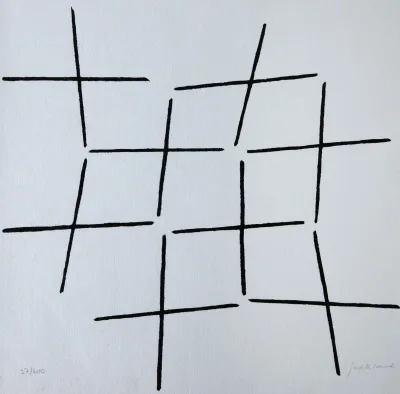
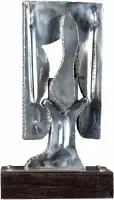
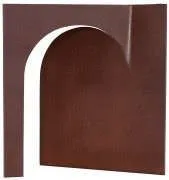
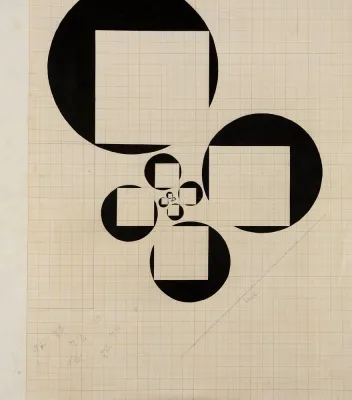
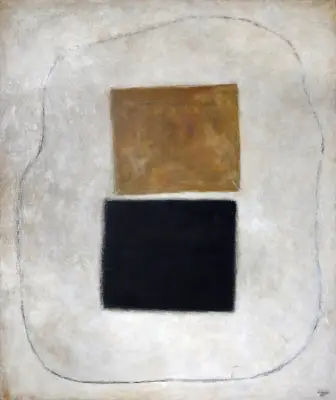
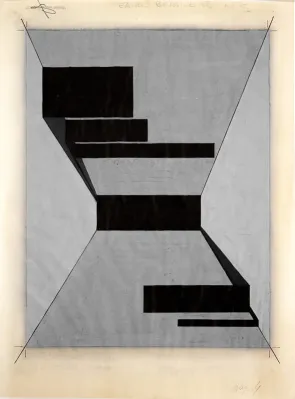
Freire did not resist the influence of these peoples: African masks and the elements that shaped the visual universe of pre-Columbian peoples are present at the beginning of her career as a painter (her sculptural work spans a shorter period than her painting), a path that led her to choose pure abstraction: relationships between forms without concrete references, united by rhythms that have at times been described as musical, the use of exact colors in a not very broad palette, and a geometry that imposes its presence, but not aggressively; on the contrary, almost as if asking permission, gently, politely. The same applies to her sculptures.
Despite the geometric weight, the two-dimensionality and the reduced palette, we are not facing a cold, distant or impenetrable body of work; the feeling is of an almost earthy warmth in the forms that intersect or keep their distance, in a constant invitation to relate to them, as if they wanted us to hear the stories they suggest. Daniel Tomasini (Fidelidad para renovar la excelencia, María Freire) wrote of her work that "a feeling of secure dynamic instability" emanates from it.
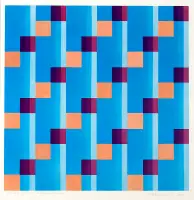
As a final summary, we give the floor back to Gabriel Peluffo, who explains, in the same text quoted above, that "since 1959 María Freire has produced a formally varied repertoire, but one whose constructive codes can be reduced to a few: the cutting of the plane involved in the construction of the polygonal sign (América series, 1958-1960), the perforation of the spatial plane leading to a nodal construction of virtually infinite development (Libra and Córdova series, 1965-1975), and the volumetric disturbance of the plane through the subdivision of its surface, creating reliefs and vibrations according to sequences of chromatic modulation (Variantes and Vibrantes series, 1975-1985)".
The painter had contact with the Argentine Madí movement and exhibited at the 2nd São Paulo Biennial in 1953, emphasizing the depoliticized character of Uruguayan constructivism, with no ties to the left, unlike its Brazilian and Argentine counterparts.