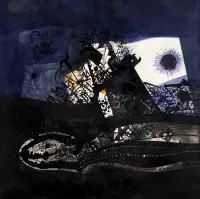
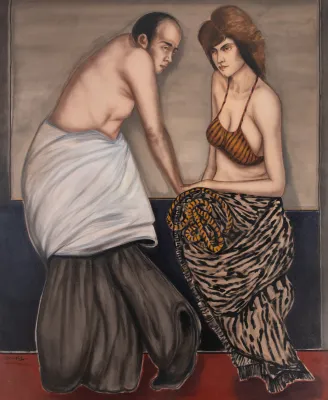
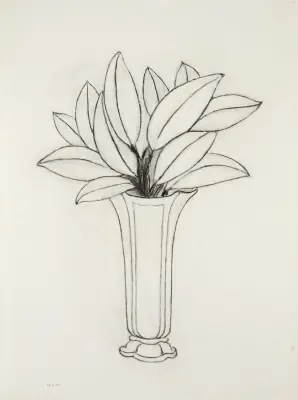
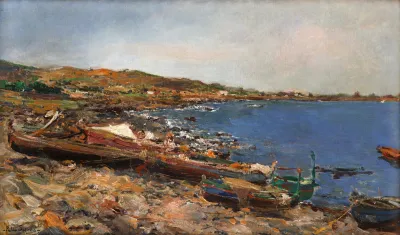
Geraldo de Barros (Chavantes SP 1923 - São Paulo SP 1998)
Photographer, painter, printmaker, graphic artist, furniture designer and draftsman.
From 1945, he studied drawing and painting in the studios of Clóvis Graciano (1907 - 1988), Yoshiya Takaoka (1909 - 1978) and Colette Pujol (1913 - 1999). In 1946, he took his first photographs with a camera he built himself. At first, he photographed football matches on the outskirts of São Paulo. Also in this period, he carried out experiments that consisted of intervening in the negative - cutting, drawing, painting, perforating, solarizing and superimposing images. He was one of the founders of Grupo 15, a studio set up in the city center in 1947, where he built a photographic darkroom. That same year he joined the Foto Cine Clube Bandeirante - FCCB, the main hub of modern Brazilian photography. In 1948, through the critic Mário Pedrosa (1900 - 1981), he discovered Gestalt Theorie [Gestalt theory]. In 1949, with Thomaz Farkas (1924), he created the photography laboratory and courses at the Museu de Arte de São Paulo Assis Chateaubriand - Masp. In 1950, he held the exhibition Fotoformas [Photoforms], whose title refers to Gestalt. His artistic trajectory places him at the forefront of experimental photography. In 1951, with a French government grant, he went to Paris, where he studied lithography at the École Nationale Supérieure des Beaux-Arts and printmaking in the studio of Stanley William Hayter (1901 - 1988). He attended the Hochschule für Gestaltung - HfG [Ulm School of Design], in Ulm, Germany, where he studied graphic arts with Otl Aicher (1922) and met Max Bill (1908 - 1994), then one of the leading theorists of concrete art. He returned to São Paulo in 1952 and joined the Grupo Ruptura, alongside Waldemar Cordeiro (1925 - 1973), Luiz Sacilotto (1924 - 2003) and Lothar Charoux (1912 - 1987), among others. From 1954, he worked in industrial design and visual communication: he founded the Cooperativa Unilabor and Hobjeto Móveis, for furniture production, and Form-Inform, a firm that created brands and logos. In 1966, he took part in founding the Grupo Rex, with Wesley Duke Lee (1931), Nelson Leirner (1932), Carlos Fajardo (1941), Frederico Nasser (1945) and José Resende (1945).
Critical Commentary
Geraldo de Barros studied with Clóvis Graciano (1907 - 1988), Yoshiya Takaoka (1909 - 1978) and Colette Pujol (1913 - 1999) from 1945 to 1947, the year in which he founded, with Takaoka, Grupo 15, made up of fifteen painters, most of Japanese origin. At first his painting approached expressionist tendencies, a period in which he came into contact with reproductions of works by Paul Klee (1879 - 1940) and Wassily Kandinsky (1866 - 1944), which led him to take an interest in the Bauhaus and industrial design.
He began researching photography in 1946 and the following year started attending the Foto Cine Clube Bandeirante, the main hub of modern photography in Brazil. Geraldo de Barros, together with Thomaz Farkas (1924), German Lorca (1922) and José Yalenti, each with his own individual research, challenged the amateur, academic pictorialist tradition of photography in Brazil, which valued the rules of classical composition. His experiments probed the limits of the traditional photographic process through interventions made directly on the negative, multiple exposures of the same film, superimpositions, montages and cut-outs of the prints that challenged the rectangular format of photography. In 1949, with Farkas, he organized the photographic laboratory of the Museu de Arte de São Paulo Assis Chateaubriand - Masp, which enabled him to pursue research outside the club. From then on, his work moved toward formal investigations in which what matters are the rhythms and planes that often project into the space beyond the frame. The following year, at Masp itself, he held the landmark exhibition Fotoformas, in which he completely fused printmaking, drawing and photography, inaugurating abstraction in Brazilian photography.
He won a French government grant and studied printmaking and graphic arts at the École Nationale Supérieure des Beaux-Arts in Paris in 1951. That same year, he attended the Hochschule für Gestaltung [Ulm School of Design] in Ulm, Germany, where the concretist theories of the Swiss Max Bill (1908 - 1994) prevailed. This encounter was important for the development of concrete art in Brazil. He won the acquisition prize at the 1st Bienal Internacional de São Paulo. Back in Brazil, together with Anatol Wladyslaw (1913 - 2004), Waldemar Cordeiro (1925 - 1973), Luiz Sacilotto (1924 - 2003) and Lothar Charoux (1912 - 1987), he took part in the Grupo Ruptura, which marked the beginning of concrete art in Brazil. In contact with Gestalt theories, he sought to establish a structural unity in the work, with a rigorous drive for order governed by mathematical principles.
His concern with the social role of the artist and with the possibilities of an art made to reach a wider public took shape in 1954 when, linked to a socialist group, he founded with Friar João Batista the Unilabor, a cooperative that made furniture and ran a children's art school and a health clinic. It gradually moved from craft production to an industrial organization. He won the competition for the poster of the 4th Centenary of São Paulo and, with Alexandre Wollner (1928), made a poster for the International Film Festival. Closely involved with design and somewhat removed from painting, in 1957 he founded with Wollner and Rubem Martins the Form-Inform design office, where he created numerous brands and logos. When the Unilabor cooperative closed, in 1964, he founded Hobjeto Móveis.
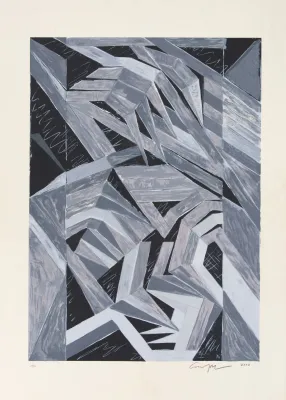
In 1966, he took part in the Grupo Rex, with Wesley Duke Lee (1931), Nelson Leirner (1932), Carlos Fajardo (1941), Frederico Nasser (1945) and José Resende (1945), responsible for the first happenings in São Paulo. From the mid-1960s, his work moved closer to pop trends and the new figuration. In the 1970s, he resumed the research begun with concrete art and produced geometric works on Formica, which allowed them to be reproduced on a large scale. What interested him was the socialization of art and obtaining a series from a single design. His works are prototypes built with few forms, which allows them to be reproduced perfectly. From the 1980s, he returned to photography and worked on the Sobras [Leftovers] series, in which he made various graphic interventions on negatives, resuming the research he had begun in the 1940s, using leftover photographic material.
Critiques
"Geraldo sees, in certain aspects or elements of the real, especially in usually hidden details, fanciful, Olympian abstract signs: lines he likes to interweave with other lines in an alchemy of more or less unforeseen and sometimes chance combinations, which always end up composing pleasing formal harmonies.
For Geraldo, composition is a duty; he organizes it by choosing among the million linear segments he perceives, superimposing negative on negative, modulating the tones of his only colors, white and black, reinforcing the inks in that laboratory work of his, so careful and pleasing".
Pietro Maria Bardi
Bardi, Pietro Maria. Fotoforma. In: AMARAL, Aracy (Org.). Projeto construtivo brasileiro na arte: 1950-1962. Rio de Janeiro: MAM, 1977. p. 207. [Texto publicado originalmente em 1950, no catálogo da exposição Fotoforma, realizada no Masp]
"In 1952, back in São Paulo, he renewed his contacts with Cordeiro around the discussions for drafting the 'Ruptura' manifesto. Both produced pictures that can be considered geometric abstraction, and both called them concrete art. However, the theoretical grounding behind each of them differs. Cordeiro's (...) is based mainly on the European theorists already mentioned (Kandinsky, Mondrian, etc.), and his political thinking is guided by Antonio Gramsci's conception of the 'leading intellectual'. Geraldo de Barros is guided by Mário Pedrosa's interpretation of Gestalt, which aims to reach the viewer without the mediation of the intellect, thereby becoming universally comprehensible. (...) He wants to democratize art insofar as he intends the art object to be accessible to the masses, seeking to achieve this by creating drawings that are designs which can easily be turned into prototypes for industrial production and manufactured in large numbers".
Gabriela Suzana Wilder
WILDER, Gabriela Suzana. Waldemar Cordeiro: pintor vanguardista, difusor, crítico de arte, teórico e líder do movimento concretista nas artes plásticas em São Paulo, na década de 50. São Paulo: ECA/USP, 1982. (Mestrado). p. 48-49.
"Geraldo de Barros, the figurative painter of tones and emphatic drawing of Grupo dos 15, discovered Paul Klee (1879-1940) in art books in 1948, which led him to draw close to the inner world of the Swiss-German master. This future member of the Concrete group would soon distinguish himself by using different expressive channels: painting, monotype, printmaking and photography. It was through photography that he made his passage from figuration to abstraction. His works in the Fotoforma exhibition at Masp (1950) followed in the line of the photograms of Moholy-Nagy and other visual artists who redefined photography. On returning from a trip to Europe (1951-1952), Geraldo de Barros was one of the signatories of the manifesto of the Grupo Ruptura. Later, however, he would break with Cordeiro and his leadership. His contribution was to have conceived concrete painting through prototypes, with works that implied multiplicable production. (...) Like other members of São Paulo concretism, he turned decisively to 'industrial design', creating brands, logos and some posters - including in collaboration with Alexandre Wollner (1928) - between 1952 and 1954. His aims would later focus on furniture design. The collectivist working solutions he aspired to had led him to found Unilabor. Another industrial organization to which he committed himself was Form-Inform, before he created Hobjeto. In the 1960s he practiced pop painting, a rare excursion among the concretists".
Walter Zanini
ZANINI, Walter, org. História geral da arte no Brasil. São Paulo: Instituto Walther Moreira Salles, Fundação Djalma Guimarães, 1983. p. 662-663.
"While in his painting he tries to move away from traditional naturalistic representation, photography, for him, represents not the transcription of the real but rather the possibility of revealing the invisible to sight, the act of developing, more and more, a path toward an art that does not come from the retina.
And among all the subjects that catch his attention, it is always in the name of the play of light and shadow that he inevitably becomes interested, like Brassai, in cracks, roughness, graffiti".
Charles Henri Favrod
FAVROD, Charles Henri. A Descoberta da Fotografia. In: BARROS, Geraldo de. Fotoformas: Geraldo de Barros, fotografia. São Paulo: Raízes, 1994. p. 7.
"Geraldo de Barros is a man centered in the world; he has 'the awareness of an impulse that drives him to exercise freedom' - the statement is from his friend Mário Pedrosa, a basic premise of the artist's condition in modern society: 'the spiritual exercise of Freedom', a freedom the artist invents and takes up again, inventor that he is of the evidence between art and man. An artist ahead of his time. With the singularity of the purest perception, he uses seriality and approaches visual communication and design with the same affective radicalism with which he 'discovers' the photograph, fragments the pop billboard, reveals the 'Klee-like' line of the print; with a Rolleiflex in his hand he discovers Art; his photographic essays reveal an artistic autonomy that bursts out beyond the concrete movement and runs through his later achievements; the enigma of photography pointed out by Roland Barthes - 'emblem of likenesses' - is thus discarded: he deconstructs the signifying, eminently imitative image; he seeks to distance himself ever more from its literalness and to do more than inventory analogical feelings; he trusts in error, in its contribution; he explores and masters chance in the search for difference; at a certain point, he abandons the camera and works light directly on the photogram. His photographic construction recalls Carlos Drummond de Andrade - 'crystal of time on paper' - and the eminence of the Artist's attitude: the capacity to innovate.
Geraldo de Barros carries the notions of error and chance over to his graphic works; his lithographs feed on the readymade labels of the stones in the Paris studio; in the aquatints and etchings, direct allusions to Klee, the gentle glimpse, the simple structure, almost a star, fragmented in metal; the monotypes, a vague field born of the inked surface: a living field on paper - as it moves it is already stain, mark, dirt, absence surfacing in a single and manifold action, a path of possibilities; the fine line of carbon paper in the drawings defies orthodoxies; he takes advantage of the light weight of the paper and its transparency to filter colors, applying them behind the drawings; color is the tenderness of time. . .
Geraldo de Barros, at 72, warns: 'Enough of the work!' and proclaims, with his usual good humor, that he will now devote himself to 'leftovers'. Let the avant-garde beware!"
Sérgio Pizoli
PIZOLI, Sérgio. [Texto]. In: BARROS, Geraldo de. Precursor. Rio de Janeiro: Centro Cultural Banco do Brasil, 1996. p. 10.
Testimonials
"(...) For me, Photography is a printmaking process. I defended this idea when I tried to introduce it as an artistic category at the 2nd Bienal Internacional de São Paulo. I also believe that photographic creation lies in 'error', in the exploration and mastery of chance. I took care to learn the technique only well enough to express myself, without letting myself be carried away by excessive virtuosity.
(...) I believe that exaggerated technical sophistication, the cult of technical perfection, leads to an impoverishment of the results, of imagination and creativity, which is negative for the art of photography".
Geraldo de Barros
BARROS, Geraldo de. A Fotografia. In: ______. Fotoformas. São Paulo: Raízes, 1994. p. 11.
Collections
Acervo Pinacoteca do Estado de São Paulo/Brasil - São Paulo SP
Archivio Della Nuova Scrittura - Milão (Itália)
Coleção Pirelli/Masp de Fotografias - São Paulo SP
Fonds d'Art Contemporain de l'Etat de Genève (Suíça)
Fonds d'Art Contemporain de la Ville de Genève (Suíça)
Fundação Bienal de São Paulo - São Paulo SP
Fundação Cultural de Curitiba - Curitiba PR
Fundação Max Bill - Zurique (Suíça)
Fundación Patricia Phelps de Cisneros - Caracas (Venezuela)
Instituto Itaú Cultural - São Paulo SP
Ludwig Museum - Colônia (Alemanha)
Musée d'Art Contemporain de Grenoble (França)
Musée de l'Elysée - Lausanne (Suíça)
Museu da Imagem e do Som - MIS/SP - São Paulo SP
Museu de Arte Contemporânea de São Paulo - MAC/USP - São Paulo SP
Museu de Arte de São Paulo Assis Chateaubriand - Masp - São Paulo SP
Museu de Arte Moderna de São Paulo - MAM/SP - São Paulo SP
Museu de Arte Moderna do Rio de Janeiro - MAM/RJ - Rio de Janeiro RJ
Museu do Itamaraty - Brasília DF
Union de Banques Suisses
Solo Exhibitions
1947 - São Paulo SP - Solo, at Theatro Municipal
1950 - Rio de Janeiro RJ - Fotoformas [Photoforms], at MEC/RJ
1950 - Salvador BA - Fotoformas [Photoforms], at MEC/BA
1950 - São Paulo SP - Fotoformas [Photoforms], at Masp
1952 - São Paulo SP - Solo, at MAM/SP
1954 - São Paulo SP - Solo, at MAM/SP
1965 - Buenos Aires (Argentina) - Solo, at Museo de Arte Moderno
1965 - São Paulo SP - Solo, at Atrium Galeria de Arte
1977 - São Paulo SP - Geraldo de Barros: 12 Years of Painting 1964 to 1976, at MAM/SP
1986 - Rio de Janeiro RJ - Solo, at Galeria Thomas Cohn
1986 - São Paulo SP - Solo, at Galeria Millan
1987 - Glarus (Switzerland) - Solo, at Galeria Tschudi
1989 - Campinas SP - Jogos de Dados [Dice Games], at Galeria de Arte da Unicamp
1989 - São Paulo SP - Solo, at MAM/SP
1990 - Lausanne (Switzerland) - Geraldo de Barros: Photography Retrospective, at Musée de l'Elysée
1990 - Rio de Janeiro RJ - Jogos de Dados [Dice Games], at MAM/RJ
1990 - São Paulo SP - Solo, at MAM/SP
1990 - São Paulo SP - Jogos de Dados [Dice Games], at MAM/SP
1991 - Milan (Italy) - Jogos de Dados [Dice Games], at Mercato del Sale
1991 - São Paulo SP - Geraldo de Barros: o Espaço do Artista quando Jovem [The Space of the Artist as a Young Man], at Paço das Artes
1993 - Lausanne (Switzerland) - Geraldo de Barros: peintre et photographie, at Musée de l'Elysée
1993 - São Paulo SP - Solo, at Casa das Rosas
1994 - São Paulo SP - Geraldo de Barros: Photographer, at MIS/SP
1995 - São Paulo SP - Fotoformas [Photoforms], at Galeria Camargo Vilaça
1996 - Campinas SP - Geraldo de Barros and Concretism, at Itaú Cultural
1996 - Curitiba PR - Desenhos de Luz [Drawings of Light], at Museu da Gravura
1996 - Curitiba PR - Geraldo de Barros: Fotoformas [Photoforms], at Fundação Cultural de Curitiba. Solar do Barão
1996 - Geneva (Switzerland) - Geraldo de Barros: Photographs, at Alexandre Mottier Gallery
1996 - Rio de Janeiro RJ - Geraldo de Barros: Precursor, at CCBB
1998 - Houston (United States) - Solo, at Sicardi Sanders Gallery
1998 - São Paulo SP - Geraldo de Barros: Tribute, at MIS/SP
Group Exhibitions
1946 - Rio de Janeiro RJ - 52nd National Salon of Fine Arts, at MNBA - silver medal
1946 - São Paulo SP - 10th Salon of the Visual Artists' Union, at Galeria Prestes Maia
1947 - Rio de Janeiro RJ - 53rd National Salon of Fine Arts, at MNBA - honorable mention
1947 - São Paulo SP - 19 Pintores [19 Painters], at Galeria Prestes Maia
1948 - Rio de Janeiro RJ - 54th National Salon of Fine Arts, at MNBA - bronze medal
1949 - Rio de Janeiro RJ - 55th National Salon of Fine Arts, at MNBA - silver medal
1949 - São Paulo SP - Grupo 15 Exhibition, at IAB/SP
1950 - Salvador BA - Bahia National Salon of Modern Art - honorable mention
1951 - Paris (France) - Salon de Photographie à Paris et à Nantes
1951 - São Paulo SP - 1st São Paulo International Biennial, at Pavilhão Trianon - acquisition prize
1952 - Lyon (France) - Cercle d'Art Photographique
1952 - São Paulo SP - Grupo Ruptura, at MAM/SP
1953 - São Paulo SP - 2nd São Paulo International Biennial, at Pavilhão dos Estados - acquisition prize
1954 - Bern (Switzerland) - Gravure Brésilienne, at Kunstmuseum
1954 - Geneva (Switzerland) - Gravure Brésilienne, at Musée Rath de Genève
1954 - Goiânia GO - Exhibition of the National Congress of Intellectuals
1954 - São Paulo SP - 3rd São Paulo Salon of Modern Art, at Galeria Prestes Maia
1954 - Zurich (Switzerland) - Gravure Brésilienne, at Kunstgewerbemuseum
1955 - Brasil - Arts Primitifs et Modernes Brésiliens
1955 - France - Arts Primitifs et Modernes Brésiliens
1955 - São Paulo SP - 3rd São Paulo International Biennial, at Pavilhão das Nações
1955 - São Paulo SP - 4th São Paulo Salon of Modern Art, at Galeria Prestes Maia - large silver medal
1955 - Switzerland - Arts Primitifs et Modernes Brésiliens
1956 - Paris (France) - Salon de Mai, at Palais de Tokyo
1956 - São Paulo SP - 1st National Exhibition of Concrete Art, at MAM/SP
1956 - Venice (Italy) - 28th Venice Biennale - acquisition prize
1957 - Buenos Aires (Argentina) - Modern Art in Brazil, at Museo de Arte Moderno
1957 - Lima (Peru) - Modern Art in Brazil, at Museo de Arte de Lima
1957 - Rio de Janeiro RJ - 1st National Exhibition of Concrete Art, at MAM/RJ
1957 - Rosario (Argentina) - Modern Art in Brazil, at Museo Municipal de Bellas Artes Juan B. Castagnino
1957 - Santiago (Chile) - Modern Art in Brazil, at Museo de Arte Contemporáneo
1960 - Zurich (Switzerland) - Konkrete Kunst, at Helmhaus
1965 - São Paulo SP - Geraldo de Barros and Nelson Leirner, at Atrium Galeria de Arte
1965 - São Paulo SP - Proposals 65, at MAB/Faap
1966 - São Paulo SP - Discovery of America, at Rex Gallery & Sons
1966 - São Paulo SP - Flash Back, at Rex Gallery & Sons
1966 - São Paulo SP - Galeria Rex: Opening Exhibition, at Rex Gallery & Sons
1967 - Rio de Janeiro RJ - Nova Objetividade Brasileira [New Brazilian Objectivity], at MAM/RJ
1967 - São Paulo SP - 9th São Paulo International Biennial, at Fundação Bienal - Itamaraty Prize
1968 - Rio de Janeiro RJ - The Brazilian Artist and Mass Iconography, at Esdi
1971 - São Paulo SP - Brazilian Furniture, at Masp
1976 - São Paulo SP - Young Drawing of the 1940s, at Pinacoteca do Estado
1977 - Rio de Janeiro RJ - Brazilian Constructive Project in Art: 1950-1962, at MAM/RJ
1977 - São Paulo SP - The Groups: The 1940s, at Museu Lasar Segall
1977 - São Paulo SP - Brazilian Constructive Project in Art: 1950-1962, at Pinacoteca do Estado
1978 - Mexico City (Mexico) - 1ª Muestra de la Fotografía Latinoamericana Contemporánea [1st Show of Contemporary Latin American Photography], at Museo de Arte Moderno
1978 - São Paulo SP - The Biennials and Abstraction: The 1950s, at Museu Lasar Segall
1979 - São Paulo SP - 15th São Paulo International Biennial, at Fundação Bienal
1979 - Venice (Italy) - Venezia '79: la fotografia, at Comune di Venezia
1981 - São Paulo SP - 16th São Paulo International Biennial, at Fundação Bienal
1982 - São Paulo SP - From Modernism to the Bienal, at MAM/SP
1982 - São Paulo SP - Design in Brazil: History and Reality, at Sesc Pompeia
1984 - Campinas SP - Geraldo de Barros and Hermelindo Fiaminghi, at Galeria de Arte da Unicamp
1984 - São Paulo SP - Geometria 84 [Geometry 84], at Paulo Figueiredo Galeria de Arte
1984 - São Paulo SP - Tradition and Rupture: A Synthesis of Brazilian Art and Culture, at Fundação Bienal
1985 - Atami (Japan) - 7th Brazil-Japan Fine Arts Exhibition
1985 - Belo Horizonte MG - Geometria Hoje [Geometry Today], at MAP
1985 - Kyoto (Japan) - 7th Brazil-Japan Fine Arts Exhibition
1985 - Rio de Janeiro RJ - 7th Brazil-Japan Fine Arts Exhibition
1985 - Santo André SP - 13th Santo André Contemporary Art Salon, at Paço Municipal
1985 - São Paulo SP - 7th Brazil-Japan Fine Arts Exhibition, at Fundação Brasil-Japão
1985 - Tokyo (Japan) - 7th Brazil-Japan Fine Arts Exhibition
1986 - São Paulo SP - 17th Panorama of Current Brazilian Art, at MAM/SP
1986 - Venice (Italy) - 42nd Venice Biennale
1987 - Rio de Janeiro RJ - 1st Geometric Abstraction: Concretism and Neo-Concretism, at Funarte. Centro de Artes
1987 - São Paulo SP - 1st Geometric Abstraction: Concretism and Neo-Concretism, at MAB/Faap
1987 - São Paulo SP - The Fabric of Taste: Another Look at Everyday Life, at Fundação Bienal
1987 - São Paulo SP - The Biennials in the MAC Collection: 1951 to 1985, at MAC/USP
1988 - São Paulo SP - 63/66 Figure and Object, at Galeria Millan
1988 - São Paulo SP - MAC 25 Years: Recent Acquisitions and Donations, at MAC/USP
1989 - São Paulo SP - Galeria São Paulo Collection, at Galeria de Arte São Paulo
1989 - São Paulo SP - Exhibition, at Gabinete de Arte Raquel Arnaud
1991 - São Paulo SP - 21st São Paulo International Biennial, at Fundação Bienal
1991 - São Paulo SP - Constructivism: Poster Art 40/50/60, at MAC/USP
1992 - Denmark - Latinamerica '92
1992 - São Paulo SP - 2nd Pirelli/Masp Photography Collection, at Masp
1992 - Zurich (Switzerland) - Brasilien: Entdeckung und Selbstentdeckung, at Kunsthaus Zürich
1993 - João Pessoa PB - Woodcut: From Cordel to the Gallery, at Fundação Espaço Cultural da Paraíba
1993 - São Paulo SP - 1st International Photography Month, at Sesc Pompeia
1993 - São Paulo SP - Ingresso para a Modernidade [Ticket to Modernity], at Espaço Arte Morumbi Shopping
1993 - São Paulo SP - Masp at Morumbi Shopping, at Shopping Morumbi
1994 - San Francisco (United States) - Contemporary Brazilian Photography: A Selection of Photographs from the Collection of Joaquim Paiva, at Center for the Arts Yerba Buena Gardens
1994 - São Paulo SP - Bienal Brasil Século XX, at Fundação Bienal
1994 - São Paulo SP - Woodcut: From Cordel to the Gallery, at Metrô
1995 - Rio de Janeiro RJ - Contemporary Brazilian Photography, at CCBB
1996 - Cologne (Germany) - Neuerwerbungen Photosammlung, at Museum Ludwig
1996 - Lausanne (Switzerland) - Collection Musées Suisses, at Musée de l'Elysée
1996 - New York (United States) - Brazil: The Thinking Photography, at Rochester Institute of Technology. College of Imaging Arts and Sciences. School of Photographic Arts and Sciences. MFA - Gallery
1996 - Rio de Janeiro RJ - Constructive Tendencies in the MAC USP Collection: Construction, Measure and Proportion, at CCBB
1996 - São Paulo SP - 4th Studio Unesp Sesc Senai of Image Technologies, at Sesc Pompeia
1996 - São Paulo SP - Brazilian Art: 50 Years of History in the MAC/USP Collection: 1920-1970, at MAC/USP
1996 - São Paulo SP - Desexp(l)os(ign)ição, at Casa das Rosas
1996 - São Paulo SP - The World of Mario Schenberg, at Casa das Rosas
1997 - Grenoble (France) - Exposition d'Été: collections 1950-1955, at Musée de Grenoble
1997 - São Paulo SP - Art Support Computer, at Casa das Rosas
1998 - Houston (United States) - 7th FotoFest 1998
1998 - São Paulo SP - The Art of Exhibiting Art, at MAM/SP
Posthumous Exhibitions
1998 - São Paulo SP - Constructive Art in Brazil: Adolpho Leirner Collection, at MAM/SP
1998 - Texas (United States) - The Joaquim Paiva Collection, at FotoFest 1998
1999 - Cologne (Germany) - Geraldo de Barros: Fotoformas [Photoforms], at Museum Ludwig
1999 - Paris (France) - International Contemporary Art Fair
1999 - Rio de Janeiro RJ - Constructive Art in Brazil: Adolpho Leirner Collection, at MAM/RJ
1999 - São Paulo SP - The 1950s and Their Involvements, at Jo Slaviero Galeria de Arte
1999 - São Paulo SP - Enigmas, at Galeria Brito Cimino
1999 - São Paulo SP - Fotocolecionismo [Photo Collecting], at Galeria Luisa Strina
1999 - São Paulo SP - Photographs, at Galeria Brito Cimino
1999 - São Paulo SP - Solo, at Galeria Brito Cimino
1999 - São Paulo SP - Parallèle, at Galeria Brito Cimino
1999 - Seattle (United States) - Photography of Hope, at Benham Studio Gallery
1999 - Wolfsburg (Germany) - Brasilianische Fotografie 1946 bis 1998, at Kunstmuseum Wolfsburg
2000 - Basel (Switzerland) - Messe Basel 2000, at Galerie Eric Frank
2000 - Campinas SP - Geraldo de Barros: Sobras [Leftovers] 1996-1998, at Itaú Cultural
2000 - Lausanne (Switzerland) - Sobras [Leftovers], at Musée de l'Elysée
2000 - Lisbon (Portugal) - 20th Century: Art of Brazil, at Centro de Arte Moderna José de Azeredo Perdigão
2000 - Madrid (Spain) - Heterotopías: medio siglo sin lugar 1918-1968 [Heterotopias: Half a Century without Place 1918-1968], at Museo Nacional Centro de Arte Reina Sofía
2000 - São Paulo SP - Brasil + 500 Rediscovery Exhibition, at Fundação Bienal
2000 - São Paulo SP - Messe Basel 2000, at Galeria Brito Cimino
2000 - São Paulo SP - The Role of Art, at Galeria de Arte do Sesi
2000 - São Paulo SP - São Paulo: From Village to Metropolis, at Galeria Masp Prestes Maia
2000 - Valencia (Spain) - De la Antropofagia a Brasilia: Brasil 1920-1950, at IVAM. Centre Julio González
2001 - Belo Horizonte MG - Constructed Realities: From Pictorialism to Modern Photography, at Itaú Cultural
2001 - Campinas SP - Constructed Realities: From Pictorialism to Modern Photography, at Itaú Cultural
2001 - Rio de Janeiro RJ - The Spirit of Our Time, at MAM/RJ
2001 - São Paulo SP - Museu de Arte Brasileira: 40 Years, at MAB/Faap
2001 - São Paulo SP - The Spirit of Our Time, at MAM/SP
2001 - São Paulo SP - Trajectory of Light in Brazilian Art, at Itaú Cultural
2002 - Rio de Janeiro RJ - Brazilian Art in the Fadel Collection: From the Restlessness of the Modern to the Autonomy of Language, at CCBB
2002 - Rio de Janeiro RJ - Artefoto, at CCBB
2002 - Rio de Janeiro RJ - Paths of the Contemporary 1952-2002, at Paço Imperial
2002 - Rio de Janeiro RJ - Parallels: Brazilian Art of the Second Half of the 20th Century in Context, Colección Cisneros, at MAM/RJ
2002 - São Paulo SP - Line as the Structure of Form, at MAM/SP
2002 - São Paulo SP - Brazilian Art in the Fadel Collection: From the Restlessness of the Modern to the Autonomy of Language, at CCBB
2002 - São Paulo SP - Cidadeprojeto / cidadeexperiência, at MAM/SP
2002 - São Paulo SP - From Anthropophagy to Brasília: Brazil 1920-1950, at MAB/Faap
2002 - São Paulo SP - Photographs in the Collection of the Museu de Arte Moderna de São Paulo, at MAM/SP
2002 - São Paulo SP - Geometric and Kinetic, at Gabinete de Arte Raquel Arnaud
2002 - São Paulo SP - Grupo Ruptura: Revisiting the Inaugural Exhibition, at Centro Universitário Maria Antonia
2002 - São Paulo SP - Modernism: From the Week of '22 to Sérgio Milliet's Art Section, at CCSP
2002 - São Paulo SP - Paralela, at a warehouse on Avenida Matarazzo, 530, São Paulo
2002 - São Paulo SP - Parallels: Brazilian Art of the Second Half of the 20th Century in Context, Colección Cisneros, at MAM/SP
2002 - São Paulo SP - Visions and Illuminations: Contemporary Brazilian Photography from the Joaquim Paiva Collection, at Oca
2003 - Brasília DF - Brazilian Art in the Fadel Collection: From the Restlessness of the Modern to the Autonomy of Language, at CCBB
2003 - Brasília DF - Artefoto, at CCBB
2003 - Mexico City (Mexico) - Cuasi Corpus: arte concreto y neoconcreto de Brasil: una selección del acervo del Museo de Arte Moderna de São Paulo y la Colección Adolpho Leirner, at Museo Rufino Tamayo
2003 - Rio de Janeiro RJ - Galeria Lurixs Arte Contemporânea: Inaugural Exhibition, at Galeria Lurixs Arte Contemporânea
2003 - São Paulo SP - The Art Behind Art: Where Artworks Are Kept and How They Travel, at MAM/SP
2003 - São Paulo SP - The Subversion of Media, at Itaú Cultural
2003 - São Paulo SP - Art and Society: A Controversial Relationship, at Itaú Cultural
2003 - São Paulo SP - MAC USP 40 Years: Contemporary Interfaces, at MAC/USP
2004 - Porto Alegre RS - Olho Vivo: a Arte da Fotografia [Sharp Eye: The Art of Photography], at Santander Cultural
2004 - Rio de Janeiro RJ - Tudo é Brasil [Everything Is Brazil], at Paço Imperial
2004 - São Paulo SP - The Biennials: A Look at Brazilian Production 1951/2002, at galeria Bergamin
2004 - São Paulo SP - Photography and Sculpture in the MAM Collection - 1995 to 2004, at MAM/SP
2004 - São Paulo SP - Paper Cabinet, at CCSP
2004 - São Paulo SP - The Price of Seduction: From Corset to Silicone, at Itaú Cultural
2004 - São Paulo SP - Tudo é Brasil [Everything Is Brazil], at Itaú Cultural
2004 - São Paulo SP - Brazilian Version, at Galeria Brito Cimino
2005 - Belém PA - Arte Pará Salon, at Fundação Romulo Maiorana
2005 - Porto Alegre RS - Mercosul Visual Arts Biennial
2005 - Rio de Janeiro RJ - Artecontemporânea, at Mercedes Viegas Arte Contemporânea
2006 - Rio de Janeiro RJ - Geraldo de Barros, at Lurixs: Arte Contemporânea
2006 - São Paulo SP - Veracidade [Veracity], at MAM/SP
2006 - São Paulo SP - Pincelada - Pintura e Método: Projeções da Década de 50 [Brushstroke - Painting and Method: Projections of the 1950s], at Instituto Tomie Ohtake
2006 - São Paulo SP - Concreta '56: a Raiz da Forma [Concrete '56: The Root of Form], at MAM/SP
2006 - São Paulo SP - MAM at Oca, at Oca
2006 - São Paulo SP - Brasiliana Masp: Modern Contemporary, at MAM/SP
2007 - São Paulo SP - Itaú Contemporâneo: Art in Brazil, at Itaú Cultural
2007 - São Paulo SP - Fragmentos: Modernismo da Fotografia Brasileira [Fragments: Modernism in Brazilian Photography], at Galeria Bergamin
2007 - São Paulo SP - The 1970s - Art as Question, at Instituto Tomie Ohtake
2007 - Uberlândia MG - Veracidade: Fotografias do Acervo do MAM [Veracity: Photographs from the MAM Collection], at Museu Universitário de Arte
2007 - São Paulo SP - Recortar e Colar [Cut and Paste] | Ctrl_C Ctrl_V, at Sesc Pompeia
2008 - São Paulo SP - Fotoformas e Suas Margens [Photoforms and Their Margins], at Centro Universitário Maria Antonia
2008 - São Paulo SP - Ruptura, Frente e Ressonâncias [Ruptura, Frente and Resonances], at Galeria Berenice
Source: Itaú Cultural