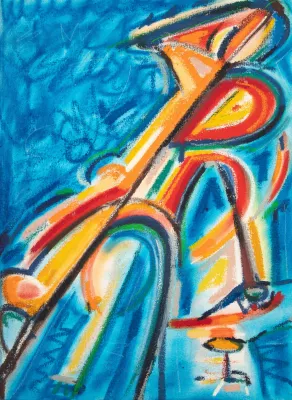
Felícia Leirner (Warsaw, Poland 1904 - Campos do Jordão SP 1996)
Felícia Leirner was a sculptor. He moved to Brazil with her husband, Isai Leirner, in 1927. In São Paulo, he studied painting with Yolanda Mohalyi (1909–1978) and, in 1948, began his studies in sculpture with Victor Brecheret (1894–1955). In the 1950s, his works began to address mainly themes related to motherhood and the family universe. In 1959, he made an important retrospective show at the Gallery of Arts of the Leaves.
From the 1960s onwards, he approached abstraction in some sculptures. He participated in several editions of the Bienal Internacional de São Paulo, having received the award for best national sculptor in 1963, and a special room in 1965. The Felícia Leirner Museum was inaugurated, which houses about 100 sculptures by the artist in an open space. Parque Ibirapuera, and the birds (1978/1979), at Praça da Sé, in São Paulo. About his production, the books Felícia were published, by the São Paulo State Department of Culture, in 1983, and Felícia Leirner: Art as a Mission, with text by the art critic Frederico Morais, by the Felícia Leirner Museum, in 1991.
Critical Comment
The initial production of Felícia Leirner, in the 1950s, reveals affinity with the work of her master, Victor Brecheret (1894 - 1955). Its main themes in this period are women, motherhood and the family universe. The artist's figures present a formal asymmetry, due to the contrast between the length of the arms and legs or the volume of the body in relation to the diminutive head, and thus approach works by Aristide Maillol (1861 - 1944) and Henry Moore (1898 - 1986). It creates textures on the surface of the bronze, through grooves, incisions and graphics.
The artist, who initially performs isolated figures, starts to work with shapes that complement each other. It expands the relationship between the empty and full spaces in its compositions, creating works of greater lightness. For the art critic Mário Pedrosa (1900 - 1981), his sculpture is enriched by the contrast between the convex and convex planes and the alternation between shadow and clarity.
Some of Leirner's works They approach abstraction, as in the Cruzes series, 1963 or structures, 1964/1966. The latter has an affinity with the constructive aspect. In cabins, 1966/1967, it explores the field of architecture, approaching works by Hans Arp (1886 - 1996) and François Stahly (1911). His sculptures from the 1980s are made up of cut-out shapes, designed to integrate into the landscape.
Criticism
"Although he frees himself from the anecdote, which still seduces it at the beginning of his artistic activity, the sculptor did not escape entirely from figurativeism. Its emotion is born in the ways it encounters in nature. It does not stylize them, but uses them as a starting point for the sublimation of their emotions. A set of forms and movements to provoke a certain impression on the spectator. What also characterizes the art of Felicia is the love of matter. It works with such sensitivity that it makes it almost pictorial, sometimes much more sensual, always rich in invention. Expressionist?Maybe it's a path that is undoubtedly passionate, but the human background seems to impress it too much so that it completely eliminates it from its work. Sculpture is not a game for it, it is an instrument of expression. instrument that he knows how to handle and with which he really says what he has to say. and has."
Sérgio Milliet
LEIRNER, Felícia. Felícia Leirner: Ten Years of Sculpture. São Paulo: Skultura Art Gallery, 1959.
"It is significant to note how this sculptor, which begins with a stylization of isolated figures, in which the subject predominates, reaches the group already in a less sentimental and more disinterested way. With the group of two, but above all three, a new element appears that accentuates certain predilections of direction already apparent, from the first accomplishments: I refer to the convex and convex planes that enrich the space game, and, making the plot more complex, already very Free, from their hollows and full, they create an alternative of shadows and clarities, full of suggestions. In this much richer movement of advancing planes and planes that retreat, from convex surfaces in the light and concave surfaces in the obscurity, matter tends to erase the resonances of the bronze to return to the organic. In this constant inclination to the organic, Felícia reveals her more than feminine, maternal nature."
Mário Pedrosa
Pedrosa, Mário. Felícia Leirner, sculptor. Mar. 1961.
"Felícia Leirner's creative process does not include drawing as an initial activity, as a means of forming or volumes. She never liked to draw, and so she doesn't prepare sketches or sketches on paper. Starting in the bronze sculpture, which first asks for the making of a plaster mold, carried out on a clay model, Felicia has always been straight to the material, as if drawing through it. Dealing with clay is like rewriting the Bible. After all, before the pneuma that made him walk, Adam was modeled in the clay. Thus, the handling of this original raw material is biblically linked to the very origin of man, and that is why, as Bachelard observes, the true modeler feels, so to speak, animating himself under his fingers, in the dough, a desire to be modeled, a desire to be born for the form. But for Felicia what came first was not the verb, but the gesture. Neither the drawing, the extension of that, but the clay. This one, says the artist, 'responds to our hand, even better, responds to our imagination. As we knead the clay, we see things being born. My soul is like the clay with which I make my sculptures. I send it through my fingers and hands, because she can stay where I want to´".
Frederico Morais
morals, Frederico. The creative process: the hand dreams. In: Felicia Leirner: Art as a Mission Campos do Jordão: Felicia Leirner Museum, 1991. P. 55-57.
Individual exhibitions
1960 - Rio de Janeiro RJ - Individual, at MAM/RJ
1961 - São Paulo SP - Individual, at MAM/SP
Collective exhibitions
1953 - São Paulo SP - 2nd São Paulo International Biennial, in the Pavilion of States - Prize Acquisition of MAM/RJ
1955 - São Paulo SP - 3rd São Paulo International Biennial, at the Pavilhão das Nações
1957 - São Paulo SP - 12 artists from São Paulo, at the Folhas Art Gallery
1959 - São Paulo SP - 5th São Paulo International Biennial, at the Ciccilo Matarazzo Sobrinho Pavilion
1959 - São Paulo SP - Retrospective Ten Years of Felícia, at the Folhas Art Gallery
1960 - São Paulo SP - Contribution of women to the visual arts in the country, at MAM/SP
1961 - Rio de Janeiro RJ - 1st The face and the work, at the Ibeu Copacabana Gallery
1961 - São Paulo SP - 6th São Paulo International Biennial, at the Ciccilo Matarazzo Sobrinho Pavilion
1963 - São Paulo SP - 7th São Paulo International Biennial, at the Bienal Foundation - Best National Sculptor Award
1965 - São Paulo Paulo SP - 8th International Biennial of São Paulo, at the Bienal Foundation
1966 - Brasília DF - Salão de Arte Moderna de Brasília
1967 - São Paulo SP - 9th São Paulo International Biennial, at the Bienal Foundation
1971 - São Paulo SP - 11th São Paulo International Biennial, at Fundação Bienal
1973 - São Paulo SP - 12th São Paulo International Biennial, at the Biennial Foundation
1978 - Penápolis SP - 3rd Northwest Plastic Arts Hall, at the Penápolis Educational Foundation. Faculty of Philosophy, Sciences and Letters of Penápolis
1978 - Rio de Janeiro RJ - Brazilian sculpture in urban space: 50 years, at Praça Nossa Senhora da Paz
1979 - São Paulo SP - 15th São Paulo International Biennial, at the Bienal
1981 - Guarujá SP - Outdoor sculpture, at the Jequitimar Hotel
1981 - São Paulo SP - 13th Panorama of Current Brazilian Art, at MAM/SP
1982 - São Paulo SP - A century of sculpture in Brazil, at MASP
1983 - São Paulo SP - Skultura Art Gallery
1984 - São Paulo SP - Tradition and rupture: synthesis of Brazilian art and culture, at the Bienal Foundation
1985 - Rio de Janeiro RJ - 8th National Salon of Plastic Arts, at MAM/RJ
1986 - São Paulo SP - Birds Series, at Galeria Skultura
1988 - São Paulo SP - MAC 25 years: Highlights from the initial collection, in the MAC/USP
1992 - São Paulo SP - The seduction of volumes: The three-dimensional MAC, at MAC/USP
1994 - São Paulo SP - Bienal Brasil Século 20th, at the Bienal Foundation
Exhibitions Posthumous
1996 - São Paulo SP - 4th Studio UNESP, SESC and SENAI of Image Technologies, at Sesc Pompéia
1996 - São Paulo SP - Brazilian art: 50 years of history in the collection MAC/USP: 1920-1970, at MAC/USP
1996 - São Paulo SP - Women Artists in the MAC collection, at MAC/USP
1996 - São Paulo SP -  4th Studio UNESP Sesc Senai of Image Technologies, at SESC Pompéia
1997 - São Paulo SP - Three-dimensionality in Brazilian Art of the 20th Century, at Itaú Cultural
1998 - Belo Horizonte MG - Three-dimensionality in Brazilian Art of the 20th century, at Itaú Cultural
1998 - Brasília DF - Three-dimensionality in Brazilian art of the 20th century, at the Itaú Cultural Gallery
1998 - Penápolis SP - Three-dimensionality in Brazilian art of the 20th century, at the Itaú Cultural Gallery
1998 - São Paulo SP - Collection 98 Skultura, at Skultura Art Gallery
Source: Itaú Cultural