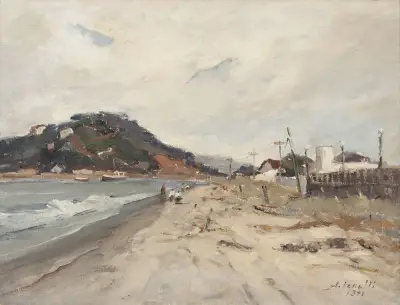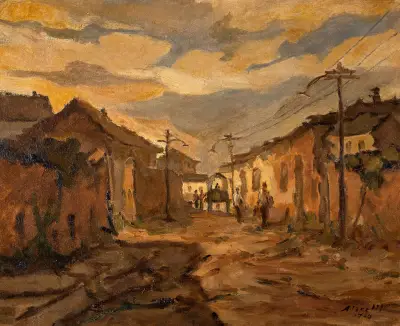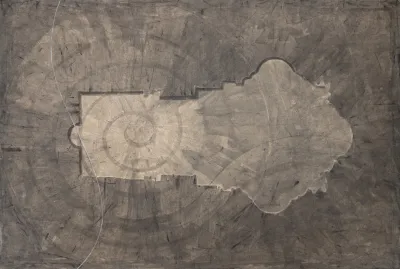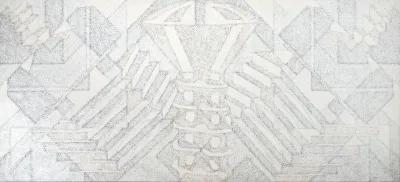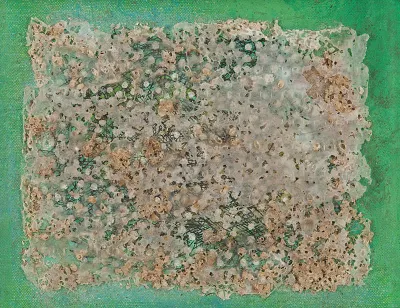

Emmanuel Nassar (Capanema PA 1949)
Emmanuel Nassar is a painter and draftsman who also makes installations and painted reliefs. In 1969, after a trip to Europe, he decided to study architecture, graduating from the Universidade Federal do Pará (UFPA) in 1974. He began his artistic output with acrylic on canvas and later went on to explore techniques such as relief on wood. From 1980, he taught art education at UFPA.
In 1981, he created the three-dimensional work Recepcôr. From this work onward, he began producing paintings depicting small mechanisms with axles, cranks and color plates, also incorporating everyday objects such as bottles. In some works, he evoked local popular culture through vibrant colors and geometric shapes inspired by houses and market stalls.
In 1985, he developed a new line of research with works that reinterpret drawings and paintings found in bars and public restrooms. In other works, he combined images from the world of consumption with elements recurrent in the suburbs of his hometown.
In 1998, he created the installation Bandeiras [Flags] at the Museu de Arte Moderna de São Paulo (MAM/SP) and the Museu Estadual do Pará, appropriating 143 flags of municipalities of Pará, arranged across the museum walls. In 1999, with the work Incêndio [Fire], he won the grand prize at the 6th Cuenca Biennial, in Ecuador.
Critical Commentary
Trained in architecture and with experience in advertising, from the early 1980s onward Emmanuel Nassar has built his work on the dialogue between two visual traditions: the popular one, in which vibrant colors in geometric shapes are used as ornaments for houses, shacks, shop windows, etc., and the constructive, geometric tradition that marked, and still marks, a significant part of Brazilian erudite art.
If at the start of his career the artist still played at describing or representing this boundary between the popular and the erudite, from 1988 onward his work became more objective. Nassar stopped painting only on canvas and incorporated other materials, such as brass, pieces of wood, hardboard, bottles, hammers, lamp sockets and neon light. In Gambiarra [Makeshift] (1988), the work lies between painting and object. In 1989, at the 20th Bienal Internacional de São Paulo, he presented the installation Fachada [Façade], in which he recreated a small traveling circus from the interior. Inside the circus, he showed some works closer to the object.
In 1998, the artist set up the installation Bandeiras at the Museu de Arte Moderna de São Paulo - MAM/SP and the Museu Estadual do Pará. He appropriated 143 flags of municipalities of Pará, which were arranged on the museum walls. The work involved the participation of the state's population, who sent the flags to the artist. In 2000, by photographing colored shapes found in the everyday popular life of Pará's towns, the artist ended up "revealing" the original source of his earlier paintings: a fundamentally photographic gaze, an issue that brings further challenges to his poetics.
Critiques
"(...) Working in acrylic on canvas, and more recently exploring other supports such as relief on wood, Nassar's painting stands out among contemporary fashions by drawing on suburban themes, incorporating symbolic or figurative elements observed in, or created from, handmade visual communication signs displayed in Belém do Pará. (...) A decentered composition inspired by geometricism of popular origin, this MAC canvas (Sonoros Brasil) is surrounded by a frame-like border in bright color containing six freehand lozenges that, perceptually, leap out before the eye of the viewer, which wanders from one element to another over the vibrant background".
Aracy Amaral
AMARAL, Aracy (Org. ). Museu de Arte Contemporânea da Universidade de São Paulo: perfil de um acervo. Prefácio Ana Mae Barbosa; texto Aracy Amaral, Sônia Salzstein. São Paulo: Techint Engenharia, 1988. 391 p. , il. color.
"From his world, the artist cuts out, highlights details, reinvents dramas. His sources are two: the popular and the suburban (...) What most struck the viewer (...) was the artist's guiltless, unprejudiced gaze. When he denounced poverty (...) he turned his denunciation into a visual experience, staying miles away from the pamphleteering and the anecdotal. His gaze was engaged without begging. Assertive without being demanding (...). Gradually, always with a critical eye, the artist began incorporating into his work images as disparate as advertising illustrations, product labels and even truck-body decorations. All this in large fields of color in which elements taken from the popular imagination found their visual space as parts of an almost abstract composition. Maturity gave Nassar something he had lacked until then: humor. In paintings (...) figurative elements (...) receive a falsely primitive treatment that allows the artist to be ironic about technique itself. Banal objects acquire an iconic value within this good-humored formal game. Playing with scale, the artist manages to transfer to the canvas the same feeling of insignificance that strikes the human being faced with Grande Rio. We occupy a tiny part of physical space, just as the figures occupy only a small portion of pictorial space (...). With a maturity that allows him to draw on the folkloric and the regional without getting caught in their nets, Nassar charts his own path".
João Cândido Galvão
GALVÃO, João Cândido. Popular e suburbano. Guia das Artes, São Paulo, v. 3, n. 13, p. 61-62, 1989.
"(...) Nassar is not an artist who simply appropriates a universe of popular colors and forms in order naively to extol the 'purity' and 'creativity' of the brave people of the North. Alert to the supposed trivialization and exhaustion of erudite visual languages, Nassar realized that these popular elements bore similarities that were, to say the least, destabilizing to the concepts that governed (and still govern) one of the major art traditions of this century in Brazil and abroad: constructivism, which in Brazil split into the concrete and neoconcrete strands. (...) the artist in fact ends up resetting both languages to zero, so that his work survives as a powerful, colorful short circuit in the gears that connect - and pull apart - these two traditions. We could briefly compare a painting by Nassar with one by Hércules Barsotti, one of the leading Brazilian painters to emerge with neoconcretism. In Barsotti's work, rigorously worked colors fill the pictorial field, creating forms that tend to lead the viewer to notions of lyricism, order and purity. In Nassar's paintings, the truth of the colors that make up the field of the painting is called into question by the deliberate unsteadiness of the line and/or by the unexpected inclusion of elements decidedly foreign to the constructive 'order': crude images of severed human limbs, illusionistic depictions of nails and other tools. . . Even the artist's initials ('E' and 'N') are by no means meant to attest to the two-dimensionality of the plane (so dear to the erudite constructive tradition), no. Incorporated into the painting, they tend to fill it with a symbolic, even autobiographical meaning, practically nonexistent in constructive art of erudite origin. What does Nassar aim for with his painting? The same as his generational peers: to destabilize the established, to bring lyricism and humor to a tradition; to reject the notion of art as a language capable of offering the viewer a predictable, a priori message about the reality around him".
Tadeu Chiarelli
CHIARELLI, Tadeu. Sobre Brasil, de Emmanuel Nassar. In: SALÃO ARTE PARÁ, 1997, Belém. Fronteiras. Apresentação Lucidéa Maiorana. Belém: Fundação Romulo Maiorana: Palácio Lauro Sodré/Museu do Estado, 1997. p. 48.
"Emmanuel Nassar belongs to the lineage of artists who dwell on the world and draw from it the substance of their expression. And what interests him most are images and things regarded as all too simple: the crude paintings and the artifacts and architecture of the poorest stratum of his native Belém.
It is a fact that we still insist on judging existing images and objects from the standpoint of a cultivated eye, as if everything were conceived at the level of high culture. The notion is so anachronistic it cannot stand, which does not stop it from still prevailing in some corners of our country. Indeed, everything made outside the cultivated standard is viewed with disdain, in the belief that so-called popular expression is nothing more than a debasement, a clumsy if not degraded reproduction of a higher order. (...)
Nassar has always drawn attention for the delicacy and interest with which he turns to what is banal and humble in the world. In his eyes, the margins of social life - which in Belém's case are the banks of each of the filaments of the liquid web of rivers - are the stage on which lyrical lessons of human ingenuity are enacted, of its inexhaustible capacity to symbolize and improvise in the face of scarce means. Nassar is the poet of the precarious, the rickety, the makeshift, the imaginative solution and the crooked drawing, who surprises with the vigor with which he renews before our eyes our atavistic desire for expression in the face of the infinite richness of the world. And he carries out his work without concealing his class origin, his condition as a refined person with a university education. His poetic project has been affirmed through the building of an amalgam between his own repertoire and the one that his experience of popular expression offers him as a living essence".
Agnaldo Farias
FARIAS, Agnaldo. O sonho de Nassar. In: NASSAR, Emmanuel. Bandeiras. Apresentação Paulo Chaves Fernandes; texto Agnaldo Farias, Benedito Nunes. São Paulo: MAM, 1998.
Solo Exhibitions
1979 - Belém PA - Solo, at Galeria Theodoro Braga
1984 - Rio de Janeiro RJ - Solo, at Galeria Macunaíma
1986 - Belém PA - Solo, at Galeria Elf
1987 - Brasília DF - Emmanuel Nassar: Paintings, at Espaço Capital Arte Contemporânea
1988 - Belém PA - Solo, at Galeria Arte Liberal
1988 - Belém PA - Solo, at Galeria Rômulo Maiorana
1988 - Rio de Janeiro RJ - Solo, at Galeria Saramenha
1989 - Amsterdam (Netherlands) - Solo, at Pulitzer Art Gallery
1989 - São Paulo SP - Solo, at Galeria Luisa Strina
1990 - Berlin (Germany) - Art Brasil Berlin: Emmanuel Nassar, at Galeria Nalepa
1991 - Campo Grande MS - Solo, at Itaugaleria
1992 - Amsterdam (Netherlands) - Solo, at Pulitzer Art Gallery
1992 - São Paulo SP - Solo, at Galeria Luisa Strina
1994 - Rio de Janeiro RJ - Solo, at Galeria Thomas Cohn
1995 - São Paulo SP - Solo, at Galeria Luisa Strina
1995 - São Paulo SP - Solo, at CCSP
1996 - Belém PA - Solo, at Galeria Theodoro Braga
1996 - Freiburg (Germany) - Solo, at Galeria Ruta Correa
1996 - Niterói RJ - Emmanuel Nassar, at Galeria de Arte UFF
1997 - Barsikow (Germany) - Solo, at Galerie Barsikow
1997 - Berlin (Germany) - Solo, at Galerie Barsikow
1997 - Cologne (Germany) - Solo, at Galerie Thomas Zander
1998 - Belém PA - Flags, at Museu do Estado do Pará
1998 - São Paulo SP - Flags, at MAM/SP
1999 - Barsikow (Germany) - Solo, at Galerie Barsikow
1999 - Berlin (Germany) - Solo, at Galerie Barsikow
1999 - São Paulo SP - Solo, at Galeria Luisa Strina
2000 - Rio de Janeiro RJ - Solo, at Laura Marsiaj Arte Contemporânea
2003 - Brasília DF - A Poesia da Gambiarra [The Poetry of the Makeshift], at CCBB
2003 - Rio de Janeiro RJ - A Poesia da Gambiarra [The Poetry of the Makeshift], at CCBB
2003 - São Paulo SP - Boa Romaria Faz Quem em Sua Casa Fica em Paz [He Makes a Good Pilgrimage Who Stays at Home in Peace], at Galeria André Millan
2004 - Recife PE - Solo, at MAMAM
2004 - São Paulo SP - A Poesia da Gambiarra [The Poetry of the Makeshift], at Instituto Tomie Ohtake
Group Exhibitions
1980 - Curitiba PR - 37th Paraná Salon - Petrobrás Distribuidora Prize, at Fundação Teatro Guaíra
1980 - Rio de Janeiro RJ - 3rd National Visual Arts Salon, at Mnba
1980 - São Paulo SP - 12th Panorama of Current Brazilian Art, at MAM/SP
1980 - São Paulo SP - 1st São Paulo Salon of Plastic and Visual Arts, at Fundação Bienal
1981 - Curitiba PR - 38th Paraná Salon, at Fundação Teatro Guaíra
1981 - Rio de Janeiro RJ - 4th National Visual Arts Salon, at MAM/RJ
1981 - São Paulo SP - Painting and Drawing in Pará, at Galeria Projecta
1982 - Rio de Janeiro RJ - 5th National Visual Arts Salon, at MAM/RJ
1982 - São Paulo SP - 3rd Brazilian Art Salon, at Fundação Mokiti Okada - acquisition prize
1983 - Atami (Japan) - 6th Brazil-Japan Fine Arts Exhibition
1983 - Kyoto (Japan) - 6th Brazil-Japan Fine Arts Exhibition
1983 - Rio de Janeiro RJ - 6th Brazil-Japan Fine Arts Exhibition, at Mnba
1983 - São Paulo SP - 6th Brazil-Japan Fine Arts Exhibition, at Masp
1983 - Tokyo (Japan) - 6th Brazil-Japan Fine Arts Exhibition
1984 - Fortaleza CE - 7th National Visual Arts Salon - guest artist
1984 - Rio de Janeiro RJ - 7th National Visual Arts Salon, at MAM/RJ - domestic travel prize
1984 - São Paulo SP - Art in the Street 2
1985 - Rio de Janeiro RJ - Old Habit: Brazilian Drawing, at EAV/Parque Lage
1985 - São Paulo SP - O Popular como Matriz [The Popular as Matrix], at MAC/USP - guest artist
1985 - São Paulo SP - Trends of the Artist's Book in Brazil, at CCSP
1986 - Fortaleza CE - Imagine: The Planet Greets the Comet, at Arte Galeria
1986 - New Delhi (India) - 6th Triennale India
1986 - São Paulo SP - 4th São Paulo Contemporary Art Salon, at Fundação Bienal - Clock Prize
1987 - Belém PA - Arte Pará Salon, at Museu do Estado do Pará
1987 - São Paulo SP - 5th São Paulo Contemporary Art Salon, at Pinacoteca do Estado
1988 - Leverkusen (Germany) - Brazil Now, at Museum Morsbroich
1988 - São Paulo SP - 15 Years of the Brazil-Japan Fine Arts Exhibition, at Fundação Mokiti Okada M.O.A.
1988 - Stuttgart (Germany) - Brazil Now, at Galerie Landesgirokasse
1989 - Amsterdam (Netherlands) - U-ABC, at Stedelijk Museum
1989 - Hannover (Germany) - Brazil Now, at Sprengel Museum
1989 - Havana (Cuba) - 3rd Havana Biennial
1989 - São Paulo SP - 20th São Paulo International Biennial, at Fundação Bienal
1989 - São Paulo SP - 20th Panorama of Current Brazilian Art, at MAM/SP
1990 - Brasília DF - Brasília Visual Arts Award, at MAB/DF
1990 - Lisbon (Portugal) - U-ABC, at Fundação Calouste Gulbenkian
1991 - Campo Grande MS - BR/80. Pintura Brasil Década 80 [BR/80: Brazilian Painting of the 1980s], at Itaugaleria
1991 - Stockholm (Sweden) - Viva Brasil Viva, at Liljevalchs Konsthall
1992 - Curitiba PR - 10th Curitiba City Printmaking Show/America Show, at Museu da Gravura
1992 - Kassel (Germany) - Projekt Stoffwechsel
1992 - Rio de Janeiro RJ - 1st On the Way to Niterói: João Sattamini Collection, at Paço Imperial
1992 - Rio de Janeiro RJ - Arte Amazonas, at MAM/RJ
1992 - Rio de Janeiro RJ - Brazilian Contemporary Art, at EAV/Parque Lage
1993 - São Paulo SP - 23rd Panorama of Current Brazilian Art, at MAM/SP
1993 - Venice (Italy) - 45th Venice Biennale
1994 - Juiz de Fora MG - America, at UFJF
1994 - Salvador BA - 1st MAM-Bahia Visual Arts Salon, at MAM/BA
1994 - São Paulo SP - Bienal Brasil Século XX, at Fundação Bienal
1995 - Brasília DF - Brasília Collections, at Ministério das Relações Exteriores. Palácio do Itamaraty
1995 - São Paulo SP - Annual Visual Arts Exhibition Program, at CCSP
1995 - São Paulo SP - Contact Project, at Galeria Sesc Paulista
1996 - Niterói RJ - Brazilian Contemporary Art in the João Sattamini Collection, at MAC/Niterói
1996 - Potsdam (Germany) - Contrapartida [Counterpart]: 12 Brazilian and German Artists, at Kunstspeicher Potsdam
1996 - São Paulo SP - 15 Brazilian Artists, at MAM/SP
1996 - São Paulo SP - Brazilian Contemporary Art: Recent Donations/96, at MAM/SP
1997 - Belém PA - Arte Pará Salon, at Museu do Estado do Pará
1997 - Belém PA - Arte Pará: Fronteira [Arte Pará: Frontier], at Museu de Arte de Belém
1997 - Goiânia GO - Brazilianness: A Selection of Brazilian Artists, at Galeria de Arte Marina Potrich
1997 - Ouro Preto MG - Experiences and Perspectives: 12 Contemporary Visions, at Museu Casa dos Contos
1997 - Porto Alegre RS - Caixa Collection Exhibition, at Conjunto Cultural da Caixa
1997 - Porto Alegre RS - Parallel Exhibition, at Museu da Caixa Econômica Federal
1997 - Rio de Janeiro RJ - 15 Brazilian Artists, at MAM/RJ
1997 - São Paulo SP - Apropriações Antropofágicas [Anthropophagic Appropriations], at Itaú Cultural
1997 - São Paulo SP - Caixa Collection Exhibition, at Conjunto Cultural da Caixa
1998 - Belo Horizonte MG - The Contemporary Urban Landscape, at Itaú Cultural
1998 - Belo Horizonte MG - Emmanuel Nassar, Leda Catunda, Marcos Benjamim, at Kolams Galeria de Arte
1998 - Campinas SP - The Contemporary Urban Landscape, at Itaú Cultural
1998 - Cuenca (Ecuador) - 6th Cuenca Biennial
1998 - Curitiba PR - Caixa Collection Exhibition, at Conjunto Cultural da Caixa
1998 - Rio de Janeiro RJ - Caixa Collection Exhibition, at Conjunto Cultural da Caixa
1998 - Niterói RJ - Mirror of the Biennial, at MAC/Niterói
1998 - Penápolis SP - The Contemporary Urban Landscape, at Itaugaleria
1998 - Rio de Janeiro RJ - Brazilian Art in the Collection of the Museu de Arte Moderna de São Paulo: Recent Donations 1996 - 1998, at CCBB
1998 - Rio de Janeiro RJ - 16th National Visual Arts Salon, at MAM/RJ
1998 - São Paulo SP - 24th São Paulo International Biennial, at Fundação Bienal
1998 - São Paulo SP - The Contemporary Urban Landscape, at MAM/SP
1998 - São Paulo SP - Frontiers, at Itaú Cultural
1999 - Belém PA - Olhares Revisitados [Revisited Gazes], at Museu de Arte Sacra
1999 - Lisbon (Portugal) - Latin America from the Avant-Gardes to the End of the Millennium, at Culturgest
1999 - Salvador BA - 60 Years of Brazilian Art, at Espaço Cultural da Caixa Econômica Federal
2000 - Belo Horizonte MG - Ars Brasilis, at Galeria de Arte do Minas Tênis Clube
2000 - Belo Horizonte MG - Investigations. Brazilian Printmaking. São ou Não São Gravuras [Are They or Aren't They Prints], at Itaú Cultural
2000 - Belo Horizonte MG - Brazil in Popular Visuality, at MAP
2000 - Belo Horizonte MG - Presente de Reis [Epiphany Gift], at Kolams Galeria de Arte
2000 - Berlin (Germany) - Brasilien in Barsikow, at Galerie Barsikow
2000 - Brasília DF - Investigations. Brazilian Printmaking. São ou Não São Gravuras [Are They or Aren't They Prints], at Itaú Cultural
2000 - Curitiba PR - 12th Curitiba Printmaking Show. Marcas do Corpo, Dobras da Alma [Marks of the Body, Folds of the Soul]
2000 - Lisbon (Portugal) - 20th Century: Art of Brazil, at Fundação Calouste Gulbenkian. Centro de Arte Moderna José de Azeredo Perdigão
2000 - Recife PE - 44th Pernambuco Visual Arts Salon, at Observatório Cultural Malakoff
2000 - Rio de Janeiro RJ - Brasil + 500 Rediscovery Exhibition. Letter of Pero Vaz de Caminha, at Museu Histórico Nacional
2000 - Rio de Janeiro RJ - Brazilianities, at Centro Cultural Light
2000 - São Paulo SP - Brazil + 500 Rediscovery Exhibition. Visual Arts, at Fundação Bienal
2000 - São Paulo SP - Cá entre Nós [Just Between Us], at Paço das Artes
2001 - Belém PA - 20th Arte Pará Salon, at Galeria da Residência
2001 - Belém PA - 20th Arte Pará Salon, at Museu do Estado do Pará
2001 - Porto Alegre RS - Liba and Rubem Knijnik Collection: Brazilian Contemporary Art, at MARGS
2001 - Rio de Janeiro RJ - The Image of the Sound of Antônio Carlos Jobim, at Paço Imperial
2001 - Rio de Janeiro RJ - Blind Mirror: Selections from a Contemporary Collection, at Paço Imperial
2001 - Rio de Janeiro RJ - The Spirit of Our Time, at MAM/RJ
2001 - São Paulo SP - Blind Mirror: Selections from a Contemporary Collection, at MAM/SP
2001 - São Paulo SP - The Spirit of Our Time, at MAM/SP
2001 - São Paulo SP - Trajectory of Light in Brazilian Art, at Itaú Cultural
2002 - Brasília DF - Fragments to Their Magnet, at Espaço Cultural Contemporâneo Venâncio
2002 - Curitiba PR - Works from Faxinal das Artes, at Museu de Arte Contemporânea
2002 - Londrina PR - Are They or Aren't They Prints?, at Museu de Arte de Londrina
2002 - Niterói RJ - Collection on Paper, at MAC/Niterói
2002 - Niterói RJ - Dialogue, Antagonism and Replication in the Sattamini Collection, at MAC/Niterói
2002 - Rio de Janeiro RJ - A Imagem do Som do Rock Pop Brasil [The Image of the Sound of Brazilian Pop Rock], at Paço Imperial
2002 - Rio de Janeiro RJ - Arte em Campo [Art on the Field], at Centro Cultural da Justiça Federal
2002 - Rio de Janeiro RJ - Paths of the Contemporary 1952-2002, at Paço Imperial
2002 - São Paulo SP - Map of Now: Recent Brazilian Art in the João Sattamini Collection of the Museu de Arte Contemporânea de Niterói, at Instituto Tomie Ohtake
2002 - São Paulo SP - Paralela
2002 - São Paulo SP - Pop Brazil: Popular Art and the Popular in Art, at CCBB
2003 - Rio de Janeiro RJ - Flags of Brazil, at Museu da República
2003 - São Paulo SP - My Friends, at Espaço MAM/Villa-Lobos
2003 - São Paulo SP - A Difficult Moment of Balance, at Espaço MAM/Villa-Lobos
2004 - Rio de Janeiro RJ - Tudo é Brasil [Everything Is Brazil], at Paço Imperial
2004 - São Paulo SP - Contemporary Art in the Municipal Collection, at CCSP
2004 - São Paulo SP - Tudo é Brasil [Everything Is Brazil], at Itaú Cultural
Source: Itaú Cultural