Edson Motta (Juiz de Fora MG 1910 - Rio de Janeiro RJ 1981)
Painter, restorer, teacher.
He began studying painting with his uncle, the artist César Turatti. Around 1927, he moved to Rio de Janeiro and enrolled at the Escola Nacional de Belas Artes - Enba, where he took painting classes with Rodolfo Chambelland (1879 - 1967) and Marques Júnior (1887 - 1960). In 1931, he founded the Núcleo Bernardelli with Ado Malagoli (1906 - 1994), José Pancetti (1902 - 1958), Milton Dacosta (1915 - 1988), Quirino Campofiorito (1902 - 1993), Manoel Santiago (1897 - 1987) and Bruno Lechowski (1887 - 1941), among other artists. In 1936, he received a silver medal at the 42nd Salão Nacional de Belas Artes and, in 1939, was awarded the foreign travel prize. In Europe, he carried out studies on painting techniques. On returning to Brazil, he painted frescoes in the main church of the town of Dores do Turvo, in Minas Gerais. In 1944, back in Rio de Janeiro, he was invited to organize the Artwork Recovery Sector of the Serviço do Patrimônio Histórico e Artístico Nacional - Sphan, remaining as director and chief conservator until 1976. Between 1945 and 1980, he taught theory, technique and conservation of painting at the Enba of the Universidade do Brasil, now the Universidade Federal do Rio de Janeiro - UFRJ. His publications include O Papel: Problemas de Conservação e Restauração [Paper: Problems of Conservation and Restoration], 1971, and Iniciação à Pintura [Introduction to Painting], 1976, both written with Maria Luiza Salgado.
Critical Commentary
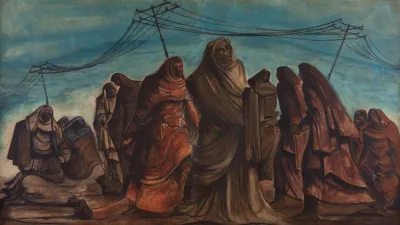
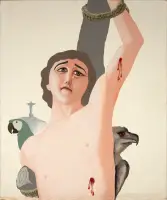
Edson Motta's pictorial production reflects technical and formal concerns defended by the Núcleo Bernardelli, of which he was the first president. In line with the group's ideas, Motta publicly opposed painting that approached a photographic and mechanical realism. However, his works do not show significant changes in relation to some teachers at the Escola Nacional de Belas Artes - Enba, which can also be observed in the production of most of the artists in the Núcleo Bernardelli.
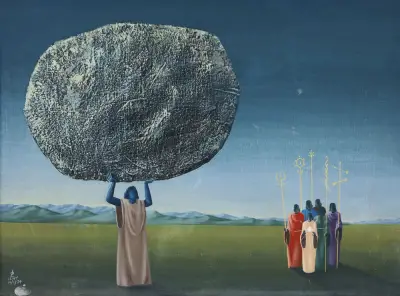
Strongly influenced by the return to order, his paintings show not great boldness but restraint and balance, in tune with figurative reality. Thus his artistic career is marked neither by experimentalism nor by an avant-garde stance. It is important to highlight his role as one of those responsible for the beginning and development of artwork restoration in Brazil.
Critiques
"What Edson Motta did all his life was to work for the benefit of the country's cultural values, whether as a painter of great sensitivity and rare technical refinement, indifferent to false fashions, or as an ardent defender of the permanence of the works of others. The humility of the restorer, of exemplary scientific training, was joined in him with the flame of the artist. But the latter was often prevented from exercising itself because Edson Motta spent his time on the resurrection (that is the word) of other people's art. A style of artwork recovery was introduced in Brazil by this discreet, upright man, who leaves only longing. To remain a creator, without selfishness, rather devoting oneself to others, of the past as of the present - how many will be capable of fulfilling this destiny of the greatest simplicity and purity?"
Carlos Drummond de Andrade
ANDRADE, Carlos Drummond de. [Texto introdutório]. In: MOTTA, Edson. O pintor Edson Motta. Rio de Janeiro: MNBA, 1982. p. [3].
"Edson Motta's painting does not show itself with the eagerness of a 'search' that would add to it aspects of surprise or hasty, successive mutations. Rather, it shows a 'finding', in proportion to lived experience. The obsession with searching, as he well recognized, can lead to attention to an instantaneous glimmer capable of making a worthless material seem precious. It is true that in the painter's most productive period (...) neither critical appreciation nor collectors' preference was denied him. It seems to us, however, that the real measure of his complete work as a painter, to which his particular vocation as a muralist is notably added, has yet to be known. He produced intensely throughout the 1930s, with still very regular continuity in the following decade. (...) The 1950s and 1960s were predominantly devoted to restoration, after which the painter returned to his brushes, adding to an easel painting renewed in its visual expressiveness the murals that would secure his mastery in a genre so little practiced among us, and with which he would demonstrate command of suitable pictorial processes, such as fresco, tempera and oil itself adapted to mural effects."
Quirino Campofiorito
CAMPOFIORITO, Quirino. O pintor Edson Motta. In: MOTTA, Edson. O pintor Edson Motta. Rio de Janeiro: MNBA, 1982. p. [12].
Solo Exhibitions
1946 - Boston (United States) - Solo, at Pan-American Society
1971 - Rio de Janeiro RJ - Solo, at Galeria do Hotel Copacabana Palace
Group Exhibitions
1928 - Rio de Janeiro RJ - 35ª Exposição Geral de Belas Artes [35th General Fine Arts Exhibition], at Enba
1930 - New York (United States) - The First Representative Collection of Paintings by Brazilian Artists, at Nicholas Roerich Museum
1930 - Rio de Janeiro RJ - 37ª Exposição Geral de Belas Artes [37th General Fine Arts Exhibition], at Enba - honorable mention
1931 - Rio de Janeiro RJ - Salão Revolucionário [Revolutionary Salon], at Enba
1932 - Rio de Janeiro RJ - 1º Salão do Núcleo Bernardelli [1st Núcleo Bernardelli Salon], at Sociedade Sul-Riograndense de Cultura
1933 - Rio de Janeiro RJ - 2º Salão do Núcleo Bernardelli [2nd Núcleo Bernardelli Salon], at Liceu de Artes e Ofícios
1933 - Rio de Janeiro RJ - Seis Artistas [Six Artists], at Studio Eros Volúsia
1934 - Rio de Janeiro RJ - 3º Salão do Núcleo Bernardelli [3rd Núcleo Bernardelli Salon], at the Enba galleries
1934 - Rio de Janeiro RJ - Salão Nacional de Belas Artes [National Fine Arts Salon] - bronze medal
1935 - Rio de Janeiro RJ - 4º Salão do Núcleo Bernardelli [4th Núcleo Bernardelli Salon], at the group's headquarters in the Enba basement
1936 - Rio de Janeiro RJ - 42º Salão Nacional de Belas Artes [42nd National Fine Arts Salon], at Instituto de Previdência - silver medal
1936 - São Paulo SP - 4º Salão Paulista de Belas Artes [4th São Paulo Fine Arts Salon] - honorable mention
1937 - Rio de Janeiro RJ - 43º Salão Nacional de Belas Artes [43rd National Fine Arts Salon], at MNBA
1937 - São Paulo SP - 5º Salão Paulista de Belas Artes [5th São Paulo Fine Arts Salon]
1938 - Rio de Janeiro RJ - 44º Salão Nacional de Belas Artes [44th National Fine Arts Salon], at MNBA
1939 - Belo Horizonte MG - Salão de Belas Artes da Cidade de Belo Horizonte [Belo Horizonte City Fine Arts Salon] - 1st painting prize
1939 - Rio de Janeiro RJ - 45º Salão Nacional de Belas Artes [45th National Fine Arts Salon], at MNBA - foreign travel prize, with the work O Banho [The Bath], shown together with Oferenda [Offering]
1944 - Rio de Janeiro RJ - 50º Salão Nacional de Belas Artes [50th National Fine Arts Salon], at MNBA
1950 - Rio de Janeiro RJ - 56º Salão Nacional de Belas Artes [56th National Fine Arts Salon], at MNBA
1951 - São Paulo SP - 1ª Bienal Internacional de São Paulo [1st São Paulo International Biennial], at Pavilhão do Trianon
1952 - Rio de Janeiro RJ - 1º Salão Nacional de Arte Moderna [1st National Salon of Modern Art], at MAM/RJ
1953 - Rio de Janeiro RJ - 2º Salão Nacional de Arte Moderna [2nd National Salon of Modern Art], at MNBA
1954 - Rio de Janeiro RJ - Salão Preto e Branco [Black and White Salon], at Palácio da Cultura
1955 - Rio de Janeiro RJ - 4º Salão Nacional de Arte Moderna [4th National Salon of Modern Art]
1956 - Rio de Janeiro RJ - 5º Salão Nacional de Arte Moderna [5th National Salon of Modern Art]
1957 - Rio de Janeiro RJ - 6º Salão Nacional de Arte Moderna [6th National Salon of Modern Art]
1958 - Porto Alegre RS - 1º Salão Pan-Americano de Arte [1st Pan-American Art Salon]
1958 - Rio de Janeiro RJ - 7º Salão Nacional de Arte Moderna [7th National Salon of Modern Art], at MAM/RJ
1959 - Rio de Janeiro RJ - 8º Salão Nacional de Arte Moderna [8th National Salon of Modern Art], at MAM/RJ
Posthumous Exhibitions
1982 - Rio de Janeiro RJ - Edson Motta: pinturas [Edson Motta: Paintings], at MNBA
1982 - São Paulo SP - Exposição Núcleo Bernardelli: arte brasileira nos anos 30 e 40 [Núcleo Bernardelli Exhibition: Brazilian Art in the 1930s and 1940s], at Acervo Galeria de Arte
1994 - São Paulo SP - Bienal Brasil Século XX [20th-Century Brazil Biennial], at Fundação Bienal
2000 - Caxias do Sul RS - Mostra Itinerante do Acervo do Margs [Traveling Exhibition of the Margs Collection]
2000 - Passo Fundo RS - Mostra Itinerante do Acervo do Margs [Traveling Exhibition of the Margs Collection]
2000 - Pelotas RS - Mostra Itinerante do Acervo do Margs [Traveling Exhibition of the Margs Collection]
2000 - Santa Maria RS - Mostra Itinerante do Acervo do Margs [Traveling Exhibition of the Margs Collection]
Source: Itaú Cultural