D. J. Oliveira (Bragança Paulista SP 1932 - Goiânia GO 2005)
Painter, printmaker, set designer, costume designer, teacher.
From childhood, Dirso José de Oliveira was interested in the visual arts and at the age of 10 began studying drawing and painting with the painter Luís Gualberto, still in his hometown. In 1948 he moved to São Paulo, where he worked as an assistant to craftsmen specializing in wall decoration and frieze painting, as well as an assistant in mural painting and set design. He attended the studio of Angelo de Sordi, with whom he learned the techniques of fresco, tempera, encaustic, sgraffito and oil painting. In 1954 he met Luciano Maurício, set designer for the Balé do IV Centenário [Fourth Centenary Ballet], who introduced him to modern art and brought him into Rede Globo de Televisão, where he worked as a set designer for a year. He moved to Goiânia in 1956, where he set up a painting and commercial design studio, making shop windows and posters. He created sets and costumes for theater in the 1960s, when he began teaching woodcut and drawing at the Escola de Belas Artes of the Universidade Católica de Goiás, UCG. With his students Iza Costa and Ana Maria Pacheco, he founded the Ateliê Livre [Open Studio] of the Escola de Belas Artes at UCG itself. He made several murals in public and private buildings, using techniques such as fresco, glazed ceramics, acrylic, nitrocellulose and others. In 1967 he traveled to Europe, where he worked mainly in Spain, but also in the Netherlands, Italy, France, England and Switzerland, returning to Goiânia in 1970. At that time, he began to devote himself to metal engraving, setting painting aside. He released several albums, using literary characters in the composition of some of his works, as in the series on Don Quixote and Sancho Panza, as well as the study of the mystic Antônio Conselheiro. Together with Cléber Gouvea, he opened the Estúdio ao Ar Livre [Open-Air Studio], frequented by artists, among them Siron Franco. He moved to Luziânia, Goiás, in 1973 and returned to painting, from which he had been away for three years. In the 1980s, he produced O Sonho de João Bosco [The Dream of John Bosco], a 170-meter mural made to honor Don Bosco, a priest who devoted himself to educating the underprivileged youth of his time. Together with other artists from Goiás, he took part in protests against the demolition of buildings housing artistic murals. In 1991, the short film Nove Minutos de Eternidade - Vida, Corpo e Obra de D.J. Oliveira [Nine Minutes of Eternity - Life, Body and Work of D.J. Oliveira] was released. Owing to the deterioration of the mural O Sonho de Dom Bosco, he decided to create a new tile panel, raising cooperation and funds from cultural institutions and public bodies. In 1996, he completed the project to rebuild his mural in glazed ceramics. There is a building named after him in Goiânia.
Critiques
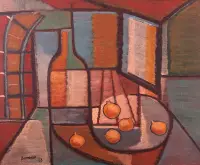
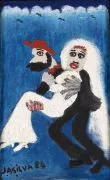
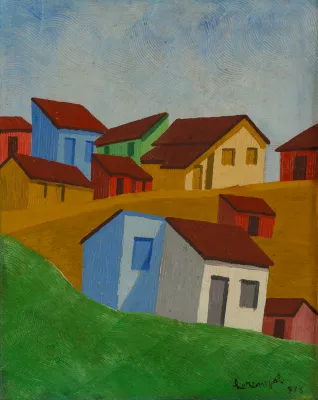
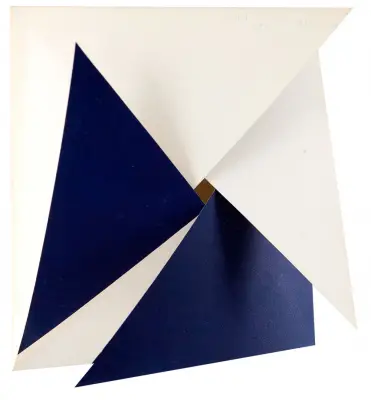
"D. J. Oliveira wishes to be simply and fundamentally a painter. More: a painter tied to the figure, from which he has never strayed a single step. (...) His proposal remains on the dramatic plane. He speaks, in a language with expressionist foundations, of the current contingencies of the human being: perplexity, fear, loneliness, the futility of certain efforts to solve their problems. And his expressionism is mixed with a muted, continuous irony, through which the painter denounces a merciless and insoluble world. (...) Without being an intellectual, he has broad visual experience, brought back from his trip to Europe, as well as solid notions of theory. His creative process has two stages: the first, instinctive, deals with the theme; the second, rational, elaborates it in terms of composition. In the most recent works, rationality becomes more pronounced, in a certain tendency toward a more geometric and rigid construction of space. None of this, however, alters the fundamental nature of Oliveira's proposal. For him, the work of art is the product of emotion. And he moves toward it, inevitably, without subterfuge, without leaps in the dark, without fear of being merely (but solidly) painting."
Olívio Tavares de Araújo
FIGUEIREDO, Aline. Artes Plásticas no Centro-Oeste. Aline Figueiredo. Cuiabá, UFMT, MACP, 1979. Bibliografia.
Solo Exhibitions
1962 - Goiânia GO - First solo exhibition
1969 - Madrid (Spain) - Solo, at Casa do Brasil
1977 - Goiânia GO - Solo, at Casagrande Galeria de Arte
1975 - São Paulo SP - Solo, at Automóvel Clube Paulista
1976 - Brasília DF - Solo, at Hotel Nacional
1981 - Goiânia GO - Solo, at Casagrande Galeria de Arte
1986 - Goiânia GO - Solo, at Casagrande Galeria de Arte
1994 - Goiânia GO - Solo, at Museu de Arte de Goiânia
Group Exhibitions
1960 - Goiânia GO - 1ª Anual de Arte [1st Art Annual], at MAM/GO - 1st prize
1961 - Goiânia GO - 2ª Anual de Arte [2nd Art Annual], at MAM/GO - 1st prize
1961 - São Paulo SP - Salão Paulista de Arte Moderna [São Paulo Salon of Modern Art]
1963 - Goiânia GO - 1º Salão de Artes Plásticas da Universidade Federal de Goiás [1st Visual Arts Salon of the Universidade Federal de Goiás]
1966 - São Paulo SP - Coletiva Artistas Goianos [Goiás Artists Group Show], at Masp
1970 - Goiânia GO - 1ª Bienal de Artes Plásticas de Goiás [1st Goiás Visual Arts Biennial] - honorable mention
1970 - São Paulo SP - Pré-Bienal de São Paulo [São Paulo Pre-Biennial], at Fundação Bienal
1973 - Goiânia GO - 1º Salão Global da Primavera [1st Global Spring Salon] - acquisition prize
1974 - Brasília DF - 1º Salão Global da Primavera [1st Global Spring Salon] - acquisition prize
1974 - Goiânia GO - 1ª CAIXEGO - honorable mention
1974 - São Paulo SP - Bienal Nacional [National Biennial]
1974 - São Paulo SP - 6º Panorama de Arte Atual Brasileira [6th Panorama of Current Brazilian Art], at MAM/SP
1975 - Goiânia GO - 2ª CAIXEGO
1976 - Goiânia GO - 3ª CAIXEGO - acquisition prize
1976 - São Paulo SP - 8º Panorama de Arte Atual Brasileira [8th Panorama of Current Brazilian Art], at MAM/SP
1977 - Goiânia GO - 4ª CAIXEGO - acquisition prize
1977 - Goiânia GO - 4º Salão de Arte Frei Confaloni [4th Frei Confaloni Art Salon]
1977 - Milan (Italy) - Coletiva Artistas Goianos [Goiás Artists Group Show], at Brazilian Embassy
1977 - Paris (France) - Coletiva Artistas Goianos [Goiás Artists Group Show], at Brazilian Embassy
1977 - Rome (Italy) - Coletiva Artistas Goianos [Goiás Artists Group Show], at Brazilian Embassy
1977 - São Paulo SP - 9º Panorama de Arte Atual Brasileira [9th Panorama of Current Brazilian Art], at MAM/SP
1978 - São Paulo SP - Panorama de Arte Atual Brasileira [Panorama of Current Brazilian Art], at MAM/SP - acquisition prize
1990 - Goiânia GO - 20 Anos do Museu de Arte de Goiânia [20 Years of the Museu de Arte de Goiânia], at Museu de Arte
1998 - Catalão GO - 60 Artistas nos 60 Anos do Jornal O Popular [60 Artists for the 60 Years of the Newspaper O Popular], at Fórum Municipal
1998 - Goiânia GO - 60 Artistas nos 60 Anos do Jornal O Popular [60 Artists for the 60 Years of the Newspaper O Popular], at Fundação Jaime Câmara
1998 - Itumbiara GO - 60 Artistas nos 60 Anos do Jornal O Popular [60 Artists for the 60 Years of the Newspaper O Popular], at Casa de Cultura de Itumbiara
1998 - Rio Verde GO - 60 Artistas nos 60 Anos do Jornal O Popular [60 Artists for the 60 Years of the Newspaper O Popular], at Secretaria Municipal de Ciências, Tecnologia e Cultura. Palácio da Intendência
Source: Itaú Cultural