Belmiro de Almeida (Serro MG 1858 - Paris France 1935)
Pinter, draftsman, caricaturist, sculptor, teacher and writer.
He attends the Lyceum of Arts and Crafts and the Imperial Academy of Fine Arts - Aiba, between 1869 and 1880, in Rio de Janeiro, where he studies with Agostinho da Motta, Zeferino da Costa and José Maria de Medeiros. In 1878, he studied with Henrique Bernardelli and Rodolfo Amoedo in the free studio. He teaches Drawing at the Lyceum of Arts and Crafts, from 1879 to 1883, and at the National School of Fine Arts - ENBA, from 1893 to 1896. From 1884 onwards, he began to live between Paris and Rio de Janeiro. The first trip to Paris, in 1884, results in an aesthetic redirection in his work, a consequence of the study and contact with the works of artists and intellectuals who renewed the art of the period: Édouard Manet and Edgar Degas in the painting and Gustave Flaubert and Emile Zola in literature. During his second stay in the French capital, which began in 1888, he contacts Georges Seurat at the Ecole Nationale Supérieure des Beaux-Arts [School of Fine Arts National High School] and studying painting with Jules Joseph Lefebvre and B. Constant et Pelez, approaching post-impressionist strands. In Rio de Janeiro, he works as a caricaturist in several magazines, such as Popular Comedy, Devil a Quatro, A Cicada, Witch and the Malho. founded the periodicals Rataplan and João Minhoca, between 1886 and 1901. He is one of the creators of the Salon of Humorists, in 1914, and a member of the Superior Council of Fine Arts, from 1915 to 1925.
Little known to the general public, Belmiro is much admired for the quality of his work and the innovation of his proposals in the country's art. Good humored and playful, he was a constant presence in the bohemian wheels. He dedicated himself to the press with biting caricatures and satirical and controversial texts. By using everyday scenes and characters from common urban life as the themes of his painting, he made an impact on the artistic environment and opened the doors to a new art, bridging the twentieth-century vanguards. It reflects in the art of the period.
Still rooted in the old customs dictated by the conservative masters of the Academy of Fine Arts, the artistic production in the years close to the proclamation of the Republic began to transform. A new generation was willing to contest prejudices and to open less austere paths for Brazilian art.
The air of the revolution was not limited to political discussions. Many students from the academy sought outside this institution the answers to the new questions that were imposed. frequented free workshops such as Henrique Bernadelli and Rodolfo Amoedo who opened their doors to the heat of republican changes.
Belmiro Barbosa de Almeida was part of the new generation of contestants alongside Visconti, Rafael Frederico, Décio Vilares, Fiúza Guimarães, among others.
He was a multifaceted artist: painter, draftsman, sculptor, caricaturist, poet, comedian, journalist and teacher. of strong temperament, he was kind to his friends and relentless with his disaffected people, against whom he used his fierce and irreverent talent.
As a caricaturist, with blunt jokes, cartoons and critical portraits he participated in several publications inaugurating a new phase of the genre. He used pseudonyms such as the anagrams Romibel and Bromeli when collaborating as a caricaturist in "The Midnight Devil", "The Binoculars", "The Devil a Four", "The Cicada", "Infernal Illustration" and "The Tackle" founding "The Rataplan" in 1886 and "João Minhoca" in 1901.
As a painter his innovations were less audacious. Despite being punctuated by a subtle humor, his painting carries a lot of academic influence, since he was a student at the Liceu de Artes e Ofícios and the Imperial Academy of Fine Arts between 1869 and 1880.
His revolutionary role within the panorama of Brazilian painting are marked by the quality of their canvas, by the choice of unexpected themes and by the original pictorial treatment that place it among the renewers who opened the doors to the 20th century.
As a good designer, in general, he tended to subordinate The colors to the drawing, as if the former were just tools in valuing the latter. Belmiro painted by drawing in rigorous, detailed and patient work. He used few inks, without excesses, without carrying the screen, preferring quick smears, brush strokes in small touches in experiences close to those of pointillism. Thus, it softens the contours, merging the colors to be able to explore the design of the works once again.
Ambivalence
Belmiro de Almeida had a very particular relationship with the academy. At the same time that he criticizes him, he cannot abandon it. While occupying the drawing chair at the National School of Fine Arts, replacing Pedro Weingärtner, at the invitation of Rodolfo Bernadelli, alongside Di Cavalcanti, Helios Seelinger, Kalisto and J. Carlos, created the Salão dos Comedos, in a Ironic allusion to the elitist salons of fine arts.
His irreverence, his talent and the innovations he experienced in the artistic field do not allow him to consider him a conservative. However, his attitude always linked to academic rigors and some reluctance to free himself completely from some canons prevent him from completely classifying him in the group of rebel artists. Added to this is the fact of being a professor at the National School of Fine Arts and having won several awards in the Academy's competitions (Honorable Mention, Silver Medal and Gold Medal in 1874/75/76/77/78/80/84). This ambiguity was not forgiven by some critics and the work of Belmiro de Almeida ended up being despised during the 20th century. The revolutions that modernism caused in the way of looking at art was so intense that everything that had been done before was surpassed. Nowadays, art criticism turns its eyes back to the past and sees in the 19th century the great manifestations of Brazilian painting.
Belmiro de Almeida emerges, then, as one of the most authentic and interesting artists of the period with a work that deserves to be highlighted and deeper studies.
The works
The amount of works painted by Belmiro is not numerous, since it dedicated itself to so many different activities. It was in the periods of internship between France and Italy that he produced his most publicized paintings.
In Arrufos of 1887, Belmiro is influenced by the strong trend in Italy of that time, linked to the realism of Coubert, who turned his eyes to life common. The theme surprises the Brazilian public and adapts to the new political conjunctures: no longer the emperor or the illustrious and solemn man is represented, but the bourgeois inside his home in the midst of trivial events. In the detailed care of each detail and in the laborious treatment that fills each part of the internal environment, we can relate this picture to the rest of the model of Almeida Júnior.
Italian influence is even clearer in the popular types represented in Neapolitan peasant and country idyll. In them, the paints are used in small amounts, leaving the harmonious white support appear in the luminous ambiance set.
In chattering, the cheerful servant opens a humorous smile facing the observer. In dark tones, the interior scene gains luminosity on the white apron molded with mastery. Treated as a female portrait, she resorts to smears in earthy tones creating soft transparencies. The brush strokes leave the marks of the touches and prevent the common stacks in oil painting. Spatiality is guaranteed by the floor design and the presence of the wooden furniture on the right. The broom thrown on the ground makes a counterpoint to the flowers in the opposite upper corner and indicates the character's social position. His luminous face in a sympathetic expression attracts the look that slides to his hands highlighted on the white background.
As a sculptor, he produced the play Manequinho, a figure of a boy urinating in bronze created for a public square. It is actually a version of the work Maneken-Pis de Brussels and is today in the neighborhood of Botafogo in Rio de Janeiro. Among other sculptures, he made the bust of industrialist Antônio Seabra, his friend and artistic protector, in addition to satirical works and caricatured figures that passed to the bronze and the sculptural design of a female figure for the tomb of Afonso Pena.
Her profile Engaged is revealed by some data: he was the founder and president of the Artists' Union in 1930, and when he died in Paris on June 12, 1935, he leaves part of his assets for the National School of Fine Arts to support artists with a lack of resources.
Foreign influences
Much of its formation is due to the European influences it received during the study period between Paris and Italy. Despite his talent, the contesting profile of his works prevented Belmiro de Almeida from winning the contest of the Imperial Academy of Fine Arts whose prize was a trip of studies to Europe. With the help of teachers with more airy minds and knowledgeable about the qualities of young people, he obtains a subscription that allows his departure to Europe in 1888.
In the 19th century, Paris became the center where meetings and exchanges of ideas and characters from all continents was possible. The Brazilian elite of artists and intellectuals was also present on this great stage.
In general this group of Brazilians tended to join other groups based in the City of Lights. The Portuguese and Italians were the most accessible for various reasons such as cultural proximity and more specifically, in the case of Belmiro de Almeida, the direct influence of the Bernadelli and his trips to Italy. By this time, the national unification and its political consequences had taken many Italian artists to Paris.
The influences of the market, which made Americans enriched with new frame buyers, stimulated the appreciation of a type of elegant, sensual and sensual realism. exotic. Nittis' Italian is successful with his canvases inspired by the English naturalism of James Tissot (1836-1902), Millais and Alfredo Stevens. Belmiro de Almeida would drink from the same source, letting Victorian social moralism appear on the screen.
In Paris, Belmiro was part of the studio of Jules Lefrève, one of the most favored painters by the official regime. This fact is pointed out by some analysts as one of the reasons, added to the artistic environment retracted from Brazil, that his painting did not have developed with as much freedom and innovation as his drawings and caricatures.
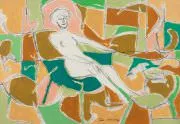
His painting has strong influences both French and Italian. The Parisian fad came to influence the painter, but always under the filter of a certain withdrawal. Belmiro seems to admire the naturalistic manifestation that gained strength in that period against Italian academicism. Certainly he identified himself with this character of contestation, typical of the Italian tonic. Some of his canvas, especially Dame a la Rose, can be associated with Giovanni Boldini's characteristics by valuing sensual and refined feminine beauty. In addition, the two have in common a taste for experimentalism, dedicating themselves with talent to the different currents of the painting of the time. In recent years, in his comings and goings between Paris and Rio de Janeiro, albeit superficially, he came to approach the more generic aspects of futurism and Cubism as on the screen Woman in circles from 1921.
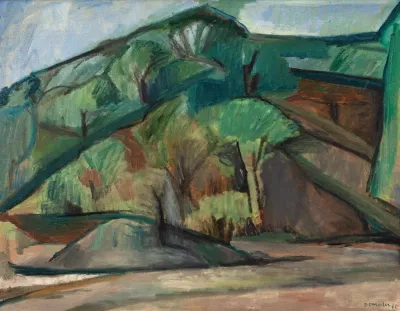
A landscape of Dampierre Painted in 1912 receives a treatment very close to the pointillism of Seurat. On this we have the testimony of Antônio Bento published in the magazine GAM n º5 of April 1967: "The canvas of Belmiro de Almeida, a small landscape built in the manner of Seurat, is excellent in the genre. It already reveals the influence of the ideas that led French painting to Cubism, through Cézanne and Seurat himself".
Critical Comment
Belmiro de Almeida enters the Imperial Academy of Fine Arts - AIBA, in 1874. Between 1884 and 1885, With his own resources, he travels to Paris, where he comes into contact with new painting trends. He is attracted by the realistic ideas of the writers Émile Zola and Gustave Flaubert. In the field of the arts, he is interested in Édouard Manet and Edgar Degas.
In 1887, he exposes Arrufos, his best-known canvas, which stands out for its rigorous invoice and the light irony with which the scene is portrayed. In 1888, the critic Gonzaga Duque, who according to some historians would be portrayed in this picture, highlights the importance of the work, due to the artist's modern vision: everyday, with a realistic approach. Working from the 19th to the 20th century, he undertakes a new painting by leaving aside the themes of historical painting to deal with more prosaic subjects in contemporary society. The critic also praises Belmiro's technique: "The paints are clear and friendly, the touches are fast, wide and well thrown. appropriate."2 Belmiro thus provocatively displays his qualities as a painter.
Historian Reis Júnior highlights the difficult relationship between the artist, with a dissatisfied spirit, and the environment in which he lives: the absence of support for new trends in art leads him not to abandon definitively the most conservative works, capable of guaranteeing his survival.
comes for the AIBA travel abroad award, in 1888. He does not get the award, but goes to Europe that year, with the help of colleagues from the academy, mainly from Rodolfo Bernardelli. Visit to Italy, where he paints some landscapes, but spends most of his time in Paris. The trips between Rio de Janeiro and Paris were constant in his career. In France, he experiences a moment of transformations in the field of painting. It performs the painting Effects of Sol, 1892, which brings the evocation of a peasant world, with a landscape structured in color spots, which stands out for its innovative character, compared to the painting that was then practiced in Brazil.
In Os Discoverers, 1899, avoids the heroic treatment that the theme of the discovery of Brazil suggests: these are two poor men, exhausted, at the foot of a defoliated tree. The landscape is totally arid and desolate, conveying the feeling of abandonment, which is reinforced by the chromatic treatment: a luminosity that spreads evenly across the surface. Belmiro refuses the monumentality of the work, but gives it a very original conception and plastic treatment. In A Tagarela, 1893, it represents a popular character, who interrupts a domestic activity. In this picture, the domain in the use of the line stands out, which structures the composition, combined with the careful work with color, as also occurs in Dame à la Rose, 1905. In works such as Portrait of Abigail Seabra, 1900 or landscape in Dampierre, 1919, the artist is inspired by the pointillist technique, the short strokes value the tones, but obey the orientation of the plans. As a woman in circles, 1921, she dialogues with the aesthetics of futurism.
Belmiro de Almeida reveals, throughout her career, great eclecticism: she constantly experiences new techniques, to which she combines personal interpretation and mastery in the invoice of the works. Parallel to his career as a painter, he has an important activity as a caricaturist, to which he owes much of his prestige, working in important newspapers and magazines of the time: the mallet, the devil a four and the cicada, among others, and founding the rataplan (1886) and João earthworm (1901). He manifests in the caricature the interest in social issues, it represents the setbacks of everyday life, work and leisure, in caustic cartoons. An artist with a controversial and dissatisfied spirit, his work has an innovative character in the panorama of the Brazilian arts.
Notes
1 Duque, Gonzaga. Brazilian art. Introduction Tadeu Chiarelli. Campinas: Mercado de Letras, 1995, p. 212.
2 Idem, p. 213.
Criticism
"(...) Historical issues have been the greatest interest of our painters who, undertaking them, are not concerned with the time or the customs that must Forming the usable characters in the composition of these canvases. Belmiro is the first, because, breaking with the precedents, is the innovator, is what, understanding in a clear way the art of his time, interprets a new subject. predilection than that of a true aesthetic transformation. The painter, despising historical matters to deal with a domestic matter, exuberantly proves that he understands the desideratum of modern societies, and knows that the concern of today's philosophers is the humanity represented by this single Strength inaccessible to the iconoclastic blows of ridicule, the firmest, the highest, the most admirable of institutions - the family. It is this art that the people need because it is the one that speaks to them intimately of the joys and disappointments, whose furrows still remain in your heart."
Luiz Gonzaga Duque-road
Duque, Gonzaga. Brazilian art: painting and sculpture. Rio de Janeiro: s. ed. , 1888, p. 190.
"(...) The author of the precious realism of the small painting Aruffos, from the National Museum of Fine Arts, had done, in the years leading up to the Week of Modern Art, experimental and smooth incursions by the Divisionism of Signac and Seurat, both in the Pontillist technique and in the composition of these Neo-Impressionists; as well as a clear and unique experimentation of futuristic appearance of which we have knowledge in Brazil in the curious woman in circles (1921), where the dynamics that characterize the works of this movement is visible through the portrayed portrait - but not built, hence their pseudofuturism - with overlapping geometric figures. It is possible that the modernists of the then rejected Belmiro de Almeida because these works were simple examples of virtuosity and not represent an adherence to new ideas. which probably could not be his name considered, either due to ignorance of these works, or because of his relationship with the National School of Fine Arts, where he was a teacher for many years. What is certain, however, is that there were some examples of attempts at modernity in certain works by artists linked to the art of the academy, even though they were sporadic and perhaps disavowed from that youth that the young people wanted. (...) But because of the group that made up the Week of Modern Art, the desire was really to present a new team, without relations with the past. Here too, the breakup is noticed."
Aracy Amaral
AMARAL, Aracy A. Flásticas in the week of 22: subsidies for a history of the renewal of the arts in Brazil. 4. Ed. São Paulo: Perspective, 1979. (Debates, 27), p. 140.
"(...) There are those who consider him a revolutionary of Brazilian painting, since his canvases, held in Paris and Rome, present, both in the conception of the themes and in the pictorial treatment, an entirely original physiognomy in relation to everything that our painters had until then done. (...) But Belmiro did not escape the influence of academic teaching to which he, in a way, submitted himself here for the inevitable contingencies and in Europe, particularly in Paris, for having sought one of the most conservative ateliers and officially favored, that of the painter Jules Lefébvre. This contact certainly did not allow him, the liberation that his rebellious spirit would need to properly assert himself properly, distanced from the conservative drowning of which his painting is partially covered, conditioned to a meticulous and not expansive drawing. The designer did not accompany the painter, who was much more ambitious. (...) well observed, his painting shows French and Italian sources, both because of the evident admiration for a naturalism that manifested itself in the peninsula against the old academic painting, as well as the influence of a certain Parisian fad that did not overcome the good behavior of the studio work. Hence, Belmiro is demonstrated accessible to a renewal with flagrant withdrawal. He always retained a very personal pictorial taste in which the color was strictly subordinated to the drawing, or, rather, as if the color took care of prolonging the design, preventing greater clearance of the invoice".
Quirino Campofiorito
Campofiorito, Quirino. History of Brazilian painting in the 19th century. Rio de Janeiro: Pinakotheke, 1983, p. 199-200.
"Although Belmiro de Almeida Palmed the path of Seurat and, perhaps, the road to Cézanne. He lived the artistic effervescence of Paris in the transition of the century. He watched, with his intelligence always alert to the news and with the vivacity of his spirit, the emergence of Impressionism, to which he joined. A few years later, he witnessed the evolution of impressionist theories under the impulses of one of his most ardent neophytes, George Seurat. Belmiro apprehends the meaning of this evolution and follows it. The effects of the sun is an impressionist study, simply, as the first works of Seurat, their studies, their blemishes, where the structured landscapes of Honfleurs and their great compositions came from, which go far beyond impressionism: the technique of this Instinct and instantaneity, that of those is one of reflection and permanence.
(...)
Process that brings him closer to Seurat that ... eliminates the dark light (...) spreads a diffuse general light on his compositions, unrelated to the real lighting. A process that Belmiro will employ, henceforth, in his work, as we can see in a teenager, from 1904, and above all in Amoada, 1905/1906, (...) This work is more than that, it is more than the work of an enamored of the French master's lyricism: it is the work of a lucid intelligence conquered by his theories. Here, the presence of the poseus master is blatant, not only in the distribution of light, diluting the shadows, but also in the science of short strokes by juxtaposing and valuing the tones; and, what is most relevant, obedient to the orientation of the plans, thus architectureating the autonomy of the painting. Work that we will follow Belmiro, carrying out through the series of European landscapes, made up of few works, by the way, but that give us from his laborious studies a sequence in time, elucidating the seriousness of his purposes. Among others, this series includes landscapes of Dampierre (1912); Le Chemin de la Ferme and Pont sur Le Quillon-Fourchiroles (1920); A Roseira do Quintal (1923) and Moulin Godart (1927)".
José Maria Reis Júnior
REIS JÚNIOR, José Maria. Belmiro de Almeida 1858-1935. Preface Quirino Campofiorito. Rio de Janeiro: Pinakotheke, 1984. 120 p., Il. P&B. Color. (Série Prata, 10), p. 55-57.
"Belmiro (...) put an end to the time when Brazilian art was still a prisoner of the rhetoric of the genres and was based on the transposition in a national key of the European tradition. He started a new art, inspired by the contemporary urban social reality, talking about the transformation of customs within the family and the condition of women in modern society. It was a painting that aimed at the moral education of the public, imitating the example of English Victorian painting, but adopting the aesthetics of French naturalism. The artist ceased to be a kind of high priest of the cult of the nation, starting to refuse the idea of a celebratory painting, promoted by the State and distant from the representation of the present. So, like Amoedo and Aurélio Figueiredo, Belmiro tried to embody the model of the artist Dandy, the urban intellectual who made his art a style and a way of life (...)"
Luciano Migliaccio
Rediscovery Show (2000: São Paulo, SP), Aguilar, Nelson (Org. ), Sassoun, Suzanna (Coord. ) 19th century art. São Paulo: Fundação Bienal de São Paulo: Associação Brasil 500 years Artes Visuals, 2000. p. 148.
"Belmiro de Almeida was not content to occupy an outstanding place in the painting at the end of the monarchy. He presents himself as an artist whose doing is not satisfied with public success. The portrait of Pereira Passos appears with a divisionist warp, which reaches the apex on the deep wall and in the suit of the portrayed and explodes in the thousands of coloristic fireworks, as if each Hausmann molecule in the Southern Hemisphere obeyed the rhythm vertiginous of the pickaxes that destroy the slums. The face, slightly reticulated, imposes itself as the center of the whirlpool of the microbrushes, giving an oriental aura to the protagonist. Belmiro notices the avant-garde revolutions and the glosses in a woman in circles or mother and son, offering the first examples of futurism among us. The divisions of tones that deserve all the care of this painter who delights in finding the spots of sun worthy of being immortalized on canvas of an extremely demure, geometric pointillism, without reaching the essentiality of Seurat's work."
Nelson Aguilar
Rediscovery Show, 2000, São Paulo, SP, Aguilar, Nelson (org.), Sassoun, Suzanna (coord.). Modern art. São Paulo: Fundação Bienal de São Paulo: Associação Brasil 500 years Visual Arts, 2000. 255 p., Il. Color. p. 35.
Acerves
Pinacoteca do Estado de São Paulo/Brazil - São Paulo SP
São Paulo Museum of Art Assis Chateaubriand - MASP - São Paulo SP
Historical and Diplomatic Museum of the Itamaraty - Brasília DF
Mariano Procópio Museum - Juiz de Fora MG
National Museum of Fine Arts - MNBA - Rio de Janeiro RJ
Castro Maya Museums - Iphan/Minc - Rio de Janeiro RJ
Individual exhibitions
1887 - Rio de Janeiro RJ - Individual, at Casa de Wilde
1887 - Rio de Janeiro RJ - Individual, at AIBA
1890 - Rio de Janeiro RJ - Individual, in the free studio of Largo São Francisco
1917 - Rio de Janeiro RJ - Individual, at the gallery Jorge
Collective exhibitions
1882 - Rio de Janeiro RJ - Shows, at the Society Propagadora de Fine Artes
1884 - Rio de Janeiro RJ - 26th General Exhibition of Fine Arts, at AIBA - Silver Medal
1890 - Rio de Janeiro RJ - General Exhibition of Fine Arts, at ENBA - Acquisition Award
1894 - Rio de Janeiro RJ - 1st General Exhibition of Fine Arts, at ENBA - 2nd Class Gold Medal
1896 - Rio de Janeiro RJ - 3rd General Exhibition of Fine Arts, at Enba
1898 - Rio de Janeiro RJ - 5th General Exhibition of Fine Arts, at Enba
1900 - Rio de Janeiro RJ - 7th General Exhibition of Fine Arts, at ENBA
1905 - Rio de Janeiro RJ - 12th General Exhibition of Fine Arts, at ENBA
1906 - Rio de Janeiro RJ - 13th General Exhibition of Fine Arts, at Enba
1907 - Rio de Janeiro RJ - 14th General Exhibition of Fine Arts, at Enba
1909 - Rio de Janeiro RJ - 16th General Exhibition of Fine Arts, at Enba
1916 - Rio de Janeiro RJ - Salão of the comedians, at the Liceu de Artes e Ofícios
1921 - Rio de Janeiro RJ - 28th General Exhibition of Fine Arts, at Enba - great gold medal
1923 - Paris (France) - Salão de Paris
1926 - Rio de Janeiro RJ - 33rd General Exhibition of Fine Arts, at ENBA
Postogent exhibitions
1941 - Rio de Janeiro RJ - 47th National Salon of Fine Arts
1942 - Rio de Janeiro RJ - Exhibition of Religious Painting, at the MNBA
1944 - Rio de Janeiro RJ - The Brazilian landscape, in the MNBA
1946 - São Paulo SP - 12th Salão Paulista de Fine Arts, at Galeria Prestes Maia
1948 - Rio de Janeiro RJ - Retrospective of painting in Brazil, at MNBA
1950 - Rio de Janeiro RJ - A century of Brazilian painting: 1850-1950, in the MNBA
1954 - Rio de Janeiro RJ - Exhibition of female portraits, at MNBA
1956 - Rio de Janeiro RJ - Exhibition of male portraits, at MNBA
1957 - Rio de Janeiro RJ - O nude in art, at MNBA
1970 - São Paulo SP - Individual, at MAB/FAAP
1970 - São Paulo SP - Pinacoteca do Estado de São Paulo 1970
1972 - São Paulo SP - The Week of 22: Background and Consequences, at MASP
1974 - Rio de Janeiro RJ - Reflections of Impressionism, in the MNBA
1976 - São Paulo SP - The portrait in the Pinacoteca collection Pinacoteca do Estado
1979 - Belo Horizonte MG - 6th Global Winter Hall, at the Clóvis Salgado Foundation. Minas Gerais Dance Company
1980 - Buenos Aires (Argentina) - Ochenta Años de Arte Brasileño, at Banco Itaú
1982 - Bauru SP - 80 years of Brazilian art
1982 - Marília SP - 80 years of Brazilian art
1982 - São Paulo SP - 80 years of Brazilian art, at MAB/FAAP
1983 - Belo Horizonte MG - 80 years of Brazilian art, at the Foundation Clovis Salgado. Palácio das Artes
1983 - Campinas SP - 80 years of Brazilian art, at Macc
1983 - Curitiba PR - 80 years of Brazilian art, at MAC/PR
1983 - Ribeirão Preto SP - 80 years of Brazilian art
1983 - Rio de Janeiro RJ - History of Brazilian painting in the 19th century, at the Arte Galeria collection, at MNBA
1983 - Santo André SP - 80 years of Brazilian art, at the Municipality of Santo André
1983 - São Paulo SP - History of Brazilian painting in the 19th century, at the Arte Galeria Collection, at the Pinacoteca do Estado
1984 - São Paulo SP - Tradition and Rupture: Synthesis of Brazilian Art and Culture, at the Fundação Bienal
1986 - Porto Alegre RS - Paths of Brazilian Drawing, at Margs
1986 - São Paulo SP - 19th century: a turn in the century, at the Pinacoteca do Estado
1989 - Fortaleza CE - Brazilian art of the 19th and 20th centuries in the collections Cearenses: Paintings and Drawings, at Unifor's Cultural Space
1991 - São Paulo SP - Desire at the Academy: 1847-1916, at the Pinacoteca do Estado
1993 - Rio de Janeiro RJ - Brazil: 100 years of modern art, at the MNBA
1994 - São Paulo SP - Bienal Brasil Século 20, at the Bienal Foundation
1994 - São Paulo SP - A critical look at the collection of the 19th century, at the Pinacoteca do State
1998 - Rio de Janeiro RJ - Negotiated Images: Portraits of the Brazilian elite, at CCBB
1999 - São Paulo SP - The female figure in the MAB collection, at MAB/FAAP
2000 - Lisbon (Portugal) - 20th century: Art of Brazil, at the José de Azeredo Perdigão Modern Art Center
2000 - Porto Alegre RS - From Frans Post to Eliseu Visconti: Collection National Museum of Fine Arts - RJ, Margs
2000 - Rio de Janeiro RJ - When Brazil was modern: plastic arts in Rio de Janeiro from 1905 to 1960, at Paço Imperial
2000 - São Paulo SP - The female figure in the MAB collection, in the MAB/FAAP
2000 - São Paulo SP - Brazil + 500 Rediscovery Exhibition, at Fundação Bienal
2001 - Rio de Janeiro RJ - Brazilian Watercolor, at the Light Cultural Center
2001 - São Paulo SP - 30 Masters of Painting in Brazil, at MASP
2001 - São Paulo SP - Trajectory of light in Brazilian art, at Itaú Cultural
2002 - Brasília DF - Barão do Rio Branco: His work and time, at the Ministry of Relations exteriors. Palácio do Itamaraty
2002 - Niterói RJ - Brazilian art on paper: 19th and 20th centuries, at Solar do Jambeiro
2002 - Rio de Janeiro RJ - Brazilian art in the Fadel collection: from the restlessness of the modern to autonomy of language, at CCBB
2002 - São Paulo SP - Brazilian art in the Fadel collection: from the restlessness of the modern to the autonomy of language, in the CCBB
2002 - São Paulo SP - Image and identity: a look at the history in the collection of the Museum of Belas Artes, at the Banco Santos Cultural Institute
2003 - Brasília DF - Brazilian art in the Fadel collection: from the restlessness of the modern to the autonomy of language, in the CCBB
2004 - São Paulo SP - The price of seduction: from the corset to silicone, at Itaú Cultural
Source: Itaú Cultural, Entreculturas