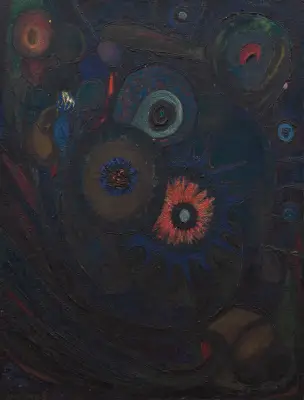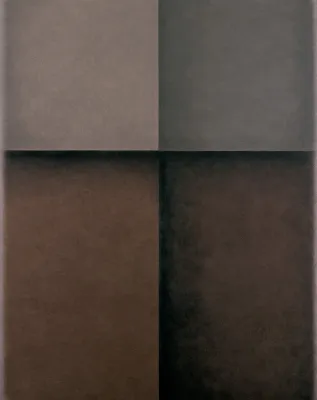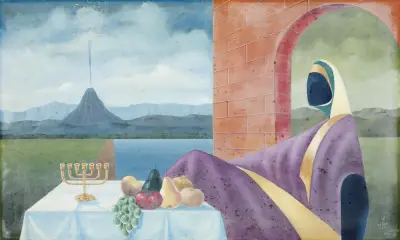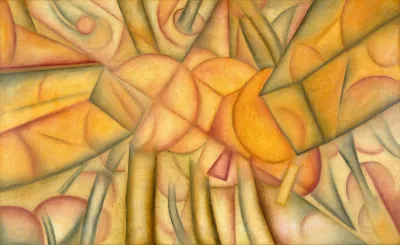
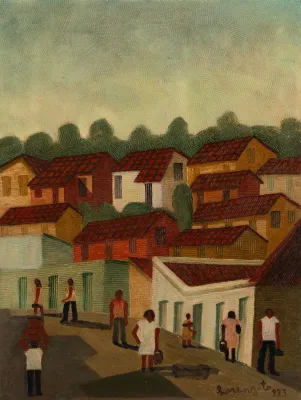
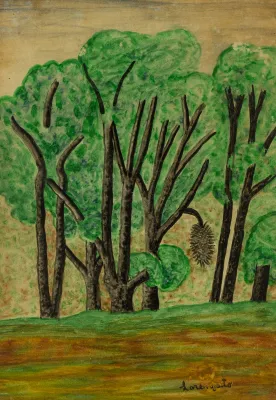
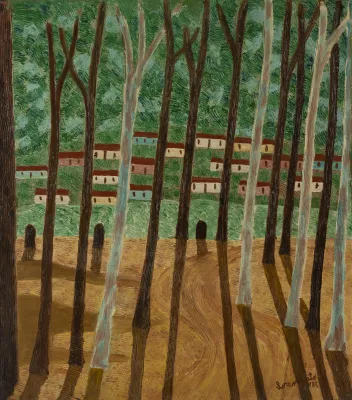
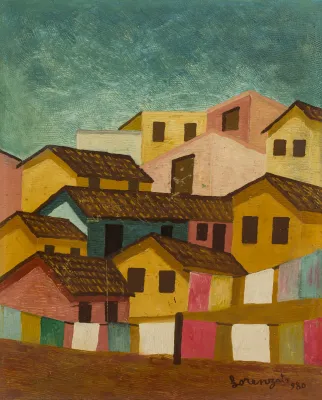


Amadeo Lorenzato (Belo Horizonte MG 1900 - idem 1995)
Amadeo Lorenzato was a painter and sculptor. He began working as a painter's assistant in 1910, working in that role until 1920, when he moved with his family to Arsiero, Italy, where he worked as a house painter on the city's reconstruction. In 1925, he enrolled at the Reale Accademia delle Arti in Vicenza. The following year, he moved to Rome, where he spent two years alongside the Dutch painter and poster artist Cornelius Keesman, with whom he often drew on weekends. In 1928, they both decided to travel by bicycle through Eastern Europe, passing through Austria, Slovakia, Hungary, Bulgaria, and Turkey. At the end of the trip, in 1930, he separated from Cornelius and moved to Paris, where he worked assembling the pavilions for the International Colonial Exposition. The following year, he returned to Italy, where he remained until April 1948, when he returned to Brazil.
In 1949, he worked assembling the booths for the Industrial and Commercial Exposition, held at the Hotel Quitandinha in Petrópolis. He then moved with his family to Belo Horizonte, where he worked as a house painter until 1956. Unable to continue working in construction due to an accident, he devoted himself full-time to painting. In the mid-1960s, he presented some works to the critic Sérgio Maldonado, who introduced him to Palhano Júnior, who organized his first solo exhibition, held in 1967.
Critical Commentary
Born in Belo Horizonte, Minas Gerais, of Italian descent, Lorenzato spends his childhood in Brazil. After World War I (1914-1918), his family decides to return to Italy. At the age of 20, he begins working as a house painter in construction. In 1925, he studied at the Reale Accademia delle Arti, in the Galleria Olimpica di Vicenza (now the Accademia Olimpica Vicenza). His first paintings are made on Sunday outings around the city.
In 1926, in Rome, he met the painter Cornelius Keissman. Around 1928, accompanied by Keissman, he embarked on a long bicycle trip through several European countries. He made his living selling small gouaches and watercolors and printed cards with photos of the two artists next to their bicycles. They remained in Brussels and Paris for longer periods. In Paris, Lorenzato befriended the Italian painter Gino Severini (1883-1966) and took the opportunity to expand his knowledge of the work of the Impressionists, for whom he expressed deep admiration. He also claimed to be deeply fascinated by the works of the Italian Renaissance masters.
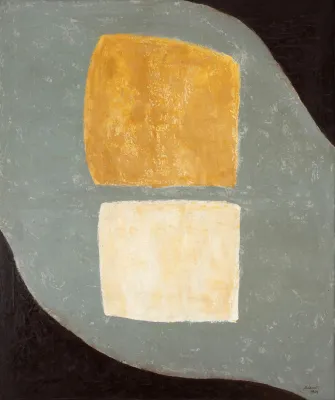
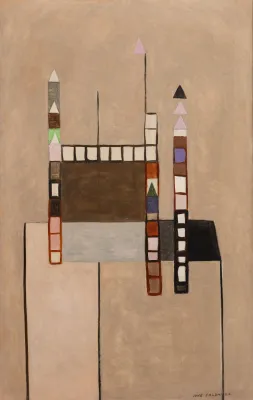
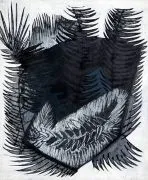
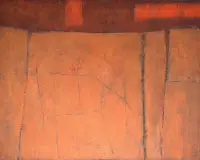
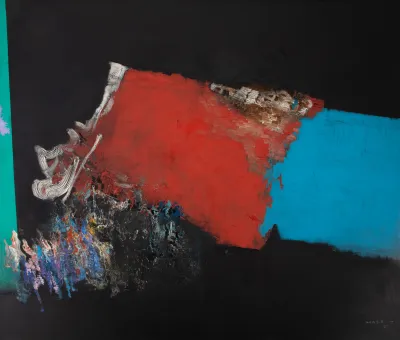
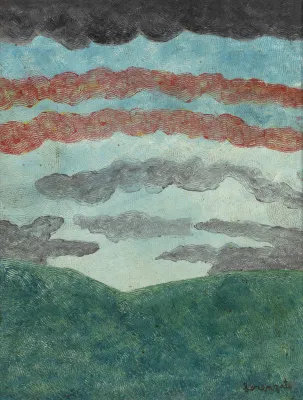
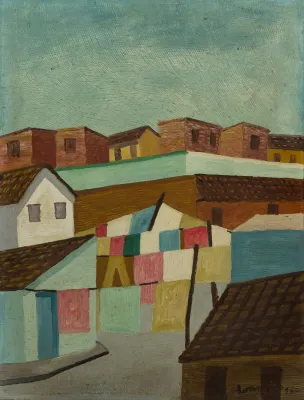
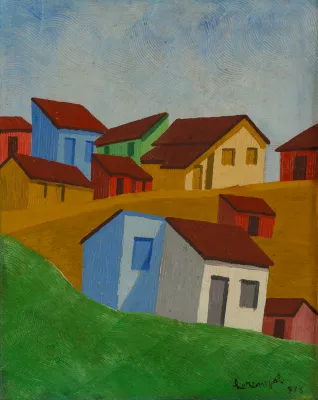
With the end of World War II (1939-1945), he returned to Brazil in 1949 and settled with his family in Belo Horizonte. He suffered an accident in 1956, resulting in his retirement. He then devoted himself entirely to painting. For scholar Cláudia Giannetti Nölle, in his paintings, the artist dispensed with details and focused on essential lines and colors, a practice common in painters close to primitivism. He began using a metal comb, commonly used for ornamental wall paintings, with which he blended the layers of paint onto the canvas. The result is a presentation of tortuous lines and slight indentations scattered throughout the painting.
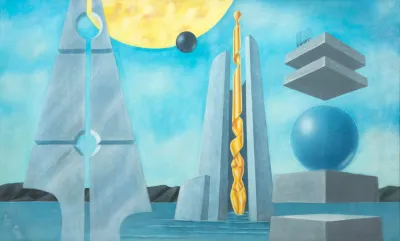
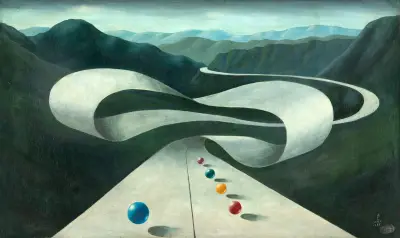
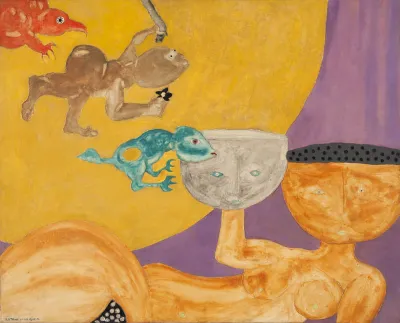
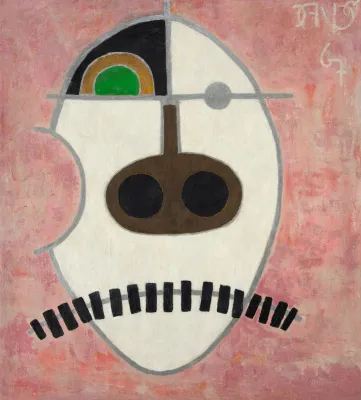
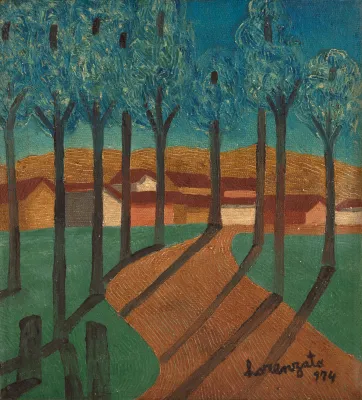
Lorenzato draws his subjects from everyday reality, both in landscapes and still lifes and portraits. He frequently uses new materials such as wire mesh, wood, and cardboard, as well as plates, boxes, and lampshades that serve as supports for his paintings. He also creates sculptures, working with clay and, in larger works, with cement. In sculpture, he tends to reduce to basic forms and essential lines, although he imbues the figures with great intensity and expressive power. For Nölle, his work is above all a spontaneous creation, in which the elements merge naturally.
Collections
Fundação Clóvis Salgado - Belo Horizonte MG
Museu de Arte da Pampulha - MAP - Belo Horizonte MG
Critiques
"(...) The arrangement of elements and colors achieves a balance that energizes his contemplative and static representations. He also manages to infuse vigor into the often geometric abstractions of the elements that compose the painting through the use of a technical resource he developed. The result is brief waves of tortuous lines etched in paint, not very prominent eminences and depressions that are dispersed throughout the painting, becoming more intense especially in the elements that serve as backgrounds (walls, skies, mountains). This comb, the only example acquired in Paris, was previously used in the ornamentation of wainscoting that imitated marble or wood, very fashionable until the middle of the century, especially in the design of veins and ribs. (...) His themes are taken directly from everyday reality. Continually seeking new materials, he has worked with wire mesh, wood and cardboard".
Cláudia Giannetti Nölle
LORENZATO. Lorenzato: 90 anos. Belo Horizonte: Manoel Macedo Galeria de Arte, 1990.
"For a long time, the work of Amadeu Luciano Lorenzato was associated with popular tradition. The frequency with which everyday landscape, favelas and rows of houses appear in his works contributed to this. However, an analysis restricted to this first relationship would ignore what is most important in his painting.
If the artist chooses popular themes, it is to extract from them the forms, colors and lights that synthesize the very essence of the work. His interest lies in reflecting on the very means of painting, in building a language that relates above all to itself, and not to the representation of a specific subject. His aim is to build forms and images that allow us to experience the world in a new way, different from that offered by everyday life pure and simple.
In this sense, his work engages in dialogue with modern painting, reaffirming its condition as a construction of meaning through visual language itself and allowing aesthetic experience beyond the literalness of the subject.
Lorenzato was always unconcerned with pre-established norms or trends, which, incidentally, he knew well because of the long period he spent in Europe, in contact with the continent's entire artistic production, from the Renaissance to the first avant-gardes of the 20th century.
As an artist eager to investigate his own practice, he made his own paint and experimented with diverse supports and materials, creating textures with techniques inherited from his former trade; sculptures and drawings on cement slabs; studies and sketches on whatever paper was at hand - exhibition invitations, his son's notebook, cigarette packs".
Janaina Alves Melo
MELO, Janaina Alves. Apresentação. In: LORENZATO; SILVA, Fernando Pedro da (coord.); RIBEIRO, Marília Andrés (coord.). Lorenzato - Depoimento. Belo Horizonte: C/Arte, 2004. 96 p., il. p&b. color. (Circuito Atelier, 8). p. [3-4].
Testimonial
How did the idea of using the comb to paint come about?
I was a painter, specializing in decoration with marbled finishes, faux marble and faux wood; the oil base was done first, then the veins in yellow, red, and black, and then we finished them off with the comb. To create the wood grain, I bought a collection of decorator's combs in Paris. Then I returned to Belo Horizonte and no longer used that thing. One day I had the idea, lined some cardboard, and then started messing around with the comb, and something came out. That was about ten years ago. So I started. I had six combs, but I lost the others and only one remained, this one here, which I split in half because it was too wide. First, I paint, spreading the paint in different colors, and then I blend it with the comb. I use the brush to spread the paint and the comb to blend the colors.
What are your favorite motifs to paint?
I really like the sky, trees, and roads. I walked many kilometers along the roads, all over Tuscany and Austria; the roads were unpaved, and there were many fruit trees: cherry, pear, and apple trees.
What is art to you?
Well, for me, art is a pastime, it's a therapy that helps me live. When I'm painting, I forget everything. Something unusual even happened the other day: we were having a barbecue here, I bought a kilo and a half of sausage and put it on the fire to fry, and then I went to work downstairs, a sculpture, and I forgot everything. When I smelled something burning, I ran and it had turned into charcoal.
What style do you paint in?
I don't even know what style it is. It's painting! They say it's primitive, naive, surrealist, I don't know... I paint what I see, what interests me.
Text excerpted from the artist's statement, published in the book Lorenzato - Circuito Atelier, Editora C/Arte, Belo Horizonte, 2004. pp. 31 to 34.
Solo Exhibitions
1964 - Belo Horizonte MG - Solo, at Minas Tênis Clube
1967 - Belo Horizonte MG - Solo, at Minas Tênis Clube
1971 - Belo Horizonte MG - Solo, at Galeria Chez Bastião
1973 - Belo Horizonte MG - Solo, at Galeria Arte Livro
1976 - Belo Horizonte MG - Solo, at Galeria Guignard
1977 - Belo Horizonte MG - Solo, at Galeria Memória Cooperativa de Arte
1981 - São Paulo SP - Solo, at Galeria Brasiliana
1984 - Belo Horizonte MG - Solo, at Casa dos Contos
1986 - Belo Horizonte MG - Solo, at Espaço Asal
1988 - Belo Horizonte MG - Solo, at Manoel Macedo Galeria de Arte
1990 - Belo Horizonte MG - Solo, at Manoel Macedo Galeria de Arte
1991 - Belo Horizonte MG - Solo, at Itaugaleria
1994 - Belo Horizonte MG - Solo, at Galeria da Caixa
1995 - Belo Horizonte MG - Solo, at MAP
Group Exhibitions
1965 - Belo Horizonte MG - Year-End Show, at Minas Tênis Clube
1965 - Belo Horizonte MG - Young Salon, at Minas Tênis Clube
1970 - Belo Horizonte MG - Five Primitives, at Galeria Guignard
1970 - Belo Horizonte MG - Group Show, at Galeria Minart
1970 - Belo Horizonte MG - Folklore Week, at Galeria Minart
1973 - Bratislava (Slovakia) - 3rd Bratislava Triennial
1976 - Belo Horizonte MG - 1st Small Painting Salon, at Galeria Guignard
1976 - Belo Horizonte MG - Popular Artists at the 4th Brazilian Folklore Festival, at Galeria Otto Cirne
1980 - Belo Horizonte MG - Primitives from Minas Gerais, at Mandala Galeria de Arte
1981 - Belo Horizonte MG - 1st Exhibition of Popular Art and Crafts, at Shopping Center
1982 - Bauru SP - 1st National Show of Popular Painting, at Galeria de Arte Sesc
1984 - Belo Horizonte MG - 1st Visual Arts Salon of the Fundação Clóvis Salgado, at Fundação Clóvis Salgado. Palácio das Artes
1985 - Belo Horizonte MG - Lorenzato and Valentim Rosa, at Galeria do Palácio das Artes
1988 - Rome (Italy) - Italy-Brazil Cultural Exchange
1992 - Belo Horizonte MG - A. Poteiro, Lorenzato, Rodelnégio, at Manoel Macedo Galeria de Arte
1994 - Belo Horizonte MG - 5th Art Fair, at Galeria Guignard
1994 - Belo Horizonte MG - Great Brazilian Artists, at Galeria Guignard
1994 - Ouro Preto MG - The Virtual Identity, Soapstone, at Museu da Inconfidência
1994 - Rio de Janeiro RJ - MEC Popular Art Salon, at MEC
1995 - Belo Horizonte MG - Exhibition, at MAP
Posthumous Exhibitions
1996 - Belo Horizonte MG - Popular Artists of Belo Horizonte, at Centro Cultural UFMG
2001 - Belo Horizonte MG - Solo, at Escola Guignard
2001 - Belo Horizonte MG - Lorenzatices, at Pace Galeria de Arte
Source: Itaú Cultural and Comar