Zina Aita (Belo Horizonte MG 1900 - Naples, Italy 1967)
Painter, ceramist and draftswoman.
Tereza Aita traveled to Florence, where she stayed from 1914 to 1918, studying with the artist Galileo Chini (1873 - 1956) at the Accademia di Belle Arti di Firenze [Florence Academy of Fine Arts]. Back in Brazil, she came into contact with the modernists Manuel Bandeira (1886 - 1968) and Ronald de Carvalho (1893 - 1935). She became friends with the painter Anita Malfatti (1889 - 1964) and the writer Mário de Andrade (1893 - 1945). She held her first solo exhibition in Belo Horizonte in 1920 and is considered a forerunner of modernism in Minas Gerais. She took part in the Semana de Arte Moderna [Modern Art Week] in São Paulo in 1922. At that time, she made illustrations for the magazine Klaxon, a publication of the São Paulo modernists. Her work remains little known, and much of it is undated. For some scholars, her painting from this period is close to Art Nouveau and Post-Impressionism. She held a solo exhibition at the O Livro bookshop in São Paulo in March 1922 and, the following year, took part in the 1st Salão da Primavera [Spring Salon] in Rio de Janeiro. In 1924, she moved to Italy and lived in Naples, where she ran a ceramics factory. Over the next six years, she studied in Rome, Florence, Milan and Venice. In Italy, she became known as a ceramist, taking part in several group shows. In 1990, the Museu de Arte da Pampulha - MAP held the exhibition Jeanne Milde, Zina Aita: 90 Anos [Jeanne Milde, Zina Aita: 90 Years].
Critical Commentary
Zina Aita studied in Florence from 1914 to 1918 with the artist Galileo Chini (1873 - 1956). She returned to Brazil and took part in the Semana de Arte Moderna, encouraged by her friends Ronald de Carvalho (1893 - 1935) and Manuel Bandeira (1886 - 1968). As art historian Marta Rossetti Batista points out, the titles of the works listed in the catalog of the 1922 Week reveal the artist's interest in the decorative and in the human figure, as well as her connection with Impressionism. The decorative tendency in her work is evident in the titles of three of the eight works shown in 1922.
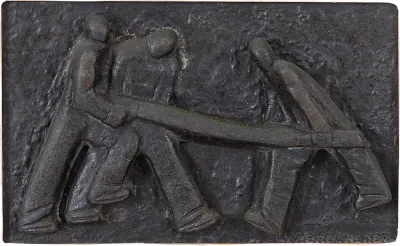
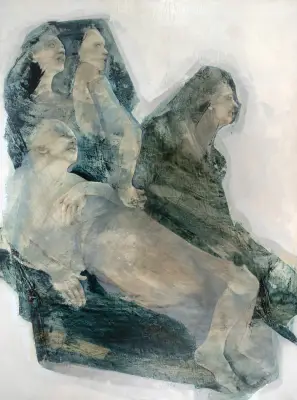
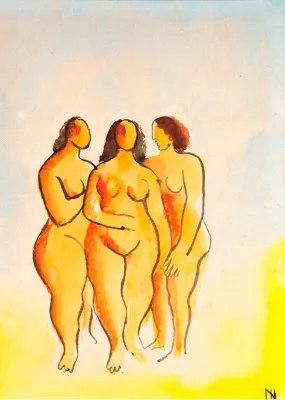
In the view of art historian Walter Zanini, during her stay in Florence Zina Aita identified with the Italian art scene, dominated by Art Nouveau and above all by the return-to-order tendency. Known works by the artist include the scene of workers paving a street, made with the divisionist technique, Homens Trabalhando [A Sombra] [Men at Work (The Shadow)], 1922. A watercolor of a female nude has also been identified, revealing her talent as a draftswoman and her affinity with the work of Degas (1834 - 1917). The painting Friso [Frieze], ca. 1928, reaffirms the artist's interest in the decorative and shows her appreciation of the work of Klimt (1862 - 1918). Most of her output is neither identified nor dated.
Critiques
"What Zina Aita's painting reveals is largely the result of studies carried out in Florence, where she moved as a teenager, and it contains various assimilations of the Italian milieu, of Art Nouveau, 'cerebral' ingredients of Parisian Post-Impressionist modernism, and above all an adherence to the retour à l'ordre line, widely dominant in the 1920s, that is, the abandonment of the idea of the avant-garde and the reassimilation of figuration along classical patterns. A decorative tendency also emerged early in her work - the fruit, certainly, of her apprenticeship with Galileo Chini - as indicated by the titles of three of the eight works shown at the Semana de Arte Moderna: no. 47, Paisagem Decorativa [Decorative Landscape], no. 48, Máscaras Siamesas [Siamese Masks], and no. 51, Painel Decorativo [Decorative Panel]. The works shown were dispersed, but the small, well-known scene of workers paving a street, which survives, documents her use of an outdated divisionist technique. Yan de Almeida Prado recorded that Zina Aita was the 1922 exhibitor who most pleased the public. It is quite likely that the painter's decorative side, a characteristic trait of her personality, contributed to this. Further evidence of the interest she aroused is her successful show at Jacinto Silva's bookshop. Her presence at the Week was certainly marked by not resorting to the isms. She looked back a little for her impetus. A watercolor of a female nude from the following year, influenced by Degas, shows her qualities as a draftswoman, also visible in other works of 1923, in India ink or watercolor. Inspired by Gustav Klimt and by her refined decorative sense is the later Friso, made when she was living outside Brazil, with images of sorrowful women, which she dedicated to Mário de Andrade".
Walter Zanini
JEANNE Milde, Zina Aita: 90 anos. Belo Horizonte: Museu de Arte de Belo Horizonte, 1990. p. 28.
Solo Exhibitions
1920 - Belo Horizonte MG - First solo exhibition, at Palácio do Conselho Deliberativo
1920 - Rio de Janeiro RJ - Solo, at Liceu de Artes e Ofícios
1922 - São Paulo SP - Solo, at the O Livro bookshop
1950 - Naples (Italy) - Solo, at the Naples Chamber of Commerce
1957 - Naples (Italy) - Ceramiche di Zina Aita, at Galleria d'Arte Vanvitelli
Group Exhibitions
1920 - Rio de Janeiro RJ - 27th General Exhibition of Fine Arts, at Enba
1922 - Rio de Janeiro RJ - 29th General Exhibition of Fine Arts, at Enba
1922 - São Paulo SP - Modern Art Week, at Teatro Municipal
1923 - Rio de Janeiro RJ - 1st Spring Salon
1952 - São Paulo SP - Angelicum
1954 - São Paulo SP - Contemporary Art: Exhibition of the Museu de Arte Moderna de São Paulo Collection, at MAM/SP
1955 - Rome (Italy) - Exhibition of the South (Mezzogiorno)
1956 - Naples (Italy) - Sacred Art Exhibition, at the Royal Palace
1957 - Rome (Italy) - Nativity Scene Exhibition, at Palazzo Braschi
1957 - Naples (Italy) - National Art Event, at the Royal Palace
1961 - Naples (Italy) - Nativity Scene Exhibition, at the Royal Palace
1967 - Rome (Italy) - 4th National Art Exhibition
Posthumous Exhibitions
1971 - São Paulo SP - 11th Bienal Internacional de São Paulo, at Fundação Bienal
1972 - São Paulo SP - The 1922 Week: Background and Consequences, at Masp
1979 - São Paulo SP - Portraits of Mário de Andrade, at Biblioteca Municipal Mário de Andrade
1982 - São Paulo SP - From Modernism to the Bienal, at MAM/SP
1986 - Belo Horizonte MG - Modernism in Minas: The 1936 Salon, at Espaço Cultural Casa do Baile
1990 - Belo Horizonte MG - Jeanne Milde and Zina Aita: 90 Years, at MABH
1993 - São Paulo SP - 100 Masterpieces from the Mário de Andrade Collection: Painting and Sculpture, at IEB/USP
1993 - Poços de Caldas MG - Mário de Andrade Collection: Modernism in 50 Works on Paper, at Casa da Cultura de Poços de Caldas
1996 - Belo Horizonte MG - The Emergence of Modernism, at Museu Mineiro
2000 - Lisbon (Portugal) - Brasil-brasis: cousas notaveis e espantosas [Brazil-Brazils: Notable and Astonishing Things]. Modernist Views, at Museu do Chiado
2001 - Belo Horizonte MG - Modernism in Minas: Reference Icons, at Itaú Cultural
2001 - Penápolis SP - Modernism in Minas: Reference Icons, at Galeria Itaú Cultural
Source: Itaú Cultural