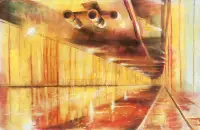
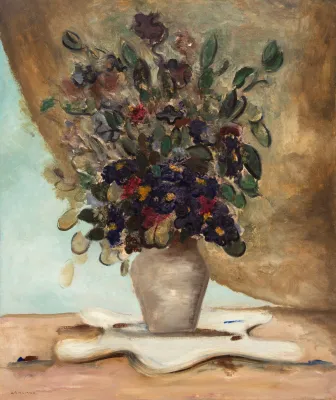
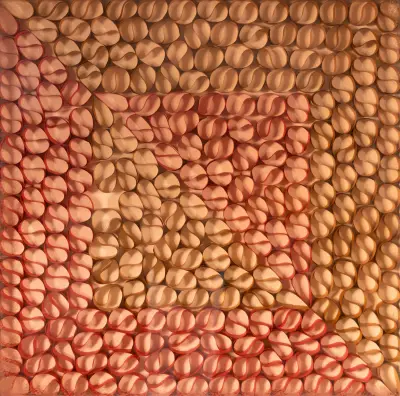
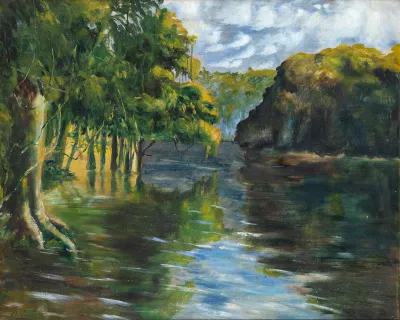
Waldemar Cordeiro. (Roma, Italy 1925 - São Paulo SP 1973)
Waldemar Cordeiro was a plastic artist, designer, illustrator, landscape designer, urban planner, journalist and art critic. Born in Rome, the son of an Italian mother and a Brazilian father, he was registered at the Brazilian Embassy, thus acquiring the Brazilian nationality. He studied at the Tasso Lyceum and at the Accademia di Belle Arti. At the beginning of the 1940s, during the fascist regime, he lived with members of the Italian Communist Party, maintaining his bond with communism throughout his life.
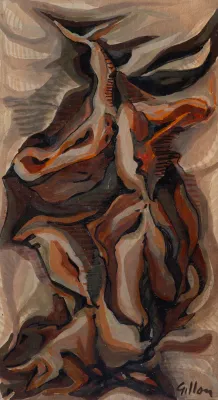
She began her career as a caricaturist, in 1943, in the satirical newspaper. PETEROSSO. He traveled to Brazil in 1946 to meet his father and, in São Paulo, began to work as a journalist and art critic at Folha da Manhã. In 1947, he painted, alongside Bassano Vaccarini (1914–2002), the murals of Santa Rita at the Bom Jesus do Brás Church, in São Paulo. He returned to Italy in 1948, where he began his first abstract productions. Back definitively in Brazil in 1949, he participated in the inaugural exhibition of the Museum of Modern Art of São Paulo (MAM/SP), from figurativeism to abstractionism.
In addition to painting and criticism, he developed an extensive work in the field of landscaping. Despite maintaining a critical stance in relation to the project of the Bienal Internacional de São Paulo, he participated in the first edition, in 1951, and in several later shows. He became a theorist and leader of the group Rupture, of Concrete Tendência, founded in 1952, with the holding of the homonymous exhibition at MAM/SP and the launch of a manifesto. In 1953, he inaugurated the Landscaping Gardens of Vanguarda.
In 1956, he was part of the 1st National Exhibition of Concrete Art, at MAM/SP. In 1964, he traveled to Europe, where he strengthened ties with artists from the Groupe de Recherche d'Art Visuel and became interested in American pop art, strongly represented at the Venice Biennale that year. Then the Popcretos series began, in partnership with Augusto de Campos. In 1965, he participated in the exhibition Opinião 65, at the Museum of Modern Art in Rio de Janeiro (MAM/RJ).
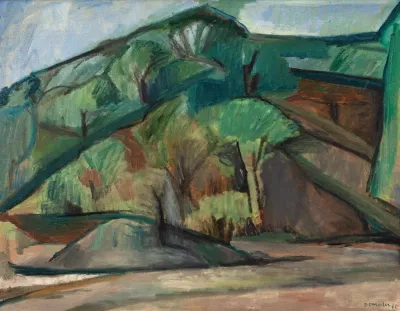
From 1968, he began research in digital art, in partnership with the physicist Giorgio Moscati. In 1971, he organized the artisan exhibition. The following year, he collaborated in the creation of the Institute of Arts of the State University of Campinas (IA/UNICAMP), where he started to direct the Image Processing Center. few move from the field of artistic production to that of theoretical reflection1, becoming one of the main articulators of concretism in the country and later abandoning this path in favor of a less utopian art and more connected with the challenges of its time. Intense career, Cordeiro explores with diligent and investigative yearning some of the main artistic currents of the 20th century. His attention, at first, falls on expressionism, a tendency with which his first works are aligned. He quickly, however, turns his interest in the defense of a production of abstract content, radically distant from figuration, naturalism and a hedonistic view of art (art for aesthetic pleasure, art for art). He has the conviction that it was up to art the role of transforming the world, no longer through the denunciation or mere repetition of old aesthetic standards, but through the execution of the new. From the end of the 1940s onwards, the group developed a work that opposes both social realism - a path primarily followed by left-wing artists in the country, such as Portinari and Di Cavalcanti - and to the possibly decorative character of lyrical abstractionism.
One of its main conceptual pillars is the "theory of pure visibility" developed in the 19th century by the German thinker Konrad Fiedler (1841-1895) - which fights the idea of aesthetic sensibility and defends, for art, a status of such an important means of knowledge as for the positive sciences. The other is the defense of the effective engagement of the intellectual and the artist in the project of political and social change defended by the Italian philosopher Antonio Gramsci (1891-1937). Cordeiro also follows with special attention the theories of the Gestalt of Form and the models of Russian Constructivism and Neoplasticism. "We defend the real language of painting that is expressed with lines and colors that are lines and colors and do not want to be pears or men", he says in a text published in 19492.
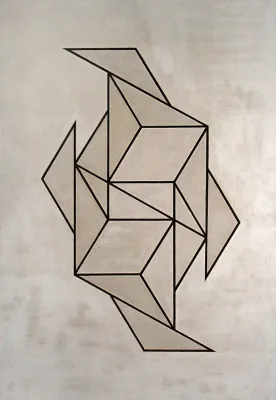
The intention is to create a new, objective, rational art. Among the most striking aspects of this production are the search for order, the defense of art as an autonomous reality, the use of materials and instruments derived from the industry, the reproducibility and the search for a collective meaning (which explains its strong harmony with other applied arts, such as design and the landscaping). Colors are always the basics, without falling into a pictorial or expressive tonalism. Lamb and his companions preach the need to realize an art accessible to all, in which the authorial and decorative character gives rise to a real action of aesthetic transformation of the world. As the critic Lorenzo Mammì summarizes, "the classical concretism was based on the series arrangement of simple elements, according to orders that resulted in a unitary and harmonic meaning"3.
Such a normative impetus, which finds an echo in the production of other Brazilian artists and establishes a rich and combative dialogue with the Rio de Janeiro artists of the group Frente, ends up in crisis, leading the members of the Rupture Group to a deep reassessment, from the 1960s onwards. rigorously built from mathematical precepts to a type of production that reflects a more anchored view of the real social conditions faced in Brazil. Added to this is a new scenario in international art, with the introduction of movements such as pop and neorealism - both mark the lamb on a trip to Europe in the 1960s. In a 1965 text, the artist reaffirms the "failure of all utopias of technological foundation". "The irrationalism of abstract rationalism has already cost the man of our time very dear", he adds.
Politically engaged and defender of art as a fundamental element of the process of social transformation, he feels the impact of the military coup and starts to incorporate a strongly critical dimension in his works, such as in popcreto for a critical or underdeveloped (1964). Such experimentalism contains an irony and an obvious critical intention and expands the field of artistic creation in Brazil in a very bold way. Hélio Oiticica (1937-1980) attributes to Lamb the pioneering spirit in terms of the appropriation of banal things in everyday life. According to him, the popcrete is not "a fusion of pop with concretism, as many want it, but a decisive transformation of the purely structural propositions to others of a semantic-structural nature" and is somehow anticipating the movement he makes, two years later, in 1966, by "proposing a return to the 'thing', to the appropriate daily object as a work". (1967) -, Cordeiro also makes a third movement of radicalization in his research, choosing as the main element of his work no longer the concrete thing, but the image of it, anticipating the importance of the virtual, digital, manipulated and transcoded image for contemporary artistic production.7
With the creations in which he uses the language of the computer, explored from the late 1960s, he performs a kind of rescue on another scale: "I go back to the starting point. Concrete art what it did: it digitized the image, numbers, surfaces with quantities, related these quantities, programmed the pictures. The execution was handmade just because there was no industry that wanted to do this and the artists did not have the money to pay [...] the concrete paintings could have been executed by a typography, by an industry, by a machine, because they had at their base a numerical program - note well - as the art digitized."8
A art that differs from much of the vanguard digital production, often marked by technological optimism. As it diagnoses the critic Arlindo Machado, Cordeiro introduces "critical dimension to computer art, adding to the images the social commentary that There was not in world production."9 Bold and coherent, Lamb explains his posture in a recorded testimony: "It is fundamentally an attitude that counts - a work of art is not an object, it is not a thing, it is a proposal for man, a proposal for society".10
Notes
1 It is difficult to separate artistic and intellectual production into the trajectory of Lamb. After all, as Anna Belluzzo summarizes, "the rigor of aesthetic understanding enunciated in texts is parallel to that of his visual works, which can be understood as experiments, in the broad sense". In Amaral, Aracy (coord.). Constructive Art in Brazil: Adolpho Leirner Collection. São Paulo: DBA, 1998. p. 97.
2 "Revista dos Novíssimos n.1", in 1949. BANDEIRA, João (Org.). São Paulo concrete art: documents. São Paulo: Cosac & Naify : Maria Antônia University Center at USP, 2002. p. 17
3 Mammi, Lorenzo, et al. Op. cit., p. 31.
4 LAMB, Waldemar. "Realism: Muse of Revenge and Sadness". In: Habitat Magazine (May-Jun 1965). Apud FERREIRA, Glória : COTRIM, Cecília. Artists' writings: 60's/70's. São Paulo: Jorge Zahar, 2006. p. 108
5 idem, p. 111 and 112.
6 OITICICA, Hélio. general scheme of the new objectivity. In: FERREIRA, Glória : Cotrim, Cecília. Op. cit., p. 159
7 Waldemar Cordeiro: Rupture as a metaphor. Text Helouise Costa, Vivian Boehringer. São Paulo: Cosac & Naify : Maria Antônia University Center, 2002. p. 34.
8 Testimony of a lamb recorded on May 16, 1970 and cited in Waldemar Cordeiro: The rupture as a metaphor. Text Helouise Costa, Vivian Boehringer. São Paulo: Cosac & Naify : Maria Antônia University Center, 2002. p. 28.
9 MACHADO, Arlindo. art and media. São Paulo: Jorge Zahar, 2007. p. 51 and 52.
Criticism
"Waldemar Cordeiro has always turned his work into a manifesto, each exposition in defense of the thesis, each title of work in the illustration of a theory. 1964, he had held an exhibition at the Atrium Gallery, in São Paulo, in which he showed for the first time his popcretes, or, how he defined these objects (two of which would be exposed in opinion 65), 'concrete semantic art'. Regarding them, the German esthete Max Bense wrote a letter-preface (15.11.1964) in which he said: 'Popcretes presuppose, therefore, a previous artistic experience, namely pop art and concrete art. They are art of art. But one can perceive the dialectic between two principles of style, who behave as thesis and antithesis. It should also be noted that the Platonic principle in concrete art is the strongest, insofar as the banal remains of the pragmatic corporeal world are subjected to the clear dominant of the ideal concrete surface. way: the idea of ordering. Undoubtedly, this is a Hegelian path, although not in the idealistic sense, in the production of the popcretos'".
Frederico Morais
MORAIS, Frederico. Opinion 65: Yesterday, Today. de Janeiro: Banerj Art Gallery, 1985. (Cycle of exhibitions on art in Rio de Janeiro, 5).
"Waldemar Cordeiro's profile is, to this day, very clear among those who followed the course of the artistic events of the Late from the 1940s to the first years of the 70's.
Controversial personality, always deepening antagonisms and shifting the marks of the artistic debate, heated, heated, the passage of aesthetics with an expressive content to those with a constructive content. (...)
Separate personality, was far from the public and at the center of the concrete movement that took place in the 1950s, in São Paulo. Agglutinating and radiating, theoretical and practical, his visual research obeyed free speculation, without responding to immediate demands. They were not in line with the consumption habits of the small plastic arts market. Not even the industry of the time would be able to absorb this experience, which, after all, was constituting an industrial aesthetic. The artists went ahead of the process, instituting objective and impersonal language, which wanted it to become the language of real life.
The lamb's path is clear: an adventure of reason. The paintings, above all, were the support of research and reflection on art and its place in urban-industrial societies.
The political vision of culture marks its critical perspective on art and the predominantly ethical dimension of its proposals.
Meio ao ao Optimism generated by industrialization, Cordeiro and the Concretist Group adjusted the artistic language to the format of the new stage of society. desacralized and innovated the means of artistic production. They worked on the technical infrastructure of language.
In the 1960s, more precisely after 64, reoriented the action strategy, Cordeiro shifts the aim to the political superstructure, to the semantic concretion, to use his words. He wants to find meanings in the midst of life, he wants to read art in the world of things, to relate to living culture. Finally, he seeks the form of participation and communicative relationship.
It was the professional landscaper who financially supported the pure artist. Landscaping, initially thought of as a means of subsistence, is included in the field of its creative activities. It is the landscaper who marks the properly urban dimension in the vision of Cordeiro. The landscaper who designs spaces destined for free time teaches the painter what the concrete participation of the fruiter is. It is also the landscaper who brings art to the dimension of the contingent and the necessary, never of the utilitarian, and in order to prevent any assumption that there is some functionalist remnant in these procedures.
The reflection on communication in modern societies impels him to overcome the physical space and act on electronic circuits. The project to carry out artistic works by advanced technological means is the last chapter of his adventure, having died before the experience was completed.
View today, his work refers to the Brazilian historical course, because he wanted to give answers and because the general trace of his project is the movement. From art to the real".
Ana Maria Beluzzo
BELUZZO, Ana Maria. Waldemar Cordeiro, An Adventure of Reason. AMARAL, Aracy (org.). MAC/USP, 1986, p. 15-16.
10 Idem, p. 36.
Testimonies
"Modern art, after a syntactic period (relationship) formal between signs) and a period - more recent - pragmatic (relation of signs with the interpreter), inaugurates a semantic period (relation of the sign with things).
The montage composes several fragments, or several Frames of different trends in a single frame. This is yet another expression of antidogmatism, of the anti-style of modern art: open art. The new figuration chose here as a theme contemporary art itself.
The artist leaves the domain of decoration to address, in the field of the most immediate and common materiality, the contingent problem of social events. The question of social function, previously posed in the question of 'design' (infrastructure), is now addressed directly at the level of the political superstructure. The informal (anti-painting) and the anti-art objects constituted an efficient critique of the search for the 'beautiful form'. The demands of pragmatic art - the random and the active role of the spectator - today constitute another step towards a total reality: the new figuration. to n. f. It should not be understood as a return to figurativeism, but as a search for new significant structures.
The new figuration denounces the forced collectivization of the individual carried out through the powerful current media (TV, cinema, radio and press), in the service of a financial oligarchy increasingly eager for profit. Adam's apple is the thing and gluttony is paid for with alienation. The talisman thing of security in the philosophy of comfort. Owning things, at any cost, is the poor ideology of the alienated.
And the thing now enters the work of art, as an element of a montage, however, that the swallow is transforming it into information sign and constructive message".
Waldemar Cordeiro
CORDEIRO, Waldemar.. VII Bienal 'New Figuration' denounces the alienation of the individual. MAC/USP, 1986, p.119.
Individual exhibitions
1945 - Rome (Italy) - Individual, at the San Marco Gallery
1959 - São Paulo SP - Individual, at the gallery of Art of Leaves
1960 - Campinas SP - Individual, at Galeria Aremar
1963 - São Paulo SP - Individual, at Galeria Astreia
1964 - São Paulo SP - Individual, at Atrium
1965 - Rio de Janeiro RJ - Individual, at MAM/RJ
1968 - Paris (France) - Individual, at the Galerie Debret
1969 - Rome (Italy) - Individual, at Galeria Doria Pamphilli
Collective exhibitions
1942 - Rome (Italy) - Gioventù Italian del Littorio Federale Comando dell'Urbe Gare Artistico-Culturali, at the Argentinian Theater
1946 - São Paulo SP - Exhibition of original drawings by artists from São Paulo, at the Alceu Amoroso Lima Municipal Library
1947 - São Paulo SP - 11th Hall of the Plastic Artists Union, at the Prestes Maia Gallery
1947 - São Paulo SP - Watercolors and Guaches, at the Mário de Andrade Municipal Library
1947 - São Paulo SP - Inaugural Exhibition, at the Domus Gallery
1948 - Rome (Italy) - Prima Shows Dei Syndicati Romani and Scultori
1949 - São Paulo SP - Art Club of São Paulo, at MASP
1949 - São Paulo SP - From figurativeism to abstractionism, at MAM/SP
1951 - São Paulo SP - 1st São Paulo Hall of Modern Art, at Prestes Maia Gallery
1951- São Paulo SP - 2nd São Paulo International Biennial, at the Trianon Pavilion
1952 - São Paulo SP - Grupo Rupla, at MAM/SP
1954 - São Paulo SP - 3rd Salão Paulista de Arte Moderna, at Galeria Prestes Maia - Acquisition and Silver Medal Award
1955 - Lissone (Italy) - 9th International Lissone Award
1955 - São Paulo SP - 4th Salão Paulista de Arte Moderna, at the Prestes Maia Gallery
1956 - São Paulo SP - 1st National Exhibition of Concrete Art, at MAM/SP
1957 - Buenos Aires (Argentina) - Modern Art in Brazil, at the Museo de Arte Moderno
1957 - Lima (Peru) - Modern Art in Brazil, at the Lima Art Museum
1957 - Rio de Janeiro RJ - 1st National Exhibition of Concrete Art, at MAM/RJ
1957 - Rosario (Argentina) - Modern Art in Brazil, at the Municipal Museo de Bellas Artes Juan B. Castagnino
1957 - Santiago (Chile) - Modern Art in Brazil, at the Museum of Contemporary Art
1957 - Tokyo (Japan) - 4th Tokyo Biennial
1957 - São Paulo SP - 4th International Biennial of São Paulo, at the Ciccilo Matarazzo Sobrinho Pavilion
1958 - São Paulo SP - 47 artists, at the Art Gallery das Folhas
1958 - São Paulo SP - Leirner Award for Contemporary Art, at the Folhas Arts Gallery
1959 - São Paulo SP - 5th São Paulo International Biennial, at the Ciccilo Matarazzo Sobrinho Pavilion
1959 - São Paulo SP - Leirner Contemporary Art Award, at the Folhas Art Gallery
1959 - Leverkusen (Germany) - First collective exhibition of Brazilian artists in Europe
1959 - Munich (Germany) - First collective exhibition of Brazilian artists in Europe, at Kunsthaus
1959 - Vienna (Austria) - First collective exhibition by Brazilian artists in Europe
1959 - Amsterdam (Netherlands) - first collective exhibition of Brazilian artists in Europe
1959 - Barcelona (Spain) - First collective exhibition of Brazilian artists in Europe
1959 - Basel (Switzerland) - First collective exhibition by Brazilian artists in Europe
1959 - London (United Kingdom) - First collective exhibition by Brazilian artists In Europe
1959 - Milan (Italy) - First collective exhibition of Brazilian artists in Europe
1959 - Rome (Italy) - First collective exhibition by Brazilian artists in Europe
1960 - Hamburg (Germany) - First exhibition Collective of Brazilian Artists in Europe
1960 - Lisbon (Portugal) - First collective exhibition of Brazilian artists in Europe
1960 - Madrid (Spain) - First collective exhibition of Brazilian artists in Europe
1960 - Paris (France) - First collective exhibition of Brazilian artists in Europe
1960 - Rio de Janeiro RJ - Concrete Art Exhibition, at MAM/RJ
1960 - São Paulo SP - 9th Salão Paulista de Arte Moderna, at the Prestes Maia Gallery - great gold medal
1960 - São Paulo SP - Leirner Contemporary Art Award, at the Folhas Art Gallery
1960 - Utrecht (Holland) - First collective exhibition by Brazilian artists in Europe
1960 - Zurich (Switzerland) - Konkrete Kunst, at Helmhaus
1961 - São Paulo SP - 10th Salão Paulista de Arte Moderna, at the Prestes Maia Gallery
1961 - São Paulo SP - 6th International Biennial of São Paulo, at the Pavilion Ciccilo Matarazzo Sobrinho
1963 - São Paulo SP - 7th São Paulo International Biennial, at the Bienal Foundation
1963 - São Paulo SP - Gallery New Trends: Inaugural Collective, at the Novas Visual Arts Association Trends
1964 - São Paulo SP - 13th Salão Paulista de Arte Moderna
1964 - São Paulo SP - Art at IAB, at IAB/SP
1965 - Rio de Janeiro RJ - Opinion 65, MAM/RJ
1965 - São Paulo SP - 8th São Paulo International Biennial, at the Bienal Foundation
1965 - São Paulo SP - Proposals 65, at MAB/FAAP
1965 - Zagreb (Croatia) - New Trends 3
1966 - Buenos Aires (Argentina) - Contemporary Brazilian artists at the Museum of Modern Art
1966 - Montevideo (Uruguay) - Contemporary Brazilian artists, Montevideo Modern Art Museum
1966 - Rio de Janeiro RJ - 1st April Salon, at MAM/RJ
1966 - Rio de Janeiro RJ - Supermarket 66, at Galeria Relevo
1966 - Salvador BA - 1st National Biennial of Plastic Arts - Special Room
1966 - São Paulo SP - 15th Salão Paulista de Arte Moderna, at Galeria Prestes Maia
1966 - São Paulo SP - Three premises, no MAB/FAAP
1967 - Biennial of Fine Arts/International Architecture Exhibition - IAB Biennial Planning Award
1967 - Rio de Janeiro RJ - Salão de Maio, at the Brazilian Society of Fine Arts
1967 - Rio de Janeiro RJ - New Brazilian Objectivity, at MAM/RJ
1967 - São Paulo SP - 9th São Paulo International Biennial, at the Bienal Foundation - Itamaraty Award
1968 - Paris (France) - Salon Comparaison
1968 - Paris (France) - Salon Grands et Jeunes d'Aujourd'hui
1968 - São Paulo SP - 17th São Paulo Salon of Modern Art, at the Prestes Gallery Maia
1969 - Belgrade (Yugoslavia) - Computers and Visual Arts
1969 - Fine Arts Biennial/International Architecture Exhibition - Bienal Prize for Landscape Planning of the UFMG Campus
1969 - Nuremberg (Germany) - I Biennial of Nuremberg
1969 - Paris (France) - 25th Salon of May, at the Musée d'Art Moderne de la Ville de Paris
1969 - Paris (France) - Salon Grands et Jeunes d'Aujourd'hui
1969 - São Paulo SP - Computer Plotter Art, at the Usis Gallery
1969 - Zagreb (Croatia) - 4th News Trends
1970 - Amsterdam (Netherlands) - Computer Graphic Roof of the Groeland
1970 - Rio de Janeiro RJ - Computer Plotter Art, in the Usis Gallery
1971 - São Paulo SP - Arteônica: The creative use of electronic media in the arts, at FAAP
1972 - Curitiba PR - 29th Salão Paranaense, at Teatro Guaíra
1972 - Hamburgo (Germany) - Computer Graphics, No Kunstverein
1972 - Montreal (Canada) - International Computer Art Exhibition
1972 - Paris (France) - Grand Palais Des Champs Elysées
1972 - Nogent-sur-Marne (France) - Salon Grands et Jeunes d'Aujourd'hui
1972 - São Paulo SP - 4th Panorama of Current Art Brazilian, MAM/SP
1972 - São Paulo SP - Art/Brazil/Today: 50 years later, at the Collectio Gallery
1973 - Birmingham (UK) - Circuit
1973 - Edinburgh (United Kingdom) - Edinburgh Festival
1973 - Paris (France) - Grand Palais des Champs Elysées
1973 - Zagreb (Croatia) - T5 - The Rational and the irrational in Visual Research Today, at the contemporary art gallery
Posthumous exhibitions
1973 - Paris (France) - Salon Grands et Jeunes d'Aujourd'hui
1973 - São Paulo SP - 12th São Paulo International Biennial, at Fundação Bienal
1975 - São Paulo SP - 13th São Paulo International Biennial, at the Biennial Foundation
1977 - Rio de Janeiro RJ - Brazilian constructive project in art: 1950-1962, at MAM/RJ
1977 - São Paulo SP - Brazilian constructive project in art: 1950-1962, at Pinacoteca do Estado
1978 - São Paulo SP - The Biennials and Abstraction: The 50's, at the Lasar Segall Museum
1978 - São Paulo SP - The object in art: Brasil 60s, at MAB/FAAP
1980 - São Paulo SP - Individual, at the Pinacoteca do Estado
1983 - São Paulo SP - 10th anniversary of the death of Waldemar Cordeiro, at the CCSP
1983 - São Paulo SP - Re-reading Project, at the Pinacoteca do Estado
1984 - São Paulo SP - Tradition and Rupture: Synthesis of Brazilian Art and Culture, at Fundação Bienal
1985 - Rio de Janeiro RJ - Opinion 65, at the Banerj Art Gallery
1985 - São Paulo SP - 18th São Paulo International Biennial, at the Bienal Foundation
1985 - São Paulo SP - Arte Novos Meios/Multimeios: Brazil 70/80, at MAB/FAAP
1986 - Rio de Janeiro RJ - Seven decades of presence Italian in Brazilian art, at Paço Imperial
1986 - São Paulo SP - Waldemar Cordeiro: An Adventure of Reason, at MAC/USP
1986 - São Paulo SP - Geometric abstraction, at MAB-FAAP
1987 - Paris (France) - Modernity: 20th-century Brazilian art, at the Musée d'Art Moderne de la Ville de Paris
1987 - Rio de Janeiro RJ - 1st Geometric abstraction: concretism and neoconcretism, at the National Foundation of art. Arts Center
1987 - São Paulo SP - The plot of taste: another look at everyday life, at Fundação Bienal
1987 - São Paulo SP - The craft of art: painting, at SESC
1987 - São Paulo SP - Imágica word, at MAC/USP
1988 - São Paulo SP - 63/66 Figure and object, at Galeria Millan
1988 - São Paulo SP - MAC 25 years: Acquisitions and recent donations, MAC/USP
1988 -São Paulo SP - Modernity: Brazilian Art of the 20th Century, at MAM/SP
1990 - São Paulo SP - Figurativism/abstractionism: the red in Brazilian painting, at the Instituto Cultural Itaú. Center for Informatics and Culture I
1990 - Brasília DF - Figoftivism/abstractionism: the red in Brazilian painting, in Itaugaleria
1991 - Belo Horizonte MG - figurativism/abstractionism: the red in painting Brazilian, at the Itaú Cultural Institute. Nucleus of Informatics and Culture
1991 - Rio de Janeiro RJ - Image about image, at the Sérgio Porto Cultural Space
1991 - São Paulo SP - Constructivism: Art Poster 40/50/60, at MAC/USP
1992 - São Paulo SP - The seduction of volumes: the three-dimensional MAC, at MAC/USP
1993 - Campinas SP - Figurativism/abstractionism: the red in Brazilian painting, at the Itaú Cultural Institute. Center for Informatics and Culture II
1994 - São Paulo SP - Bienal Brasil Século 20th, at Fundação Bienal
1995 - Rio de Janeiro RJ - Opinion 65: 30 years, at CCBB
1996 - Rio de January RJ - Constructive trends in the MAC/USP collection: Construction, Measurement and Proportion, at CCBB
1996 - São Paulo SP - 4th Studio UNESP SESC SENAI of Image Technologies, at Sesc Pompéia
1996 - São Paulo SP - Brazilian Art: 50 years of history in the MAC/USP collection: 1920-1970, at MAC/USP
1996 - São Paulo SP - Desexp(l)os(ing)ição, at Casa das Rosas
1996 - São Paulo SP - The World of Mario Schenberg, at Casa das Rosas
1997 - São Paulo SP - Computer Support Art, at Casa das Rosas
1997 - Porto Alegre RS - 1st Bienal of Mercosul Visual Arts, at the Mercosul Visual Arts Biennial Foundation
1997 - Porto Alegre RS - Constructive Strand and Design, at the ULBRA Cultural Space
1997 - Porto Alegre RS - Political Side, at the Bienal de Mercosul Visual Arts
1997 - São Paulo SP - Three-dimensionality in Brazilian art of the 20th century, at Itaú Cultural
1998 - Belo Horizonte MG - Three-dimensionality in Brazilian art of the 20th century, at Itaú Cultural
1998 - Brasília DF - Three-dimensionality in Brazilian art of the 20th century, at Itaú Galeria
1998 - Penápolis SP - Three-dimensionality in Brazilian art of the 20th century, at the Itaú Cultural Gallery
1998 - São Paulo SP - Constructive Art in Brazil: Collection Adolpho Leirner, at MAM/SP
1998 - São Paulo SP - Theory of Values, at MAM/SP
1999 - Rio de Janeiro RJ - Constructive Art in Brazil: Adolpho Leirner Collection, in the MAM/RJ
1999 - São Paulo SP - daily life/art. Technique - Art Machines, at Itaú Cultural
2000 - Lisbon (Portugal) - 20th century: Art of Brazil, at the José de Azeredo Perdigão Modern Art Center
2000 - Rio de Janeiro RJ - Situations: Brazilian Art Years 70, at Fundação Casa França-Brasil
2000 - São Paulo SP - Brazil + 500 Rediscovery Exhibition. Modern Art, at the Bienal Foundation
2000 - Valencia (Spain) - From La Anthropophagia to Brasilía: Brazil 1920-1950, in Ivam. Center Julio Gonzáles
2001 - São Paulo SP - Individual, at the Brito Cimino Gallery
2001 - São Paulo SP - Trajectory of light in Brazilian art, at Itaú Cultural
2002 - Fortaleza CE - Ceará rediscovered the Brazil, at Centro Dragão do Mar de Arte e Cultura
2002 - Rio de Janeiro RJ - Brazilian Art in the Fadel Collection: from the restlessness of the modern to the autonomy of language, at ccbb
2002 - Rio de Janeiro RJ - Caminhos of the contemporary 1952-2002, at the Paço Imperial
2002 - Rio de Janeiro RJ - Parallels: Brazilian art from the second half of the 20th century in context, Collección Cisneros, at MAM/RJ
2002 - São Paulo SP - Brazilian art in the Fadel collection: from the restlessness of the modern to the autonomy of language, in the CCBB
2002 - São Paulo SP - From Anthropophagia to Brasília: Brazil 1920-1950, at MAB/FAAP
2002 - São Paulo SP - Geometric and Kinetic (2002 : São Paulo, SP) - Art Cabinet Raquel Arnaud (São Paulo, SP)
2002 - São Paulo SP - Grupo Ruptro: Revisiting the inaugural exhibition, in the Maria Antonia University Center
2002 - São Paulo SP - Individual, at Centro Universitário Maria Antonia
2002 - São Paulo SP - Paralela, in the shed located at Avenida Matarazzo, 530, São Paulo. Exhibition idealized and organized together by the Galerias Fortes Vilaça, Luisa Strina, Casa Triângulo and Brito Cimino
2002 - São Paulo SP - Parallels: Brazilian art from the second half of the 20th century in context, Colección Cisneros, in the MAM/SP
2003 - Brasília DF - Brazilian art in the Fadel collection: from the restlessness of the modern to the autonomy of language, in the CCBB
2003 - Mexico City (Mexico) - Cuasi Corpus: Arte Concreto y Neoconcreto of Brazil: Una Selection del Acervo del Museo de Arte Moderna de São Paulo and La Colección Adolpho Leirner, at the Museo Rufino Tamayo
2003 - São Paulo SP - The subversion of the media, At Itaú Cultural
2003 - São Paulo SP - Approaches to the Pop Spirit: 1963-1968, at MAM/SP
2003 - São Paulo SP - MAC USP 40 years: Contemporary interfaces, MAC/USP
2004 - Houston (United States) - Inverted Utopias: Avant Garde Art in Latin America, The Museum of Fine Arts
2004 - Rio de Janeiro RJ - Tudo é Brasil, in Paço Imperial
2004 - São Paulo SP - Plataforma São Paulo 450 years old, at MAC/USP
2004 - São Paulo SP - Tudo é Brasil, Instituto Itaú Cultural
2004 - São Paulo SP - Brazilian version, at the Brito Gallery Cimino
2005 - São Paulo SP - Pain, form, beauty: the creative representation of the traumatic experience, at the Pinacoteca Station
2005 - Chicago (United States) - Tropicália: A Revolution in Brazilian Culture, Museum of Contemporary Art
2005 - Porto Alegre RS - 5th. Mercosul Biennial
2005 - São Paulo SP - 100 years of the Pinacoteca: the formation of a collection, Galeria do Sesi
2005 - São Paulo SP - through, or the corrupted geometry, Galeria Bergamin
2005 - São Paulo SP - Digital Kinetic, Instituto Itaú Cultural
2005 - São Paulo SP - Fifty 50, São Paulo Museum of Modern Art
2005 - São Paulo SP - Homo Ludens: do Faz from account to Vertigo, Instituto Itaú Cultural
2005 - São Paulo SP - Technical Visualities, Instituto Cervantes
2006 - LEEDS (United Kingdom) - Open space / closed space: sites for sculptures in modern Brazil, Henry Moore Institute
2006 - London (England) - Tropicália: A Revolution in Brazilian Culture, Barbican
2006 - Miami (United States) - The Sites of Latin American Abstraction, Cisneros Fontanals Art Foundation
2006 - São Paulo SP - Concrete 56: The root of the form, São Paulo Museum of Modern Art
2006 - São Paulo SP - brush stroke. Painting and Method, Projections in the 50's, Instituto Tomie Ohtake
2007 - São Paulo SP - 70's: Arte as a question, at the Tomie Ohtake Institute
2007 - Austin (States United States) - The Geometry of Hope: Latin American Abstract Art from the Patricia Phelps de Cisneros Collection, Blanton Museum of Art
2007 - Houston (United States) - Dimensions OD Constructive in Brazil: The Adolpho Leiner Collection, Museum of Fine Arts
2007 - Rio de Janeiro RJ - Tropicália, Rio de Janeiro Museum of Modern Art
2008 - São Paulo SP - Fotoformas and its banks, Centro Universitário Maria Antonia
2008 - São Paulo SP - Laços do Olhar, at the Tomie Ohtake Institute
2008 - São Paulo SP - Constructive Trends, at the Museum of Contemporary Art of the University of São Paulo
2009 - Houston (United States) - North Looks South: Building The Latin American Art Collection, at The Museum of Fine Arts
2009 - São Paulo SP - Art as a Question - 70's, Tomie Ohtake Institute
2009 - São Paulo SP - Concrete dialogue, design and constructivism in Brazil, Caixa Cultural
2010 - Brasília DF - Brasília and Constructivism: a postponed meeting, Banco do Brasil Cultural Center
2010 - Newark (States United) - Constructive Spirit: Abstract Art in South and North America, 1920S-50S. Newark Museum
2010 - Rio de Janeiro RJ - The constructions of Brasília, Instituto Moreira Salles
2010 - São Paulo SP - The constructions of Brasília. Instituto Moreira Salles
2010 - São Paulo SP - Tékhne, Fundação Armando Álvares Penteado
2010 - São Paulo SP - One day you will have to finish, Museum of Contemporary Art - USP
2011 - São Paulo SP - Adventure Sculpture: Art that (almost) moves, at the Museum of Contemporary Art of the University of São Paulo
2011 - São Paulo SP - Modernisms in Brazil, at the Museum of Contemporary Art of the University of São Paulo
2011 - Campinas SP - Instant: Experience and event in art and technology, at Sesc Campinas
2011 - Porto Alegre RS - Iberê Camargo and the post-war cultural environment, at the Iberê Camargo Foundation
2011 - Brussels (Belgium) - europalia.brasil
2011 - Madrid (Spain) - Latinoamérica abstraction in Latin America (1934-1973), Fundación Juan March
2011 - New York (United States) - Waldemar Cordeiro & Franz Mon, Mini/Goethe-Institut
2011 - São Paulo SP - Brazil: Figuration x Abstraction in the late 1940s, Institute of Contemporary Art
2012 - São Paulo SP - Buzz, at the Nara Roesler Gallery
2012 - Brasília DF - Geometry of Transformation: Brazilian constructive art in the Fadel Collection, at the National Museum of the Cultural Complex of the Republic
2012 - Buenos Aires (Argentina) - Art of Contradicciones: Pop, Realismos y Politics - Brazil - Argentina 1960, at Fundación Proa
2013 - Campinas SP - 100 years of São Paulo art in the collection of the Pinacoteca do Estado de São Paulo, at the CPFL Cultura Art Gallery
2013 - Madrid (Spain) - La Invención Concreta: Colección Patricia Phelps de Cisneros, at the Museo Nacional Art Center Reina Sofía
2013 - São Paulo SP - Waldemar Cordeiro: Fantasia Exata, at Itaú Cultural
Source: Itaú Cultural