Tatti Moreno (Salvador 1944)
Octávio de Castro Moreno Filho, better known as Tatti Moreno, was born in Salvador on December 18, 1944.
His family has intimacy with the arts. The mother and sister are painters, pianists and poets and the brother is a drummer, and a partner of artists such as Caetano Veloso, Maria Bethânea and Gilberto Gil.
The artistic vocation of Tatti Moreno emerged at the age of twelve or thirteen, When he, as a boy, he manipulated scraps and wire dolls. He began by creating symbols and images of the Afro-Brazilian cult. Afterwards, he joined the School of Fine Arts at the Federal University of Bahia, where he was a student of Mário Cravo Júnior and other Bahian artists. The next step was the making of brass, stainless steel and aluminum.
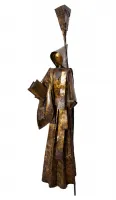
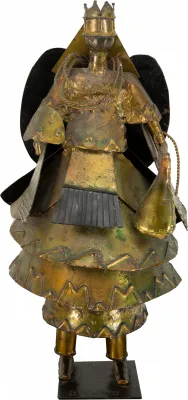
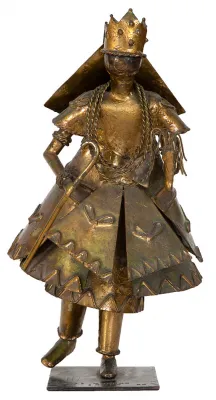
Tati Moreno's creations are modeled in clay and passed on to plaster and wood. They are melted in polyester resin, fitted and plated with varnish and resin. They are heavy sculptures: some, such as Oxalá, Xangô, Ogum, Ede, Iemanjá, Iansã, Nanã and Oxum, weigh a ton. Transport to the exhibition sites is very laborious and sometimes lasts a few days. The small pieces, 15 to 90 centimeters tall, made of brass.
“Tatti Moreno, says Klintowitz, is a erudite artist who uses popular culture as a source. His series of sculptures with the theme “Orixás” is a Technological saga, in which he had to solve complex casting and adaptation issues to unconventional materials, weight, volume and floating system calculations, as well as transport logistics, which required trucks up to 20 meters long.
His orixás are Famous: “Oxalá, in religious syncretism, he says, corresponds to the Catholic Lord of Bonfim – he is the strongest of the Orixás, representing purity and dignity. White is its color.”
His Santos and Orixás were applauded in France, United States, Portugal and Holland and are spread across Brazil, Jardim dos Namorados and Dique do Tororó, in Salvador; at the Porto Seguro Convention Center; in the lake Paranoá, in Brasília and at the Tucuruvi Metro station in São Paulo. The sculptures of the floating orixás, in the Dique do Tororó, in Salvador, are a postcard for the Bahian capital and mean three years of intense work by a team of 14 people between modelers, carpenters and other artisans)
“I receive a lot of encouragement, which I can symbolize in the person of the Heitor Reis of the Museum of Modern Art of Bahia, he says. I consider, however, that the sculpture could have greater support, if the format of the awards changed to, instead of passages, the publication of books. What remains of the work is written history!” And more: “Art is the state of sublime creation, where man has contact with God. It's culture, it's part of the evolutionary process.”
Currently Tatti Moreno is creating 12 bronze fused totems two meters high, representing images of the popular culture of Brazil, intended for an itinerant exhibition that should cover some capitals of the country.
Sources:
1) Cláudio Júnior - Tati Moreno (available at http://claudiojr.wordpress.com/2009/11/24/vidas-e-obras-de-tati-moreno-sante-scaldaferri-e-eliana-kertezs/
2) Bahia by- (available at http://www.michellemarie.com.br/interviews/108-tati-moreno)
3) Blog Demais (available at http://oliveiradimas.blogspot.com.br/2012/12/tatti-moreno-faz-escultura-em-homagem.html)