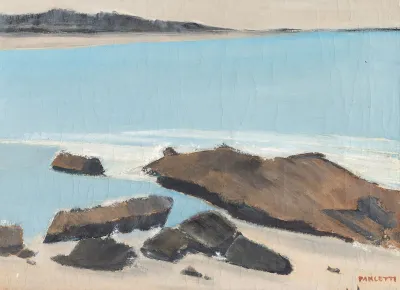
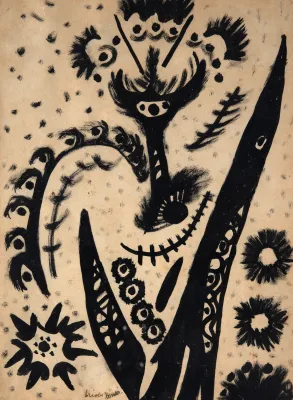
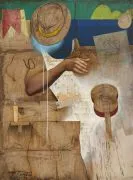
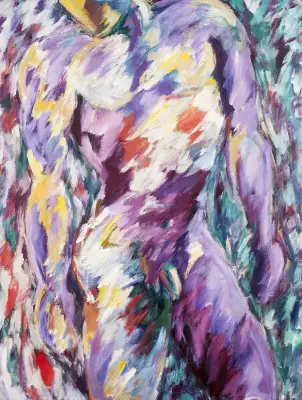
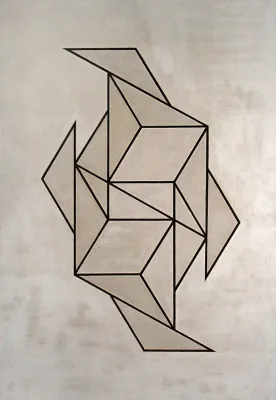
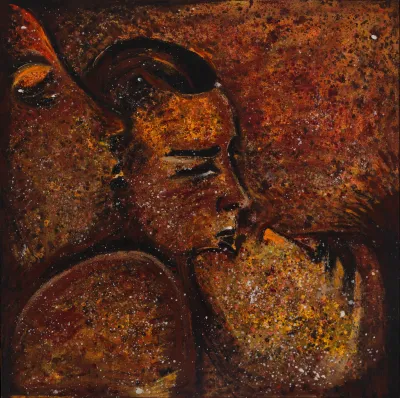
Sérgio Milliet (São Paulo SP 1898 - Idem 1966)
Sérgio Milliet was a writer, art critic, sociologist, teacher, translator and painter. He carried out primary and secondary studies in São Paulo. In 1912, he moved to Switzerland, where he started the course in economic and social sciences in Geneva, concluding it in Bern. In 1916, he began to collaborate with the magazine Le Carmel and, in the following years, published his first books of poetry: Par Le Sentido (1917) and Le Départ sur la Pluie (1919). He returned to Brazil at the end of 1920. He participated in the 1922 Modern Art Week, in São Paulo, adhering to the modernist platform and becoming a defender and encouraging new ideas about art and literature promoted by the group.
em 1923, returned to Europe and settled in Paris, where he accompanied the development of new artistic theories. He collaborated with Brazilian magazines such as Klaxon, Terra Roxa, Ariel and Revista do Brasil, sending foreign texts for publication in Brazil and translating poems by Brazilian modernists for the magazine Lumière. He lived with Brazilian modern artists and writers until he returned definitively to Brazil, in 1925. In that same year, he founded, alongside Oswald de Andrade and Afonso Schmidt, the magazine Cultura. In 1927, he became manager of the Diário Nacional, a São Paulo newspaper of the newly created Democratic Party.
In 1935, he joined the group of intellectuals formed by Paulo Duarte, Mário de Andrade, Rubem Borba de Morais, Tácito de Almeida, among others, who conceived the creation of the Department of Culture of the Municipality of São Paulo. He was appointed Head of the Department's Historical and Social Documentation Division. From 1937 to 1944, he worked as a professor at the School of Sociology and Politics of São Paulo, to which he was linked since the foundation, having held the position of secretary between 1933 and 1935. He met the anthropologist Claude Lévi-Strauss and helped him to make his ethnographic expedition viable.
From 1938, he began to write regularly on art and literature for the newspaper O Estado de S. Paulo, starting a phase of intense production in the critics of art. He published Painters and Painting (1940), The Salt of Heresy (1941), Fora de Forma (1942) and the marginality of modern painting (1942). He strengthened ties with painters from São Paulo and began to paint. Between 1941 and 1944, he collaborated with Clima magazine. In 1943, he traveled to the United States and, upon returning, published the American painting. He took over the direction of the Municipal Library of São Paulo and promoted various cultural activities, such as lectures and round tables with the participation of Luís Martins, Lourival Gomes Machado, Osório César, Roger Bastide, Luis Saia, among others. 1944, he published painting almost always and the first volume of Diário Critical, an anthology that would last for ten volumes until 1959. At the opening of the 1st Brazilian Congress of Writers, in 1945, he inaugurated the Art Section of the Municipal Library, forming the first collection Brazilian modern art audience. That same year, he joined the Democratic Left.
He was one of the main articulators of the creation of the Museum of Modern Art of São Paulo (MAM/SP), founded in 1948 and opened to the public in 1949, integrating his council in the painting and sculpture. He participated in the meetings for the return of the Socialist Party in 1947. In 1949, he was one of the founders and the first president of the Brazilian Association of Art Critics (ABCA). He conceived the retrospective of Tarsila do Amaral at MAM/SP, in 1950, writing the text for the presentation of the catalogue. He published Panorama da Poesia Brasileira in 1952.
He was artistic director of MAM/SP between 1952 and 1957 and directed the 2nd, 3rd and 4th International Biennial of São Paulo, between 1953 and 1958. He retired in 1959. In 1967, MAM/SP organized a retrospective of its pictorial production. The reissue of a critical diary began in 1981, with a famous preface by Antonio Candido in the first volume. In 1998, the year of the centenary of his birth, commemorative events were held at the São Paulo Municipal Library Mário de Andrade, at the Museum of Image and Sound (MIS/SP) and at the University of São Paulo (USP).
Critical Comment
Literary and intellectual critical in the Brazilian artistic and cultural milieu and, in particular, São Paulo, it has great relevance due to its influence on both the modernist generation and on the generation of artists and writers that emerge in the 1930s and 1940s. Interested in the problems of his time, his critical reflection follows the paths of Brazilian modern art from the 1920s to the early 1960s. At first, he works in the press primarily as a literary commentator. Influenced by the predominant ideas in the Brazilian sociocultural environment of the period, he adopts a position in favor of a Brazilianism in the artistic-literary production, although with reservations in relation to the more nationalist postures.
The 1930s mark a change of orientation, when He leaves poetry in the background to dedicate himself to critical activity. In 1932, the book Terminus Seco was edited, the name of the column that he signed in the Diário Nacional, which features articles of artistic criticism. In 1936, he published Marcha a Defendant, a meeting of comments on art and literature. His texts bring reflections on problems of modern life, contemporary man and the crisis that surrounds him. Alongside discussions about art, it addresses political ideas and themes on the agenda in the Brazilian reality of the period, such as, for example, the so-called social literature. From 1938 onwards, he began to write for the newspaper O Estado de S. Paulo and the activity focused on the visual arts becomes more regular. In 1938, he published essays, a collection of texts on literature, arts and social history, many of them originally published in the Revista do Arquivo or in the State column. His texts on art are almost always referring to everyday events: exhibitions by emerging artists, salons, cultural themes in vogue, etc. Almost all of his critical books bring together articles, notes, essays or personal notes, usually published in a newspaper. Owner of a very personal, fluid, poetic, malleable writing, adopts the diary as a preferred form of expression, for which the journalistic character of most of his production also weighs.
The newspaper is yet another vehicle through which it establishes a dialogue with other intellectuals, getting involved in debates and controversies. one of the most famous of them was fought with the concrete artist Waldemar Cordeiro (1925 - 1973) in the 1950s. Sérgio Milliet's caveat in relation to abstract art and aesthetic design Concretism concerns hermeticism, a risk that artists run by too much emphasis on formal exercise, compromising the communicability of the work. Cordeiro, who signed articles for the newspaper Folha da Manhã, counter-arguments accusing him of defending an official and traditionalist art. The debate was cooled down, Sérgio Milliet recognizes the importance of concrete participation in Brazilian art, but continues to warn about the danger of the inexhaustible exploitation of formulas, which is why it is also refractory to said engaged art. A period of great activity in the field of visual arts, marked not only by its written production, but above all by its involvement in numerous events and cultural movements in the São Paulo scene. One of its main concerns is certainly to act with the public didactically, seeking to free it from prejudices in relation to modern art and bring it closer to the new aesthetic values. In this assumption, it anchors its critical production and action in the cultural environment. For him, the critic's task is to inform, explain, clarify, understand a fact according to his historical perspectives, put these relationships and meanings within the reach of the public, opening an understanding in multiple directions. Its production is guided by the objectives of elucidating, guiding and stimulating the public.
Committed to introducing the understanding of modern art in society, it does not follow a unique theoretical position, driven more by the concern to reveal the different points of view. Hence he found in the form of the critical diary the ideal way to express his thoughts and impressions, expose the transience and malleability of ideas without adhering to a posture or current. The diary allows you to mark a reflection in process, register without having to conclude. In the ten critical journal volumes, their understanding of the function of criticism is revealed - the chemistry of reason and intuition, the relativity of arguments about the facts - and the central problems that concern it: the communicability of the work of art, the ability to be transmissible, the participation of the artist In society, the relationship of artists with the time in which they live, the social and cultural conditioning of the works, among others.
The work in the Municipal Library is enlightening the ethical and humanist orientation present in its work, aimed at dissemination as well as the care with the preservation and memory of the arts. Expanding the remodeling work started by his predecessor and friend Rubem Borba de Morais, in his management he organizes the collections, undertakes new acquisitions, promotes conference cycles and creates the Art Section, which plays an important formative role in the generation of young artists and the general public.
The art collection on the paper section of the art section, constituted by the example of European and North American libraries, contains drawings, engravings and paintings. Sérgio Milliet and his collaborator Maria Eugênia Franco favor the production of artists engaged in the languages of the historical moment itself, incorporating many of the young artists of the 1940s and 1950s. from the Museum of Modern Art of São Paulo - MAM/SP. Since 1938, Milliet has defended in the press the creation of a Museum of Modern Art in São Paulo, insisting on the importance of creating instances of legitimation of the various contemporary artistic currents. pedagogical characteristic. The exhibitions organized by him, in addition to exposing contemporary production, pass on the main artistic movements of the 20th century, in a clear strategy of familiarizing the public with the trajectory of international modern art. Prejudice sometimes makes him too flexible and benevolent with the production of his time. But for Sérgio Milliet, flexibility and reticence in relation to rigid positions obey a greater methodological orientation. They come from his contact with North American sociology and anthropology, from his role as a professor at the School of Sociology and Politics and from the option for the relativist approach to the artistic phenomenon.
The conference entitled Marginality of Modern Art, presented at the 1st International Congress of Critics de Arte - AICA, in 1948, brings a reflection of a sociological character on art. In it, Milliet thematizes the functionality of aesthetic taste in the organization of society, anchored in readings of anthropology and sociology, questioning the influence of art for the construction of social consensus. Based on this approach, it builds its interpretation on modern art, linking the formal characteristics of production to aspects experienced in the modern period, such as the multiplication of contacts between subjects, the liberation of conditioning, the uprooting caused by the rapid change in the social order. Hence, in his view, comes the marginal situation of modern art in relation to the prevailing taste and the position of isolation of contemporary artists.
Article of an action organized in favor of modern art, always involved with the practice of intellectual and artistic life, Milliet exerts an undeniable influence In the national artistic and cultural development and leaves an important contribution to the criticism of the Brazilian visual arts.
Critiques
"Since he started to paint, his concept of painting has changed. to move away from the fine arts criticism. To his close friends, especially painters, he said repeatedly: 'If they knew how difficult it is to paint, they would not write so much about painting'. It seemed ridiculous to believe the critic in the normative value of his musings. Worse is to consider himself a superior being who would exist even without the artist...' Later, he assures: 'The function of art is to express the emotion through which we rise above the vulgar, we participate in the human deep that is actually the divine'. could be extended in this note about Sérgio. He was one and many. His life - always illustrated by a human trait - splendid without the color of the will-oe... left our friend, departed without telling anyone, from one moment to another and without an advertising act. He left accompanied by the great silence".
Quirino da Silva
Homage to Sérgio Milliet. Presentation by José Geraldo Vieira and Quirino da Silva. São Paulo: MAM, 1969.
"In Sérgio Milliet's criticism, common sense translates into 'need for plastic construction' (balance); Curiosity in 'sensitivity', 'imagination' is inventiveness, it is freedom of research. These are the permanent aesthetics. For Sérgio, there is no art without lyricism, but it takes consideration so as not to incur the ease that deny the plastic surgery. He wants to explain the 'chaos' of the incommunicability of art with the public. It finds the reason in the breaking of the classic patterns of artistic work and, within the scope of society, points out the accelerating changes in norms and social values as a cause. For art to regain its social function of communicating with the public, society needs to be brought back to stability and new stability will come with socialism."
Lisbeth Rebolo Gonçalves
Gonçalves, Lisbeth Ruth Rebolo. Sérgio Milliet, art critic São Paulo : Perspectiva, 1992, p. 45.
"He felt and expressed in the 1920s, for example, what Mário de Andrade would only realize in the 1940s: that there were (they were all), somehow failed. Milliet created (while others engaged in the illusions of triumphalism) an eminently (self) critical spirit that was aimed at his poetic work, and, later, in his critical and historiographical work. 'So that they believe me to be a modernist poet/I speak of trails/of cars/but how this exoticism of steel weighs me' (Saudade, 1925). In the modernist poet, the departure of this abyss that the subject saw in history was, first of all, a deep reflection on the self in front of the nationalist project. Unlike the vogue/nationalist of various hues that took on the modernist culture, especially after the week, Millie always maintained a suspicious and even ironic stance with the obligation to have 'the things of Brazil' as a mandatory material to think about modernity, at the contrary to the 'critical ufanian' Oswald de Andrade (as the Roberto Schwartz defined) or the optimism of Mário de Andrade's Brazilianness. This brought him a distanced, albeit participative, stance from the means of acting of the intellectuals of the period."
Francisco Alambert Júnior
Alambert Júnior, Francisco [1992]. Exoticism of Steel. O Estado de S. Paulo. Culture. Supplement, p.2.
Collective exhibitions
1942 - São Paulo SP - 7th Hall of the Plastic Artists Union, at Galeria Prestes Maia
1948 - São Paulo SP - Mario Zanini, Rebolo, Sérgio Milliet and Volpi, at the Domus Gallery
1952 - Venice (Italy) - 26th Venice Biennale
1954 - Goiânia GO - Exhibition of the National Congress of Intellectuals
1954 - São Paulo SP - Contemporary Art: Exhibition of the Museum of Modern Art of São Paulo, at MAM/SP
1956 - Venice (Italy) - 28th Venice Biennale
Posthumous exhibitions
1969 - São Paulo SP - Homage to Sérgio Milliet, at MAM/SP
1980 - São Paulo SP - The Brazilian landscape: 1650-1976, at Paço das Artes
1982 - São Paulo SP - From Modernism to Bienal, at MAM/SP
1982 - Rio de Janeiro RJ - Universo do Futebol, at MAM/RJ
1992 - São Paulo SP - Sérgio's look on Brazilian art: drawings and paintings, at the Mário de Andrade Municipal Library
1993 - São Paulo SP - 100 masterpieces from the Mário de Andrade collection: painting and sculpture, in the IEB/USP
1997 - São Paulo SP - Mário de Andrade and the Modernist Group, at the Centro Cultural e de Estudos Aúthos Paganos
2000 - Valencia (Spain) - From La Anthropophagia to Brasilía: Brazil 1920-1950, at Ivam. Center Julio Gonzáles
2002 - São Paulo SP - From Anthropophagia to Brasília: Brazil 1920-1950, at MAB/FAAP
2004 - São Paulo SP CCSP
2004 - São Paulo SP - Paper Office, at CCSP
Source: Itaú Cultural