Regina Graz (Itapetininga SP 1897 - São Paulo SP 1973)
Pintor, decorator.
Between 1913 and 1920 Regina Gomide Graz studies at the School of Fine Arts and Decorative Arts of Geneva, Switzerland, alongside his brother Antonio Gomide (1895 - 1967) and John Graz (1891 - 1980), with whom he marries in 1920. Brazil. In 1923, in Rio de Janeiro, he carried out research on indigenous weaving in Alto Amazonas, being, alongside Vicente do Rego Monteiro (1899 - 1970), a pioneer in the interest of the Brazilian indigenous tradition. He dedicates himself to the tapestry and makes pananeaux, quilts, pillows, fabrics and lamps in a cubist style and art deco. In 1930, he participated with her husband in the decoration of the modernist house, designed by Gregori Warchavchik (1896 - 1972) in São Paulo. From 1932 to 1934 he is part of the Pró-Arte Moderna Society - Spam and between 1934 and 1940 he participated in Group 7 with Victor Brecheret (1894 - 1955), Elisabeth Nobiling (1902 - 1975), Yolanda Mohalyi (1909 - 1978), Rino Levi (1901 - 1965), John Graz and Antonio Gomide. created in 1941 the industry of Carpets Regina Ltda.
Critical Comment
Regina Graz returns to Brazil in 1920, after studying in Geneva, and started to develop, with Antonio Gomide (1895 - 1967) and John Graz (1891 - 1980), paintings and decorative objects linked to the Art Deco style.
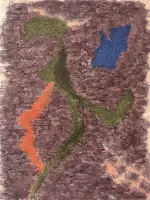
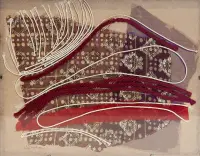
From his production from the 1920s, few works were preserved. Regina Graz is mainly dedicated to interior decoration, working with velvet tapestries, panneaux and pillows, creating motifs that are close to geometric abstraction, derived from Cubist experiences. In the Diana Caçadora tapestry, Déc.1920, the linear figures emphasize the lightness of the form; The background landscape is only indicated and tends to abstraction. In Coqueiros, CA.1930, geometrization and formal simplification predominate.
The artist is dedicated to the study of indigenous textile art, at the Museu do Índio, in Rio de Janeiro. It starts to make rugs, tapestries, lampshades, pillows and quilts, using patterns designed by itself or by John Graz.
Critiques
"Regina, in the field of arts so dictated so applied, has the same value that must be attributed to Tarsila. She was the woman who most assimilated the instances of evolving time; she had the strength of a frankly European education, but with an exquisitely national feeling. Too bad many of her works have Disappeared, what we have left to assert her as a high-value artist. Regina, sister of Antonio Gomide and wife of John Graz, was the animator of the group to which modernism owes its connection with the Art Deco."
p. M. Bardi
BARDI, Pietro Maria. Modernism in Brazil. São Paulo: Sudameris, 1978. (Art and Culture, 1). p. 79.
"At a time when the manifestations of Brazilianness were few or almost none, she, who came from a culturally more advanced center, such as Switzerland, adhered to a nationalism without any folkloric intention that, years later, in Rio, would expand to A deep research of indigenous weaving of Alto Amazonas, which would extend to his woven works. It is up to Regina Gomide Graz Another historical participation: that of being the first artist to be concerned with the decorative arts and their renewal, 'attentive to an interrelationship between Art Nouveau, sought by the young men, and the decoration', as Aracy Amaral observes, stressing that the artist 'tried to carry out in São Paulo a work in the field of decoration and manual arts, such as the one that Sônia Delaunay developed in Paris in the 1920s, in parallel with her work of painter´".
Geraldo Edson de Andrade
ANDRADE, Geraldo Edson de. Aspects of Brazilian tapestry. Presentation by Clarival do Prado Valladares. Rio de Janeiro: Funarte, 1978.
Individual exhibitions
1947 - São Paulo SP - Individual
Collective exhibitions
1920 - São Paulo SP - Regina Gomide Graz and John Graz, at Central Cinema
1922 - São Paulo SP - Modern Art Week, at Theatro Municipal
1931 - Rio de Janeiro RJ - Exhibition at the first modernist house in Rio de Janeiro, at Rua Toneleros
1931 - Rio de Janeiro RJ - Revolutionary Hall, at Enba
1933 - São Paulo SP - 1st Spam Modern Art Exhibition, at Palacete Campinas
1934 - São Paulo SP - 1st Paulista Salão de Belas Artes, at Rua 11 de Agosto
1942 - São Paulo SP - 7th Salon of the Plastic Artists Union, at the Prestes Maia Gallery
1960 - São Paulo SP - Contribution of women to the plastic arts in the country, in the MAM/SP
1972 - São Paulo SP - The Week of 22: Antecedents and Consequences, in the MASP
Posthetic exhibitions
1974 - São Paulo SP - Time of the Modernists, in the MASP
1974 - São Paulo, SP - 1st Brazilian Tapestry Exhibition, at MAB/FAAP
1975 - São Paulo SP - SPAM and CAM, at the Lasar Segall Museum
1976 - São Paulo SP - The Graz-Gomide Family: The Art-Deco in Brazil, at the Lasar Segall Museum
1984 - São Paulo SP - Tradition and rupture: synthesis of Brazilian art and culture, at the Bienal Foundation
1994 - São Paulo SP - Bienal Brazil 20th Century, at Fundação Bienal
1998 - São Paulo SP - Constructive Art in Brazil: Adolpho Leirner Collection, at MAM/SP
1999 - Rio de Janeiro RJ - Constructive Art in Brazil: Adolpho Collection Leirner, at MAM/RJ
2000 - Valencia (Spain) - From La Anthropophagia to Brasilía: Brazil 1920-1950, at IVAM. Center Julio Gonzáles
2002 - São Paulo SP - From Anthropophagia to Brasília: Brazil 1920-1950, at MAB/FAAP
2004 - São Paulo SP - Women painters, at the Pinacoteca of the State
Source: Itaú Cultural