Pedro Alexandrino

Available artworks

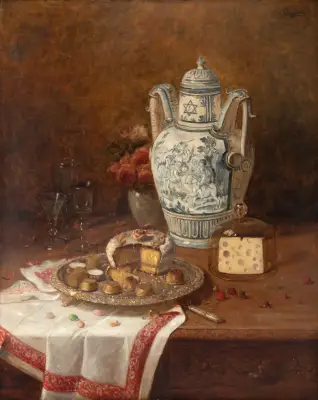
Pedro Alexandrino - Dead Nature

Dead Nature

oil on canvas70 x 86 cm
Pedro Alexandrino - Dead Nature

Dead Nature

oil on canvas125 x 100 cm
Pedro Alexandrino - Dead Nature

Dead Nature

oil on canvas73 x 87 cm

Biography

Pedro Alexandrino Borges (São Paulo SP 1856 - Idem 1942)

Pedro Alexandrino Borges was a painter, decorator, designer and teacher. He began his career in painting at the age of 11, working with the French decorator Barandier (ca.1812 - 1867) at the Cathedral of Campinas, São Paulo. At the same time, he helped the French decorator Stevaux in São Paulo, carrying out work in churches, residences and palaces. In 1880, he received his first painting lessons from Mato Grosso's painter from Mato Grosso João Boaventura da Cruz. From 1883, he began to study with Almeida Júnior (1850 - 1899) in his studio, at Rua da Glória, in São Paulo. Between 1887 and 1888, he studied drawing with José Maria de Medeiros (1849 - 1925) and painting with Zeferino da Costa (1840 - 1915), as a scholarship student at the Imperial Academy of Fine Arts (Aiba), in Rio de Janeiro. Between 1890 and 1892, he joined the National School of Fine Arts (ENBA), but did not complete the course. 1896. He traveled to Paris with Almeida Júnior, as a pensioner in the state of São Paulo, and attended the studio of René-Loui Chrétien (1867 - 1942) and the Académie Fernand Carmon. He met Antoine Vollon (1833 - 1900) and studied with him from 1899 onwards. He also attended the Atelier Lauri and studied with the painter Monroy. He returned to Brazil in the first decade of the 20th century, establishing himself in São Paulo, where he taught drawing and painting. Among his students were Tarsila do Amaral (1886 - 1973), Anita Malfatti (1889 - 1964) and Bonadei (1906 - 1974), among others.

Formation

1880 - Pirapora SP - receives the first lessons of artistic painting by Mato Grosso painter João Boaventura da Cruz
1883 - São Paulo SP - is a student of Almeida Júnior, who advises him to Continue painting still lifes
1887/1888 - Rio de Janeiro RJ - As a fellow, studies drawing with José Maria de Medeiros (1849-1925) and painting with Zeferino da Costa (1840-1915), at AIBA
ca.1890/1892 - Rio de Janeiro RJ - studies at ENBA. does not complete the course
ca.1896 - Paris (France) - study in the studio of René Chrétien and at the Académie Fernand Carmon
1899/CA.1901 - Paris (France) - studies at Atelier by Antoine Vollon, at Ateliê Lauri and with the painter Monroy

Critical Comment

Before even from his study trip to Paris, Pedro Alexandrino is already an artist specializing in still life. According to art historian Ruth Tarasantchi, his production from this period is influenced by his master, Almeida Júnior (1850 - 1899), mainly in the smooth invoice and in the use of dark backgrounds. In Cozinha na Roça, 1894, he presents a composition with freer brushstrokes, in which it is possible to observe the painter's ability to use colors.

In France, he has contact with the work of Antoine Vollon (1833 - 1900) and by René-Louis Chrétien (1867 - 1942). In Paris, as Tarasantchi points out, his compositions become more complex, carried out with wider brushstrokes, with less concern for details. The artist's taste for rounded or cylindrical shapes is revealed in flowers and sweets, s.d. or in metals, porcelain and strawberries, s.d.

alexandrino is known for the representation of metal objects, from which it manages to convey the impression of volume and brightness. Sometimes, in the same painting, he gathers two or three different types of metals, demonstrating his ability to reproduce the different tones of each piece. Another constant in his work is the exploration of the effects of transparency, when he paints crystals or glass bottles.

Critics

"Pedro Alexandrino (...) proved to be the artist who, in his time, our society demanded. collectors' needs, because their paintings, easy to read, satisfied the senses, not having to resort to the artistic culture they did not have. He painted realistic objects and fruits that were part of the life or aspirations of São Paulo society; therefore, through his work we have a idea of our environment at the end of the last century and even almost the middle of this one. It was he, more than any other painter, who made us glimpse our provincial environment, with little culture, at the same time as pretentious, seeking to be Francesed."
Ruth Sprung Tarasantchi
TARASANTCHI, Ruth Sprung. The silent life in the painting of Pedro Alexandrino. 1981. Dissertation (Master's) - School of Communications and Arts - ECA/USP, São Paulo, 1981.

"Pedro Alexandrino, happier than the others, went to the hectic Parisian focus to improve himself in the workshops of notable and consecrated experts (...). But he will have, with that, conquered the realms of complete and true artist, he will have given his work the indispensable educational nature that immortalizes, in the history of each people, the great conceptions of your esthetes? Frankly, it seems to me that it is not. If the role of art is (...) to contribute to the perennial culture of the affective feelings of man, in the home, in the country and in the world, (...) Times of planetary evolution, we will reach this inapplayable conclusion: Still life is a true aberration. What high ideas and that profitable cogitations can suggest us, for example, a blonde bunch of ripe bananas (...)? You can, at most, wake us up the lower instinct of gluttony."
Alberto de Sousa
TARASANTCHI, Ruth Sprung. The silent life in the painting of Pedro Alexandrino. 1981. Dissertation (Master's) - School of Communications and Arts - ECA/USP, São Paulo, 1981.

"Pedro Alexandrino specialized in still life because this is the genre most according to the His placid and prudent temperament never felt the attraction of the ignorant, he never took in confusing paths that disturbed his serenity found in artistic conviction. His art without pretensions to creative genius is solid because he is Undoubtedly a master of naturalistic design, he is sincere because the joy of colors overflows from his paintings in firm and conscious brushstrokes, is honest because he does not transgress his art from the principles he has adopted as being the real ones". Tarsila do Amaral
TARASANTCHI, Ruth Sprung. The silent life in the painting of Pedro Alexandrino. 1981. Dissertation (Master's) - School of Communications and Arts - ECA/USP, São Paulo, 1981.

Individual exhibitions

1880 - São Paulo SP - Individual, at Livraria Garraux 
1881 - São Paulo SP - Individual, at Livraria Garraux 
1883 - São Paulo SP - Individual, at Livraria Garraux 
1890 - São Paulo SP - Individual, at Casa Henschel
1890 - São Paulo SP - Individual, at Casa Apollo 
1891 - Rio de Janeiro RJ - Individual, at Casa Apollo
1891 - Rio de Janeiro RJ - Individual 
1891 - São Paulo SP - Individual, at Casa Apollo 
1896 - São Paulo SP - Individual, at the Grêmio dos Guarante-Brosty
1905 - São Paulo SP - Individual, at the Liceu de Artes e Ofícios
1906 - Campinas SP - Individual, at the Carlos Gomes Museum
1910 - São Paulo SP - Individual, at the Liceu de Artes e Ofícios
1922 - Santos SP - Individual, at the American Bazar

Collective exhibitions

1894 - Rio de Janeiro RJ - 1st General Exhibition of Fine Arts, at ENBA - 3rd class gold medal
1895 - Rio de Janeiro RJ - 2nd General Exhibition of Fine Arts, at ENBA - 2nd Class Gold Medal
1895 - São Paulo SP - Almeida Júnior and Pedro Alexandrino, at Ateliê Almeida Júnior
1899 - Paris (France) - Salão de Paris
1900 - Paris (France) - Paris Salon
1901 - Paris (France) - Paris Salon
1903 - Paris (France) - Paris Salon
1907 - Paris (France) - Hall from Paris 
1908 - Paris (France) - Paris Salon
1911 - São Paulo SP - 1st Brazilian Exhibition of Fine Arts, at the Liceu de Artes e Ofícios
1912 - São Paulo SP - 2nd Brazilian Exhibition of Fine Arts, at the Liceu de Artes e Ofícios
1922 - Rio de Janeiro RJ - 29th General Exhibition of Fine Arts
1922 - Rio de Janeiro RJ - Contemporary Art Exhibition
1922 - Rio de Janeiro RJ - Exhibition of the Centenary of Independence
1922 - São Paulo SP - 1st General Exhibition of Fine Arts, at Palácio das Indústrias - Gold Medal
1928 - São Paulo SP - Grupo Almeida Júnior, at Palácio das Arcadas
1928 - São Paulo SP - Muse Italiche Fine Art Salon, at Palácio das Indústrias  
1934 - São Paulo SP - 1st Paulista Salon of Fine Arts - Honor Award and Gold Medal
1937 - Paulo SP - 5th Paulista Salon of Fine Arts
1939 - Rio de Janeiro RJ - 45th National Salon of Fine Arts - Medal of Honor
1939 - Santos SP - Painting exhibition, commemorating the first centenary of the elevation of Santos to the category of City
1939 - São Paulo SP - 6th São Paulo Salon of Fine Arts
1940 - São Paulo SP - 7th São Paulo Salon of Fine Arts
1940 - São Paulo SP - Retrospective Exhibition: Works by the great masters of painting and His disciples

Posthumous exhibitions

1943 - São Paulo SP - 9th Salão Paulista de Belas Artes, at the Prestes Maia Gallery 
1944 - São Paulo SP - is honored at the Salão de Fine Arts
1944c. - São Paulo SP - Collection on display at Sala Pedro Alexandrino, at Pinacoteca do Estado
1946 - São Paulo SP - Salão Paulista de Belas Artes, at the Prestes Maia Gallery 
1950 - Rio de Janeiro RJ - A Century of Brazilian painting: 1850-1950, at the MNBA
1954 - São Paulo SP - 19th Salão Paulista de Belas Artes, at the Prestes Maia Gallery 
1970 - São Paulo SP - Pinacoteca do Estado de São Paulo 1970
1976 - São Paulo SP - The portrait in the collection of the Pinacoteca, at the Pinacoteca do Estado
1980 - Buenos Aires (Argentina) - Ochenta Años de Arte Brasileño, at Banco Itaú
1980 - São Paulo SP - Featured in March, at Galeria Sesc Paulista
1981 - São Paulo SP - Four great painters in São Paulo, at the Bienal Foundation
1982 - Bauru SP - 80 years of Brazilian art
1982 - Marília SP - 80 years of Brazilian art 
1982 - São Paulo SP - 80 years of Brazilian art, MAB/FAAP
1982 - São Paulo SP - Marines and Ribeirinhas, at the Lasar Segall Museum
1983 - Belo Horizonte MG - 80 years of Brazilian art, at the Clóvis Salgado Foundation. Palácio das Artes
1983 - Campinas SP - 80 years of Brazilian art, at MacC  
1983 - Curitiba PR - 80 years of Brazilian art, at MAC/PR  
1983 - Ribeirão Preto SP - 80 years of Brazilian art  
1983 - Santo André SP - 80 years of Brazilian art, at the Municipality of Santo André
1986 - São Paulo SP - nineteenth: a turn in the Century, at the Pinacoteca do Estado
1987 - São Paulo SP - Brazil painted by national and foreign masters: 18th - 20th centuries, at Masp 
1988 - São Paulo SP - Brasiliana: O Homem e A land, at the Pinacoteca do Estado
1989 - São Paulo SP - Painting Brazil 19th and 20th Century: Works of the Banco Itaú Collection, in Itaugaleria
1990 - São Paulo SP - The Art Collection of the Municipality of São Paulo MASP
1992 - São Paulo SP - Pedro Alexandrino revisited, at the Pinacoteca do Estado  
1993 - Santos SP - Six great painters, at Pinacoteca Benedito Calixto  
1994 - São Paulo SP - A critical look at the 19th century collection at the Pinacoteca do Estado
2000 - Porto Alegre RS - from Frans Post to Eliseu Visconti: National Museum of Fine Arts Collection - RJ, at Margs 
2000 - São Paulo SP - 51st São Paulo Salon of Fine Arts, at the Legislative Assembly of São Paulo
2000 - São Paulo SP - Almeida Júnior: a revisited artist, in the Pinacoteca do Estado
2000 - São Paulo SP - Brazil + 500 Rediscovery Exhibition. 19th century art at the Bienal Foundation
2001 - São Paulo SP - Brazilian Art Museum: 40 years at MAB/FAAP
2002 - Brasília DF - Barão do Rio Branco: His work and his time, at the Ministry of Relations exteriors. Palácio do Itamaraty
2003 - São Paulo SP - Painters from the coast of São Paulo, in Sociarte

Source: Itaú Cultural

See also