Orlando Teruz (Rio de Janeiro RJ 1902 - idem 1984)
Painter, teacher.
Orlando Rabello Teruz studied at the Escola Nacional de Belas Artes - Enba [National School of Fine Arts] between 1920 and 1923, as a pupil of Baptista da Costa and Rodolfo Chambelland, and the following year took part for the first time in the Exposição Geral de Belas Artes [General Exhibition of Fine Arts] in Rio de Janeiro. In 1934 he received the travel prize, which he only used in 1939, when he traveled to France, the Netherlands and Italy, but he had to cut the trip short because of the outbreak of the Second World War (1939 - 1945). He worked with Lucio Costa and Candido Portinari to establish the modern division of the Salão Nacional de Belas Artes, which came into effect in 1940. In 1944 he took part in the Exhibition of Modern Brazilian Paintings held at Burlington House, the headquarters of the Royal Academy of Arts in London. In 1951 and 1953 he took part in the 1st and 2nd Bienal Internacional de São Paulo. In the mid-1950s he taught painting at the Instituto de Belas Artes da Guanabara. His work was shown in several solo exhibitions in Brazil and abroad during the 1960s and entered important collections around the world, such as those of the Museu de Arte de São Paulo Assis Chateaubriand - Masp, the Museu Nacional de Belas Artes - MNBA and the Hermitage Museum in Saint Petersburg, Russia. In the 1970s he and his family began building his private museum in the Tijuca neighborhood of Rio de Janeiro.
Critical Commentary
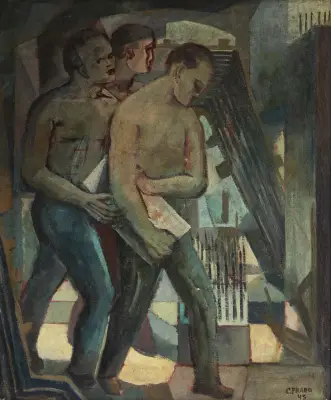
As the writer Carlos Heitor Cony (1926 - 2018) points out in a book devoted to Orlando Teruz's work, his production is very close to that of Candido Portinari, with whom he had been friends since their training at the Escola Nacional de Belas Artes - Enba in Rio de Janeiro, in both formal and thematic terms. Both proposed a modern painting that would escape the solutions dictated by academic training while maintaining a relationship with tradition.
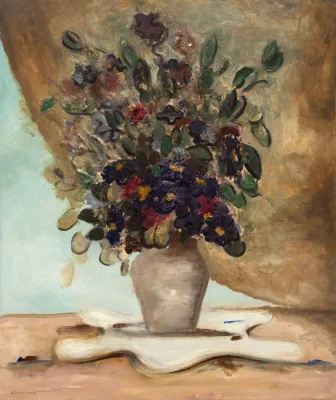
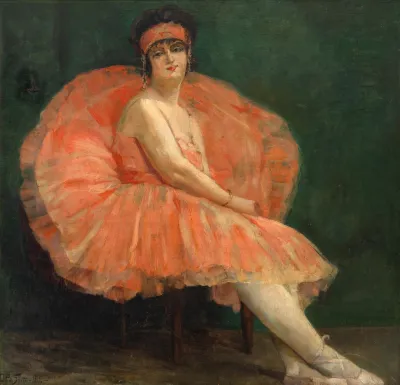
Like Portinari, Teruz had great technical mastery, both in painting and in observational drawing, refined during his training at Enba. His subjects include scenes of childhood - countless and present in every period of the painter's vast output - horses and popular gatherings. According to the historian Walmir Ayala, Teruz's conception of modernity coincides with "the aspirations of the modernist seed: an everyday Brazilianness, in scenes and figures recognizable at first sight as ours."1
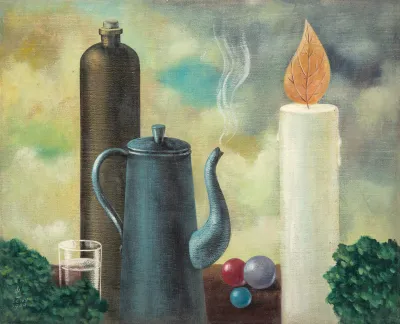
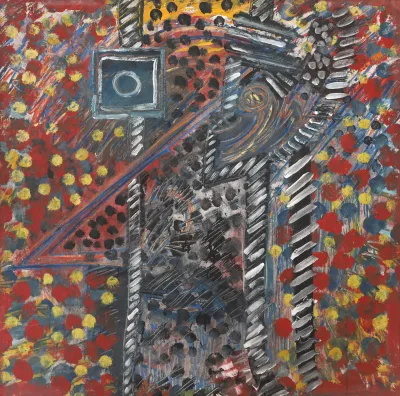
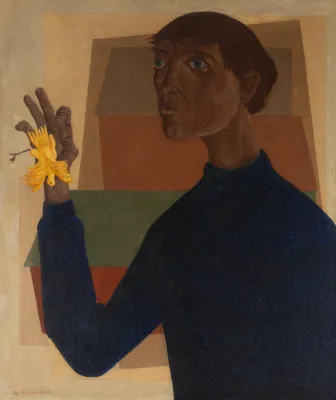
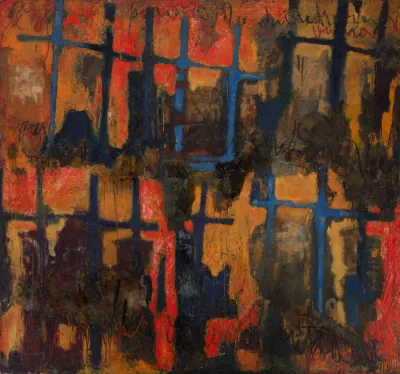
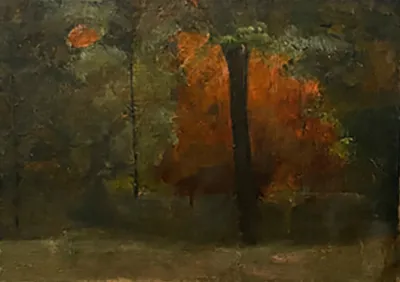
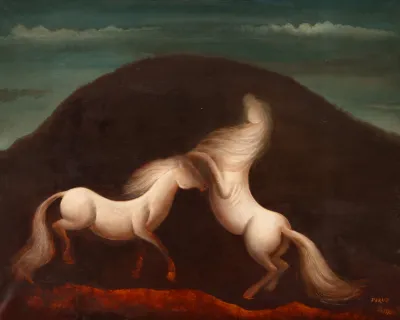
Ayala also draws attention to what constitutes the main characteristic of Teruz's painting: an "intermediate level between the old and the new, the norm and the rupture, following a path traveled little by little, day by day, without major contradictions or anxieties."2 On this threshold between the modern and the traditional, Teruz at times touches on solutions brought by the avant-garde movements, Surrealism being the most striking reference in terms of dreamlike settings, present even in his late production, as in Cavalos [Horses], 1969, or Rosas [Roses], 1965. Here again, the subdued browns and blues recall the Portinari of 1940. Religious themes also run through Teruz's production from the 1930s on.
Notes
1 AYALA, Walmir. Dicionário de Pintores Brasileiros, p. 379.
2 Idem
Critiques
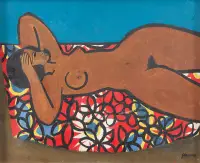
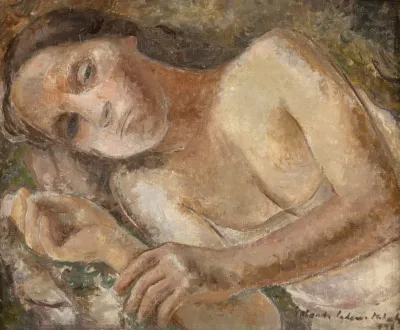
"One of the most obvious features of Teruz's work is sensuality. Not only the rounded drawing, with full, carnal forms, but the warmth of his paint and the peculiar play of light that brings out the forms - whether the haunches of a horse or the legs of a girl. In his nudes, without ever slipping into vulgarity, he manages to convey his erotic vision of woman, whether in the Baroque of her curves or in the careless, languid posture of legs or arms. Curiously, Teruz painted his subjects with such sensuality that there was never room for the erotic as such. His nudes are, without exception, chaste. Except for two or three bolder incursions into the erotic, such as the girl and the horse, where two of his favorite themes merge and, in merging, create a double meaning. The theme of motherhood, one of his constants, finds in Teruz one of its most abundant exponents in Brazilian painting".
Carlos Heitor Cony
CONY, Carlos Heitor. Orlando Teruz: pintor. s.l., Galeria de Arte Antônio Bandeira, Acervo Teruz, Korum, 1985.
Collections
Coleção Gilberto Chateaubriand - MAM RJ - Rio de Janeiro RJ
Museu de Arte de São Paulo Assis Chateaubriand - Masp - São Paulo SP
Hermitage Museum - Saint Petersburg (Russia)
Museu Nacional de Belas Artes - MNBA - Rio de Janeiro RJ
Solo Exhibitions
1965 - Rio de Janeiro RJ - Solo, at MNBA
1965 - São Paulo SP - Solo, at Galeria Atrium
1966 - Rio de Janeiro RJ - Solo, at Galeria Oca
1967 - Paris (France) - Solo, at Galeria Debret
1971 - Recife PE - Solo, at Ranulpho Galeria de Arte
Group Exhibitions
1921 - Rio de Janeiro RJ - 28th General Exhibition of Fine Arts, Escola Nacional de Belas Artes
1923 - Rio de Janeiro RJ - 30th General Exhibition of Fine Arts, Escola Nacional de Belas Artes
1924 - Rio de Janeiro RJ - 31st General Exhibition of Fine Arts, Escola Nacional de Belas Artes - honorable mention
1925 - Rio de Janeiro RJ - 32nd General Exhibition of Fine Arts, Escola Nacional de Belas Artes - bronze medal
1926 - Rio de Janeiro RJ - 33rd General Exhibition of Fine Arts, Escola Nacional de Belas Artes - silver medal
1927 - Rio de Janeiro RJ - 34th General Exhibition of Fine Arts, Escola Nacional de Belas Artes
1928 - Rio de Janeiro RJ - 35th General Exhibition of Fine Arts, Escola Nacional de Belas Artes
1929 - Rio de Janeiro RJ - 36th General Exhibition of Fine Arts, Escola Nacional de Belas Artes
1930 - Rio de Janeiro RJ - 37th General Exhibition of Fine Arts, Escola Nacional de Belas Artes
1931 - Rio de Janeiro RJ - Salão Revolucionário [Revolutionary Salon], Escola Nacional de Belas Artes
1933 - Rio de Janeiro RJ - 39th General Exhibition of Fine Arts, Escola Nacional de Belas Artes
1933 - São Paulo SP - 2nd SPAM Modern Art Exhibition, Palacete Campinas
1934 - Rio de Janeiro RJ - 40th National Salon of Fine Arts, Escola Nacional de Belas Artes - foreign travel prize
1935 - Rio de Janeiro RJ - Social Art Exhibition, Clube de Cultura Moderna
1938 - São Paulo SP - 2nd Salão de Maio, Esplanada Hotel de São Paulo
1941 - Rio de Janeiro RJ - 47th National Salon of Fine Arts, Museu Nacional de Belas Artes - domestic travel prize
1944 - London (United Kingdom) - Exhibition of Modern Brazilian Paintings, Royal Academy of Arts
1944 - Rio de Janeiro RJ - 50th National Salon of Fine Arts, Museu Nacional de Belas Artes
1945 - Buenos Aires (Argentina) - 20 Artistas Brasileños, Salas Nacionales de Exposición
1945 - La Plata (Argentina) - 20 Artistas Brasileños, Museo Provincial de Bellas Artes
1945 - Montevideo (Uruguay) - 20 Artistas Brasileños, Comisión Municipal de Cultura
1951 - São Paulo SP - 1st Bienal Internacional de São Paulo, at Pavilhão do Trianon
1953 - São Paulo SP - 2nd Bienal Internacional de São Paulo, at Pavilhão dos Estados
1954 - Goiânia GO - Exhibition of the National Congress of Intellectuals
1958 - Rio de Janeiro RJ - Art Salon The Mother and the Child
1958 - Vatican - International Exhibition of Sacred Art
1972 - São Paulo SP - Art/Brazil/Today: 50 Years Later, Galeria da Collectio
1975 - São Paulo SP - SPAM and CAM, Museu Lasar Segall
1978 - Rio de Janeiro RJ - 2nd Brasil Arte Turismo, at Hotel Copacabana Palace
1980 - Buenos Aires (Argentina) - Ochenta Años de Arte Brasileño, Banco Itaú
1982 - Bauru SP - 80 Years of Brazilian Art
1982 - Lisbon (Portugal) - Brazil 60 Years of Modern Art: Gilberto Chateaubriand Collection, Centro de Arte Moderna José de Azeredo Perdigão
1982 - London (United Kingdom) - Brazil 60 Years of Modern Art: Gilberto Chateaubriand Collection, Barbican Art Gallery
1982 - Marília SP - 80 Years of Brazilian Art
1982 - São Paulo SP - 80 Years of Brazilian Art, at Museu de Arte Brasileira
1983 - Belo Horizonte MG - 80 Years of Brazilian Art, Fundação Clóvis Salgado. Palácio das Artes
1983 - Campinas SP - 80 Years of Brazilian Art, MACC
1983 - Curitiba PR - 80 Years of Brazilian Art, Museu de Arte Contemporânea
1983 - Ribeirão Preto SP - 80 Years of Brazilian Art
1983 - Rio de Janeiro RJ - 6th National Visual Arts Salon, Museu de Arte Moderna
1983 - Rio de Janeiro RJ - Brazilian Self-Portraits, Galeria de Arte Banerj
1983 - Santo André SP - 80 Years of Brazilian Art, Prefeitura Municipal de Santo André
1984 - Fortaleza CE - 7th National Visual Arts Salon
Posthumous Exhibitions
1984 - Rio de Janeiro RJ - 7th National Visual Arts Salon, MAM/RJ
1984 - Rio de Janeiro RJ - Salão de 31 [1931 Salon], Funarte
1984 - São Paulo SP - Tradition and Rupture: A Synthesis of Brazilian Art and Culture, Fundação Bienal
1985 - São Paulo SP - 100 Itaú Works, Museu de Arte de São Paulo
1986 - São Paulo SP - Time of Maturity, Ranulpho Galeria de Arte
1989 - São Paulo SP - Thirty-Three Ways of Seeing the World, Ranulpho Galeria de Arte
1991 - São Paulo SP - Chico and the Animals, Ranulpho Galeria de Arte
1996 - Barra Mansa RJ - 12 Names in Brazilian Painting, Centro Universitário de Barra Mansa
2001 - Brasília DF - Collections of Brazil, Centro Cultural do Banco do Brasil
2001 - São Paulo SP - 4 Decades, Nova André Galeria
2002 - São Paulo SP - Landscapes of the Imaginary, Nova André Galeria
2003 - Rio de Janeiro RJ - Caixa Treasures: Brazilian Modern Art in the Caixa Collection, Conjunto Cultural da Caixa
2003 - São Paulo SP - 7 Visions, Nova André Galeria
2005 - São Paulo SP - Homo Ludens: From Make-Believe to Vertigo, Itaú Cultural
2006 - Recife PE - Modern Art in Context: ABN AMRO Real Collection, Instituto Cultural Banco Real
2006 - Rio de Janeiro RJ - Modern Art in Context: ABN AMRO Real Collection, Museu de Arte Moderna
2006 - São Paulo SP - Modern Art in Context: ABN AMRO Real Collection, Banco Real
Source: Itaú Cultural