Omar Rayo (Roldanillo, Colombia 1928 - Palmira, Colombia 2010)
Omar Rayo was a painter, sculptor, caricaturist and visual artist. The eldest son of Ray and Maria Luisa Reyes, he began his drawing studies through correspondence courses and later attended an academy in Buenos Aires. In 1947, he settled in Cali. Unable to find work as an illustrator for local newspapers, he supported himself by drawing caricatures and briefly attended the Academy of Fine Arts.
The following year, he moved to Bogotá, where he worked as an illustrator for several publications in the capital. He was hired by the newspaper El Siglo to create caricatures of the participants in the Pan-American Games and the Ninth Pan-American Conference. In the city, he frequented the Café Automático, a meeting point for intellectuals and writers such as León de Greiff, Luis Vidales and Jorge Zalamea. From this period on, he began his own work, with pieces such as a series of portraits on wood shavings of the bohemians who frequented the café, as well as stylized human figures created from elongated forms.
Between 1948 and 1953, he held several exhibitions, won competitions and gained some recognition in the capital's art scene. In 1953, he had the opportunity to study in Madrid on a scholarship, but chose instead to travel through Latin America, giving presentations and exchanging experiences with local artists. During this journey, he lived with Indigenous peoples of the Amazon and studied Inca and Mesoamerican art. This contact with pre-Columbian art was decisive for his development and awakened his interest in geometry as an artistic language, which would become the basis of his work.
He returned to Colombia in 1958 and, the following year, with the support of a grant, spent a year in Mexico at the La Esmeralda printmaking workshop, where he met artists such as José Luis Cuevas and Francisco Toledo. In 1960, he received a grant from the Guggenheim Foundation and moved to New York, the city where he would settle permanently in 1976 and where his work would achieve full international recognition.
During this period, he devoted himself especially to the technique of relief intaglio, addressing various themes in series on animals, everyday objects and human figures. In 1970, he received a special prize at the Latin American Print Biennial in San Juan, Puerto Rico, and, that same year, first prize at the Salón Nacional de Artistas [National Artists' Salon] of Colombia. In 1971, the Museum of Modern Art of Bogotá organized a retrospective of his work, and he took part in the São Paulo Biennial.
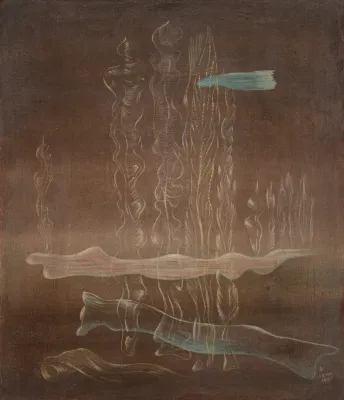
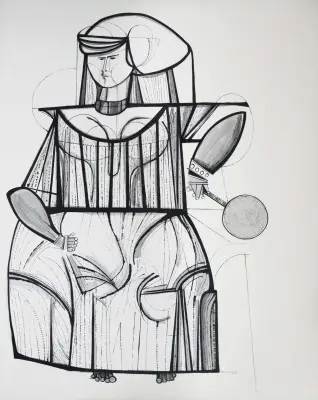
Although his printmaking received great recognition, Rayo devoted himself intensely to painting, developing a singular geometric style influenced by pre-Columbian art and an abstract primitivism. His compositions are characterized by overlapping forms that create patterns with striking optical effects, giving the works an illusion of three-dimensionality and a sense of infinite continuity. The rigorous use of geometry, black and white or vibrant colors, combined with technical precision, intensifies the visual experience of contemplation.
In 1981, he opened in his hometown the Museo Rayo de Dibujo y Grabado Latinoamericano [Rayo Museum of Latin American Drawing and Printmaking]. Designed by the Mexican architect Leopoldo Gout, the museum houses some two thousand works by the artist, as well as exhibition rooms, a library and printmaking workshops.