Nuno Ramos (São Paulo SP 1960)
Nuno Ramos is a sculptor, painter, draftsman, scenographer, essayist and videographer. He studied Philosophy at the Faculty of Philosophy, Letters and Human Sciences of the University of São Paulo (FFLCH/USP) between 1978 and 1982. Between 1980 and 1981, he served as editor of the magazines Almanaque 80 and Kataloki. He started painting in 1983, the year he founded the Ateliê Casa 7, together with Paulo Monteiro (1961), Rodrigo Andrade (1962), Carlito Carvalhosa (1961) and Fábio Miguez (1962). He carried out his first three-dimensional works in 1986. The following year, he was awarded the 1st Émile Eddé de Artes Flásticas Scholarship, granted by the Museum of Contemporary Art of the University of São Paulo (MAC/USP).
In 1992, in Porto Alegre, presented for the first time the installation 111, which refers to the massacre of prisoners in the Casa de Detenção de São Paulo (Carandiru), which took place that year. In 1993, he published the book em Prose whose and, in 1995, the book-object Balada. In 2000, he won the contest held in Buenos Aires for the construction of a monument in memory of the disappeared during the military dictatorship in that country. In 2002, he published the book of short stories O Pão do Corvo. To compose his works, he uses various supports and materials, working with engraving, painting, photography, installation, poetry and video.
Critical Comment
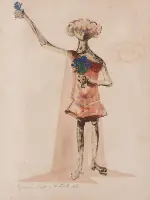
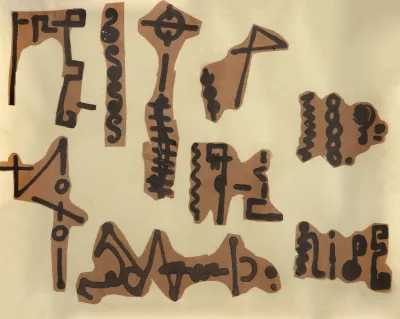
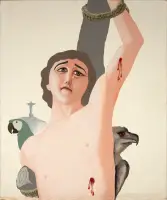
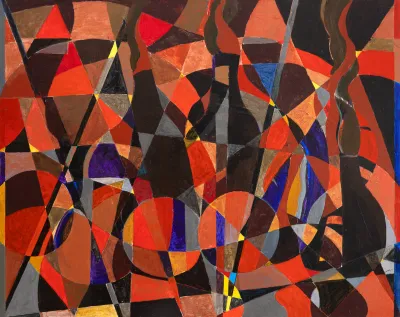
Nuno Ramos begins to paint in 1982, at Casa 7, Ateliê Graduated with the artists Fábio Miguez (1962), Paulo Monteiro (1961), Rodrigo Andrade (1962) and Carlito Carvalhosa (1961). At the time, his works are figurative and gestural, made with synthetic enamel on paper. His painting is influenced by Julian Schnabel (1951) and Anselm Kiefer (1945). As of 1985, he starts using oil paint on canvas. The ink mass becomes thicker and the shapes more abstract. In the period, it acquires prestige and visibility. He participates in the 18th International Biennial of São Paulo (1985) and the 2nd Bienal de Havana (1986).
In 1987, he exhibits his first three-dimensional works. Makes sculptures with lime, fabric and wood. The works show a change in his career: the interest shifts from a figuration associated with the expressive gesture, to the composition of pieces in which disparate materials are related. The following year, the surfaces of its paintings swell, taken by a thick and colorful mass, where objects of different nature such as wood, cloth and wire amalgam. This aggregate of materials projects the surface to the limits of the support, transforming it into a relief.
In the 1990s, it develops its first facilities. It also brings together materials of different natures. It has sculptures, photographic images, texts and other objects incorporated in the space. In 1992, he carried out 111, where he addresses the brutality of the massacre of 111 inmates at the São Paulo House of Detention (Carandiru), which took place in the same year. In 1996, it expands the area where its work is shown and carries out the Matacão Environmental Project. The artist inserts stones into open-air pits, in the rural area of Orlândia, São Paulo.
At the same time, he makes marble and granite pieces with Vaseline, such as Manorá, 1997/1999 and makes canvases each bigger and bigger. In 2002, he shows his first film, Luz Negra, in honor of the singer and songwriter Nélson Cavaquinho (1910 - 1986). The following year, he installed large pieces of sand at the Pampulha Art Museum - MAP, in Belo Horizonte, and at the Açude Museum, in Rio de Janeiro. Duplicate are four ways that Nuno Ramos found to emphasize and problematize the invention in art. It is through them that he built, in addition to the stylistic or more immediate visual appearance, an invariant poetic. He wants you to deviate, he always sought to continue the discontinuous and, in this movement, expose the tension between them. This is how, when investigating the doing by the gesture, he seeks to continue it as such in the painting despite the insurmountable discontinuity between a gesture and the mark he or who, by highlighting the doing by juxtaposition, does not create collages with discrete elements, but amalgams or mergers of the most diverse things, in which there is a continuous act of aggregating. It guarantees a continuity between them and their sensitive traces through a skillful counterpoint between the evident and the enigmatic. Already, when it addresses the doing for the relationship between model and copy, the different scales gain fluidity and continuity in the game of imagination that is offered to the spectator. But if the formula 'continues the discontinuous' sounds abstract - as if it were a mathematical, philosophical problem -, it may be enough, to make it concrete, to look at one of his works, in which any wreckage, fragment, rest, in the end, but only in the At the end of the day, it is saved from its sinking. And who knows how to experience the unique feeling, typical of art and of not much more, that the flaps, the discontinuity and the finitude of life flow into a greater, uninterrupted and continuous course as the successor of generations."
alberto Tassinari
Tassinari, Alberto. Gestar, Juxtapor, Aludar, Duplicate. In: Tassinari, Alberto; Mammì, Lorenzo; NAVES, Rodrigo. Ramos. São Paulo: Ática, 1997, p. 16-29.
"The time of these works is not the time of succession, which allows things to accumulate. It is rather a porous time, which operates within an extensive gift, to repeatedly create its own suspension, annulling one after the other all successive movements. With this, it is the very process of conformation that is put in check. If in the modern tradition, in a good measure, the form was obtained from a phenomenological conception of matter - which did not prevent it from having a hitherto unknown presence - and consequently from a constructivity that was given in the perceptive relationship itself, in a clash in which the resistance of the elements was symmetrical To the power of formalization of the subject, we now have, as it were, a pulverization of this nexus by an excessive malleability of the matter that passively makes the structuring attempts to passively unfeasible. In a way, the wooden plot is a theatricalization of this drama".
Rodrigo Naves
Naves, Rodrigo. Powder. In: Tassinari, Alberto; Mammì, LORENZO; NAVES, Rodrigo. Nuno Ramos. São Paulo: Ática, 1997, p. 184-185.
"Their works respect the delimited fields of artistic practices, they are paintings or sculptures, and They even accentuate, albeit in an oblique way, the difference between the two genres: a recent cycle of sculptures, white and aseptic as a collection of plasters, is opposed, in this sense, to the explosion of pictorial matter in the last paintings. However, as much as they are installed at the center of an artistic domain, these works reveal a certain discomfort, an instability, an especially physical weakness: in sculptures, compact matter is replaced by lime dust, always to the point of falling apart or collapsing on itself; In paintings, the different materials continue to react on each other, they do not stabilize, they do not 'dry'. Congenital restlessness de-virtualizes the work as an object. What we see is just the precarious result of a process, a moment of ecstasy that almost doesn't break. The wet surface of the paintings denounces that the object of art, the work as we generally understand it, is not yet ready, and will never be. (...)
In order for the work to fulfill its promise, it must first of all abolish the certainty that there will be, in one way or another, an apparition. It must be able to nullify the wall, the space, the liturgy that sanctify it. These are precisely the problems with which the vanguard of the 60s and 70s came to exhaustion. But several recent works, including those of Nuno Ramos, show that these issues can be resumed within the limits of pictorial work, without losing their tension. (...) It is thanks to the abandonment of the way that Nuno Ramos' paintings enable an aesthetic experience. The work is subtracted from the look because the filters through which we organize our vision are abolished. It offers itself without defense, and thus hides - so concrete that it becomes unattainable. (...) Lime sculptures could not be played without falling apart, and became unattainable, as if they were closed in a magnetic field - these paintings cannot even be looked at, without the Sink into the body of the frame, get bogged down. The impossibility of manipulation, although as a visual strategy, restores to the work an aura, a sacredness - but it is a different sacredity from the traditional one: it points out that, if art returned to the galleries, it returned, however, irreducibly foreign. It is no longer articulated in a hierarchy of values, it suspends them: it is a black hole".
Lorenzo Mammì
MAMMì, Lorenzo. Nuno Ramos. In: Tassinari, Alberto; Mammì, Lorenzo; NAVES, Rodrigo. Nuno Ramos. São Paulo: Ática, 1997, p. 188-189.
"The complex use of the most diverse materials - paraffin, Vaseline, turpentine. Felt, paper, wax, linseed, clay, salt, cloth, rope, aluminum blade, synthetic enamel, marble, glass, pitch - creates a dense mixture thanks to the free arrangement of its constitutive elements. The work results in a kind of active field, through the constant displacement of these elements, suggesting a discontinuous search that progresses through difficulties, incompatibilities and oppositions. His works are thus revealed to be multi-directed experiences, tracing an immense cultural arena where conflicts are exposed. In these surfaces receptive to so many and so many senses, we are not knowing what to retain them, what drives them away, what amalgamates them, in short, what determines them. This combination of diffuse elements forms a kind of contemporary symphonic poem of dissonant harmonies with rapid rhythm changes, without any tonal center or thematic structures".
Vanda Mangia Klabin
KLABIN, Vanda Mangia Presentation to the catalog Nuno Ramos. Rio de Janeiro, Centro de Arte Hélio Oiticica, 1999/São Paulo, Museum of Modern Art, 2000, p 6.
Testimonies
"I confuse a little what art is with why I'm an artist. It's almost a tool, a way for you to have access to something - one thing that looks more true than another. And it's you making what you have access to, have a body, not a thing that passes, that goes away. It is logical to have access to several things, doing, dancing, playing football. With art you are able to stop it, to make it a real thing, a materializable thing that also changes over time. Almost a will to materialize an existential tickle, an indefinite thing, an anxiety, a will, an ambition, a desire to talk about everything, to be able to be the author of a memorable thing. (...)
Because it doesn't have a clear novelty, art now has a very enigmatic force. The force comes from painting, they are superpicassian groups, not at all evolutionary. We put aside the concern with the path to the new. The novelty is very confusing and difficult to locate. Other than that, there is a general interest in something of a heavy, crude, raw thing. There is an attempt to infringe on what would be an aesthetic thought. (...)
In a working group, as is 'house 7', you need to set a position and this generates several conflicts. One of them is linked to the issue of novelty. Each one ends up using the other's world a little, and that is sometimes dangerous, boring. It causes difficulties, even jealousy. But I believe that from this great internal competition the work ends up coming out stronger".
Nuno Ramos
ramos, Nuno. Why am I an artist? In: Arte em São Paulo, São Paulo, n. 29, Mar. 1985, N. P.
"I put them all together: water, seaweed, mud, in a vertical puddle like a sculpture, sewn by its own weight. Pieces of the world (words mainly, words) were reflected there and the golden color of these reflections gave an untouched impression of reality. The horrible sound of a saw came out of the puddle and completed the ritual, like a promise (for which I hoped, attentive) that it was knowledge and revelation. It was then, as if sweating, that a few drops appeared on its surface and oozed, first slowly and then into the sips, in a quicksuffering that brought the interior to the surface and tore into pieces the suspension and paralysis. and made dirt, at my feet, was a lament of what I had seen and lost".
Nuno Ramos
ramos, Nuno. whose. Rio de Janeiro, Editora 34, 1993, p. 9.
Cerves
Collection Museum of Contemporary Art of São Paulo
Collection Museum of Modern Art of São Paulo
Collection Museum of Modern Art of Brasília
Collection Museum of Modern Art of Porto Alegre
Charles Collection Cosac
Beatriz Bracher Collection
Dulce Collection and João de Figueiredo Ferraz - Ribeirão Preto, São Paulo
Pan American School of Arts Collection
Fernando Altério Collection - São Paulo
Gilberto Chateaubriand Collection - MAM/RJ
Isabella Prata Collection
João Pedrosa Collection
José Zaragosa Collection
Karla Camargo Collection
Marcantonio Vilaça Collection
Maria Helena and Antonio Carlos Vianna de Barros Collection
National Engineering Collection S/A
Pedro Tassinari Filho Collection
Raquel Arnaud Collection
Raymon Louis Rebetez Collection
Rodrigo Barroso Collection
Individual exhibitions
1983 - São Paulo SP - Individual, at SESC Vila Nova
1987 - Rio de Janeiro RJ - Individual, at Funarte
1988 - São Paulo SP - Individual, at MAC/USP
1988 - Rio de Janeiro RJ - Individual, at Funarte
1990 - Amsterdam (Netherlands) - Individual, at Pulitzer Art Gallery
1990 - São Paulo SP - Individual, at CCSP
1990 - São Paulo SP - Individual, at the Art Cabinet Raquel Arnaud
1991 - Belo Horizonte MG - Individual, in the graphic art gallery
1991 - São Paulo SP - Individual, at the Art Office Raquel Arnaud
1992 - Assunção (Paraguay) - Individual, at the Center for Brazilian Studies. Sala Lívio Abramo
1992 - Porto Alegre RS - 111, at the State Institute of Visual Arts
1992 - Porto Alegre RS - Nuno Ramos: Paintings, at MAC/RS
1993 - São Paulo SP - 111, at the Art Cabinet Raquel Arnaud
1994 - São Paulo SP - Montes, at Sesc Pompéia
1995 - New York (United States) - Milky Way at Brooke Alexander
1996 - Orlândia SP - Matacao (permanent work)
1996 - São Paulo SP - To Goeldi, at AS Studio
1996 - Vitória ES - Sometimes at UFES. Gallery of Art and Research
1997 - Asunción (Paraguay) - Manora, at the Center for Brazilian Studies
1997 - São Paulo SP - Afogadas, at Masp
1997 - Rio de Janeiro RJ - Drowned, at the Hélio Oiticica Art Center
1998 - Madrid (Spain) - White Nights, at Arco
1998 - Rio de Janeiro RJ - Fungos, at Castro Maya Museums. CHÁCARA DO CÉU MUSEUM
1998 - Rio de Janeiro RJ - Individual, at Funarte
1998 - Rio de Janeiro RJ - Individual, at Paço Imperial, Atelier Finep Project
1998 - São Paulo SP - Fungos, at the Camargo Vilaça Gallery
1999 - Rio de Janeiro RJ - Individual, at the Hélio Oiticica Art Center
2000 - São Paulo SP - Individual, at MAM/SP
2002 - São Paulo SP - Luz Negra, at Galeria Fortes Vilaça
2002 - São Paulo SP - Individual, at Centro Universitário Maria Antonia
2003 - Belo Horizonte MG - Individual, at MAP
2003 - São Paulo SP - Individual, at CCSP
2004 - Rio de Janeiro RJ - Individual, at Silvia Cintra Art Gallery
2004 - São Paulo SP - Death of Houses, at CCBB
Collective exhibitions
1984 - Fortaleza CE - 7th National Salon of Plastic Arts
1984 - Piracicaba SP - 16th Contemporary Art Salon of Piracicaba
1984 - Rio de Janeiro RJ - 7th National Salon of Plastic Arts, in the MAM/RJ
1984 - São Paulo SP - 2nd São Paulo Contemporary Art Salon, at MIS/SP - Acquisition Award
1984 - São Paulo SP - 7th National Salon of Fine Arts - Travel Abroad Award
1984 - São Paulo SP - Art at Rua 2
1984 - São Paulo SP - Grupo Casa 7 and Sérgio Fingermann, at CCSP
1984 - São Paulo SP - Panels, at Paço das Artes
1985 - Rio de Janeiro RJ - 8th National Salon of Plastic Arts, at MAM/RJ
1985 - Rio de Janeiro RJ - Casa 7: Painting, at MAM/RJ
1985 - São Paulo SP - 12 artists from São Paulo, in the commercial sub-district of Art
1985 - São Paulo SP - 18th São Paulo International Biennial, at Fundação Bienal
1985 - São Paulo SP - 8th National Salon of Fine Arts
1985 - São Paulo SP - House 7: Painting, at MAC/USP
1986 - Buenos Aires (Argentina) - 1st Latin American Biennial of Art on Paper, at the Museum of Modern Art of Buenos Aires - Itinerante
1986 - Havana (Cuba) - 2nd Havana Biennial
1986 - New Delhi (India) - 6th New Delhi Triennale - 1st Prize
1987 - Belém PA - Salão Arte Pará, at the State Museum do Pará
1987 - Paris (France) - Modernity: Brazilian Art in the 20th Century, at the Musée d'Art Moderne de la Ville de Paris de Paris de Paris
1988 - Leverkusen (Germany) - Brazil already, at the Museum Morsbroich
1988 - São Paulo SP - 80s, at Arco Contemporary Art Gallery Bruno Musatti
1988 - São Paulo SP - Homage to Carlos Ziccardi, at the sub-district gallery
1988 - São Paulo SP - MAC 25 years: Acquisitions and recent donations, at MAC/USP
1988 - São Paulo SP - Modernity: 20th century Brazilian art, at MAM/SP
1988 - Stuttgart (Germany) - Brazil Já, at the Galerie Landesgirokasse
1989 - Hannover (Germany) - Brazil Já, at the Sprengel Museum
1989 - Jaú SP - Jaú e Arte: a commitment
1989 - São Paulo SP - 10 artists, at Atelier Fortunato
1989 - São Paulo SP - 20th International Biennial of São Paulo, at the Bienal Foundation
1990 - Brasília DF - Brasília Award for Plastic Arts, at the Museu de Arte de Brasília
1990 - São Paulo SP - Annual Program for Plastic Arts Exhibition, at CCSP
1991 - Belo Horizonte MG - Brazilian Metallic Structures, in the shed Embra
1991 - Caracas (Venezuela) - Brazil: La Nueva Generación, at Fundación Museo de Bellas Artes
1991 - Cuenca (Ecuador) - 3rd International Biennial of Cuenca
1991 - Curitiba PR - 80/90 Three-dimensional shapes: the organic question, at the Municipal Museum of Art
1991 - São Paulo SP - BR/80. Painting Brazil 80's, at Itaugaleria
1992 - Paris (France) - Latin American Artists of the Twentieth Century, at the Center Georges Pompidou
1992 - Rio de Janeiro RJ - 10 artists from São Paulo, at MAM/RJ
1992 - Rio de Janeiro RJ - Brazilian Contemporary Art, at EAV/Parque Lage
1992 - São Paulo SP - The seduction of volumes: the three-dimensional of MAC, at MAC/USP
1992 - São Paulo SP - Brazilian Contemporary Art, at MAC/USP
1992 - São Paulo SP - João Sattamini/Subdistrict, at Casa das Rosas
1992 - São Paulo SP - Four artists from the Marcantônio Vilaça collection, at Casa das Rosas
1992 - São Paulo SP - Week of the Week, at Theatro Municipal
1992 - Seville (Spain) - Latin American Artists of the Twentieth Century, at the Plaza de Armas Station
1993 - Cologne (Germany) - Latin American Artists of the Twentieth Century, at the Kunsthalle Kologne 1993 - New York (United States) - Latin American Artists of the Twentieth Century, at MOMA
1993 - Porto Alegre RS - Anti Corpo, at Margs
1993 - São Paulo SP - A Arte Brazilian in the world, a trajectory: 24 Brazilian artists, at Dan Galeria
1993 - São Paulo SP - Poetics, at the Art Office Raquel Arnaud
1994 - São Paulo SP - 22nd International Biennial of São Paulo, at Fundação Biennial
1994 - São Paulo SP - Contaminated photography, at CCSP
1994 - São Paulo SP - Bienal Brasil Century 20th, at the Bienal Foundation
1994 - São Paulo SP - Collective of sculptures, at Espaço Namour
1995 - Curitiba PR - 11th Mostra da Engraving Cidade de Curitiba, at the Cultural Foundation of Curitiba. Solar do Barão
1995 - Londrina PR - Brazilian art: confrontations and contrasts, at the international pavilion Octávio Cesário Pereira Júnior
1995 - São Paulo SP - 80s: the stage of diversity, at the Art Gallery of the SESI
1995 - Venice (Italy) - 46th Venice Biennale
1996 - Niterói RJ - Brazilian Contemporary Art in the João Sattamini Collection, Nomac/Niterói
1996 - São Paulo SP - Contemporary Brazilian Art: Recent Donations/96, at MAM/SP
1996 - São Paulo SP - Collective, at the Camargo Vilaça Gallery
1996 - São Paulo SP - Excess, in the Paço das Artes
1997 - Belém PA - 16th Art Pará Salon, at the Pará State Museum. Lauro Sodré Palace
1997 - Belém PA - Art Pará: Fronteiras, at the Belém Museum of Art
1997 - City of Mexico (Mexico) - Así está la cosa: Instalación y Arte Objecta en America Latina, at the Centro Cultural Arte Contemporáneo
1997 - Ciudad Bolívar (Venezuela) - 5th National Art Biennial Guayana, at the Jesús Soto Art Museo
1997 - Curitiba PR - The Contemporary Art of Engraving, at the Metropolitan Museum of Art of Curitiba
1997 - Guayana (Venezuela) - 5th National Art Biennial of Guayana
1997 - São Paulo SP - 3rd United Artists: Luz, at Casa das Rosas
1997 - São Paulo SP - Diversity of contemporary Brazilian sculpture, on Avenida Paulista - Realization Ministry of Culture/Itaú Cultural
1997 - São Paulo SP - Three-dimensionality in Brazilian art of the 20th century, at Itaú Cultural
1998 - Belo Horizonte MG - Three-dimensionality in Brazilian art of the 20th century, at Itaú Cultural
1998 - Brasília DF - Three-dimensionality in 20th Century Brazilian Art, at Galeria Itaú Cultural
1998 - Niterói RJ - Mirror of the Bienal, at MAC/Niterói
1998 - Penápolis SP - Three-dimensionality in Brazilian art of the 20th century, at Galeria Itaú Cultural
1998 - Ribeirão Preto SP - The dimensions of contemporary art, at the Museum of Art of Ribeirão Preto Pedro Manuel-Ghismondi
1998 - Rio de Janeiro RJ - Brazilian art in the collection of the Museum of Modern Art of São Paulo: Recent Donations 1996-1998, at CCBB
1998 - São Paulo SP - Canibáliafetiva, at A Estufa
1998 - São Paulo SP - Fronteiras, at Itaú Cultural
1998 - São Paulo SP - Navigating is necessary, at the CCSP
1998 - São Paulo SP - The Collector, at MAM/SP
1998 - São Paulo SP - The modern and the contemporary in Brazilian art: Gilberto Collection Chateaubriand - MAM/RJ, at MASP
1999 - Rio de Janeiro RJ - Show Rio Engraving: Brazilian modern engraving: Collection National Museum of Fine Arts, in MNBA
1999 - São Paulo SP - Figures, MAM/SP
1999 - São Paulo SP - Why Duchamp?, at Paço das Artes
2000 - Curitiba PR - 12th Exhibition of Engraving of Curitiba. body marks, folds of the soul
2000 - Lisbon (Portugal) - 20th century: art of Brazil, at the José de Azeredo Perdigão Modern Art Center
2000 - Niterói RJ - Paintings in the João collection Sattamini, at MAC/Niterói
2000 - São Paulo SP - Brazilian sculpture: from the Pinacoteca to Jardim da Luz, at the Pinacoteca do Estado
2000 - São Paulo SP - end of the millennium: the 90s in MAM, at MAM/SP
2000 - São Paulo SP - Investigations. The artist's work, at Itaú Cultural
2001 - Barra Mansa RJ - The Hedonist Look, at UBM
2001 - Oxford (United Kingdom) - Experiment Experience: Art in Brazil 1958-2000, at the Museum of Modern Art
2001 - Recife PE - Policies de la Diferencia: Iberoamerican Arte Fin de Siglo, at the Pernambuco Convention Center
2001 - Rio de Janeiro RJ - The image of sound by Antônio Carlos Jobim, at Paço Imperial
2001 - Rio de Janeiro RJ - Blind Mirror: Selections from a Contemporary Collection, at the Paço Imperial
2001 - Rio de Janeiro RJ - The spirit of our time, at MAM/RJ
2001 - São Paulo SP - Blind Mirror: Selections from a contemporary collection, at MAM/SP
2001 - São Paulo SP - The spirit of our time, at MAM/SP
2001 - São Paulo SP - Trajectory of light in Brazilian art, At Itaú Cultural
2002 - Brasília DF - Fragments to its magnet, in the contemporary cultural space Venâncio
2002 - Niterói RJ - Dialogue, antagonism and replication in the Sattamini collection Mac/Niterói
2002 - Passo Fundo RS - Engravings: Paulo Dalacorte Collection, at the Ruth Schneider Museum of Visual Arts
2002 - Porto Alegre RS - Engravings: Paulo Dalacorte Collection, at the Museu do Trabalho
2002 - Porto Alegre RS - Violence and Passion, at Santander Cultural
2002 - Rio de Janeiro RJ - 1st Exhibition Rio Art Contemporânea, at MAM/SP
2002 - Rio de Janeiro RJ - Caminhos do Contemporânea 1952-2002, at Paço Imperial
2002 - São Paulo SP - Map of the Now: Recent Brazilian Art in the João Sattamini Collection of the Museum of Contemporary Art of Niterói, at the Instituto Tomie Ohtake
2002 - São Paulo SP - Open Opera: Celebration, at Casa das Rosas
2002 - São Paulo SP - Paralela, in the shed located at Avenida Matarazzo, 530
2002 - São Paulo SP - Rotating Phase 2, at Galeria Fortes Vilaça
2002 - Toronto (Canada) - Ultrabaroque: Aspects of Post-Latin American Art, at the Art Gallery of Ontario
2003 - São Paulo SP - 2080, at the MAM/SP
2003 - São Paulo SP - Art and Society: a controversial relationship, at Itaú Cultural
2003 - São Paulo SP - MAC USP 40 years: Contemporary interfaces, at MAC/USP
2003 - São Paulo SP - Marcantonio Vilaça - Contemporary Passport, at MAC/USP
2003 - Vila Velha ES - O Sal da Terra, at the Vale do Rio Doce Museum
2004 - Rio de Janeiro RJ - Brazilian contemporary art in the collections of Rio, in the MAM/RJ
2004 - Rio de Janeiro RJ - New Acquisitions 2003: Gilberto Chateubriand Collection, at MAM/RJ
2004 - Rio de Janeiro RJ - Where are you, Generation 80?, CCBB
2004 - São Paulo SP - Affinities and Diversity, at Avenida Roque Petroni Jr., 630
2004 - São Paulo SP - Contemporary Art in the Municipal Collection, at the CCSP
2004 - São Paulo SP - Contemporary Art: An Open History, at the Art Office Raquel Arnaud
2004 - São Paulo SP - Summer Bazar, at the Fortes Vilaça Gallery
Source: Itaú Cultural