Mariana Palma (São Paulo SP 1979)
Critiques
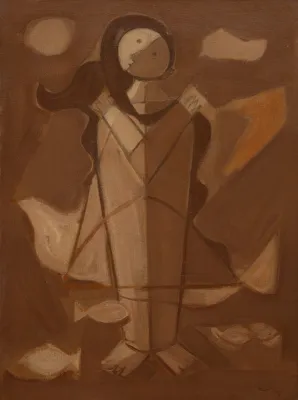
I first saw Mariana's work in the early 2000s in exhibitions such as the Bienal de Santos and the Salão de Arte de Ribeirão Preto. They were enigmatic paintings that mixed landscapes, fragments of the human figure and layer upon layer of fabrics of all kinds. The canvases were something like a combination of Matissean patterning with the tradition of the grotesque and the formless.
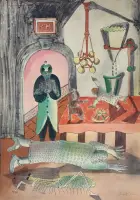
Years after this first encounter I came to know the artist's watercolor production, coincidentally at another edition of the Salão de Arte de Ribeirão Preto, in 2004. The works seemed to me a refinement of the language Mariana had been developing in painting: there were the hybrids of skin, fabric and organic figures, this time animal ones (bones, fur, horns, webs), all stitched together by careful decorative refinement, in the best sense of the term.
In drawing, the artist's discourse became more vigorous and also clearer. There, one could see what she had come for. And the rest of the story could not be more coherent: Mariana Palma joined the roster of the prestigious gallery Casa Triângulo, where she held a solo exhibition in 2005, was selected for Rumos Itaú Cultural Artes Visuais in 2006 and is regarded on the contemporary art circuit as one of the greatest promises of the 2000s generation.
Things became more intriguing when I re-encountered Mariana the painter in exhibitions such as Paralela 2006 and her solo show at Casa Triângulo. What happened to this artist's painting?, I asked myself, somewhat astonished. What had been latent in the canvases of years before, after the maturing of her poetics in the process of creating vast series of watercolors, was transformed into one of the most powerful pictorial languages in Brazilian art today.
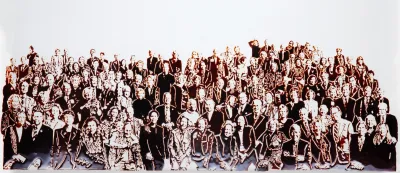
The seductive surfaces that depict an amalgam of fur coats, textile patterns, ornaments and noises of humanity (marks, creases, traces of presence, evidence of absence) fascinate and repel at the same time. There is no longer room for fragments of landscape where the eye can rest: the painting is suffocating, taken over entirely by textures rendered with virtuosity, as if the artist had zoomed in on her early canvases and chosen only the formless heap of clothes and bodies.
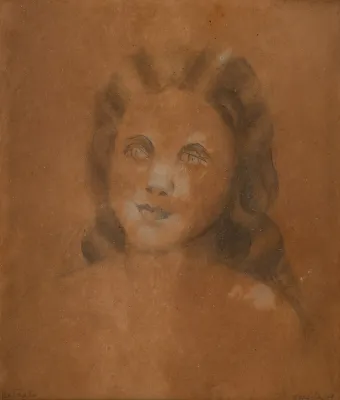
In the drawings, we see this logic inverted. Instead of the surface of the paper being completely filled, there are more blanks and voids than drawn forms. In place of suffocation, there is morbidity: we are drawn to see the delicate image up close and, once there, face to face with the reverse of all things, hooked by the “real” (understood as the “return of the repressed”, according to Lacan and also Hal Foster, following him), we glimpse a fissure of life. I, at least, do.
Juliana Monachesi
Cara a cara com o avesso de todas as coisas [Face to Face with the Reverse of All Things].
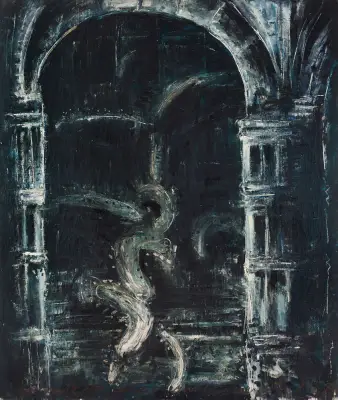
Mariana Palma creates a singular and powerful painting. One of those rare ones you glance at, try to move on, and cannot. The eye is captured into this vortex of colors and kaleidoscopic planes. It will never again be sated with examining the highly detailed colored surfaces, which boldly and shamelessly embrace the contemporary heresy of making something beautiful.
Beauty is a tool for perception. The artist believes in, and likes, being kind to the gaze of others, winning it over to look more and better. An effective articulation of fragments structures her pictorial language, which acts through contrast or harmony, whether with colors or planes, textures or perspectives. In this way, she makes the eye move back and forth from the epidermis to the last layer of paint. Everything has its own presence and, in equal measure, adds up to a whole.
It is clear that Mariana has no patience with precariousness cultivated through calculation or to disguise technical shortcomings. What she has is radical persistence in seeking mastery of the tools of the trade. A seductive painting, moreover, does not mean an easy painting. Mariana Palma intelligently takes on the challenge of post-Matisse oil painting, which is no small thing. Her canvases of cut-out prints and draperies of multicolored fabrics are striking, elements that gain congruence through the subtle tuning of colors.
Accumulation is not an excess but an exercise in balance. The Baroque root is clear. The precise chromaticism reveals familiarity with the history of painting and, in particular, with the Flemish masters. Things seen from very close up denote the contemporary root of the image, contaminated by the close-up and the zoom of the camera. Fragmentation points to another characteristic of contemporaneity: the avalanche of images and the impossibility of seeing the totality of things, only a little at a time.
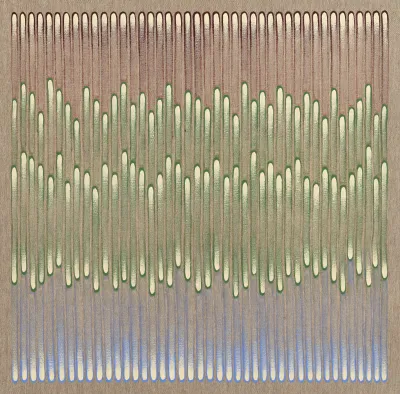
The new series of works, with a verticalized visuality, refines and renews a prosaic technique for decorating paper: marbling. Sinuous swirls of paint, obtained by floating pigments on water, generate patterns that are applied and overlapped in rhythmic bands in space. It is a tribute to informal abstraction, full of freshness and free of the prejudices of those who believe in an apartheid between fine arts and applied arts.
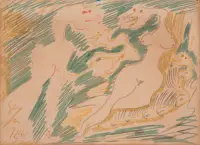
The watercolors seem to accelerate the gaze. The totality of the image is grasped at a glance, but the strangeness of what is seen also demands close examination. Improbable plant syntheses refer to the masculine/feminine duality, in erotically charged combinations reminiscent of the botanical taxonomy of the traveling artists who depicted the New World in the 16th century. Contemporary emotional relationships, another new world, are fertile in hybridities and averse to rigid classifications, as this beautiful series of works seems to suggest. This is an exhibition that affirms the technical and poetic consistency of a young painter who has already achieved prominence on the current scene.
Angélica de Moraes
Olhar Desacelerado [Slowed-Down Gaze]
Education
1998-2001
Bachelor's Degree in Visual Arts - FAAP - São Paulo
Solo Exhibitions
2012
Deságue [Outflow], Galeria Casa Triângulo, São Paulo, SP
2010
Mariana Palma - Desenhos [Mariana Palma - Drawings], SESC, Ribeirão Preto, SP
2009
Mariana Palma - Casa Triângulo - São Paulo
2008
Anestesia para Transformar [Anesthesia to Transform], Galeria Mário Sequeira, Braga, Portugal
2006
Mariana Palma, Museu Victor Meirelles, Florianópolis, SC
Mariana Palma, Instituto de Arte Contemporânea de Recife, Recife, PE
Mariana Palma, Fundação Cultural de Curitiba, Curitiba, PR
Mariana Palma, Museu de Arte de Ribeirão Preto, Ribeirão Preto, SP
2005
Mariana Palma, Casa Triângulo, São Paulo
2004
Paisagem de Delírio [Delirium Landscape] - Ateliê Aberto
Campinas - SP
Mariana Palma, SESC Ribeirão Preto, SP
Group Exhibitions
2013
Trajetórias – Arte Brasileira na Coleção Fundação Edson Queiroz [Trajectories – Brazilian Art in the Fundação Edson Queiroz Collection], curated by Paulo Herkenhoff, Espaço Cultural Unifor, Fortaleza, CE
2012
This is Brazil! 1990-2012, curated by David Barro, Palacio de Exposiciones y Congresos – Palexco, A Coruña, Spain
Nova Pintura [New Painting], curated by Rejane Cintrão, Centro de Exposições Santander, São Paulo, SP
“...(chamo silêncio à-linguagem-que-já-não-é-órgão-de-nada)...”, curated by Fátima Lambert, Quase Galeria, Porto, Portugal
2011
Os Primeiros Dez Anos [The First Ten Years], Agnaldo Farias, Tiago Mesquita and Núcleo de Pesquisa e Curadoria do Instituto Tomie Ohtake, Instituto Tomie Ohtake, São Paulo, SP
Passante no Mundo - Paulo Reis e Cª [Passerby in the World - Paulo Reis and Co.], curated by Fátima Lambert, Quase Galeria, Porto, Portugal
Boîte Invaliden, curated by Paulo Reis (in memoriam) and Josué Mattos, Invaliden1 Gallery, Berlin, Germany
Realidades - Desenho Contemporâneo Brasileiro [Realities - Brazilian Contemporary Drawing], curated by Nazareno Rodrigues, SESC Pinheiros, São Paulo, SP; SESC Bauru, Bauru, SP
2010
Edições [Editions], Galeria Casa Triângulo, São Paulo, SP
Paralela - A Contemplação do Mundo [Parallel - The Contemplation of the World], curated by Paulo Reis, Liceu de Artes e Ofícios, São Paulo, SP
PhotoFidalga Quase Galeria, Espaço T, Porto, Portugal
Ateliê Fidalga no Paço das Artes [Ateliê Fidalga at Paço das Artes], Paço das Artes, São Paulo, SP
2009
Ateliê Fidalga - 55 artistas - SP Brasil [Ateliê Fidalga - 55 Artists - SP Brazil], Galeria Carlos Carvalho Arte Contemporânea Zoom, Lisbon, Portugal
Entre Tempos [Between Times], curated by Paulo Reis, Carpe Diem Arte e Pesquisa, Lisbon, Portugal.
PhotoFidalga, Carpe Diem Arte e Pesquisa, Lisbon, Portugal
Em Torno De [Around], curated by Ricardo Resende, Funarte, São Paulo, SP
Nuevas Miradas, 14 artistas brasileños contemporáneos, Galeria Fernando Pradilla, Madrid, Spain
Nova Arte [New Art], curated by Paulo Venâncio, Centro Cultural Banco do Brasil (CCBB), São Paulo, SP
Investigações Pictóricas [Pictorial Investigations], curated by Daniela Labra, Museu de Arte Contemporânea (MAC) de Niterói, Niterói, RJ
Drawings, Pablo's Birthday Gallery, New York, USA
2008
Inevi Continuum, curated by Claire Breukel and Gean Moreno, Locust Projects, Miami, USA
Nova Arte [New Art], curated by Paulo Venâncio, Centro Cultural Banco do Brasil (CCBB), Rio de Janeiro, RJ
Beneath the Bridge, curated by Juliana Moreira, Pablo's Birthday Gallery, New York, USA
Poéticas da Natureza [Poetics of Nature], curated by Kátia Canton, Museu de Arte Contemporânea (MAC), São Paulo, SP
Arte pela Amazônia, Arte e Atitude [Art for the Amazon, Art and Attitude], Fundação Bienal de São Paulo, Pavilhão Ciccillo Matarazzo, São Paulo, SP
Presente Fidalga [Fidalga Present], SESC Ribeirão Preto, Ribeirão Preto, SP
2007
Mono#Cromáticos - Vertentes na Arte Contemporânea Brasileira [Mono#Chromatics - Strands in Brazilian Contemporary Art], curated by Paulo Reis, Galeria Mário Sequeira, Braga, Portugal
La Espiral de Moebius o Los Límites de la Pintura, curated by Claudia Laudanno, CCPE / AECI, Rosario, Argentina
2006
Paralela, curated by Daniela Bousso, PRODAM, São Paulo, SP
Arquivo Geral [General Archive], curated by Paulo Venâncio, Centro de Arte Hélio Oiticica, Rio de Janeiro, RJ
Rumos Artes Visuais [Rumos Visual Arts], curated by Aracy Amaral, Lisette Lagnado, Luisa Duarte, Cristiana Tejo and Marisa Mokarzel, Itaú Cultural, São Paulo, SP, Paço Imperial, Rio de Janeiro, RJ
Outros Lugares [Other Places], Rumos Artes Visuais [Rumos Visual Arts], curated by Cristiana Tejo, Espaço Cultural Casa das Onze Janelas, Belém, PA
25º Arte Pará, curated by Paulo Herkenhoff, Milton Guran, Celso Fioravante, Lídia Souza and Fabize Muinhos, Museu de Arte de Belém, Belém, PA (Honorable Mention, New Talents)
6º Salão Nacional de Arte de Goiás [6th Goiás National Art Salon], curated by Bianca Knaak, Cristiana Tejo, Denise Mattar, Felipe Chaimovich, Marcio Doctors and Divino Sobral, Flamboyant Shopping Center, Goiânia, GO
11º Salão Paulista [11th São Paulo Salon], Museu de Arte Contemporânea de São Paulo - MAC USP, Bienal building, São Paulo, SP
10ª Bienal de Santos [10th Santos Biennial], Centro Cultural, Santos, SP, curated by Ana Maria de Moraes Belluzzo, Kátia Canton and Tiago Mesquita
34º Salão de Arte Contemporânea de Santo André [34th Santo André Contemporary Art Salon], Paço das Artes, Santo André, SP, curated by Cauê Alves, Felipe Chaimovich and Nancy Betts (acquisition prize)
2005
Fidalga'05, curated by Nancy Betts, Paço das Artes de Santo André, Santo André, SP
A Pintura como Ferramenta [Painting as a Tool], curated by Nelson Maravalhas, Casa de Cultura da América Latina, Brasília, Brazil
30º SARP, Museu de Arte de Ribeirão Preto, Ribeirão Preto, Brazil
2004
Título de Pintura [Painting Title], Ateliê Aberto, Campinas, SP
Seja lá Onde For [Wherever It May Be], MAC, Americana, SP
Acervo em Evidência [Collection in Evidence], MAC, Campinas, SP
I Salão Aberto - Paralelo à 26ª Bienal Internacional de São Paulo [1st Open Salon - Parallel to the 26th São Paulo International Biennial], Casa das Retortas, São Paulo, SP
Fermento (Atelier Fidalga exhibition parallel to the Biennial), Casa, São Paulo, SP
IX Bienal de Santos [9th Santos Biennial], Secretaria Municipal de Cultura, Santos, SP
Diálogos [Dialogues], MAC, Campinas, SP
1st International Art Salon laisle.com at Gugg und Chaim, Fundación Gugg und Chaim, Rio de Janeiro, RJ
2003
Mostra SESC de Arte da Juventude [SESC Youth Art Exhibition] (solo exhibition prize), SESC, Ribeirão Preto, SP
Edital 2003 MAC (acquisition prize), MAC, Campinas, SP . 28º Salão de Arte de Ribeirão Preto [28th Ribeirão Preto Art Salon], MARP, Ribeirão Preto, SP . Mostra Darcy Penteado de Arte [Darcy Penteado Art Exhibition], Mube, São Paulo, SP
2002
Onze [Eleven], Espaço Virgílio, São Paulo
AquiAli, Ateliê Aberto, Campinas
2001
33rd Art Annual, FAAP, São Paulo, SP
Ateliê Fidalga Group Show, Espaço Urbe, São Paulo
2000
32nd Art Annual FAAP, São Paulo
1999
31st Art Annual FAAP, São Paulo
Collections
Instituto Itaú Cultural, São Paulo, Brazil
Museu de Arte Contemporânea de Campinas, Brazil
Museu de Arte de Ribeirão Preto, Brazil
Banco Itaú S.A. Collection, São Paulo, Brazil
Prefeitura Municipal de Santo André, Brazil
Awards
2006
Acquisition Prize, Casa do Olhar, Santo André
2005
Acquisition Prize, Museu de Arte de Ribeirão Preto (MARP)
2003
Acquisition Prize, Museu de Arte Contemporânea (MAC) de Campinas
Solo Exhibition Prize, SESC Ribeirão Preto
Source: Artist's Website and Pipa