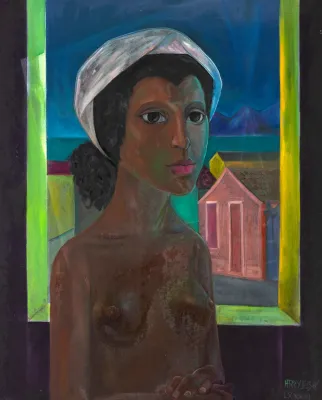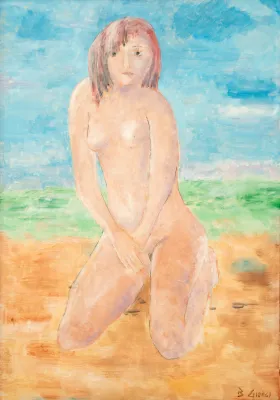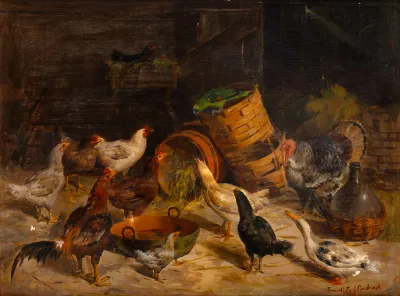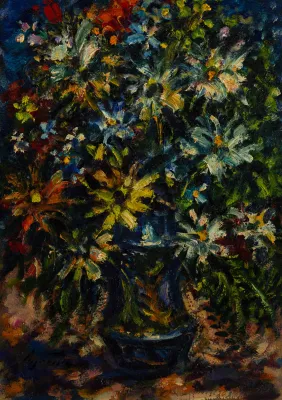
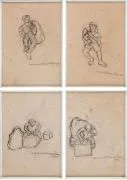

Manoel Martins (São Paulo SP 1911 - Idem 1979)
Manoel Martins was an illustrator, painter, draftsman, engraver, sculptor and goldsmith. He began his artistic career in 1924, exercising the trade of goldsmith. In 1927, he dedicated himself to watchmaking and, later, began to work in the commerce. In parallel with these activities, he resumed his interest in the arts and, from 1931 onwards, attended the classes taught by the sculptor Vicente Larocca (1892–1964). As a way of continuing his studies, he participated in courses offered by the Sociedade Pró-Arte Moderna (SPAM), located near the Santa Helena Building.
In 1936, he began to share a studio with Mario Zanini (1907–1971) and met the other members of the Santa Helena group. The following year, he joined the São Paulo Artistic Family (FAP). In 1939, he attended, with other artists, the meetings of the Cultural Musical Group, promoted by the doctor Afonso Jagle, and installed his studio on Rua Bittencourt Rodrigues. In 1942, he participated in the cultural meetings promoted by Osório César and collaborated with some work in the publication of the album 35 lithographs by seven artists. In 1944, he traveled to Salvador, where he illustrated the book Bahia de Todos os Santos, by Jorge Amado (1912–2001), and, together with journalist Odorico Tavares (1912–1980), was responsible for holding the first exhibition of Modern art in the city.
Critical Comment
Manoel Martins, son of Portuguese immigrants, grows in Brás, an industrial neighborhood in the city of São Paulo. From 1924 onwards, he dedicated himself to the craft of goldsmith. In 1931, he began his artistic studies with the sculptor Vicente Larocca (1892 - 1964). He then attends the School of Fine Arts. Begins to be part of the Santa Helena group in 1935, with Alfredo Volpi (1896 - 1988), Francisco Rebolo (1902 - 1980), Fulvio Pennacchi (1905 - 1992), among others. Shares studio with Mario Zanini (1907 - 1971). In 1937, he participated in exhibitions by the São Paulo Artistic Family - FAP.
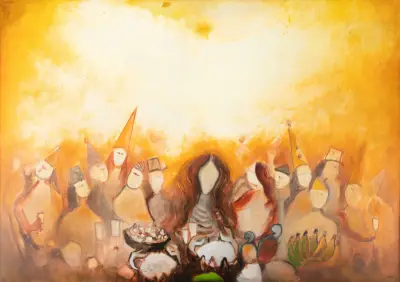
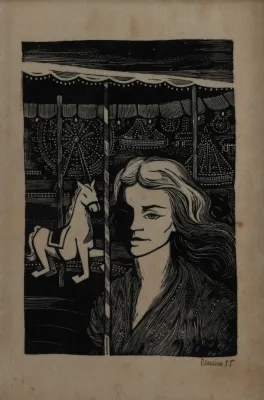
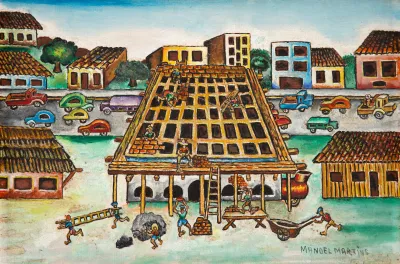
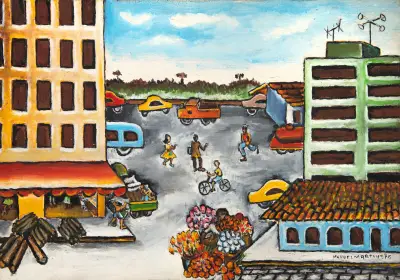
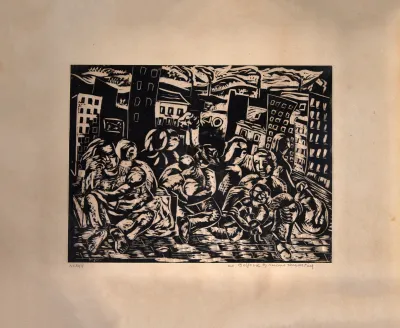
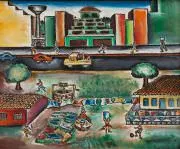
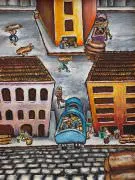
Chooses painting as an expressive form and, at the end of the 1930s, began to make engravings in linoleum and wood. His work presents great social concern. It is dedicated, among others, to themes linked to the daily life of the poorest classes and the life of the worker. It paints landscapes in the center and surroundings of São Paulo and is seen by critics as a reporter for life in São Paulo. It presents several profiles of the city, in imaginary scenes recreated in its studio. It records the changes of the metropolis, growing fast during the 1930s and 1940s, with the emergence of skyscrapers, as in Praça da Sé, ca.1940. The artist sometimes mixes images of the current city with others, of an old and peaceful São Paulo experienced in his childhood. In canvas and engravings, it represents the anonymous man, whose figure is very reduced in relation to buildings.
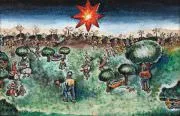
During the years of World War II, he carries out works that focus on bombeded cities. Other themes also arise from the war, such as the torpedo of ships, represented in the lithography Naufragos (1942). In these works, surreal incidences are observed and, mainly, the dialogue with Expressionism and with the work of Lasar Segall (1891 - 1957).
In the 1960s, he began to work with metal engraving. Manoel Martins, among the members of the Santa Helena group, is the most focused on graphic activity. Parallel to the craft of a painter, he performs the illustration of books, such as O Cortiço, by Aluísio de Azevedo (1857 - 1913), and Bahia de Todos os Santos, by Jorge Amado (1912 - 2001), and magazines. The critic Mário Schenberg highlights that, in his trajectory, the artist was able to maintain the purity of primitivist vision, which results in the great charm of his landscapes.
Criticism
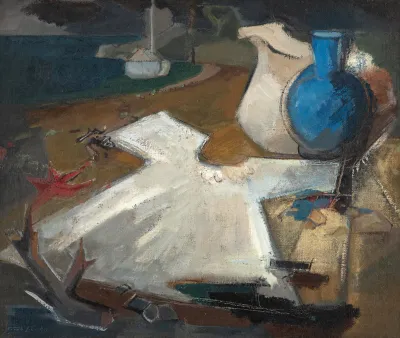
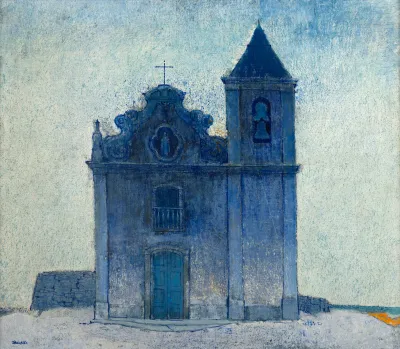
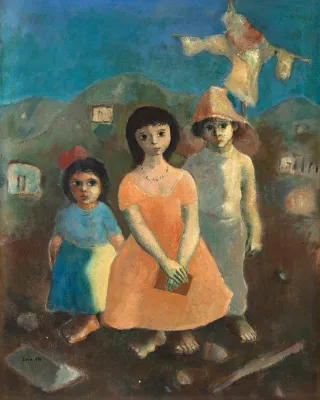
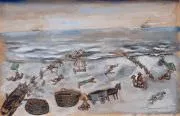
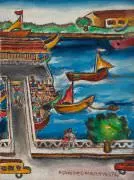
"The great charm of Manoel's landscapes. Martins results from his ability to have developed his art without having lost a purity of primitivist vision, which has preserved more than his companions of the Santa Helena, even grinding wheel. There is thus in Martins's landscape a subtle effect of coexistence of the current moment with a subjective vision of another time. Sadness for the growing dehumanization of our urban landscape. Among Martins' recent paintings we find some seaside landscapes based on memories of other times, which impress for their vitality and joy, as well as for the richness of their composition in several successive planes. Paradoxically, these landscapes evoked by the artist's memory vigorously convey experiences of here-now. The richness of the problems of the experience of time is certainly the most original and fascinating aspect of Manoel Martins' painting."
Mário Schenberg
Manoel Martins. Presentation by Mario Schenberg. News, 1978.
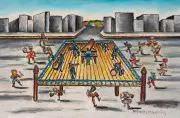
"The characterization of São Paulo's art from the end of the 1930s and the following brings together artists under the name Grupo Santa Helena; With this, any production that distances itself from the painting of São Paulo in the open air is erased, such as the engraving by Manoel Martins. Both critics of the time and more recent historians highlight as the theme of those artists, who came from artisanal professions, the landscape of the surroundings of São Paulo, aiming, certainly, to distance them from school learning, in the valorization of painting of free observation as spontaneity. It is known, however, that this practice begins in São Paulo at the beginning of the 20th century, and that observation painting was not, for them, a single reason. Manoel Martins is an example of this: his paintings interpret the city in the studio, but his engravings do it even more, as they are graphic synthesis of imaginary cities".
Mayra Laudanna, May 2000
engraving: Brazilian art of the 20th century. Presentation Ricardo Ribenboim; Text Leon Kossovitch, Mayra Laudanna, Ricardo Resende São Paulo: Itaú Cultural : Cosac & Naify, 2000. p.200.
"Manoel Martins manages to distract the spectator with his almost childish naivety and with his taken from urban criticism. But the critics know that, under the 'toboggans', the huddled factories and the constructions (demolitions) of the subway, there is a rich exercise in composition, unfortunately hidden later by the multicolored brush strokes. The purity of this artist always remains, who did not know how to use the artifice of letting the lay people also show the precious structures designed, as well as not coloring with malice to create climates of lights and reflections, but only to personalize, by the color, each character of his 'painted story'".
Paulo Maranca, October 2, 1978
engraving: Brazilian art of the 20th century. Mayra Laudanna, Ricardo Resende. São Paulo: Itaú Cultural : Cosac & Naify, 2000. p.200.
Collectives
Collection Museum of Contemporary Art of the University from São Paulo - São Paulo SP
Individual exhibitions
1948 - São Paulo SP - Individual, at Galeria Itapetininga
1963 - São Paulo SP - Individual, at the SeleArte Gallery
1978 - São Paulo SP - Individual, at Centro de Artes Shopping News
Collective exhibitions
1937 - São Paulo SP - 1st Salon of the São Paulo Artistic Family, at Esplanada Hotel de São Paulo
1938 - São Paulo SP - 1st Salon of May
1938 - São Paulo SP - 4th Hall of the Plastic Artists Union, at Automóvel Clube
1939 - São Paulo SP - 2nd Salon of the São Paulo Artistic Family, at Automóvel Clube
1939 - São Paulo SP - 2nd Salon of May
1939 - São Paulo SP - 5th Hall of the Plastic Artists Union
1940 - Porto Alegre RS - Salão de Belas Artes
1940 - Rio de Janeiro RJ - 46th Salon National of Fine Arts, at the MNBA - Honorable Mention
1940 - São Paulo SP - 3rd Salon of the São Paulo Artistic Family
1941 - Rio de Janeiro RJ - 47th National Hall of Fine Arts, at the MNBA - Medal Bronze
1941 - São Paulo SP - 1st Art Salon of the National Industries Fair, at Água Branca Park
1942 - Rio de Janeiro RJ - Art Salon of the National Defense League
1942 - São Paulo SP - 7th Hall of the Plastic Artists Union, at the Prestes Maia Gallery
1942 - São Paulo SP - Fair National Industries Fair
1944 - Belo Horizonte MG - Modern Art Exhibition, in the Mariana Building
1944 - London (England) - Artists Hall
1944 - London (England) - Exhibition of Modern Brazilian Paintings, Royal Academy of Arts
1944 - Norwich (England) - Exhibition of Modern Brazilian Paintings, at Norwich Castle and Museum
1944 - Rio de Janeiro RJ - 50th National Salon of Fine Arts, at the MNBA - Silver Medal
1944 - São Paulo SP - Exhibition of modern painting Brazilian-American, at the Prestes Maia Gallery
1945 - Bath (England) - Exhibition of Modern Brazilian Paintings, at the Victory Art Gallery
1945 - Bristol (England) - Exhibition of Modern Brazilian Paintings, at the Bristol City Museum & Art Gallery
1945 - Edinburgh (Scotland) - Exhibition of Modern Brazilian Paintings, at the National Gallery
1945 - Glasgow (Scotland) - Exhibition of Modern Brazilian Paintings, at Kelingrove Art Gallery
1945 - Manchester (England) - Exhibition of Modern Brazilian Paintings, Manchester Art Gallery
1946 - Santiago (Chile) - Collective of Brazilian painters
1946 - São Paulo SP - Modern Art Salon
1948 - São Paulo SP - Modern Art Salon
1949 - Rio de Janeiro RJ - 55th National Salon of Belas Arts, at the MNBA
1951 - São Paulo SP - 1st São Paulo International Biennial, at the Trianon Pavilion
1952 - Rio de Janeiro RJ - 1st National Hall of Modern Art
1953 - Rio de Janeiro RJ - 2nd National Salon of Modern Art
1954 - Goiânia GO - Exhibition of the National Congress of Intellectuals
1958 - Rio de Janeiro RJ - 7th National Hall of Modern Art, at MNBA
1958 - São Paulo SP - 7th Salão Paulista de Arte Moderna, at Galeria Prestes Maia
1962 - São Paulo SP - 11th São Paulo Salon of Modern Art, at the Prestes Maia Gallery - Acquisition Award
1963 - Rio de Janeiro RJ - 12th National Salon of Modern Art
1964 - São Paulo SP - 13th São Paulo Modern Art Salon - Bronze Medal
1966 - São Paulo SP - Recorders of São Paulo, at Galeria 4 Planetas
1966 - Paulo SP - Santa Helena's group, today, at Galeria 4 Planetas
1967 - Dresden (Germany) - 3rd Exhibition of Modern Art
1967 - São Paulo SP - 16th Salão Paulista de Arte Moderna - Prize Acquisition
1967 - São Paulo SP - The São Paulo Artistic Family: 30 years later, in the auditorium Italy
1967 - São Paulo SP - The artistic family thirty years later, in the auditorium Italy
1968 - São Paulo SP - 17th Salão Paulista de Arte Moderna - Acquisition Award
1972 - São Paulo SP - 2nd International Engraving Exhibition, at MAM/SP
1972 - São Paulo SP - Art/Brazil/Today: 50 years later, Galeria da Collectio
1975 - São Paulo SP - 40 years old - Grupo Santa Helena, at Paço das Artes
1976 - São Paulo SP - The Salons: From the São Paulo Artistic Family, May and the Plastic Artists Union of São Paulo, at the Lasar Museum Segall
1977 - São Paulo SP - Grupo Seibi - Grupo do Santa Helena: Decade 35 to 45, at MAB/FAAP
1978 - Penápolis SP - 3rd Salon of Plastic Arts of the Northwest, in the Faculty of Philosophy, Sciences and Letters of Penápolis
Posthumous exhibitions
1979 - São Paulo SP - 11th Panorama of Current Brazilian Art, at MAM/SP
1979 - São Paulo SP - O Santa Helena Group, at Uirapuru Art Gallery
1980 - Penápolis SP - 4th Northwest Plastic Arts Hall, at the Penápolis Educational Foundation. Faculty of Philosophy, Sciences and Letters of Penápolis
1980 - São Paulo SP - Images of Dance, at Paço das Artes 1982 - São Paulo SP - From modernism to the biennial, at MAM/SP
1982 - São Paulo SP - The work in popular painting, at the Museum of the Brazilian House
1985 - São Paulo SP - 18th International Biennial of São Paulo, at Fundação Bienal
1987 - São Paulo SP - Individual, at Bemge Galeria
1995 - São Paulo SP - Grupo Santa Helena, at MAM/SP
1996 - Rio de Janeiro RJ - Grupo Santa Helena, at CCBB
1998 - São Paulo SP - São Paulo in engravings of 1950, at the Mário de Andrade Municipal Library
1998 - São Paulo SP - São Paulo iconography in private collections, at the Brazilian House Museum
2000 - São Paulo SP - Grupo Santa Helena, at Jo Slaviero Galeria de Arte
2000 - São Paulo SP - Investigations: Brazilian engraving, at Itaú Cultural
2001 - Brasília DF - Investigations. The Brazilian engraving, at Galeria Itaú Cultural
2001 - Penápolis SP - Investigations. The Brazilian engraving, at Galeria Itaú Cultural
2002 - São Paulo SP - Modernism: from the week of 22 to the Art Section of Sérgio Milliet, at the CCSP
2002 - São Paulo SP - Workers in Paulista: MAC-USP and artisan artists, at the SESI Art Gallery
2003 - São Paulo SP - painters on the coast of São Paulo, at Sociarte
2004 - São Paulo SP - Paper Office, at CCSP
2004 - São Paulo SP - New acquisitions: 1995 - 2003, at MAB/FAAP
Source: Itaú Cultural